Israel Police Arrest Suspects Over Settler Attacks on US Journalist, European Diplomats

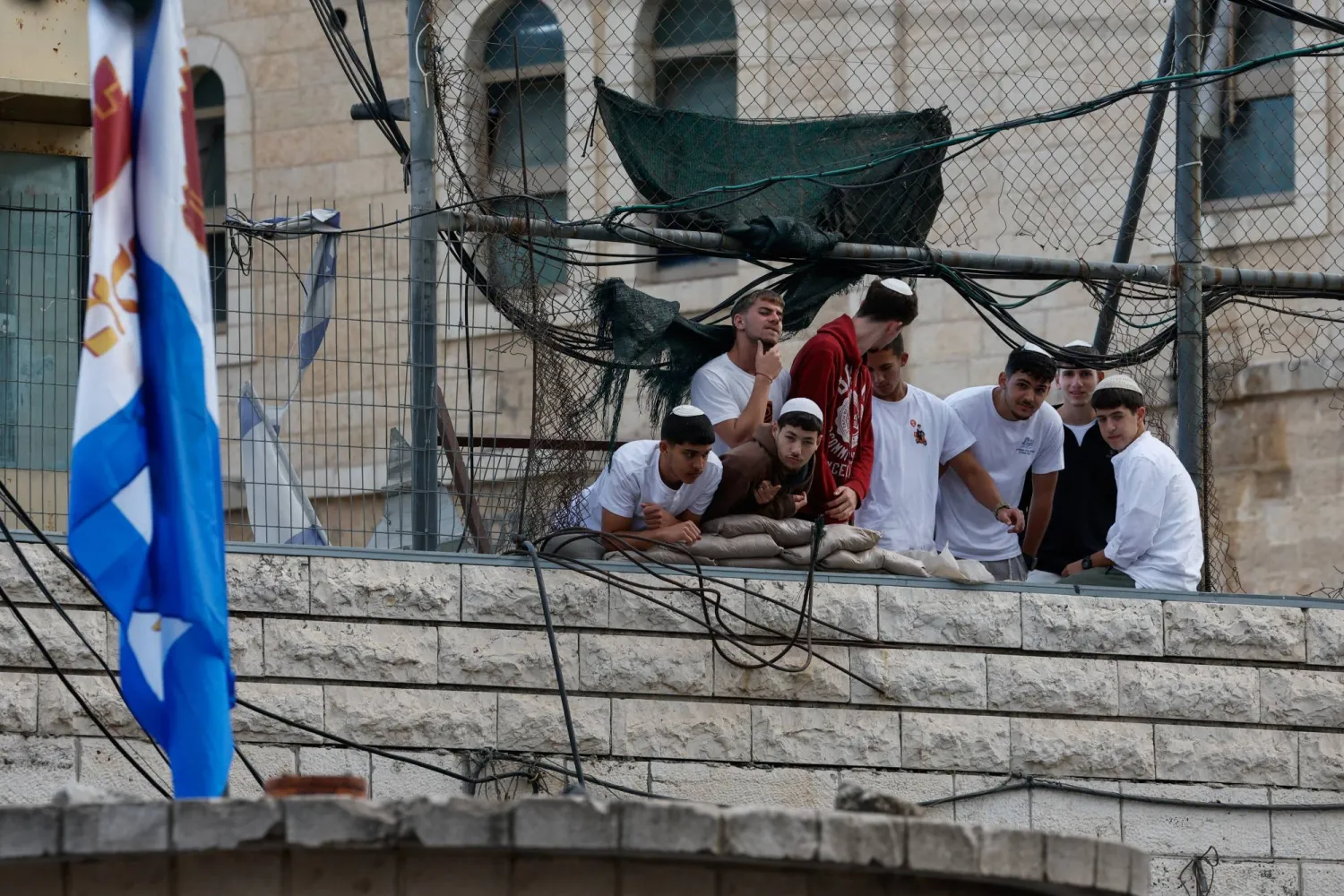
 Israeli settlers take part in a weekly tour in Hebron, in the Israeli-occupied West Bank, October 17, 2026. (Reuters)
Israeli settlers take part in a weekly tour in Hebron, in the Israeli-occupied West Bank, October 17, 2026. (Reuters)
TT

Israel Police Arrest Suspects Over Settler Attacks on US Journalist, European Diplomats

 Israeli settlers take part in a weekly tour in Hebron, in the Israeli-occupied West Bank, October 17, 2026. (Reuters)
Israeli settlers take part in a weekly tour in Hebron, in the Israeli-occupied West Bank, October 17, 2026. (Reuters)

Israeli police said on Monday they had arrested 10 suspects as part of an investigation into violent incidents in the occupied-West Bank over the weekend, including separate attacks on a Washington Post photojournalist and European diplomats. 

The arrests were made after calls from the United States, Israel's closest ally, to crack down on settler violence and for the perpetrators of the attack on the Washington Post photojournalist to be jailed. France, Belgium and Poland, whose diplomats were attacked, have ‌also called on ‌Israel to take action. 

Police said the suspects were arrested in ‌a ⁠pre-dawn operation on suspicion ⁠of involvement in acts of violence, violating a closed military zone order and illegal construction. 

The suspects, who police have not identified, have been taken into custody for questioning. Israel's Army Radio reported that the suspects were Israeli citizens. 

Prosecutions of Israeli settlers are rare. 

A video released by the police of the pre-dawn operation appeared to show two slingshots, which are used to hurl stones, being found at one property. Police, military forces ⁠and the Shin Bet domestic security service took part in the ‌operation. 

Referring to the West Bank by its ‌biblical name "Judea and Samaria", Israeli police commissioner Daniel Levy said the law applies to everyone, "regardless of ‌identity or affiliation". 

"The Israel Police is committed to professional, equal, and impartial law ‌enforcement, based on evidence and in accordance with the law," he said in a statement announcing the arrests. 

MASKED SETTLERS 

Masked Israeli settlers were filmed on Friday assaulting Washington Post photojournalist Heidi Levine, a US citizen, who was covering a Palestinian olive harvest in the West Bank. Levine was ‌hospitalized after sustaining a number of injuries in the attack and underwent surgery on a finger. 

On Saturday, French, Belgian and ⁠Polish diplomats as ⁠well as a French mayor were attacked by masked settlers in another part of the West Bank. A Belgian diplomatic vehicle was also damaged. 

Israeli Foreign Minister Gideon Saar and the military have blamed "Israeli rioters" for the attack on the diplomats. 

However, Prime Minister Benjamin Netanyahu, whose religious-nationalist coalition is projected to lose its governing majority at the October 27 election, has been more circumspect. 

He has said the diplomats entered a "sensitive area with a history of confrontations" and without coordinating with the military. He has also said that the facts of the attack on Levine were "unclear". Levine has said she was attacked by settlers and Israel's President Isaac Herzog has apologized. 

Settler attacks on the Palestinians are surging, with at least 170 since September 27, according to Yesh Din, an Israeli human rights group. Journalists, Israeli activists and foreign observers have also been targeted. 


IMF Says Its Staff in Lebanon to Discuss Banking Restructuring Strategy

A man sits at the entrance of a money transfer company office in Beirut on November 10, 2026. (AFP)
TT

IMF Says Its Staff in Lebanon to Discuss Banking Restructuring Strategy

A man sits at the entrance of a money transfer company office in Beirut on November 10, 2026. (AFP)

The ‌International Monetary Fund has begun a staff mission to discuss the country's strategy for restructuring the banking sector, IMF spokeswoman Julie Kozack said on Thursday, declining to say whether a preliminary agreement was imminent.

Kozack told reporters that the IMF's staff ‌mission in ‌Beirut was under way ‌as ⁠part of a ⁠close discussion with Lebanese authorities to underpin a comprehensive reform program to restore financial stability and support an economic recovery.

She said IMF staff would ⁠communicate at the end ‌of the mission ‌with any relevant updates.

Lebanese media ‌quoted Lebanese Finance Minister Yassine Jaber ‌telling reporters this week that the IMF mission would continue through Friday, adding his hope that ‌a preliminary agreement could be reached this week.

IMF Managing Director ⁠Kristalina ⁠Georgieva last month said there were "intense" discussions under way on support for Lebanon reflecting significant progress towards a loan program.

"We have made significant progress towards the program. We have still a bit more work to do together, and I'm confident we will be successful," she said at the time.


Libya's Dbeibah, Erdogan Discuss Bilateral Agreements, Cooperation

Libya's Dbeibah meets Turkish President Tayyip Erdogan on the sidelines of the Antalya summit on Thursday (Dbeibah's Office)
TT

Libya's Dbeibah, Erdogan Discuss Bilateral Agreements, Cooperation

Libya's Dbeibah meets Turkish President Tayyip Erdogan on the sidelines of the Antalya summit on Thursday (Dbeibah's Office)

Turkish President Tayyip Erdogan and Libyan Prime Minister Abdulhamid Dbeibah discussed ways to strengthen cooperation and the latest political and security developments in Libya on Thursday on the sidelines of the COP31 World Leaders Climate Summit in the Turkish city of Antalya.

Dbeibah's media office said the meeting covered bilateral relations and prospects for expanding cooperation in various fields, particularly the economy, investment, security and defense, as well as progress in implementing agreements and memorandums of understanding signed by the two countries.

The talks also addressed efforts to support stability and unify Libya's institutions, alongside continued coordination on regional and international issues.

Erdogan reaffirmed Türkiye's continued support for Libya's stability, stressing that "any initiative not embraced by Libyans will have no impact on the ground."

On the sidelines of the climate summit, Dbeibah also met UN Secretary-General Antonio Guterres to discuss developments in Libya's political process and efforts by the UN mission to support stability.

Dbeibah reaffirmed his government's readiness to continue coordinating with the mission to help it fulfill its mandate, praising UN envoy Hanna Tetteh's efforts to facilitate dialogue and bridge differences among Libyan factions.

He also welcomed the "4+4 agreement" and called for building on its outcomes to end the transitional periods and pave the way for elections.

Representatives of Dbeibah's government and the eastern-based General Command signed the 4+4 agreement on Aug. 30 to break the political deadlock and create conditions for presidential and parliamentary elections within 24 months, through unified institutions and a single executive authority.

Dbeibah's meetings in Antalya on Thursday also included talks with Sudan's Transitional Sovereignty Council Chairman General Abdel Fattah al-Burhan, focusing on developments in Sudan, ways to strengthen economic and trade cooperation, facilitate the movement of citizens and coordinate on security and border issues.

Dbeibah reiterated Libya's support for Sudan's unity, sovereignty and territorial integrity, rejecting any attempts to divide the country or undermine its national institutions.

He stressed the need to intensify regional and international efforts to secure a ceasefire and ensure humanitarian aid reaches those affected by the conflict.

Dbeibah attended the summit's opening on Wednesday. The event, hosted by Antalya on Nov. 11-12 under Erdogan's chairmanship, brought together Guterres and around 102 leaders and senior representatives from 95 countries and seven international organizations.

Discussions focused on climate finance, the energy transition and strengthening international cooperation to achieve sustainable development goals.

The meetings come amid renewed momentum in Libyan-Turkish relations after Libya's House of Representatives ratified a maritime memorandum of understanding signed in 2019 between Ankara and Libya's former Government of National Accord.

Contacts and consultations between Libya's rival factions and Turkish officials have intensified recently.

On Wednesday, Turkish Ambassador Guven Begenc met General Salahuddin al-Namroush, chief of the general staff under Dbeibah's interim Government of National Unity, to discuss developing military relations in ways that serve the two countries' mutual interests.

Meanwhile, General Khaled Haftar, chief of the general staff under the eastern-based General Command, arrived in the Turkish capital Ankara on Thursday for an official visit lasting several days.


Tunisia Says It Is Prepared For 'Various Threats, Scenarios'

Tunisian Defense Minister Khaled Sehili speaks with Justice Minister Leila Jaffel during a parliamentary session (EPA)
TT

Tunisia Says It Is Prepared For 'Various Threats, Scenarios'

Tunisian Defense Minister Khaled Sehili speaks with Justice Minister Leila Jaffel during a parliamentary session (EPA)

Tunisia is preparing for a number of scenarios as conflicts widen and regional and global tensions mount, Defense Minister Khaled Sehili said, outlining plans to bolster military readiness and secure essential supplies, according to local media reports.

Speaking during a joint parliamentary plenary session on Thursday, Sehili said the country's proactive strategy includes stockpiling fuel, medicines and food, diversifying supply sources and tightening surveillance along its land, air and maritime borders.

The military is also reinforcing border security by extending an earthen barrier along the entire eastern frontier and building a parallel 95-km (59-mile) trench to curb infiltration and smuggling, he said.

Sehili announced plans for legislation regulating drone use to address emerging challenges and govern the technology.

Preparing for potential threats and scenarios "requires developing defense capabilities and strengthening readiness" to protect Tunisia and its national interests amid rapidly changing security conditions, he said.

He described the Defense Ministry's budget as "an investment in Tunisia's security and stability" and a safeguard for independent national decision-making as regional and international developments bring mounting military and security risks.

Sehili said Tunisia's security situation remained "relatively stable," but warned that continued vigilance and preparedness were essential.

The military is responding to evolving threats through targeted preemptive operations aimed at putting pressure on suspicious elements and restricting their ability to act and move, he said.

Those efforts include securing borders, combating terrorism and dismantling logistical support networks used by terrorist groups.

"Tunisia's security cannot be separated from that of its regional surroundings," Sehili affirmed, underscoring the need to prepare for different scenarios.

He warned of escalating armed conflicts, growing security threats, intensifying strategic competition over transit routes and a widening arms race.

The developments are closely linked to Tunisia's immediate neighborhood, particularly North Africa, the Sahel and the Sahara, where mounting security challenges risk creating fertile ground for terrorist and criminal groups, he said.

Sehili called for more effective military operations, better use of available resources and greater self-reliance, alongside continued international military cooperation to build a strong national army capable of carrying out its duties effectively.