China’s Economic Growth Picks up as Exports Boom, Consumers Balk

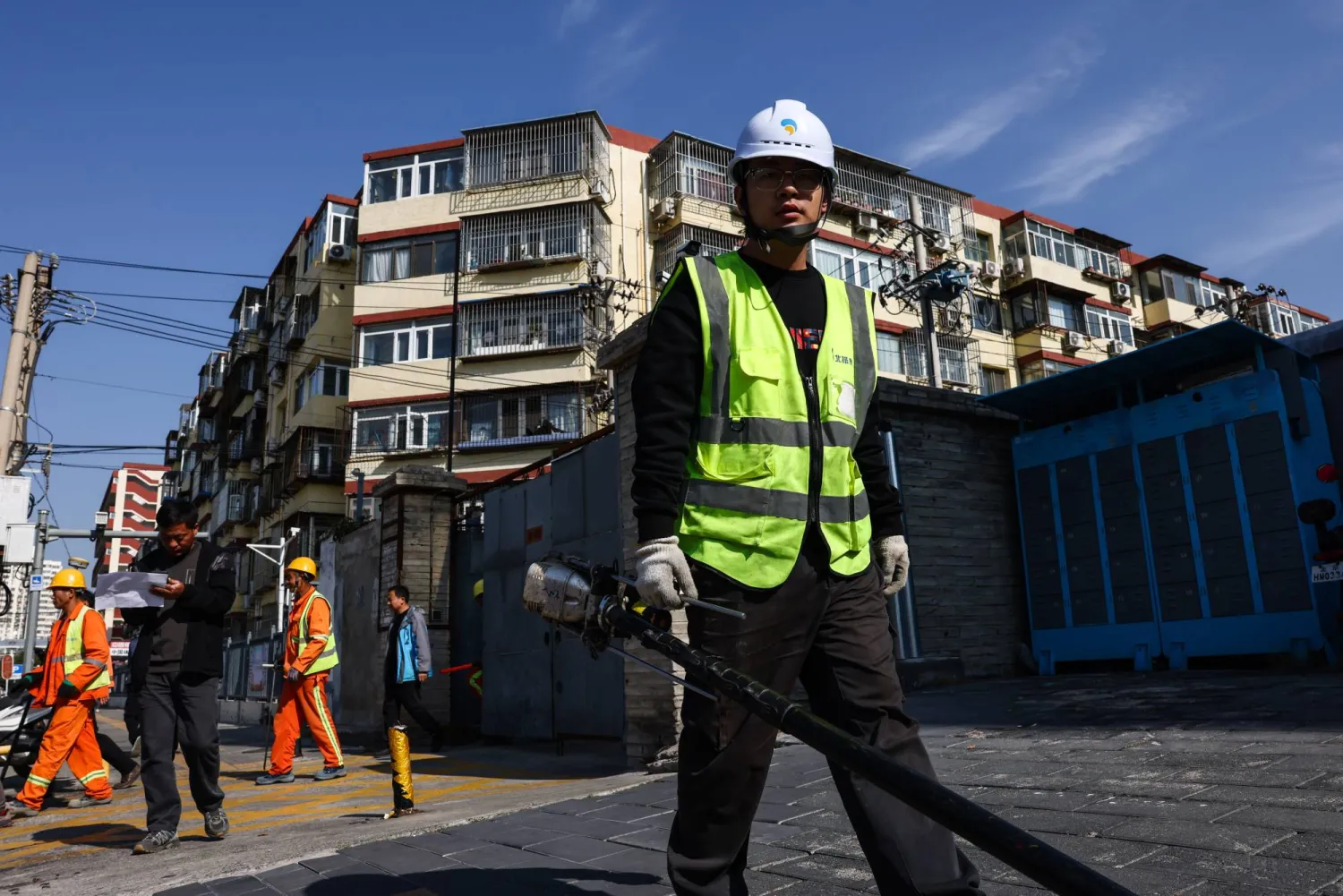
Construction workers walk in front of a residential compound in Beijing, China, 19 October 2026. (EPA)
TT

China’s Economic Growth Picks up as Exports Boom, Consumers Balk

Construction workers walk in front of a residential compound in Beijing, China, 19 October 2026. (EPA)

China's economic growth bounced off three-year lows in the third quarter, as roaring exports offset consumers' tight grip on their wallets, though analysts warn the growing reliance on external drivers is deepening structural imbalances.

The 4.5% pace beat consensus forecasts and analysts expect Beijing to reach its 2026 target of 4.5%-5.0% without resorting to additional stimulus, helped by a strong start to the year and some recent modest fiscal and monetary support.

Monday's data showed retail sales again lagging industrial output, while the property market was still in a downturn, having significantly eroded household wealth for the past five years.

Together with last week's releases showing soft consumer inflation and exports soaring by more than a third, a picture emerges of an economy increasingly dominant in global markets but struggling to generate prosperity at home.

Weak domestic demand has pushed Zhang Chao's motorbike headlights company to all but abandon selling in China to focus on export markets, where orders have doubled this year.

"It's too competitive and there's no profit," Zhang, who manages Southeast Asia operations for his firm, ‌said of China. "The ‌barrier to entry is a bit lower overseas."

Weak consumer demand has intensified price wars, forcing companies to ‌slash ⁠costs, including on ⁠payroll.

Having lost her sales job in June, Laura Shi still road-tripped through China's week-long national holidays in October, but slept in her car on most nights to save on hotels.

"The downside was that I couldn't shower, and there was noise outside," she said.

China's increasingly lopsided growth is prompting the rest of the world to react.

The European Union and China have agreed to limit hybrid car exports to the bloc, but Brussels is planning further curbs as data last week showed September's trade surpluses with Germany and France each jumping more than 200% year-on-year.

"This year’s growth figures highlight a deeper rebalancing challenge for the medium term," ANZ analysts said in a note on Monday's data.

"Rising trade tensions, protectionist measures and geopolitical frictions pose significant risks to future growth," they said, adding "the economy is exposed ⁠to changes in the external environment to a greater extent than policymakers would prefer."

The yuan firmed to its ‌strongest level since July 2022 on Monday.

EXPORT TSUNAMI

China is on track to top last year's $1.2 ‌trillion trade surplus despite rising global tensions.

Exports ranging from chicken meat and beauty products to electric cars and prefabricated homes have surged.

Some manufacturers that moved production abroad ‌are coming back, as US tariffs on Chinese goods are now closer to those on rivals such as Vietnam.

"High-tech manufacturing, chip output, new energy ‌vehicles, and export delivery values reflect a competitive industrial upgrading that is real and accelerating," said ITC Markets analyst Andy Ji.

"However, the growth composition remains deeply unbalanced... Growth is export- and state-led. Domestic demand is not yet self-sustaining, and the property sector shows no floor."

Industrial output rose 5.5% in September.

Statistics bureau official Mao Shengyong said the 4.6% growth in the first nine months of the year was "hard won," acknowledging "unbalanced and inadequate development." High-end manufacturing, "the digital economy" and "modern services" contributed more than 40% of the growth over ‌the period.

Even so, Beijing has rolled out fresh support measures, underscoring concerns over lingering weakness beyond the factory sector.

Measures since late September include cheaper credit for infrastructure and tech, modest mortgage subsidies, and more funds for ⁠local governments, whose tight finances contributed ⁠to a 7.2% fall in fixed-asset investment in January-September.

Economists say the measures are enough to dispel fears of missing the growth target, but remain tilted to the supply side.

"China's export expansion is not without limits," Societe Generale economist Michelle Lam said.

"Without a decisive policy shift toward supporting household incomes and consumption, China is likely to remain trapped in a prolonged period of low inflation and sub-par growth."

On the demand side of the ledger, October's holiday saw average spending per trip fall to four-year lows, while social media flare-ups over gruelling work schedules, low pay and weak labor protections are becoming more frequent.

Retail sales were up 1.1% in September, marking the quickest growth in six months, though off a low base.

In the eastern city of Ningbo, a restaurant owner surnamed Dai said many diners now bring their own drinks rather than ordering from the menu.

"Everyone is cutting jobs these days," Dai said. "Sometimes I wonder whether I should let one or two staff members go and do more work myself."

Unemployment inched lower to 5.2% in September, but economists say the figures are flattered by a growing gig economy. Anyone working even one hour a week is considered employed.

In Hangzhou, 26-year-old accountant Carol Huang is angry that her employer almost halved her bonus. But she says similar jobs in the city offer 3,000-6,000 yuan ($449-$897) per month, much less than she earns, so she is staying put.

"What on earth happened to the job market?" Huang said.


Italy’s Eni to Increase Gas Processing Capacity in Egypt’s Western Desert

 The logo of Italian oil and gas group Eni is seen on the facade of its headquarters in Rome, Italy, December 23, 2017. (Reuters)
The logo of Italian oil and gas group Eni is seen on the facade of its headquarters in Rome, Italy, December 23, 2017. (Reuters)
TT

Italy’s Eni to Increase Gas Processing Capacity in Egypt’s Western Desert

 The logo of Italian oil and gas group Eni is seen on the facade of its headquarters in Rome, Italy, December 23, 2017. (Reuters)
The logo of Italian oil and gas group Eni is seen on the facade of its headquarters in Rome, Italy, December 23, 2017. (Reuters)

Eni will increase its gas processing capacity in Egypt's Western Desert with its Meleiha Phase 2 project, the Italian state-controlled energy group said on Tuesday.

The company said it launched the start-up activities ‌for the development ‌a new ‌gas hub ⁠within the Merged ⁠Meleiha concession.

The project will significantly increase gas processing capacity and support the growth of Egypt's gas output, Eni ⁠said.

The new facility ‌has ‌been designed to process ‌up to 100 million standard ‌cubic feet of gas per day.

It will ensure the connection of new ‌production to Egypt's existing gas infrastructure.

The project ⁠will ⁠also contribute to increasing gas availability for the domestic market.

Eni is currently Egypt's leading energy producer, with a hydrocarbon production of approximately 242 thousand barrels of oil equivalent per day on an equity basis in 2025.


Saudi Arabia Identifies 100 Trade and Investment Opportunities in Global Markets

A meeting of the Saudi-French Business Council in Riyadh. (Saudi-French Business Council)
TT

Saudi Arabia Identifies 100 Trade and Investment Opportunities in Global Markets

A meeting of the Saudi-French Business Council in Riyadh. (Saudi-French Business Council)

Saudi Arabia has identified 100 promising trade and investment opportunities across international markets as it seeks to expand economic partnerships and strengthen the global presence of Saudi businesses.

The opportunities emerged from 23 reports prepared by the Federation of Saudi Chambers during the first quarter of the year, examining foreign economies, trade and investment ties with the Kingdom, and areas for further cooperation.

The findings will help Saudi-foreign business councils set priorities, organize economic missions and develop commercial partnerships.

According to a recent federation report reviewed by Asharq Al-Awsat, its 103 bilateral business councils are working to connect Saudi companies with overseas markets, address obstacles to their expansion and strengthen ties with international partners.

The councils reported SAR 14.25 billion in investments realized across seven foreign markets, 109 meetings and delegations connecting businesses with potential partners, and new cooperation initiatives under development in 80 markets.

Cambodia

Saudi company Shamsan opened a branch in Cambodia during the first quarter, building on an earlier agreement to acquire two agarwood forests covering 150 million square meters for more than $1 billion.

The investment followed a visit by a Saudi-Cambodian Business Council delegation in August 2026. The federation highlighted the establishment of a commercial presence six months after the visit as a model it hopes to replicate through other business councils.

Sweden

The Saudi-Swedish Business Council supported Swedish healthcare group Medicover’s entry into the Kingdom, culminating in the launch of a project with an initial investment of 8 million euros ($9 million).

The company plans to increase that amount to 50 million euros ($56.3 million) by 2028.

The federation cited the venture as an example of how bilateral business relations can generate tangible investments and attract international healthcare companies to Saudi Arabia.

Portugal

The federation organized a business delegation to Portugal between August and September 2026, coinciding with Health Minister Fahad Al-Jalajel’s visit.

The mission included 18 meetings and field visits involving government agencies, economic institutions, healthcare providers, investors and research organizations.

It resulted in two memorandums of understanding between the federation and Portugal’s investment agency AICEP and the Portuguese Industrial Association-Chamber of Commerce and Industry, alongside four agreements between private companies from both countries.

The visit also advanced healthcare cooperation, including a memorandum between the two health ministries and discussions on digital health, biotechnology, medical devices and technology transfer and localization.

The number of Portuguese companies operating in Saudi Arabia has increased from around 24 to 60, with the federation seeking to build on that momentum.

Italy

In September, the federation hosted a senior Italian delegation from CDP Group in Riyadh, bringing together representatives of the group, SIMEST, Italian companies and relevant Saudi institutions.

The visit produced a memorandum of understanding with CDP establishing a framework for cooperation, business networking and the exchange of commercial and investment opportunities, supported by coordination and follow-up mechanisms.

Both sides also agreed to strengthen ties with SIMEST to assist Italian companies seeking to enter or expand in the Saudi market.

Further plans include cooperation between SIMEST and the bilateral business council, as well as integrating CDP’s Business Matching platform with the federation’s network to facilitate direct contacts between Saudi and Italian firms.

These arrangements aim to move beyond individual meetings toward sustained, structured business cooperation.

Algeria

A Saudi-Algerian Business Council delegation attended the 57th Algiers International Fair alongside eight Saudi companies to explore trade and investment prospects.

Bilateral discussions identified six opportunities that remain under follow-up.

China

The Saudi-Chinese Business Council continued to engage with embassies, government agencies and companies to identify priorities, address challenges and strengthen economic ties.

A strategic partnership agreement was signed to establish a factory in Sudair Industrial City specializing in compressed natural gas solutions and technologies, supporting Chinese technology transfer and localization in Saudi Arabia.

The council is also coordinating with relevant authorities to attract Chinese real estate developers and bring their expertise and practices to the Kingdom. The initiative remains under implementation, according to the report.

India

The Saudi-Indian Business Council established direct channels with the Indian Embassy, its commercial office and Indian government officials, aligning its work plan with shared priorities.

Discussions focused on investment prospects, visa facilitation for Saudi businesspeople and opportunities linked to Indian trade exhibitions.

The council also introduced businesses in Saudi Arabia’s Eastern Region to the Indian market and worked to activate sector-specific committees, register members and raise concerns with Indian counterparts.

France

Saudi-French business relations saw specialized sector activities, including the fourth hospitality networking event in September.

The gathering brought together tourism, investment and hospitality stakeholders to facilitate direct contacts between companies and relevant institutions.

Uzbekistan

During Health Minister Al-Jalajel’s visit to Uzbekistan in July, the Saudi-Uzbek Business Council participated in the signing of eight agreements and memorandums of understanding involving public and private healthcare institutions.

The visit also featured the announcement of a digital virtual hospital in Tashkent and a Saudi investment project to establish an 800-bed multidisciplinary medical center in the Fergana region.


Gold Eases as Elevated Oil Prices Keep Inflation Risks in Focus

An Egyptian jeweller holds gold bars during an interview with Reuters in Cairo, Egypt, March 9, 2026. (Reuters)
TT

Gold Eases as Elevated Oil Prices Keep Inflation Risks in Focus

An Egyptian jeweller holds gold bars during an interview with Reuters in Cairo, Egypt, March 9, 2026. (Reuters)

Gold eased on Tuesday as firmer oil prices heightened inflation concerns, while investors awaited next week's Federal Reserve policy meeting for signals on the US interest rate outlook.

Spot gold slid 0.3% to $4,128.92 per ounce by 0621 GMT, while US gold futures for December delivery dropped 0.3% to $4,148.50.

"Some of the geopolitical issues that have ‌flared up ‌in the Middle East, are putting upward pressure ‌on ⁠oil and as ⁠a result that has kind of weighed on gold to kick off the week," said Kyle Rodda, senior financial market analyst at Capital.com.

Oil prices advanced, with Brent hovering around a five-month high. Higher ‌energy prices often raise expectations ‌that the Fed will keep interest rates higher for longer to ‌contain inflation.

While gold is typically seen as an inflation ‌hedge, higher interest rates tend to diminish its appeal by increasing the opportunity cost of holding the metal.

Recent comments from Fed officials signaling little urgency for further policy tightening have tempered expectations of ‌a rate hike at the central bank's October 27-28 policy meeting, but traders still see a ⁠92% chance ⁠of a hike in December, according to CME's FedWatch Tool.

"The interesting dynamic is that there's going to be a big move, no matter what the Fed does, and the initial reaction... might be supportive of gold if they keep interest rates unchanged," Rodda said.

Elsewhere, Bank of Japan Governor Kazuo Ueda said underlying inflation is "quite close" to the central bank's 2% target, with strong global AI demand adding to inflationary pressure from a tight job market, signaling scope for further rate increases.

Among other metals, spot silver rose 0.5% to $57.38 per ounce, platinum gained 0.4% to $1,647.05 and palladium fell 0.5% to $1,114.50.