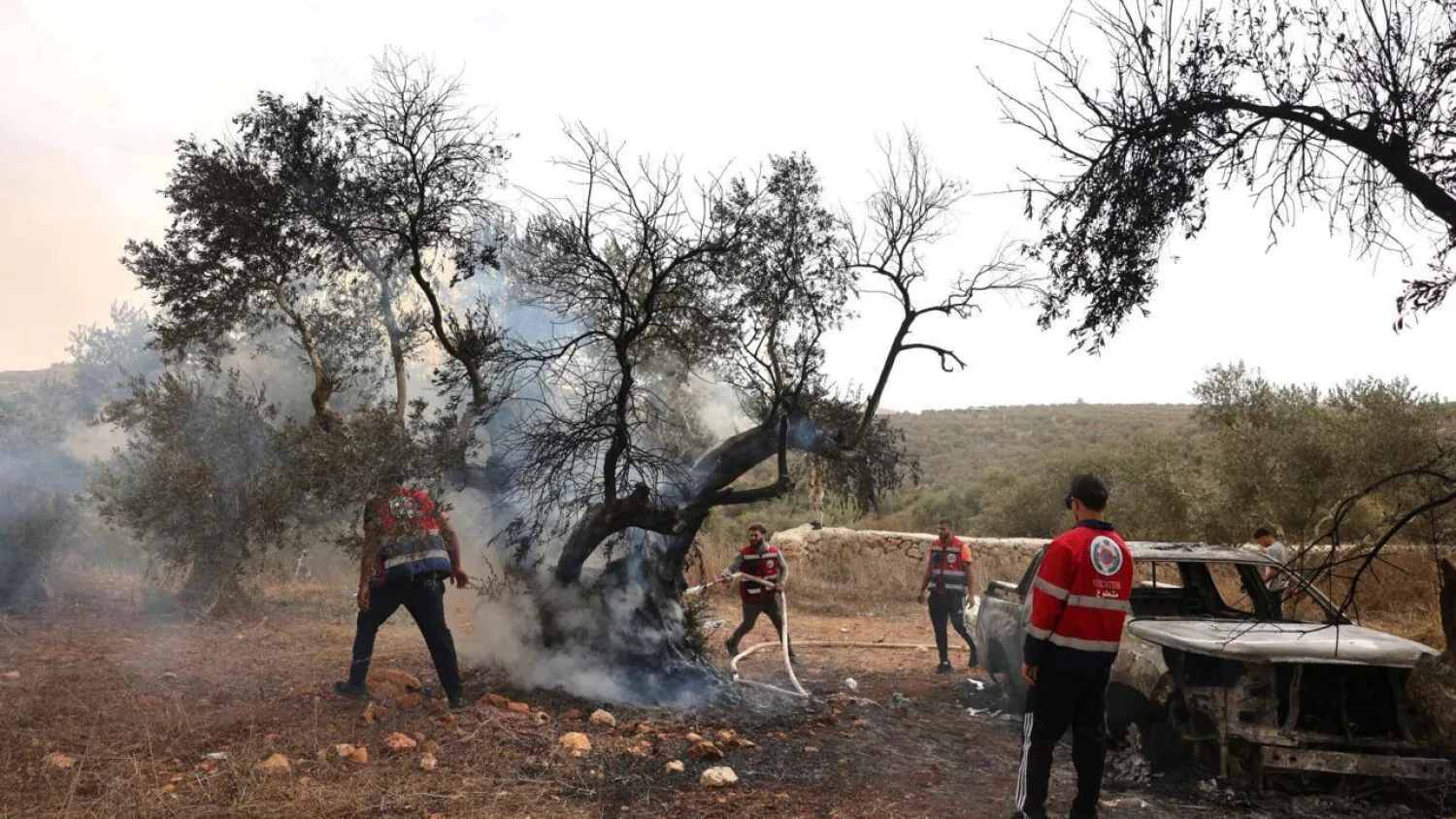
UN Experts Urge Israel to Protect West Bank Olive Farmers

Palestinian volunteers douse an olive tree set on fire by Israeli settlers, near the village of Turmus Ayya, north of Ramallah, in the Israeli-occupied West Bank on October 16, 2026.  Ahmad Gharabli, AFP
Palestinian volunteers douse an olive tree set on fire by Israeli settlers, near the village of Turmus Ayya, north of Ramallah, in the Israeli-occupied West Bank on October 16, 2026. Ahmad Gharabli, AFP
TT

UN Experts Urge Israel to Protect West Bank Olive Farmers

Palestinian volunteers douse an olive tree set on fire by Israeli settlers, near the village of Turmus Ayya, north of Ramallah, in the Israeli-occupied West Bank on October 16, 2026.  Ahmad Gharabli, AFP
Palestinian volunteers douse an olive tree set on fire by Israeli settlers, near the village of Turmus Ayya, north of Ramallah, in the Israeli-occupied West Bank on October 16, 2026. Ahmad Gharabli, AFP

UN rights experts on Monday called on Israel to protect Palestinian farmers in the West Bank as settler attacks worsen with the annual olive harvest.

"Palestinian farmers must be protected and able to access their land safely. Yet, year after year, the violence, destruction and restrictions intensify," the experts said in a statement.

"The olive harvest should be a time when farmers can enjoy, in safety and dignity, the food and livelihoods their nature and land provide, not another season of fear, loss, violence and destruction."

The experts urged Israel to ensure that its forces protect Palestinian farmers from settler attacks and refrain from interference with their access to land. They also urged the international community to "exercise maximum pressure to protect Palestinian civilians", reported AFP.

Israel has occupied the West Bank since 1967. About 500,000 Israelis live in the West Bank, alongside three million Palestinians.

Violence is surging in the territory ahead of Israel's bitterly fought October 27 elections. The vote coincides with Palestinians' annual olive harvest which has been repeatedly disrupted by Israeli settlers as Prime Minister Benjamin Netanyahu seeks to shore up his pro-settlement right-wing base.

According to the UN humanitarian agency OCHA, 178 settler attacks related to the 2025 olive harvest were recorded in the West Bank, affecting 88 Palestinian communities.

More than 6,000 trees and saplings were "vandalised", it said -- nearly double the number in 2024 and the highest figure in six years.

"The olive harvest is an essential source of food, income and livelihood for thousands of Palestinian families," the UN experts said.

"Olive trees take years to mature and can sustain families for generations. Their destruction deprives families of far more than a single harvest: it undermines local food systems, cultural practices and ways of life, as well as the right to food and the food sovereignty of Palestinian communities."

The seven signatories to the statement include Sofia Monsalve Suarez, special rapporteur on the right to food; and Francesca Albanese, special rapporteur on human rights in the occupied Palestinian territories.

The special rapporteurs are independent experts mandated by the Human Rights Council. They do not speak for the United Nations itself.


Battles in Lahij and Taiz as Airstrikes Target Houthi Capabilities

A government fighter in battle against the Houthis. (Military media)
TT

Battles in Lahij and Taiz as Airstrikes Target Houthi Capabilities

A government fighter in battle against the Houthis. (Military media)

Military clashes have renewed between Yemeni government forces and the Houthis along the frontlines of the Lahij and Taiz governorates, amid an escalation in air and artillery strikes under Operation Dawn of Yemen, as government troops continue daily ground and air operations against the group's capabilities.

At dawn on Saturday, fierce fighting broke out on the Maabaq front in the Al-Maqatirah district, north of Lahij, pitting government forces and tribal fighters against the Houthis.

Field sources said that the clashes witnessed heavy exchanges of artillery fire and gunfire and airstrikes by warplanes on Houthi positions.

In Taiz, government forces repelled a Houthi attack on the city's western front with the Taiz Axis Media Center saying there were dead and wounded among the Houthi attackers, without specifying an exact toll.

The media center said an airstrike destroyed a rocket launchpad atop Jabal Habashi, while another strike targeted a Houthi gathering in Al-Munim, killing several members, including a commander. Warplanes carried out three airstrikes on Houthi positions in western Taiz.

The Yemeni Armed Forces announced on Friday that they had carried out 854 strikes targeting Houthi positions, gatherings, and movements as part of Operation Dawn of Yemen, stating that the operations left 193 of the group's leaders and fighters dead or wounded.

Armed Forces spokesperson Staff Colonel Majid Al-Nuzaili said the operations comprised 31 airstrikes and 687 artillery, 91 drone, and 45 rocket launcher strikes.


Fire at Power Station in Iraq's Basra Kills at Least 4, Injures 35

Firefighters work near houses damaged by a fire near the Hartha power station, north of Basra, Iraq, November 21, 2026. REUTERS/Mohammed Aty
TT

Fire at Power Station in Iraq's Basra Kills at Least 4, Injures 35

Firefighters work near houses damaged by a fire near the Hartha power station, north of Basra, Iraq, November 21, 2026. REUTERS/Mohammed Aty

At least 4 people were killed and 35 injured in a fire at a power station in southern Iraq on Saturday, with the toll expected to rise, security officials said.

Civil defense teams brought the fire at the Hartha ‌power station north of ‌Basra under control after firefighters responded to ‌the ⁠incident, Iraq's state ⁠news agency, INA, reported.

The fire spread to neighboring houses and forced operations at the power station to stop, the security officials said.

The fire broke out at around 6 a.m. (0300 GMT), with most casualties reported among residents of the affected houses who suffered burns and smoke ⁠inhalation, Iraq's Security Media Cell said.

Iraq's Electricity ‌Ministry said the incident ‌involved a gas pipeline supplying the power station.

Prime Minister Ali al-Zaidi ‌ordered an urgent investigation into the explosion at the ‌station to determine its causes and establish responsibility, his office said.

The Hartha station has an installed generating capacity of 800 megawatts but had been operating at around 400 megawatts before ‌the fire, the security officials said.

Pictures from the scene showed severely damaged sections ⁠of a ⁠gas pipeline, with the surrounding ground blackened and debris scattered across the site, Reuters reported.

There was no immediate official information on what caused the incident or the full extent of the damage.

Iraq's electricity infrastructure has long struggled with decades of underinvestment, inadequate maintenance and an inability to meet peak demand, particularly during the extremely hot summer months. Fires and technical failures at substations and power facilities have previously disrupted electricity supplies and caused widespread outages.


Aoun: Israel, Iran Are 2 Main Obstacles to Lebanon’s Full Independence

Lebanese national flags line a highway ahead of the country's 83rd Independence Day celebrations in the Dbayeh coastal suburb, north of Beirut, Lebanon, 20 November 2026. EPA/WAEL HAMZEH
TT

Aoun: Israel, Iran Are 2 Main Obstacles to Lebanon’s Full Independence

Lebanese national flags line a highway ahead of the country's 83rd Independence Day celebrations in the Dbayeh coastal suburb, north of Beirut, Lebanon, 20 November 2026. EPA/WAEL HAMZEH

Lebanese President Joseph Aoun said on Saturday that Israel and Iran represent the two principal obstacles to the completion of Lebanon’s sovereignty and independence, stressing on the eve of Independence Day that the country must not remain captive to either project.

Aoun said Lebanon is facing a critical and defining test, arguing that the two challenges are inextricably linked.
He identified them as “the Israeli occupation of parts of our territory” and “foreign interference in our internal affairs, particularly by influential actors within the Iranian regime, through weapons and decision-making structures that operate outside the authority of the Lebanese state.”

According to Aoun, each of these realities serves to justify and perpetuate the other. “Each obstacle invokes the other, derives legitimacy from it, and provides it with a pretext,” he said, adding that “in both cases, Lebanon is the one that pays the price.”

The president said his administration has advanced a national rescue plan based on addressing both issues simultaneously.
“Our vision is founded on the parallel and simultaneous resolution of both problems: no occupation under any circumstances, and no weapons outside the authority of the (Lebanese) state that take orders from, or serve the interests of, any foreign power, whoever that power may be.”

Addressing the issue of Hezbollah’s arsenal, Aoun acknowledged the group’s past role while arguing that its continued possession of arms has come at a heavy cost.

“Hezbollah’s weapons served their purpose during an earlier period, and there were genuine sacrifices and achievements associated with them. In a later phase, however, they exhausted its community, its social environment, its people, and the country as a whole. They imposed immense losses on them, and on all of us, once they became openly dedicated to causes that were not Lebanese.”

He concluded with a direct appeal: “The weapons must be handed over.”