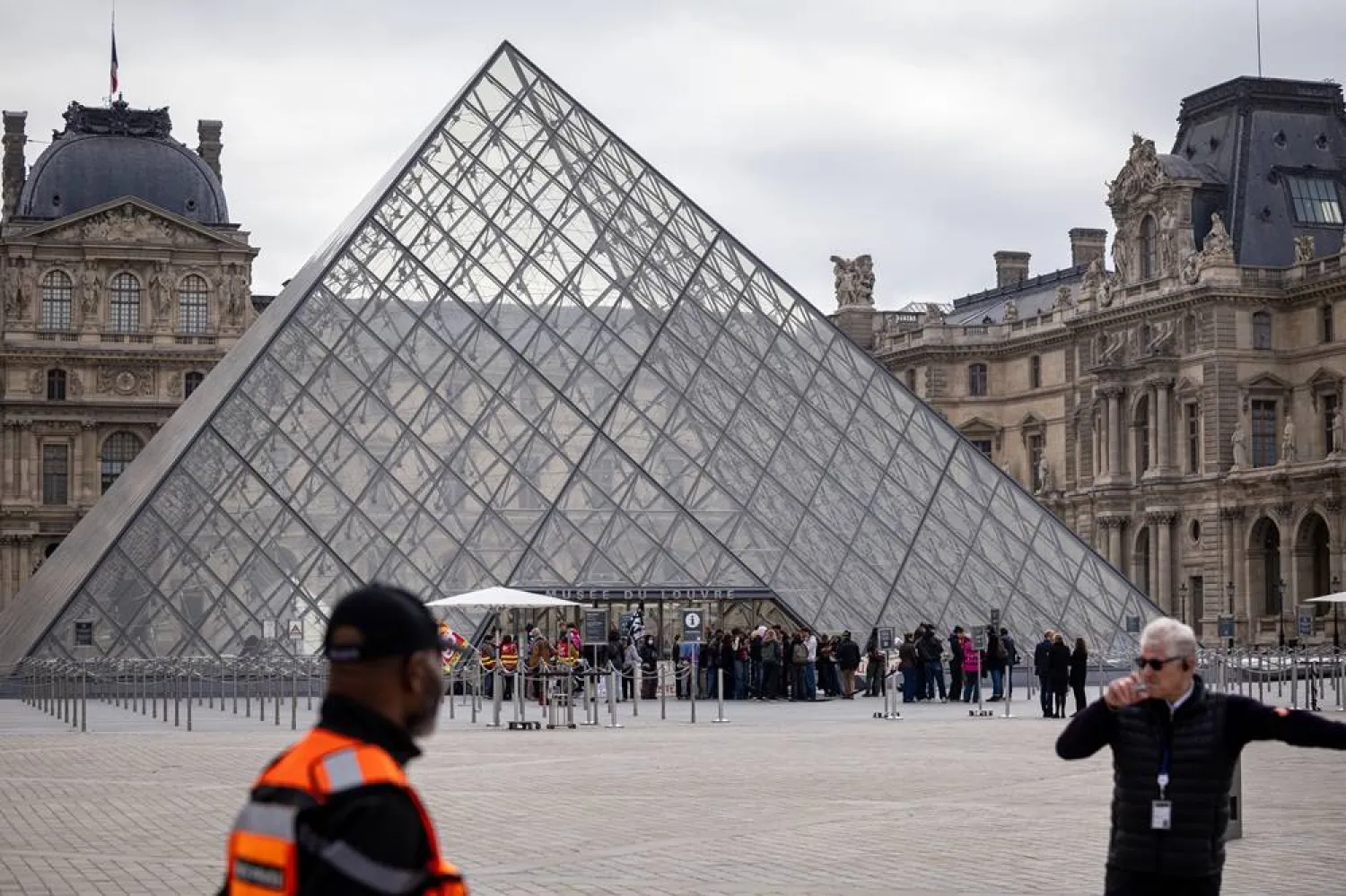
Paris’ Louvre and Other Top Museums to Close on Saturday Over Concern about Protest Violence

Visitors wait outside as protesters block the entrance to the Louvre Museum to express their support for the high school students' movement in Paris, France, 19 October 2026, two days after demonstrations and riots took place alongside nationwide cost-of-living protests. (EPA)
TT

Paris’ Louvre and Other Top Museums to Close on Saturday Over Concern about Protest Violence

Visitors wait outside as protesters block the entrance to the Louvre Museum to express their support for the high school students' movement in Paris, France, 19 October 2026, two days after demonstrations and riots took place alongside nationwide cost-of-living protests. (EPA)

The Louvre and several other major Paris museums will be closed on Saturday over concerns about potential violence during planned protests, France’s culture ministry said.

In a statement to The Associated Press, the ministry said the Orsay and Picasso museums were also among those that will close.

Protests last Saturday devolved into mayhem, with rioters setting fires, smashing shop windows, looting and clashing with police. The ministry called on all institutions under its authority to adopt any necessary measures to ensure “visitor safety, staff protection and the preservation of artworks,” according to the statement.

Others are taking the same tack. After two days when admission was invite-only, Art Basel Paris opened to the public on Friday — but only for the day, with the threat of unrest prompting organizers on Thursday to cancel the weekend program.

Paris’ Grand Palais is hosting 211 international galleries and their exhibitions for Art Basel, considered one of the world’s most prestigious contemporary art fairs.

“It’s kind of like the art Olympics,” New York-based artist Drake Carr, who is showing his work with Mariposa Gallery, said in an interview.

However, timing proved unfortunate, with the French capital gripped by social tension. The clashes and widespread looting over the weekend marked France’s most violent unrest in years.

A protest on Thursday afternoon in Paris was peaceful, and Art Basel's organizers announced the decision to close for the weekend around the same time. The protest planned for Saturday is expected to be much larger.

"This decision has not been taken lightly, and the safety of everyone involved in the fair remains our utmost priority," organizers said in a statement. Its website posted a similar announcement and said weekend ticketholders would be contacted.

Saloni Doshi, an art collector who travelled to Paris from India for the fair, grew worried last Saturday as she saw the fires and panicked people, and she received phone calls from friends asking whether Paris was safe. She agreed with the organizers' rationale to close.

“It's hard that something like this has to happen, but state activities and people's freedom have to continue,” she told the AP. “I cannot imagine that a bunch of elite, privileged people getting inconvenienced because of this should have a voice.”

Antoine Donzeaud and Elisa Rigoulet, the owners of the gallery exo exo, felt the same.

“We understand this decision, which we consider reasonable and consistent with the urgency of the social demands currently unfolding in France,” they said in a text message.


Saudi Heritage Commission Unveils Evidence of Human Activity Dating Back 125,000 Years at Mundafan Palaeolake

Saudi Heritage Commission Unveils Evidence of Human Activity Dating Back 125,000 Years at Mundafan Palaeolake
TT

Saudi Heritage Commission Unveils Evidence of Human Activity Dating Back 125,000 Years at Mundafan Palaeolake

Saudi Heritage Commission Unveils Evidence of Human Activity Dating Back 125,000 Years at Mundafan Palaeolake

Saudi Arabia’s Heritage Commission has unveiled the findings of an archaeological and environmental study conducted at the Uruq Al-Julaybah site, located along the shores of the ancient Mundafan Palaeolake in the Empty Quarter of Najran Region, reported the Saudi Press Agency on Friday.

Carried out in collaboration with Australia's Griffith University, King Abdullah University of Science and Technology (KAUST), and several national and international research institutions, the study revealed evidence of human activity dating back 125,000 years during a humid period in the Arabian Peninsula, evidenced by stone tools as well as animal and plant remains along the ancient shoreline.

Published in Science journal, the study indicates that Mundafan Palaeolake spanned approximately 340 square kilometers and reached a maximum depth of about 29 meters. Sedimentary and geomorphological data, alongside aquatic organism remains, point to a relatively stable freshwater body surrounded by open grasslands and vegetation that sustained diverse human and animal populations.

Across more than 130 locations at the site, researchers documented over 500 vertebrate and invertebrate fossils, including hippopotamuses, extinct long-horned buffalo, camels, Arabian oryx, gazelles, ostriches, mollusks, and freshwater crustaceans (ostracods), reflecting the rich ecological diversity of Mundafan Palaeolake during the humid periods of the Pleistocene epoch.

Researchers recovered 5,511 stone artifacts, each exceeding two centimeters in size, from the primary study area, more than 98% of which were crafted from flint. Analyses confirmed the use of the Levallois technique, an advanced core-preparation method characteristic of Middle Paleolithic toolmaking used to control the shape and size of resulting flakes and points, demonstrating that these implements were both manufactured and utilized on-site.

Despite surface erosion over time, the spatial distribution of the stone tools alongside fossil deposits and preserved organic remains indicates repeated, cumulative human habitation over an extended period. Microscopic, chemical, and use-wear analyses identified preserved organic residues, including plant fibers, wood, resins, fats, and collagen, as well as traces of palm and woody plant processing, pointing to diverse daily activities around the palaeolake.

Several stone points displayed impact fractures and traces of hafting onto handles. Chemical testing also detected plant-derived compounds associated with Acokanthera schimperi, a species traditionally used in hunting, suggesting the possible use of composite hunting technologies, though researchers noted that current evidence is insufficient to determine exact preparation methods, concentrations, or efficacy.

Director General of the Antiquities Sector at the Heritage Commission Dr. Ajab Alotaibi noted that fieldwork continued throughout the 2023 season under the commission's mandate to oversee and fund archaeological surveys and excavations. He underscored the commission's commitment to fostering multidisciplinary research partnerships bringing together Griffith University, KAUST, King Saud University, and specialized international centers.

Dr. Abdullah Alsharekh of the Department of Archaeology at King Saud University's College of Tourism and Archaeology affirmed that the shores of Mundafan Palaeolake provided an ideal habitat roughly 125,000 years ago, where the convergence of fresh water, wildlife, flora, and raw materials supported stone-tool production, hunting-gear preparation, resource processing, and fiber working.

Professor Michael Petraglia of Griffith University stated that the discovery significantly advances understanding of early human settlement across the Arabian Peninsula, highlighting the role of sites like Uruq Al-Julaybah in documenting human habitation during past humid phases.

Dr. Frans van Buchem of KAUST noted that collaboration across diverse scientific disciplines yielded a comprehensive portrait of ancient human behavior and prehistoric environments.

The research forms part of the Heritage Commission's broader efforts to leverage advanced scientific methodologies and global partnerships to illuminate the history of human settlement and environmental transformation in the Kingdom.


King Salman Global Academy for Arabic Language, ALECSO Launch Unified Arabic Terminology Dictionary Platform

The dictionary platform aims to address the fragmentation of terminology dictionaries across multiple publications and different structures - SPA
TT

King Salman Global Academy for Arabic Language, ALECSO Launch Unified Arabic Terminology Dictionary Platform

The dictionary platform aims to address the fragmentation of terminology dictionaries across multiple publications and different structures - SPA

The King Salman Global Academy for Arabic Language (KSGAAL), in partnership with the Arab League Educational, Cultural and Scientific Organization (ALECSO), launched the Unified Arabic Terminology Dictionary platform during the 28th regular session of the ALECSO General Conference, held in Muscat, Oman.

The session saw the adoption of resolutions concerning two projects submitted by Saudi Arabia and implemented by the academy in cooperation with ALECSO and in coordination with the Saudi National Commission for Education, Culture and Science.

The launch coincides with Saudi Arabia’s presidency of the ALECSO Executive Council and comes within the framework of a memorandum of understanding (MoU) signed to strengthen joint Arab action and develop linguistic, knowledge-based, and digital resources, according to SPA.

The dictionary platform aims to address the fragmentation of terminology dictionaries across multiple publications and different structures, which has made it difficult to search their contents collectively or link them to digital applications. To address this, data from these dictionaries has been restructured in accordance with international standards, enabling instant searches across all their contents through a single interface. Application programming interfaces (APIs) have also been developed to connect the unified dictionary with external systems.

The conference also adopted the “Language Policy System in Arab Countries” project, which is intended to serve as an Arab reference supporting research, planning, and linguistic policymaking. The project includes data, studies, and reports documenting the state of linguistic policies in Arab countries and analyzing their impact.

The ALECSO General Conference commended Saudi Arabia’s efforts to serve the Arabic language and strengthen its regional and international presence. It also praised KSGAAL’s contributions to developing linguistic policies, indicators, and standards; building databases, corpora, dictionaries, and Arabic language processing tools; and harnessing scientific and technological capabilities to support joint projects.

The conference also commended Saudi Arabia, represented by KSGAAL, for implementing the two projects and supporting joint Arab efforts in the field of Arabic language. It called on linguistic, scientific, and academic institutions in Arab countries to benefit from the projects’ outcomes, contribute to enriching their content, update their data, and strengthen cooperation with the academy in related fields.

The launch of the platform and the adoption of the two project decisions mark a continuation of KSGAAL’s efforts to build strategic partnerships, develop digital language solutions, and strengthen integration among institutions concerned with the Arabic language. These efforts reinforce Saudi Arabia’s contribution to supporting joint Arab initiatives and providing scientific and knowledge-based references that serve the Arabic language and keep pace with its development.


India to Build Mega-Museum with World’s ‘Largest Display Area’

 Pedestrians walk amid smog at the Kartavya Path near India gate in New Delhi on November 3, 2026. (AFP)
Pedestrians walk amid smog at the Kartavya Path near India gate in New Delhi on November 3, 2026. (AFP)
TT

India to Build Mega-Museum with World’s ‘Largest Display Area’

 Pedestrians walk amid smog at the Kartavya Path near India gate in New Delhi on November 3, 2026. (AFP)
Pedestrians walk amid smog at the Kartavya Path near India gate in New Delhi on November 3, 2026. (AFP)

India's cabinet approved on Wednesday a mega-museum showcasing the country's history and civilization, which the government said will cost around $340 million and have the largest display area in the world.

First announced in 2023, the project received approval as Prime Minister Narendra Modi's Hindu nationalist government renewed its emphasis on the country's pre-colonial cultural identity.

The museum's name, Yuge Yugeen Bharat, translates roughly as "India through the ages" and invokes the country's ancient Sanskrit name, Bharat.

It will occupy former civil service offices in New Delhi, known as North and South Blocks, which were designed by British architects Edwin Lutyens and Herbert Baker in the 1920s.

In a statement, the cabinet said the museum will be "spread over a proposed built-up area of approximately 178,509 square meters".

"Benchmarked against major international museums, Yuge Yugeen Bharat Museum is going to be the museum (with) the largest display area in the world," it added.

India's cabinet said the Yuge Yugeen Bharat is "envisaged as a landmark civilizational museum showcasing the continuity, diversity and richness of Bharat's (India's) civilizational heritage".

The first gallery is expected to open to the public by the end of 2027, with project completion scheduled for financial year 2030-31.

Modi came to national power in May 2014, and has since taken multiple steps to glorify the country's heritage and culture.

His government built the world's tallest statue, a 182-meter (597-foot) monument to Vallabhbhai Patel, for his role in bringing princely states into India.

Modi also backed the revamp of New Delhi's historic administrative district in his second term and moved lawmakers to a new parliament building in 2023.

"The Museum is envisaged as a national public cultural institution... it will provide opportunities for learning, research, cultural engagement and appreciation of India's civilizational heritage," the government statement said on Wednesday.

Around 1.8 million objects have been identified from national and state museums, archaeological collections and private holdings for potential display.

The museum is designed to accommodate up to 10 million visitors a year.