



Brazil Heads to Polls in Runoff between Leftist Lula and Bolsonaro Jr.

Brazil's incumbent leader Luiz Inacio Lula da Silva and his right-wing challenger Flavio Bolsonaro traded blows during a heated election debate. NELSON ALMEIDA / AFP
TT

Brazil Heads to Polls in Runoff between Leftist Lula and Bolsonaro Jr.

Brazil's incumbent leader Luiz Inacio Lula da Silva and his right-wing challenger Flavio Bolsonaro traded blows during a heated election debate. NELSON ALMEIDA / AFP

Brazilians head to the polls on Sunday in a tight runoff vote that could shift Latin America's largest nation sharply rightward, bringing it closer to the United States as part of a broader conservative shift across the region.

The runoff pits leftist President Luiz Inacio Lula da Silva against right-wing Senator Flavio Bolsonaro, the son of convicted former President Jair Bolsonaro. Flavio scored a major upset at the start of the month by defying pollsters ‌to lead voting in ‌the first round, Reuters said.

A victory for Bolsonaro, 45, would ‌extend ⁠a wave of right-wing ⁠victories for Latin American candidates friendly to US President Donald Trump, while a fourth mandate for Lula would be a disappointment in Washington, which has clashed with his government over trade and security.

The election race has been dominated by corruption scandals, economic anxiety and accusations of US meddling, which Washington denies. It has also been colored by fallout from Jair Bolsonaro's 2025 conviction for plotting a 2022 coup, ⁠with Flavio pledging to free his father if he is ‌elected.

Trump has called the case a "witch ‌hunt" and imposed a 50% tariff on Brazil in 2025, in a decision explicitly linked ‌to Jair Bolsonaro’s trial. While many of those were later watered down, Trump ‌unleashed new levies against Brazil this year, citing unfair trade practices.

Lula has cast the Trump administration’s proximity to the Bolsonaro clan as part of an attempt to sway the election, while labeling tariffs and other punitive measures as bullying.

On economic issues, despite falling ‌inequality and unemployment, Lula has struggled to win over an electorate grappling with high living costs and heavy household ⁠debt. Endemic gang violence ⁠also weighs on voters’ minds.

Bolsonaro has sought to capitalize on cost-of-living concerns and has also promised a heavy-handed approach to fighting crime, pledging maximum-security jails and chemical castration for serious sexual offenses.

CANDIDATES ARE NECK AND NECK

Polls show the candidates are practically tied going into the runoff, as Lula has closed the gap in the final days.

Historical precedent favors Bolsonaro, however, as no candidate has ever won the presidency after coming second in the first-round vote.

Bolsonaro picked up 47% of ballots cast in the first round, while Lula trailed with 45%.

The senator's first-round win sent Brazil's markets and currency soaring on expectations of pro-business reforms.

His first-round success was mirrored in congressional elections for his Liberal Party and other right-wing politicians, which could pave a legislative path for him, or complicate governance for Lula.



Two Migrants Die, Hundreds Rescued off Greek Islands

Migrants who arrived from North Africa walk towards a controlled area at the port of Heraklion, on the island of Crete, Greece, Saturday, Nov. 28, 2026. (Image On Line via AP)
TT

Two Migrants Die, Hundreds Rescued off Greek Islands

Migrants who arrived from North Africa walk towards a controlled area at the port of Heraklion, on the island of Crete, Greece, Saturday, Nov. 28, 2026. (Image On Line via AP)

Two migrants died and more than 400 others were rescued in less than 24 hours off the islands of Gavdos and Crete, the Greek coastguard said Saturday.

South of Gavdos, rescuers found two bodies and rescued 41 people trying to reach the European Union in a joint operation by the Greek authorities and the EU border agency Frontex, according to the ANA news agency and port officials.

The coastguard also reported six rescue operations since Friday evening off Gavdos and Crete, in which 391 migrants were brought to safety.

In one operation on Saturday, 102 migrants, including 16 women and five minors, were transferred to the port of Heraklion, Crete's main city.

Authorities gave no details on the migrants' nationalities or point of departure, though most crossings in the area originate from Libya.

Shipwrecks and accidents have become increasingly common off Crete as migrants attempt the dangerous sea crossing, often in rough weather and high winds.

Earlier this month, at least 22 people died in migrant boats trying to reach the island, according to port authorities.

The UN's International Organization for Migration has said the growing number of attempted crossings from Libya to Crete has exposed gaps in search and rescue capabilities.


At Risk of Losing Power, Netanyahu Makes Long-Shot Unity Appeal to Rival Eisenkot

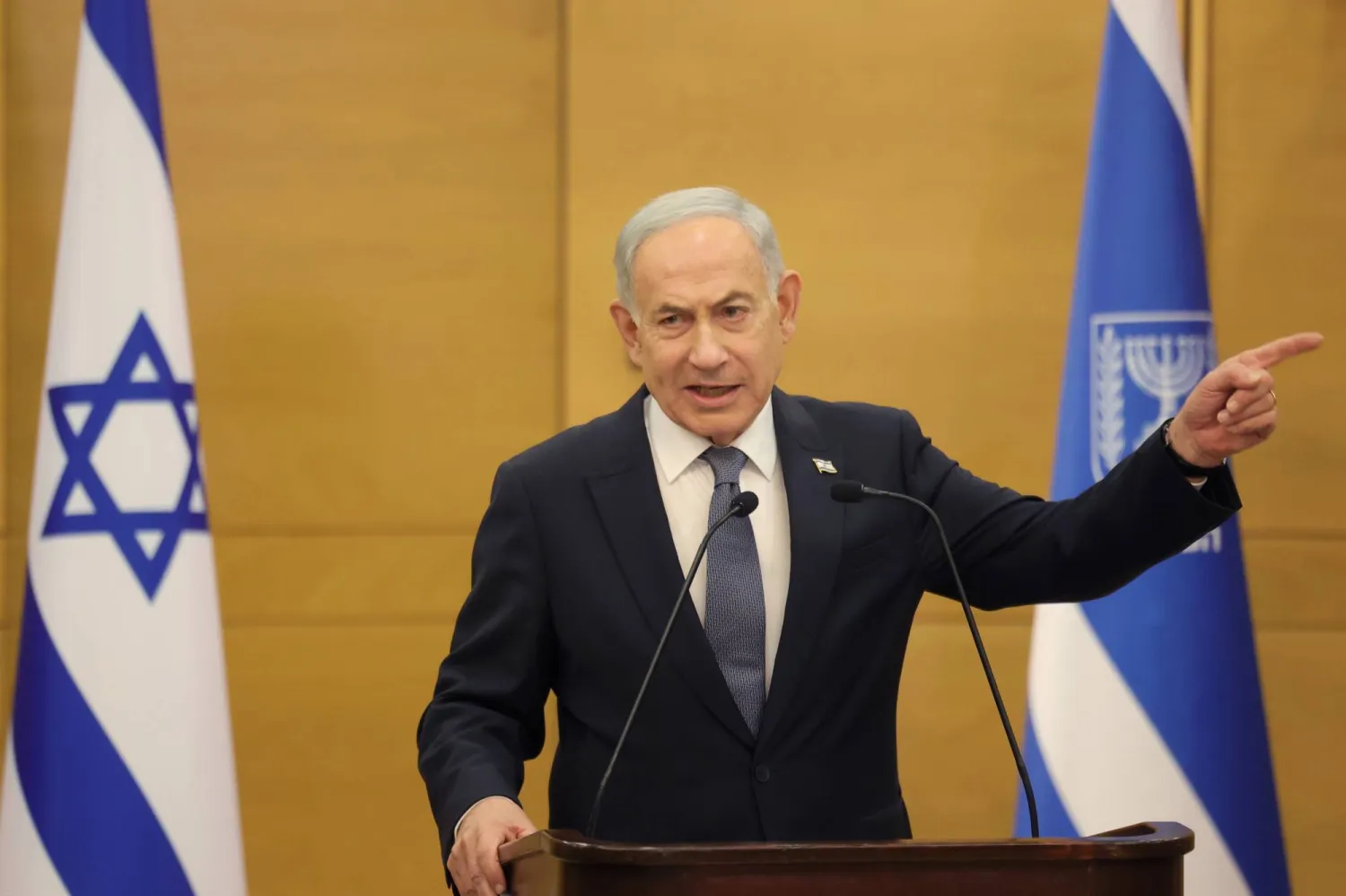
Israeli Prime Minister Benjamin Netanyahu delivers a media statement at the Knesset, the Israeli parliament, in Jerusalem, 25 November 2026. (EPA)
TT

At Risk of Losing Power, Netanyahu Makes Long-Shot Unity Appeal to Rival Eisenkot

Israeli Prime Minister Benjamin Netanyahu delivers a media statement at the Knesset, the Israeli parliament, in Jerusalem, 25 November 2026. (EPA)

Israeli Prime Minister Benjamin Netanyahu said on Saturday he would be willing to relinquish his role in a unity government led first by ‌Gadi Eisenkot, the ‌latest sign that the former ‌military ⁠chief may be close ⁠to forming an opposition-backed coalition intent on ousting Netanyahu. 

Netanyahu’s announcement underscores the pressure Israel’s longest-serving leader is under as Eisenkot wins support from potential partners that could hand him a governing majority or allow him to form ⁠a coalition government. 

Netanyahu offered to ‌go second in ‌a rotation agreement with Eisenkot in a proposed unity ‌government agreement between their two parties. 

Eisenkot was ‌tapped by Israel’s president to try to form a government after an inconclusive October 27 election that left neither him nor Netanyahu with a ‌clear path to power. 

This week, Eisenkot signed coalition deals with two ⁠left- and ⁠right-wing partners whose support could bring him closer to a majority. 

A spokesperson for Eisenkot's Yashar party did not immediately respond to a request for comment. 

Netanyahu said in a statement that he should lead the Israeli government but "given the magnitude of the existential threat and the possibility that a government could be formed that isn’t able to deal with this danger," his "responsibility as a leader" required he "put everything aside." 


Iran Rial Falls to Near 3 Million to US Dollar as Sanctions, Blockade Weigh

Iranians shop at a street market in Tehran, Iran, 23 November 2026, as the country faces an economic crisis amid ongoing US-Iran tensions. (EPA)
TT

Iran Rial Falls to Near 3 Million to US Dollar as Sanctions, Blockade Weigh

Iranians shop at a street market in Tehran, Iran, 23 November 2026, as the country faces an economic crisis amid ongoing US-Iran tensions. (EPA)

Iran's currency plunged ‌to a record low on Saturday, approaching the psychological threshold of 3 million rials to the US dollar, amid rising inflation, hardening US sanctions and a widening embargo.

The US dollar was sold at around 2.990 million rials, up from 2.938 million on Friday, according to free-market tracking website bon-bast.com, while alanchand.com reported 2.997 million rials per dollar, up 1.77%.

Iran is facing one of its worst inflation surges in decades, driven by the nine-month-old Iran war, with ‌a particularly sharp ‌rise in food prices.

The US reimposed ‌its ⁠naval blockade on ⁠Iranian ports in July, and earlier this month announced Task Force Iron Gate to restrict the movement of weapons and sanctioned materials across Iran's land borders and the Caspian Sea.

“Iran’s economy is underwater, and its leaders are panicking,” US Treasury Secretary Scott Bessent said in a statement ⁠earlier this week after imposing new sanctions ‌aimed at isolating Iran from ‌the global economy and disrupting its shadow banking networks.

Iranian Central Bank ‌Governor Abdolnaser Hemmati said on Saturday that Iran had ‌sufficient hard currency to pay for basic goods and medicine for months to come, but added that the foreign exchange market was affected not only by economic fundamentals but also by ‌psychological factors.

"Foreign exchange is affected by many factors such as the economy, expectations and ⁠politics... We ⁠are trying to stabilize the market as much as we can," Hemmati told state television.

Many Iranians seeking safe havens for their savings have been buying dollars, other hard currencies or gold.

Consumer prices in Iran in October were 88.7% higher than a year earlier, while annual average inflation accelerated to 76.8%, according to the Statistical Centre of Iran. Food and beverage prices rose 112.6% year-on-year.

Iran’s currency plunged to a record low in August, crossing the threshold of 2 million rials to the US dollar, while annual inflation reached 66% in July.