Soldiers Guard Center of Milan as Thousands of Protesters March in Cities Across Europe

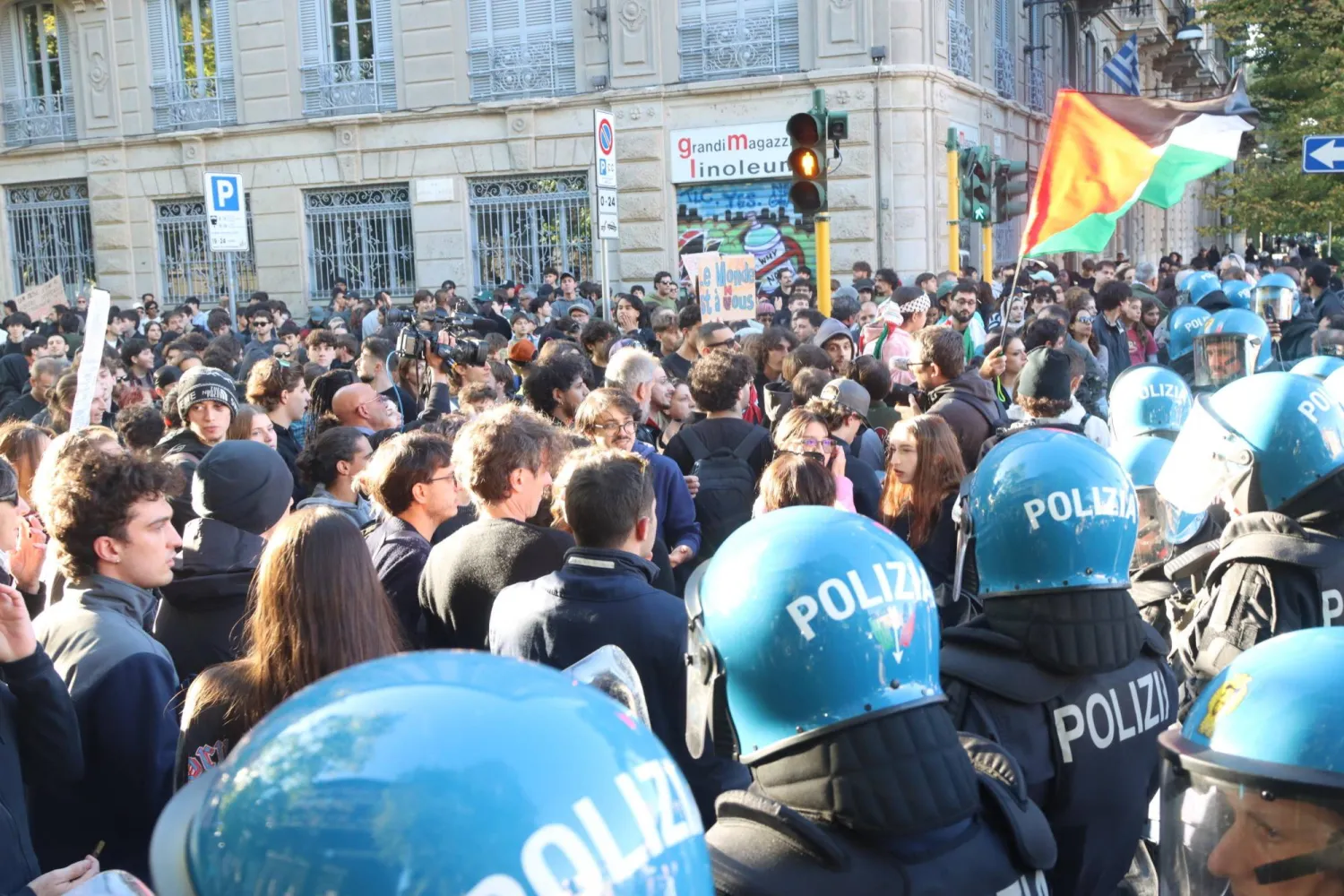
Protesters confront anti riot police during a demonstration at Lanza in Milan, Italy, 24 October 2026. (EPA)
TT

Soldiers Guard Center of Milan as Thousands of Protesters March in Cities Across Europe

Protesters confront anti riot police during a demonstration at Lanza in Milan, Italy, 24 October 2026. (EPA)

Thousands of young people marched Saturday through the streets of several Italian cities, including Milan, Rome and Turin, as authorities deployed large numbers of police and soldiers in a largely successful bid to stave off a repeat of the violent clashes and looting that marred similar protests last week.

The demonstration in Milan remained peaceful, but there were brief clashes with police in both Rome and Turin.

In Milan, thousands of young people marched the streets as soldiers were deployed and luxury boutiques were boarded up, but by late afternoon, most shops had opened, Italian media reported.

Premier Giorgia Meloni announced a raft of measures, including sending an additional 500 soldiers to Milan and tougher penalties for minors, who police said made up a large part of the violent protesters last week. In Milan, police detained several minors as a preventive measure, media reported.

While protests in France have claimed most international attention, large demonstrations also rocked many European cities Saturday from Milan to Rome to Madrid, Lisbon and Tirana.

The protests encompass a broad range of issues from education and corruption to anti-war movements, pensions and housing.
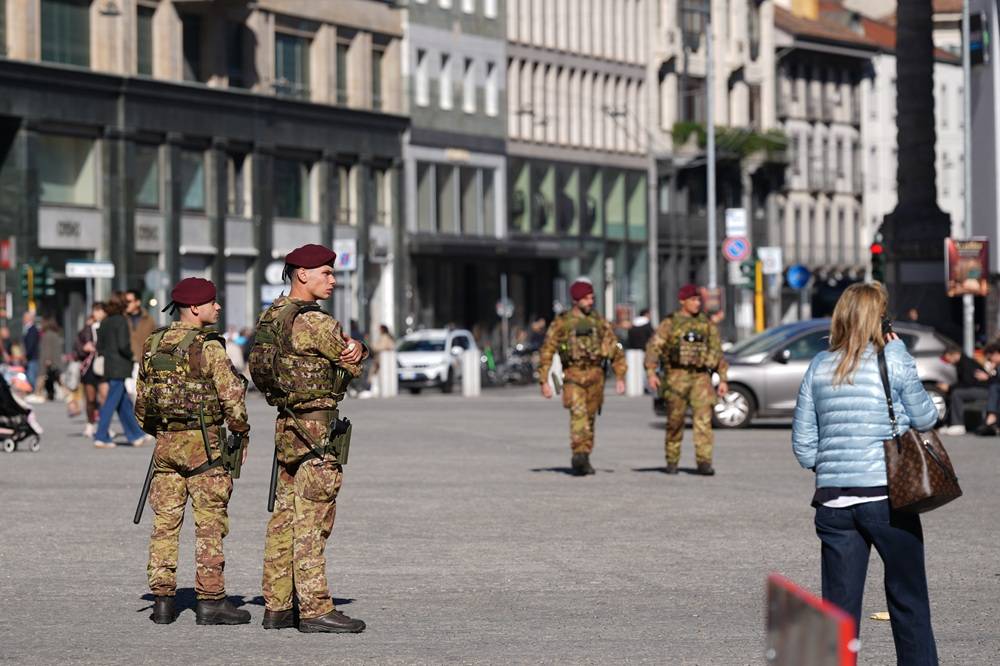
Italian army paratroopers patrol the streets of Milan, Saturday, Oct. 24, 2026, ahead of an expected protest against the rising cost of living and deteriorating public services during one of several protests in Italy organized by groups across the political spectrum. (AP)

Army vehicles and boarded-up luxury stores in Milan

In Milan, huge crowds of mostly young people gathered as night fell, chanting insults to Meloni and holding aloft banners such as “No to lies of the state.”

A group of protesters dumped manure outside Italy’s energy regulator and burned a symbolic, oversized electricity bill, images broadcast on local television showed.

The 500 soldiers deployed to Milan came in addition to hundreds already stationed there, supporting about 5,000 police and other security personnel. Authorities used drone surveillance, checks at railway stations, rapid-response units and online monitoring for potential calls to violence.

A mayoral hopeful, Pierfrancesco Majorino, who announced his candidacy Thursday, joined the marchers and remarked how peaceful the day was, according to Italian media. He will contest a center-left primary in early 2027. Milan's center-left Mayor Giuseppe Sala, who has held the role since 2016, is not running again.

Many stores, particularly luxury boutiques within Milan's fashion district including Omega, Tiffany and Gucci, boarded up their front windows. The Apple store also shut down and remained shut even as others reopened.

Rioters last weekend smashed their way into stores, targeting sneakers, athletic wear and sporting goods on streets that run off the city’s central Duomo square.

Security measures extended beyond the city center over concerns protesters could move into other neighborhoods.

The protesters ended their march peacefully Saturday evening outside the Milan Polytechnic, more than 3 kilometers (2 miles) from the city center.
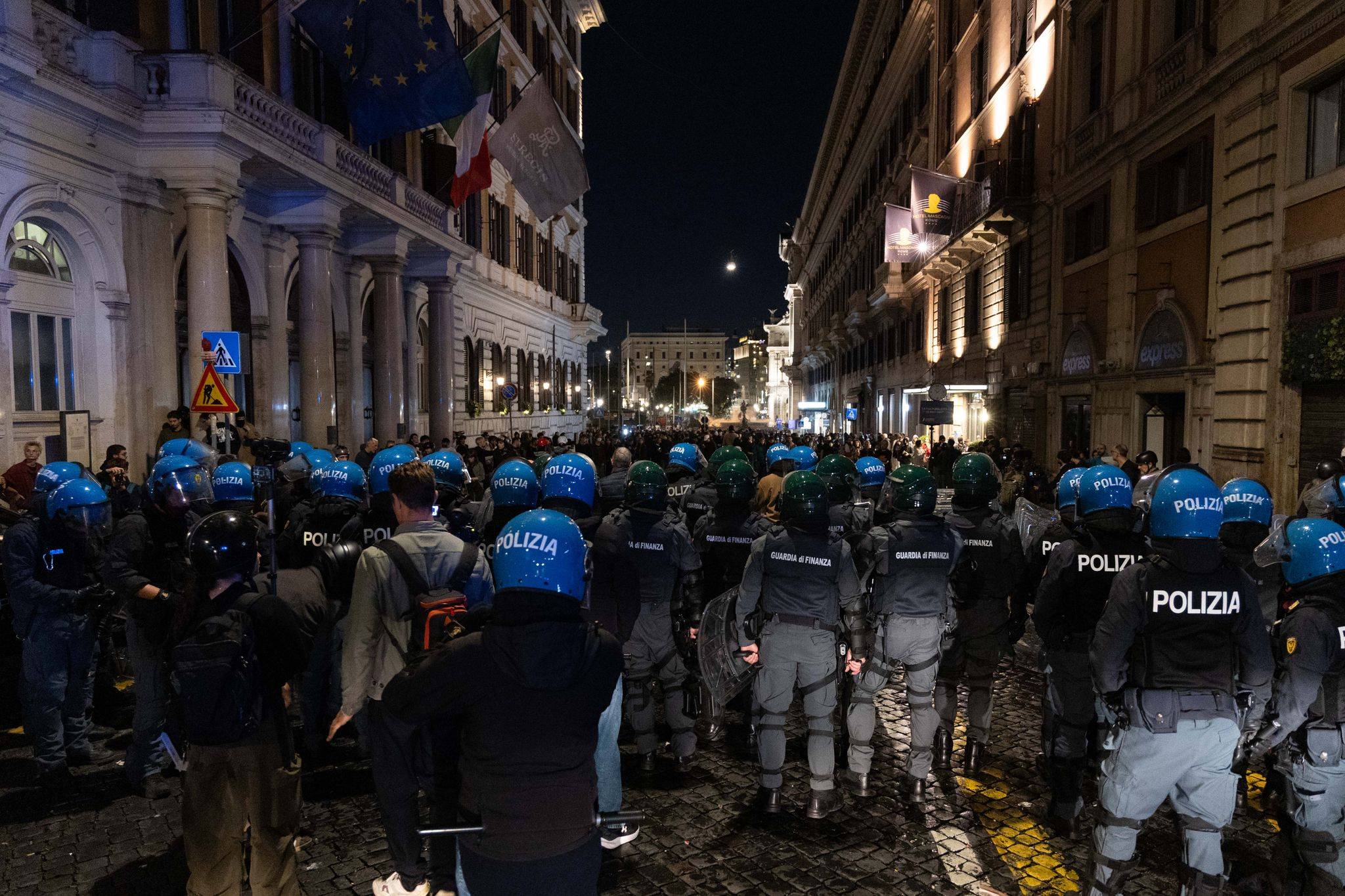
24 October 2026, Italy, Rome: Police officers stand guard during a march organized by the October 17 Movement against the rising cost of living. (dpa)

Officials said Saturday they were investigating a 30-year-old freelance journalist said to be the “mastermind” of the newly formed Oct. 17 movement, which has been the main driver of the recent protests in Italy.

Milan police say last week's violence and looting involved about 2,000 very young protesters, many of them “naturalized, second-generation Italians,” alongside foreign nationals. Over two days, police arrested 45 people, including 34 minors.

A group of about 30 far-right activists, described as hooligans linked to Inter Milan football club, made a brief appearance chanting anti-immigrant and anti-Muslim slogans but were isolated by police.

Defense Minister Guido Crosetto said the soldiers deployed Saturday were only recently allowed to use plastic restraint ties and only in areas around train stations, not throughout the city. They are not authorized to carry pepper spray or tasers, he said.

Protesters try to force entry into Colosseum in Rome

Security was also heightened in Rome, where authorities locked down luxury shopping streets and stepped up controls around the Circus Maximus and Piazza del Popolo.

A small number of protesters tried to force their way into the Colosseum, but were ushered out by guards. Elsewhere, several hundred students demonstrated peacefully to stress they were not rioters.

“I think the images from last week were truly something terrible, especially for the young people, for the students, for the vast majority of the younger generations who want to study ... and do not accept being represented by those who use issues and needs to devastate entire cities,” said Riccardo Ponzio, national president of an Italian far-right student association.

A separate anti-war march took place in central Rome. Organizers sought to distance themselves from potential unrest, urging participants to keep their faces uncovered and hands visible.

But it was these marchers who briefly clashed with police near the Piazza della Repubblica, even as organizers were trying to hold the crowd back using batons and tear gas. In the end, the protesters pulled back when a water cannon was turned on. They retreated to a location about half a kilometer away.
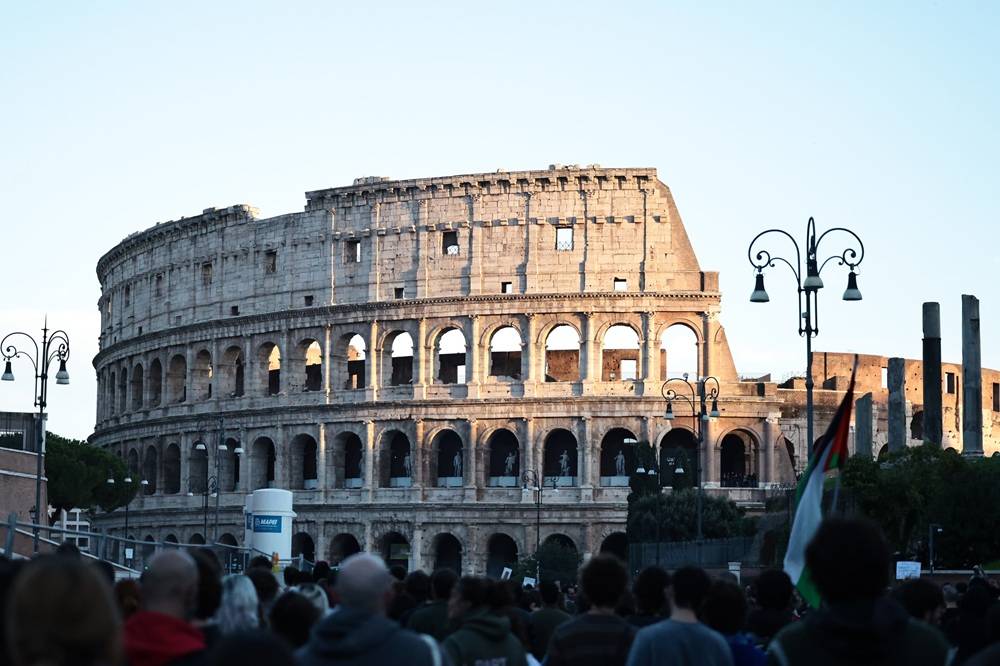
Students and peace activists gather in front of the Colosseum during an anti-war rally in Rome, Italy, 24 October 2026. (EPA)

Clashes and buildings set on fire in Albania

In Albania's capital Tirana, riot police used water cannons on large groups of protesters, some of whom set government buildings on fire and threw projectiles at police. Authorities said 2,500 officers patrolled the streets Saturday.

For over a week, protesters have hurled rocks, flares, firebombs and fireworks at police who have used batons and tear gas in clashes in the city center.

High school and university students are demanding lower tuition fees, greater state investment in education and protesting corruption in the education system. Some have joined a broader anti-government movement calling for the resignation of Socialist Prime Minister Edi Rama.

A separate protest organized by the opposition outside the prime minister's office turned violent earlier, with some activists lighting fires on the street.

Rama said Saturday his government was preparing a response to the students' demands and called them to a dialogue. He warned that violent protesters will face penalties.
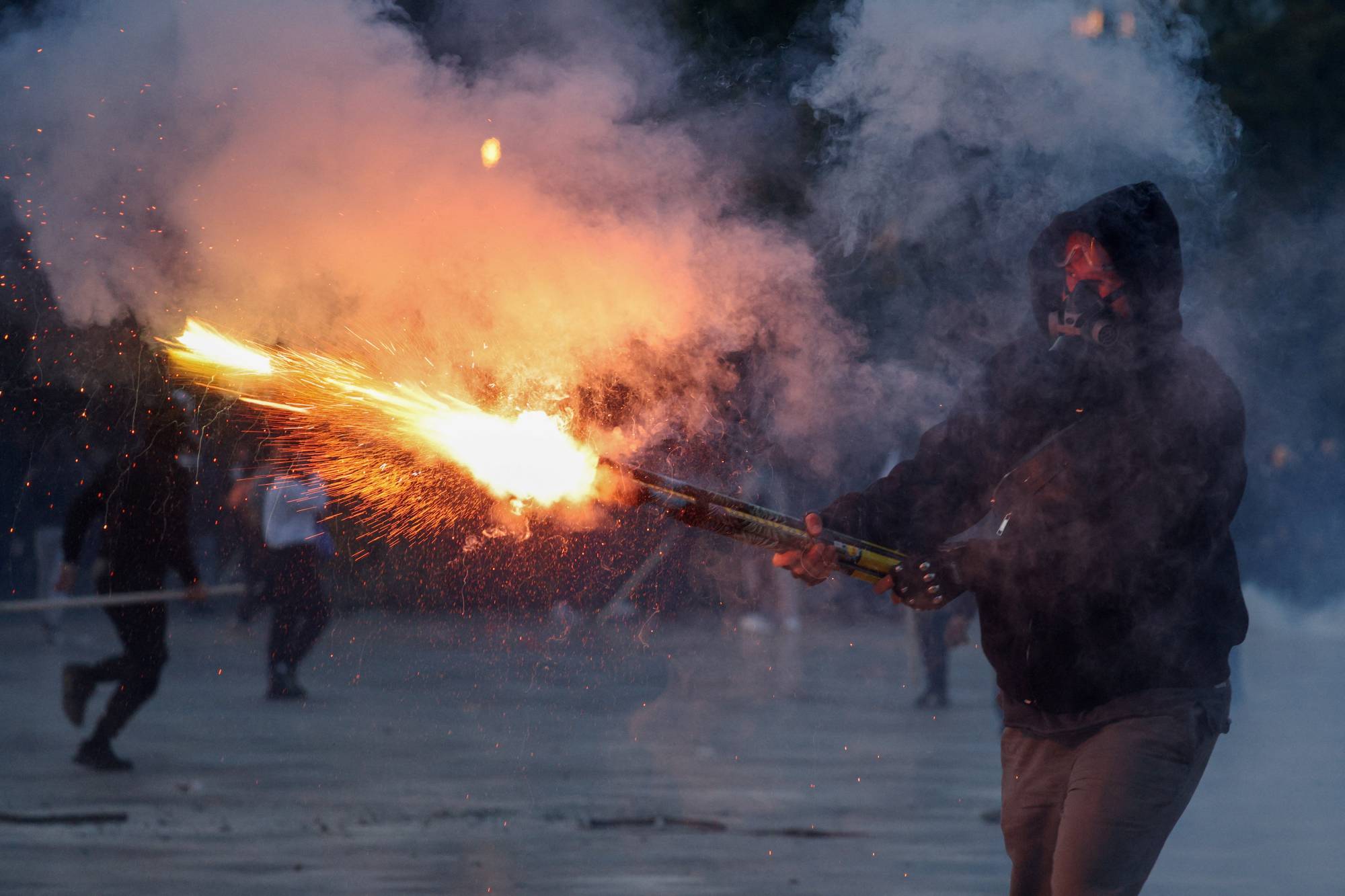
A demonstrator sets off a pyrotechnic device during an anti-government protest by students in Tirana, Albania, October 24, 2026. (Reuters)

Pensions and housing spark Madrid and Lisbon protests

Thousands of retirees and others marched peacefully in Spain's capital Saturday to demand public pensions aren’t meddled with.

“They are threatening us with privatizing pensions. It’s just another thing they want to profit from," said Maria José Benito, 68.

The protests came ahead of next month’s snap election as Prime Minister Pedro Sánchez’s Socialist Party criticized the conservative opposition Popular Party for making overtures about privatizing public pensions.

Spain also has been roiled by protests this fall around the issue of housing, as rental and home costs have risen in recent years beyond what many Spaniards can afford.

Taking their cue from Spaniards, protesters in Lisbon demanding affordable housing marched across the city on Saturday.

They have also targeted recent measures announced by the government of Prime Minister Luis Montenegro that include easing the cap on yearly rent increases and facilitating the eviction of tenants who fail to pay rent.

Montenegro defends the measures, saying that they aim at reinforcing trust between tenants and landlords and boosting the rentals market. Protesters claim that the measures are not balanced and put tenants in a more vulnerable position.


NATO Chief Pledges to Defend Poland after Russian Missile Incursion

FILE PHOTO: NATO Secretary General Mark Rutte speaks to the media on the day of the Ukraine Defense Contact Group meeting at NATO headquarters in Brussels, Belgium,  November 17, 2026. REUTERS/Stephanie Lecocq/File Photo
FILE PHOTO: NATO Secretary General Mark Rutte speaks to the media on the day of the Ukraine Defense Contact Group meeting at NATO headquarters in Brussels, Belgium, November 17, 2026. REUTERS/Stephanie Lecocq/File Photo
TT

NATO Chief Pledges to Defend Poland after Russian Missile Incursion

FILE PHOTO: NATO Secretary General Mark Rutte speaks to the media on the day of the Ukraine Defense Contact Group meeting at NATO headquarters in Brussels, Belgium,  November 17, 2026. REUTERS/Stephanie Lecocq/File Photo
FILE PHOTO: NATO Secretary General Mark Rutte speaks to the media on the day of the Ukraine Defense Contact Group meeting at NATO headquarters in Brussels, Belgium, November 17, 2026. REUTERS/Stephanie Lecocq/File Photo

NATO Secretary General Mark Rutte on Saturday pledged to defend Poland after Russian missiles landed in the country, with the alliance's top decision-making body set to discuss the incident.

Warsaw said two Russian missiles hit its southeast on Friday, accusing the Kremlin of "intentional provocation" near where thousands of European troops are holding exercises.

Rutte, on a visit to Warsaw, said the alliance would determine what happened in the incident to identify any vulnerabilities, and pledged to defend Polish territory, in remarks to Polish media.

On Friday Rutte condemned what he said were "grave violations", calling the incident "clearly dangerous".

NATO's main political decision-making body will discuss the incident in Brussels on Monday "as part of regular consultations among allies", an alliance official told AFP.

Poland will be represented by its deputy defense minister, Pawel Zalewski, according to Polish public radio.

Polish Prime Minister Donald Tusk said on Friday that Warsaw would ask NATO to strengthen its detection and surveillance systems over Poland, as Russia frequently launches waves of missiles and drones at western Ukraine, near the Polish border.

The Institute for the Study of War (ISW), a US think tank, said it believed Russia "intentionally fired missiles and drones into Polish airspace".

The gesture was timed to coincide with exercises by the "Coalition of the Willing" taking place in Poland, the ISW said.

"Coalition of the Willing" refers to a group of Ukraine's European backers who are prepared to send peacekeeping troops to the country.


French Protesters Rally Again Over Living Costs, Public Services

Protesters carry banners and placards during an anti-government demonstration in Paris, France, 21 November 2026. EPA/MOHAMMED BADRA
TT

French Protesters Rally Again Over Living Costs, Public Services

Protesters carry banners and placards during an anti-government demonstration in Paris, France, 21 November 2026. EPA/MOHAMMED BADRA

France saw nationwide demonstrations for the sixth weekend in a row on Saturday, as protesters took to the streets to demand better public services and express anger over the rising cost of living and inequality.

The protest movement, sparked in mid-September by high school students demanding better learning conditions, fueled a nationwide campaign against soaring prices, inadequate public services and police brutality that spread across Europe, even as turnout in France has dwindled.

Several thousand people gathered in central Paris's Place de la Republique square in a festive atmosphere, with musicians playing, food trucks, costumes and homemade signs.

Flags and vests of trade unions and left-wing parties mingled with those of student organizations and the Yellow Vest movement, which is marking its anniversary eight years after it rattled President Emmanuel Macron's government.

On Friday crowds rallied across multiple countries to vent anger over issues from high living costs to military spending and the climate crisis, ramping up pressure on political leaders they accuse of ignoring the concerns of young people.

"I want to live, not survive," read one placard held by a protester in Paris.

Another read: "No to the license to kill", in reference to a law adopted by France's parliament on Friday increasing protection for law enforcement officers using their weapons -- heavily criticized by the left.

The protests have been largely peaceful but have seen fringe violence and accusations of police brutality.

At least 31 people have been seriously injured by security forces since the protests began, according to a count by AFP based on direct testimonies, victims' lawyers and NGO records. Authorities have not provided an official toll.

Last month, some rallies across France degenerated into clashes between riot police and demonstrators, with shops looted and buildings attacked and torched.

Interior Minister Laurent Nunez had warned regional authorities to be "particularly vigilant regarding the groups most hostile to law enforcement" after the police law was adopted.

Protesters marched on Saturday in cities from Lille in the north to Marseille in the south and Lyon in the southeast.

Clashes broke out on the sidelines of some protests as people set fire to vehicles and bins and police fired tear gas.

The interior ministry had said the demonstrations began in a "generally calm" atmosphere and turnout was "down compared to previous days".


Qatari Delegation Visits Tehran, Pezeshkian Admits that Iran Faces Tough Economic War

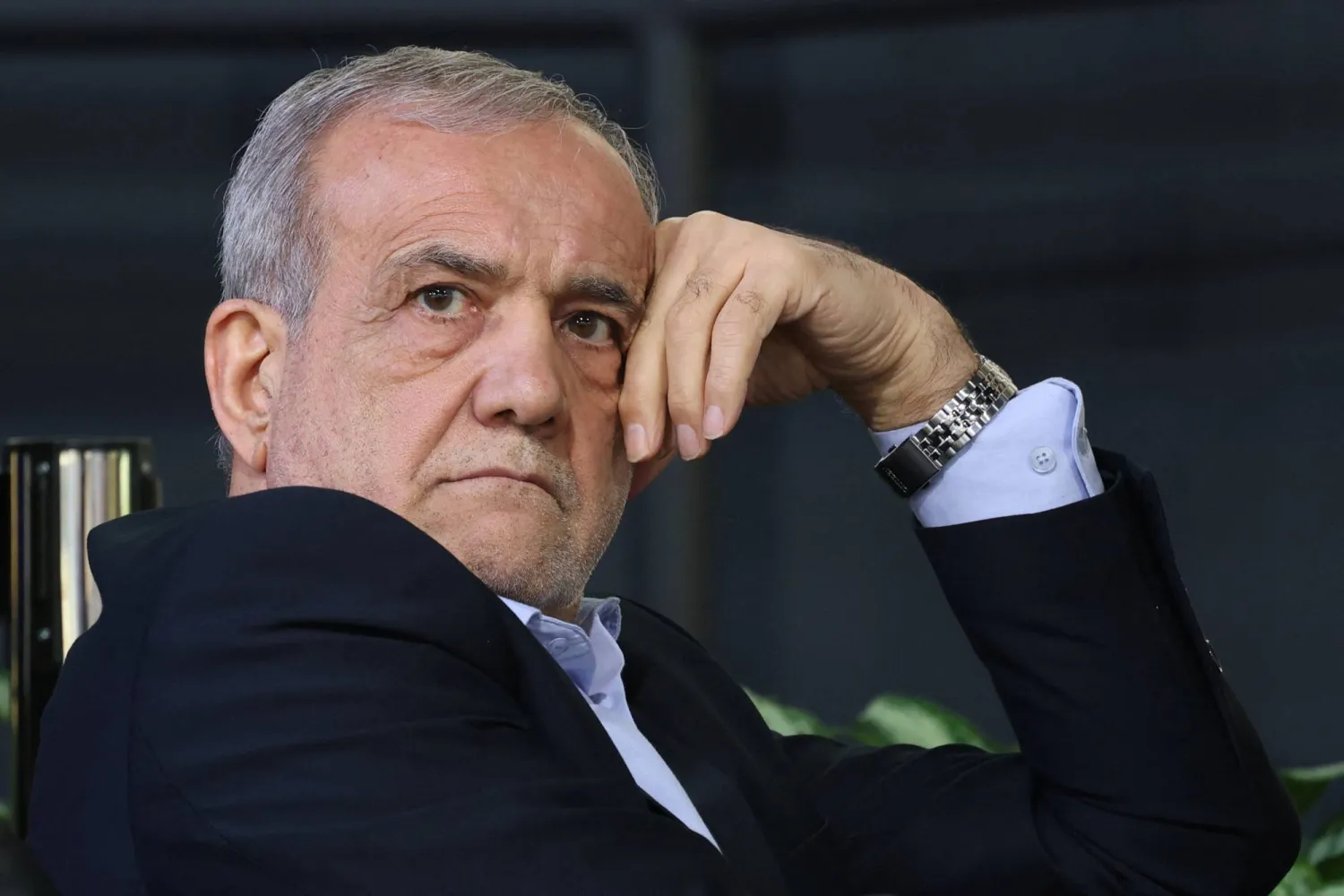
Iranian President Masoud Pezeshkian waits to make a speech during the UN Climate Change Conference (COP31) in Antalya, November 11, 2026. REUTERS/Murad Sezer
TT

Qatari Delegation Visits Tehran, Pezeshkian Admits that Iran Faces Tough Economic War

Iranian President Masoud Pezeshkian waits to make a speech during the UN Climate Change Conference (COP31) in Antalya, November 11, 2026. REUTERS/Murad Sezer

A Qatari delegation held talks in Tehran on Friday night, an Iranian official said, as diplomatic efforts continued to end the war.

Iranian Deputy Foreign Minister Kazem Gharibabadi said Tehran remained in contact with mediators.

"We are in contact with mediators, including the Qataris, both in person and virtually, and are holding ⁠the necessary discussions to see whether another opportunity can be given to diplomacy," Gharibabadi said, according to the semi-official Tasnim news agency.

Gharibabadi echoed remarks by Iranian Foreign Minister Abbas Araghchi in an interview with the state-owned Iran newspaper that Tehran still hoped diplomacy could end its war with the United States.

US President Donald Trump has said Iran wanted a deal, but one that was not acceptable to him.

In an interview published on Saturday by the state-run Iran Daily newspaper, Araghchi reiterated that Tehran would not allow its stockpiles of enriched uranium to leave the country.

"I believe a solution can be found, but we have clear red lines: the material will not be taken out of the country," he said.

Meanwhile, Iranian President Masoud Pezeshkian said on Saturday that Iran is facing a tough economic war.

“We are in a silent war, which is much more difficult than a war in which missiles are launched and destruction is carried out.

“It is an economic war that you, the economic activists, are dealing with, and it is not a simple war,” Pezeshkian told a meeting of investors and producers, according to Iran’s state-run news agency IRNA.