Israel to Give Verdict on Netanyahu in Pivotal Election

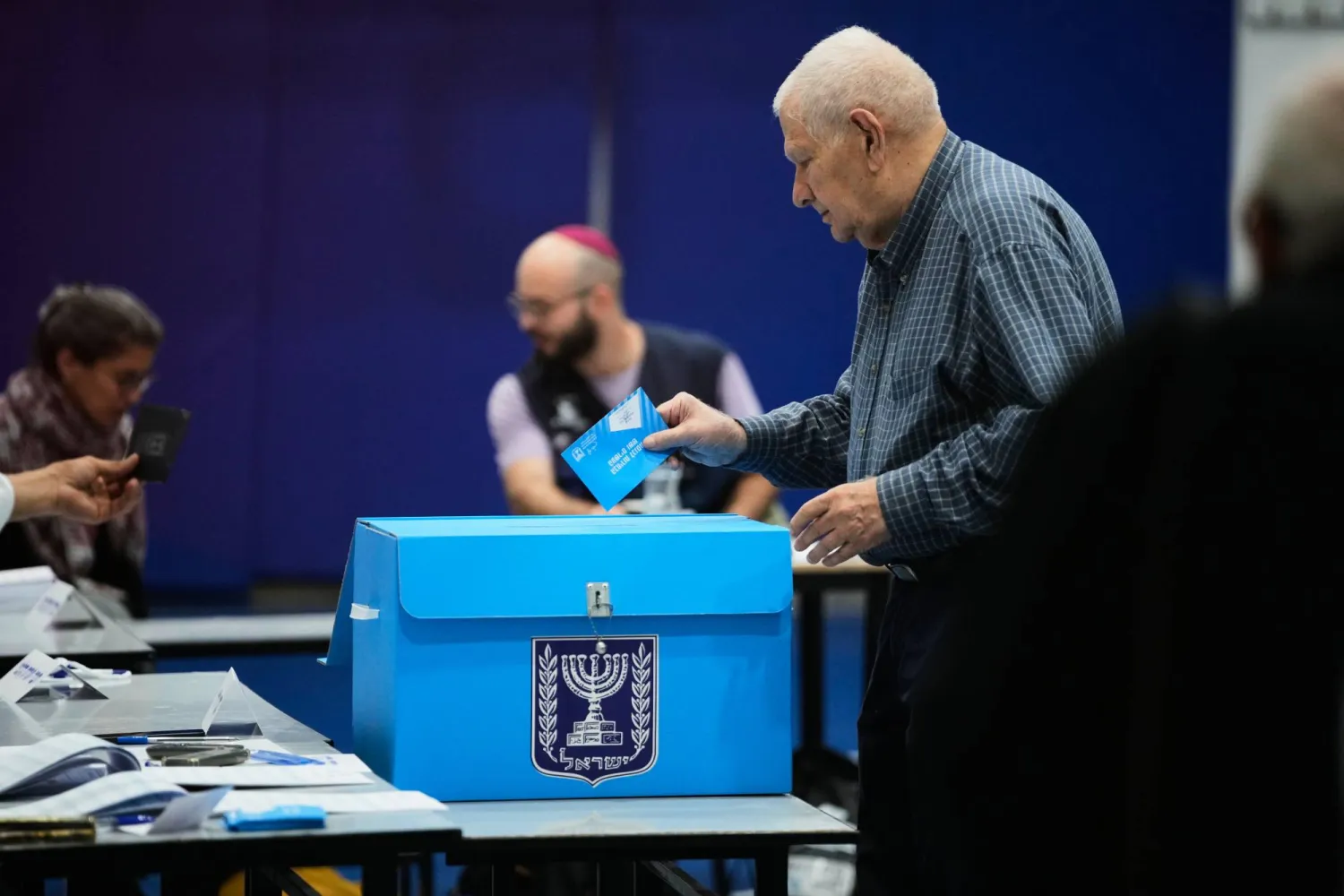
A man casts his ballot at a polling station during Israel's general election in Jerusalem, Tuesday, Oct. 27, 2026. (AP Photo/Ohad Zwigenberg)
TT

Israel to Give Verdict on Netanyahu in Pivotal Election

A man casts his ballot at a polling station during Israel's general election in Jerusalem, Tuesday, Oct. 27, 2026. (AP Photo/Ohad Zwigenberg)

A deeply divided Israel heads to the polls on Tuesday for the first time since Hamas's October 7, 2023 attack, with voters delivering their verdict on veteran Prime Minister Benjamin Netanyahu and the country's rightward drift.

Israelis are casting their ballots in the shadow of three years of multi-front regional wars triggered by October 7, with the trauma still fresh and questions over accountability and security central to the campaign, said AFP.

The close-fought vote comes as Israel looks increasingly isolated on the world stage, driven by a devastating military campaign in Gaza, soaring settlement construction and violence in the occupied West Bank, and a move towards hard-right religious nationalism.

The last polls to be published showed Netanyahu, Israel's longest-serving prime minister, running neck and neck with his main centrist rival Gadi Eisenkot, a political novice and former military chief whose mild manner is seen as the antithesis of the incumbent.

Some 7.3 million people are eligible to vote, with more than half a million young people due to cast their ballot for the first time. Surveys show they overwhelmingly identify as center-right or right-wing.

Tens of thousands of Israelis are estimated to have flown in from abroad to vote in an election seen as crucial to deciding the future character of their country.

"I think this is one of the most important election days in the history of the state of Israel," Uriel Brandler, a 58-year-old real estate agent, told AFP in Jerusalem the day before the vote.

"The country definitely needs a change for the better in every aspect."

Netanyahu, 77, has served as Israel's prime minister on and off for more than 19 years.

The wily political operator focused heavily on his security credentials during his campaign, playing on his relationship with US President Donald Trump and insisting he is the only one who can keep Israelis safe.

In the years since October 7, Netanyahu led multiple wars that have seen Israeli forces reduce Gaza to rubble, occupy southern Lebanon and for the first time pummel arch-foe Iran with US help.

At home, Israelis have faced bombardment from Iran, Hamas, Lebanese militant group Hezbollah, and Yemen's Houthis.

- 'Not afraid to take action' -

Zipporah Bennett, an 85-year-old retiree, said she was voting for Netanyahu "because he has had the experience of navigating the country through a lot of difficult seasons".

"He has the full support of the American government," she said, "and I believe he's a man who's not afraid to take action."

Netanyahu returned to power in December 2022, bringing into his coalition far-right ultra-nationalists who have since seen their political clout skyrocket.

The opposition has scorned the premier for his backing of ultra-Orthodox parties fighting to keep exemptions for religious Jewish students from drafting into the military, which faces personnel shortages.

But one of the biggest criticisms levelled at Netanyahu is his failure to take responsibility for the October 7 attack, the deadliest day in the country's history.

Eisenkot, 66, has pledged to establish an independent state commission of inquiry into the security failures that led to the attack, something Netanyahu's government has resisted.

Seeking to unseat the premier is an informal bloc of parties led by Eisenkot's Yashar and spanning from the right to the center-left.

Eisenkot has vowed to prevent the creation of a Palestinian state and expressed support for Israeli settlements, but has promised to crack down on violent settlers.

Neither Eisenkot nor Netanyahu have publicly said they would partner with the predominantly Arab lists, which represent some 21 percent of Israel's population and who could become kingmakers if the results are as close as expected.

Most polling stations will close at 10:00 pm (2000 GMT).

Final results could take days to trickle in and it is highly unlikely that any single party will come close to the 61 seats needed for a majority in the 120-member parliament.

Cobbling together any coalition could take weeks or months, with possible new elections on the horizon if negotiations fail.


US Forces Ready to Launch Operations Against Iran Within 96 Hours of Trump Order

US Forces Ready to Launch Operations Against Iran Within 96 Hours of Trump Order
TT

US Forces Ready to Launch Operations Against Iran Within 96 Hours of Trump Order

US Forces Ready to Launch Operations Against Iran Within 96 Hours of Trump Order

US forces in the Middle East are prepared to launch new, potentially major, military operations against Iran “within 96 hours of receiving” an order from President Donald Trump, two US officials told CNN on Monday.

Sufficient forces are now deployed in the region to carry out the potential attacks, the sources said.

The scope of new US military operations would likely go beyond efforts to simply “mow the lawn” or maintain the status quo by striking radars, launchers and other Iranian assets that can be quickly reconstituted — as has been the case since Trump halted full combat operations earlier this year, the sources added.

“It will be a big effort,” one of the officials told CNN. That view has been echoed by other current and former US officials familiar with internal military planning discussions — some of whom say it is a question of when, not if, Trump will issue a go-order. They believe it could come any time before the end of the year, though most likely after the US midterm election.

Potential Targets Include Energy, Nuclear Facilities

Iranian forces are now more familiar with US tactics, and it would therefore be harder for the American military to effectively destroy all potential intended targets. However, leaders in US Central Command and the Pentagon have been developing a wide-ranging target list, which includes Iranian energy infrastructure, military sites and nuclear facilities.

Officials say that Trump has not made up his mind on what he will do after the midterms but that he appears to be leaning toward ordering major action. But officials also caution that Trump has appeared in the past to lean toward certain actions only to back off at the last moment.

The White House declined to comment.

A senior Pentagon official told CNN in a statement, “The Department is a planning organization, and its job is to develop and execute military options ordered by the President.”

Recent US intelligence assessments indicate Iran and Houthis are taking the possibility of renewed attacks by the US and potentially Israel very seriously, according to two additional sources familiar with the matter.

If the US and Israel launch new military operations against Iran, Tehran and the Houthis would likely retaliate immediately by targeting American personnel and facilities around the region — and potentially beyond, the sources familiar with those recent US intelligence assessments said.

An unclassified October 23 memo from Director of National Intelligence Jay Clayton to Secretary of State Marco Rubio says US intelligence has found that “Iran has substantially increased efforts to target US personnel” and plotting efforts “have reached advanced stages in both the Middle East and certain other countries,” CNN previously reported.

US intelligence officials believe Iran and the Houthis are unlikely to carry out preemptive escalatory attacks against American personnel or Israel at this point but would not hesitate to respond if Iran is targeted first by US or Israeli forces, one of the sources familiar with the latest American intelligence assessments noted.

Amid these developments, Admiral Brad Cooper, the CENTCOM commander, visited the Strait of Hormuz on Sunday as the US military maintains its blockade on Iranian ports and assists shipping traffic through the critical waterway.

Cooper “observed the current operational environment” while flying over the strait in a helicopter, CENTCOM said, adding that he met with service members who cleared the waterway of Iranian mines.

“We continue to stand shoulder to shoulder with our Gulf partners and the shipping industry,” Cooper said in a news release. “This visit underscores our strong commitment to continued freedom of navigation through the Strait of Hormuz.”

Despite the increase in tankers transiting the strait, oil prices remain high, partly due to the threat of possible Iranian attacks.

One US official acknowledged the status quo around the strait is “untenable” for the long term, and barring a last-minute diplomatic breakthrough, is one reason Trump may turn to military action — despite questions about whether the White House has a broader strategy for ending the conflict.

Netanyahu Pushing For More Strikes

Israeli Prime Minister Benjamin Netanyahu has been pushing to carry out new attacks against Iran, but US officials have requested he delay until the Trump administration is ready to conduct joint operations, according to two US officials and an Israeli security source.

“Netanyahu really wanted and tried to convince Trump for a joint attack in Iran before the elections, and Trump did not give a green light,” the Israeli security source told CNN. The prime minister’s office said this was “fake news.”

Israel was preparing for the possibility of launching additional attacks against Iran in the last week or so and had been lobbying US officials to support and complement those new strikes, a source briefed on the matter told CNN. But senior US officials — including Trump — told Israel to hold off, instead signaling the two countries would launch joint operations soon.

Israel seemed to agree to delaying new strikes on Iran in part because it needs US support for missile defense, the source briefed on the matter added.

Israel Will Not Attack Before Elections

Israeli army chief of staff Eyal Zamir told US General Dan Caine, chairman of the Joint Chiefs, that it would harm the elections in Israel and lead to their postponement, the Israeli security source added.

Israel’s Channel 12 News reported Sunday there was an “unprecedented” confrontation between Zamir and Netanyahu fewer than 48 hours before Tuesday’s vote.

According to the report, Zamir received a directive from the political echelon related to Iran but requested an in-depth discussion and legal authorizations before carrying it out, fearing the action could lead to a miscalculation that could trigger an immediate conflict.

Defense Minister Israel Katz said the report was “completely baseless and false.”

Tehran: Outcome of Israeli Elections ‘Makes No Difference’

Iran's foreign ministry said Monday that the outcome of the Israeli elections in which Netanyahu is facing a tight race will make “no difference.”

“It makes no difference to us who, in these elections, takes the helm of a regime that has brought nothing but violence and massacres to our region,” said ministry spokesman Esmaeil Baqaei in a weekly press briefing.

Tuesday's legislative elections will take place amid mounting threats by Israel and the United States to renew attacks on Iran after they launched their war in late February.

Netanyahu has in recent days repeatedly said the only way to remove the threat posed by Iran is to topple its government.


Israel to Give Verdict on Netanyahu in Pivotal Election

A man casts his ballot at a polling station during Israel's general election in Jerusalem, Tuesday, Oct. 27, 2026. (AP Photo/Ohad Zwigenberg)
TT

Israel to Give Verdict on Netanyahu in Pivotal Election

A man casts his ballot at a polling station during Israel's general election in Jerusalem, Tuesday, Oct. 27, 2026. (AP Photo/Ohad Zwigenberg)

A deeply divided Israel heads to the polls on Tuesday for the first time since Hamas's October 7, 2023 attack, with voters delivering their verdict on veteran Prime Minister Benjamin Netanyahu and the country's rightward drift.

Israelis are casting their ballots in the shadow of three years of multi-front regional wars triggered by October 7, with the trauma still fresh and questions over accountability and security central to the campaign, said AFP.

The close-fought vote comes as Israel looks increasingly isolated on the world stage, driven by a devastating military campaign in Gaza, soaring settlement construction and violence in the occupied West Bank, and a move towards hard-right religious nationalism.

The last polls to be published showed Netanyahu, Israel's longest-serving prime minister, running neck and neck with his main centrist rival Gadi Eisenkot, a political novice and former military chief whose mild manner is seen as the antithesis of the incumbent.

Some 7.3 million people are eligible to vote, with more than half a million young people due to cast their ballot for the first time. Surveys show they overwhelmingly identify as center-right or right-wing.

Tens of thousands of Israelis are estimated to have flown in from abroad to vote in an election seen as crucial to deciding the future character of their country.

"I think this is one of the most important election days in the history of the state of Israel," Uriel Brandler, a 58-year-old real estate agent, told AFP in Jerusalem the day before the vote.

"The country definitely needs a change for the better in every aspect."

Netanyahu, 77, has served as Israel's prime minister on and off for more than 19 years.

The wily political operator focused heavily on his security credentials during his campaign, playing on his relationship with US President Donald Trump and insisting he is the only one who can keep Israelis safe.

In the years since October 7, Netanyahu led multiple wars that have seen Israeli forces reduce Gaza to rubble, occupy southern Lebanon and for the first time pummel arch-foe Iran with US help.

At home, Israelis have faced bombardment from Iran, Hamas, Lebanese militant group Hezbollah, and Yemen's Houthis.

- 'Not afraid to take action' -

Zipporah Bennett, an 85-year-old retiree, said she was voting for Netanyahu "because he has had the experience of navigating the country through a lot of difficult seasons".

"He has the full support of the American government," she said, "and I believe he's a man who's not afraid to take action."

Netanyahu returned to power in December 2022, bringing into his coalition far-right ultra-nationalists who have since seen their political clout skyrocket.

The opposition has scorned the premier for his backing of ultra-Orthodox parties fighting to keep exemptions for religious Jewish students from drafting into the military, which faces personnel shortages.

But one of the biggest criticisms levelled at Netanyahu is his failure to take responsibility for the October 7 attack, the deadliest day in the country's history.

Eisenkot, 66, has pledged to establish an independent state commission of inquiry into the security failures that led to the attack, something Netanyahu's government has resisted.

Seeking to unseat the premier is an informal bloc of parties led by Eisenkot's Yashar and spanning from the right to the center-left.

Eisenkot has vowed to prevent the creation of a Palestinian state and expressed support for Israeli settlements, but has promised to crack down on violent settlers.

Neither Eisenkot nor Netanyahu have publicly said they would partner with the predominantly Arab lists, which represent some 21 percent of Israel's population and who could become kingmakers if the results are as close as expected.

Most polling stations will close at 10:00 pm (2000 GMT).

Final results could take days to trickle in and it is highly unlikely that any single party will come close to the 61 seats needed for a majority in the 120-member parliament.

Cobbling together any coalition could take weeks or months, with possible new elections on the horizon if negotiations fail.


Algeria to Deploy Army Units to Niger to Protect Energy and Economic Interests

 People walk past Algerian flags outside the parliament building in Algeria, Sunday, Oct. 25, 2026. (AP)
People walk past Algerian flags outside the parliament building in Algeria, Sunday, Oct. 25, 2026. (AP)
TT

Algeria to Deploy Army Units to Niger to Protect Energy and Economic Interests

 People walk past Algerian flags outside the parliament building in Algeria, Sunday, Oct. 25, 2026. (AP)
People walk past Algerian flags outside the parliament building in Algeria, Sunday, Oct. 25, 2026. (AP)

Algeria will send army units to Niger to protect energy and economic interests, according to a statement from the presidency on Monday, marking Algeria's first foreign troop deployment since it sent forces to support Egypt in the 1973 war.

Algeria's parliament approved a resolution on Sunday authorizing ‌the deployment ‌of National Army units ‌to ⁠Madama in northern Niger, near ⁠the Libyan border.

The presidential statement did not say when the troops will be sent or how many there would be.

Military officers have ruled Niger, a nation rich ⁠in uranium, oil and gold resources, ‌since the ‌July 2023 coup that ousted President Mohamed Bazoum, ‌which Algeria opposed.

Relations worsened last ‌year, when Niger recalled its ambassador from Algiers after Algeria shot down a Malian drone near their border.

Algeria's interests in Niger ‌are mainly in energy. Its state-run Sonatrach is working with ⁠Niger ⁠and Nigeria on the Trans-Saharan Gas Pipeline, which is intended to create a new export corridor for African gas to international markets, particularly Europe.

Niger is battling insurgents linked to al-Qaeda and ISIS. The fighting has killed thousands and displaced millions across West Africa's central Sahel region over the past decade.