Israel President Urges Against New Vote Despite Inconclusive Result

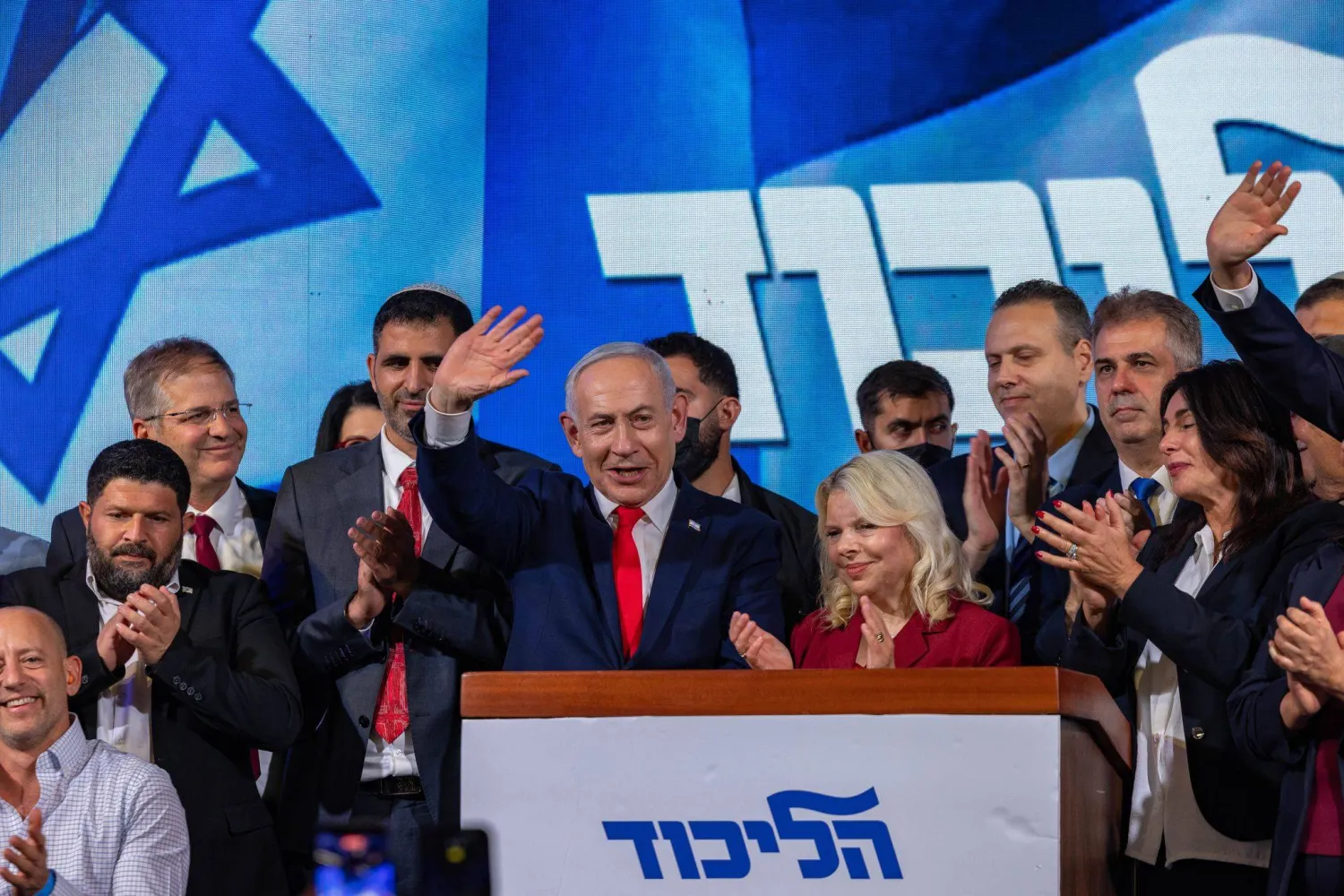
28 October 2026, Israel, Jerusalem: Israeli Prime Minister and Likud party leader Benjamin Netanyahu (C) speaks to supporters at the Likud party's election-night event at the International Convention Center in Teddy Hall, following the release of the exit poll results in Israel's legislative election. (dpa)
TT

Israel President Urges Against New Vote Despite Inconclusive Result

28 October 2026, Israel, Jerusalem: Israeli Prime Minister and Likud party leader Benjamin Netanyahu (C) speaks to supporters at the Likud party's election-night event at the International Convention Center in Teddy Hall, following the release of the exit poll results in Israel's legislative election. (dpa)

Israel's president voiced hope Wednesday for avoiding a second election after a hard-fought vote produced no clear winner, leaving Prime Minister Benjamin Netanyahu and the opposition scrambling for options and making Israeli Arab parties possible kingmakers. 

With more than 85 percent of ballots counted, Netanyahu's right-wing bloc was slightly ahead but still short of a majority after Tuesday's election, the first since the October 7, 2023 attack that led Israel to wage war in Gaza and across the region. 

Both Netanyahu, Israel's longest-serving prime minister who is allied with far-right and ultra-Orthodox Jewish parties, and Gadi Eisenkot, a former military chief leading a broad opposition bloc, said they would seek to form the next government. 

But neither looks set to reach the 61-seat threshold, with Netanyahu's bloc projected to win 53 of the 120 seats in parliament and Eisenkot's opposition set for 48. 

The final results could still change, but one group which made clear gains was Israeli Arabs, whose seats were set to jump to 19. 

"We must do everything we can, certainly after yesterday, to avoid another round of elections," said President Isaac Herzog, who is tasked with determining which candidate to tap to form a government, urging parties to keep "an open mind". 

- 'Have to talk to us' - 

Yousef Jabareen, head of the leftist Arab-majority Joint List, said the Israeli public had voted for new leadership and "anyone who wants to offer a substantive and genuine alternative to Netanyahu's blood-soaked government will have to talk to us". 

He later told AFP, however, that while he was willing to cooperate with an opposition-led government to unseat Netanyahu, he was not open to joining such a coalition outright. 

"We do not see the possibility of being part of an Israeli government coalition under the current political circumstances, particularly given the ongoing war in Gaza, the settlements in the West Bank" and other issues, he said. 

The ad hoc support of Arab lawmakers could enable Eisenkot to maintain a minority government, although few observers believe such an arrangement would survive for long. 

Arab voters, descendants of Palestinians who stayed after Israel's creation and who make up around 20 percent of the population, turned out in unprecedented numbers for Tuesday's vote, enraged by the Netanyahu government's ultra-nationalist Jewish vision for the country and the Palestinian territories. 

Netanyahu during the campaign relentlessly stoked fears of Arabs in power to motivate his base, and his Likud party on Wednesday accused the Arab lists of having "stolen" the election. 

It alleged "corruption, threats, violence, falsehoods and the use of prohibited software" to encourage voter turnout. It did not share evidence but said it would share it with authorities. 

Eisenkot and most of his allies have resisted partnering with Arab lawmakers. 

But Yair Golan, the head of Israel's main left-wing party and a member of Eisenkot's camp, became its first to call for such an alliance. 

"We must no longer accept Netanyahu's racist division between Jewish votes and Arab votes," Golan said on social media. 

- Iran conflict - 

A lack of a clear majority for either camp could mean weeks spent trying to cobble together coalitions, with new elections a possibility if negotiations fail. 

"Maybe everybody lost in these elections but the Arab parties. And for the Arab parties, it's unclear that they can make use of their huge success," Hebrew University of Jerusalem political scientist Gideon Rahat said. 

A stalemate could in the immediate term benefit Netanyahu, who would remain caretaker prime minister until a new government is formed. 

Both Netanyahu and Eisenkot appeared to indicate another factor was on the horizon: an Israeli attack alongside the United States on Iran. 

Netanyahu has ordered two campaigns against Iran, reluctantly stopping the most recent only after US President Donald Trump reached a now-defunct ceasefire. 

In the days leading up to the election, Netanyahu repeatedly called for the overthrow of Iran's government. News reports, which Netanyahu denied, said military top brass pushed back on his plans for pre-election action. 

Trump has said that the United States is no longer negotiating with Iran but will not attack until after next Tuesday's US midterm elections. 

Speaking at a rally, Netanyahu said that Israel had a "unique opportunity" with Trump to "forever eliminate the existential threat of Iran". 

Eisenkot in a post-election appearance warned Israel's security chiefs not to let Netanyahu put his political survival over the national interest. 

"Netanyahu, don't you dare use Israel's security for your political needs," he said. 

Defense Minister Israel Katz lashed out at the remarks on Wednesday, calling them "an anti-democratic statement detached from reality". 

All eyes will now be on Herzog, who has reportedly supported a unity government, which could take on more urgency if Netanyahu attacks Iran, although Eisenkot has publicly ruled out serving with him. 


Iran Shadows Washington’s Moves in Lebanon as Visits, Calls Fuel Race for Influence

Ali Larijani, former senior adviser to Khamenei, with Lebanese Parliament Speaker Nabih Berri (File photo: Lebanese Parliament Media Office)
TT

Iran Shadows Washington’s Moves in Lebanon as Visits, Calls Fuel Race for Influence

Ali Larijani, former senior adviser to Khamenei, with Lebanese Parliament Speaker Nabih Berri (File photo: Lebanese Parliament Media Office)

Iran is keeping a close watch on Washington's moves in Lebanon and moving swiftly to counter them.

From dispatching senior officials to Beirut to calling Parliament Speaker Nabih Berri directly, Tehran has repeatedly sought to match or respond to US diplomatic initiatives in a contest for influence over Lebanese decision-making.

The message, according to the pattern of Iranian moves, is clear: Tehran will not let Washington dictate Lebanon's next chapter alone.

"Every time a US official visits Beirut, an Iranian official follows, even when there is nothing to discuss," a former Lebanese prime minister told Asharq Al-Awsat.

The pattern has become more pronounced in recent years, particularly since the 2024 war, the former premier said.

Ministerial sources said Iranian envoys typically follow US diplomatic moves with visits and meetings, particularly with Tehran's Lebanese allies, to gauge Washington's latest positions and learn what was discussed behind closed doors.

The contacts are also part of an exchange of political messages between Tehran and Washington, the sources told Asharq Al-Awsat.

Iran, they said, wants to show that it still holds the Lebanese card — and retains the leverage to shape political settlements.

The pattern was particularly evident in the autumn of 2024, as international efforts, led largely by Washington, intensified to halt Israel's war on Lebanon.

Iranian Foreign Minister Abbas Araghchi visited Beirut on Oct. 4. A week later, Iranian Parliament Speaker Mohammad Baqer Qalibaf arrived, saying he had diverted his trip to Switzerland to deliver a "message of support" from then-Supreme Leader Ali Khamenei.

The diplomatic maneuvering continued in November as a US ceasefire initiative gained ground.

On Nov. 14, US Ambassador Lisa Johnson handed Berri a draft of Washington's ceasefire proposal.

The following day, Ali Larijani, then an adviser to Iran's supreme leader, arrived in Beirut for talks with Berri and then-Prime Minister Najib Mikati.

He declared Iran's support for "any decision Lebanon makes to achieve a ceasefire."

Tehran's Familiar Playbook

Former Lebanese minister Boutros Harb sees little new in Tehran's approach.

Iran, he said, has long treated Lebanese groups aligned with it as subordinates, speaking and negotiating on their behalf rather than allowing Lebanon to pursue an independent negotiating position based on its national interests.

But the stakes are now higher, Harb told Asharq Al-Awsat.

Lebanon has an opportunity to capitalize on international diplomatic efforts, he said, while Iran is working to prevent the Lebanese file from being separated from its own negotiations with Washington.

Tehran wants to keep that card in hand to demonstrate that it remains an influential regional player, he added.

"Tehran treats Lebanon as an Iranian province, as though there were no state or government," Harb said.

He acknowledged that Lebanon's political landscape had changed to some extent under President Joseph Aoun and Prime Minister Nawaf Salam.

"But unfortunately, the card is still in Iran's hands, and it is exploiting it to preserve its regional role," he said.

Lebanon Tied to US-Iran Talks

By 2026, Tehran's diplomatic push had increasingly shifted from visits to telephone calls carrying political messages tied to negotiations with Washington.

The shift became particularly apparent after Iran announced that it had told mediators any ceasefire agreement with the United States and Israel must also halt Israeli attacks on Lebanon.

On April 1, Berri said Araghchi had conveyed Iran's insistence that any agreement include Lebanon.

"What applies to Tehran applies to Beirut," Berri quoted the Iranian foreign minister as saying.

The pattern resurfaced on July 9, when a US diplomatic move in Beirut coincided with a visit by an Iranian delegation led by Deputy Foreign Minister Vahid Jalalzadeh.

While US Ambassador Michel Issa met Aoun to discuss implementation of the Lebanese-Israeli framework agreement, the Iranian delegation held talks with Berri and Deputy Prime Minister Tarek Mitri.

The latest episode came on Nov. 16, following a Beirut visit by US Ambassador to the United Nations Mike Waltz.

Waltz met Lebanon's president, prime minister and parliament speaker and urged Hezbollah to voluntarily hand over its weapons to the state.

"No country can have two armies," he said.

That same day, Qalibaf called Berri, stressing Iran's "special interest" in Lebanon.

Regional calm, he said, could not return without an end to the war in Lebanon and the restoration of Lebanese sovereignty over all its territory.

Hezbollah's Weapons: Another Front

Iran's response to US moves has not been confined to ceasefire diplomacy.

The same pattern emerged in August 2025, when Lebanon's government decided to draw up a plan to bring all weapons under state control, amid US pressure to carry it out.

On Aug. 13, Ali Larijani, then secretary of Iran's Supreme National Security Council, visited Beirut and met Lebanon's president, prime minister and parliament speaker.

He opposed foreign pressure over Hezbollah's weapons, calling instead for "dialogue among the Lebanese" and warning against imposing "foreign dictates on Lebanon."

Five days later, US envoy Tom Barrack and deputy US envoy Morgan Ortagus arrived in Beirut to follow up on Washington's roadmap for placing weapons exclusively under state control and to discuss security issues.


Turkish Court Hands New Sentence and Political Ban to Jailed Istanbul Mayor, Media Says

Istanbul Mayor Ekrem Imamoglu greets his supporters as they gather in front of his office as a Turkish court sentenced Imamoglu to more than two years in prison and imposed a political ban for insulting public officials, in Istanbul, Türkiye, December 14, 2022. (Reuters)
TT

Turkish Court Hands New Sentence and Political Ban to Jailed Istanbul Mayor, Media Says

Istanbul Mayor Ekrem Imamoglu greets his supporters as they gather in front of his office as a Turkish court sentenced Imamoglu to more than two years in prison and imposed a political ban for insulting public officials, in Istanbul, Türkiye, December 14, 2022. (Reuters)

A ‌Turkish court on Wednesday sentenced jailed Istanbul mayor Ekrem Imamoglu to a further two years in prison for violating the election law and imposed a new political ban on him, local media reported.

Imamoglu was one of nine defendants sentenced to two years and one month in prison in a ‌case concerning ‌the opposition Republican People's Party's (CHP) ‌convention ⁠in November 2023, state ⁠broadcaster TRT Haber said.

CNN Turk and other media reported that the court imposed a political ban on Imamoglu, who before his arrest was seen as the main potential ⁠challenger to President Recep Tayyip Erdogan.

The defendants were ‌accused of making improper inducements to encourage ‌people to vote for Ozgur Ozel ‌when the CHP elected him as leader at the 2023 congress. They denied the allegations.

Courts previously imposed political bans ‌on Imamoglu in 2022 and 2025 and sentenced him to more ⁠than ⁠six years in prison. He is appealing against both of the earlier bans.

Imamoglu was previously convicted in several other cases and went on trial in March in a sweeping corruption trial of more than 400 defendants linked to the Istanbul municipality. He denies the corruption charges, which carry prison sentences amounting to hundreds of years.


US Tightens Iran Blockade with Curbs on Oil Transfers at Sea, Advisory Shows

Container ships are seen through haze in the Strait of Hormuz off Bandar Abbas, Iran, Saturday, Nov. 14, 2026. (Amirhosein Khorgooi/ISNA via AP)
TT

US Tightens Iran Blockade with Curbs on Oil Transfers at Sea, Advisory Shows

Container ships are seen through haze in the Strait of Hormuz off Bandar Abbas, Iran, Saturday, Nov. 14, 2026. (Amirhosein Khorgooi/ISNA via AP)

The US ‌military will treat ships that receive cargo at sea from vessels loaded in Iran as attempting to evade its blockade of Iranian ports and could take action against them, according to an advisory issued by US Central Command (CENTCOM) on Wednesday.

The US naval blockade on Iran-related oil exports was first imposed on April 13 ‌and lifted ‌in June after Washington ‌reached a ⁠draft understanding with ⁠Tehran. It was reimposed on July 14 after the agreement collapsed.

"Any ship that receives cargo via a ship-to-ship transfer with a vessel subject to the blockade and carrying cargo loaded at an Iranian ⁠port or coastline may be ‌considered to ‌be evading the blockade, even if it has not ‌entered Iranian ports or the Iranian ‌coastline," CENTCOM said in an update.

"Such ships may be stopped, boarded, diverted, captured, or directed to proceed to the Iranian port where ‌the cargo originated."

Ships that fail to comply immediately with lawful orders from ⁠blockade ⁠or boarding forces could face enforcement action, "including the use of force consistent with applicable law", the advisory added.

Iran has managed to export some liquefied petroleum gas and jet fuel since July, despite the US naval blockade, according to shipping intelligence and security sources who spoke to Reuters in October.

Iran's crude exports, however, have remained near a standstill for months, shipping sources say.