Grossi: No Signs Iran Tried to Repair Nuclear Facilities Damaged in US Strikeshttps://english.aawsat.com/world/5334534-grossi-no-signs-iran-tried-repair-nuclear-facilities-damaged-us-strikes
Grossi: No Signs Iran Tried to Repair Nuclear Facilities Damaged in US Strikes
Candidate for the position of United Nations secretary-general, Rafael Mariano Grossi speaks during the "UN Town Hall: The Next Secretary-General" event at United Nations headquarters in New York City, US, July 23, 2026. REUTERS/Eduardo Munoz
The head of the UN nuclear agency said Tuesday there has been no indication Iran has tried to repair or reconstruct its nuclear facilities damaged in US and Israeli military strikes this year or last year.
President Donald Trump has said one of the major reasons the US went to war with Iran on February 28 was to deny Tehran the ability to develop nuclear weapons, even as he has insisted that strikes the US carried out on Iranian nuclear sites in June 2025 “obliterated” the country’s atomic program.
During a UN Security Council meeting, International Atomic Energy Agency chief Rafael Grossi urged Iran to give inspectors access to all nuclear sites, including those damaged in the military attacks.
The IAEA has not been able to verify the status of Iran’s stockpile of near weapons-grade uranium since the US bombed its sites last year.
However, Grossi said that “since June 2025, we have not identified any activity to repair or reconstruct any of the facilities damaged in the military attacks of 2025 and 2026.”
Trump has consistently downplayed the economic impact of the Iran war, which has emerged as a liability for Republicans heading into next week’s midterm elections, and has argued that higher fuel prices are worth paying to prevent a nuclear-armed Iran.
The White House didn’t immediately respond Tuesday evening to a request for comment on Grossi’s remarks.
Iran maintains that its nuclear program is peaceful. However, the IAEA says the country has a stockpile of 440.9 kilograms of uranium enriched up to 60% purity — a short, technical step away from weapons-grade levels of 90%.
What’s Ahead as Votes Are Counted in an Israeli Election with No Clear Winnerhttps://english.aawsat.com/world/5334567-what%E2%80%99s-ahead-votes-are-counted-israeli-election-no-clear-winner
Supporters of the Yashar party of the former Israeli military chief Gadi Eisenkot react to the first exit polls, in Tel Aviv, Israel, 27 October 2026. (EPA)
TT
TT
What’s Ahead as Votes Are Counted in an Israeli Election with No Clear Winner
Supporters of the Yashar party of the former Israeli military chief Gadi Eisenkot react to the first exit polls, in Tel Aviv, Israel, 27 October 2026. (EPA)
Israelis appear to have handed a rebuke to Prime Minister Benjamin Netanyahu in national elections, but what’s next is uncertain as exit polls suggest there's no clear winner and no obvious path to a governing majority.
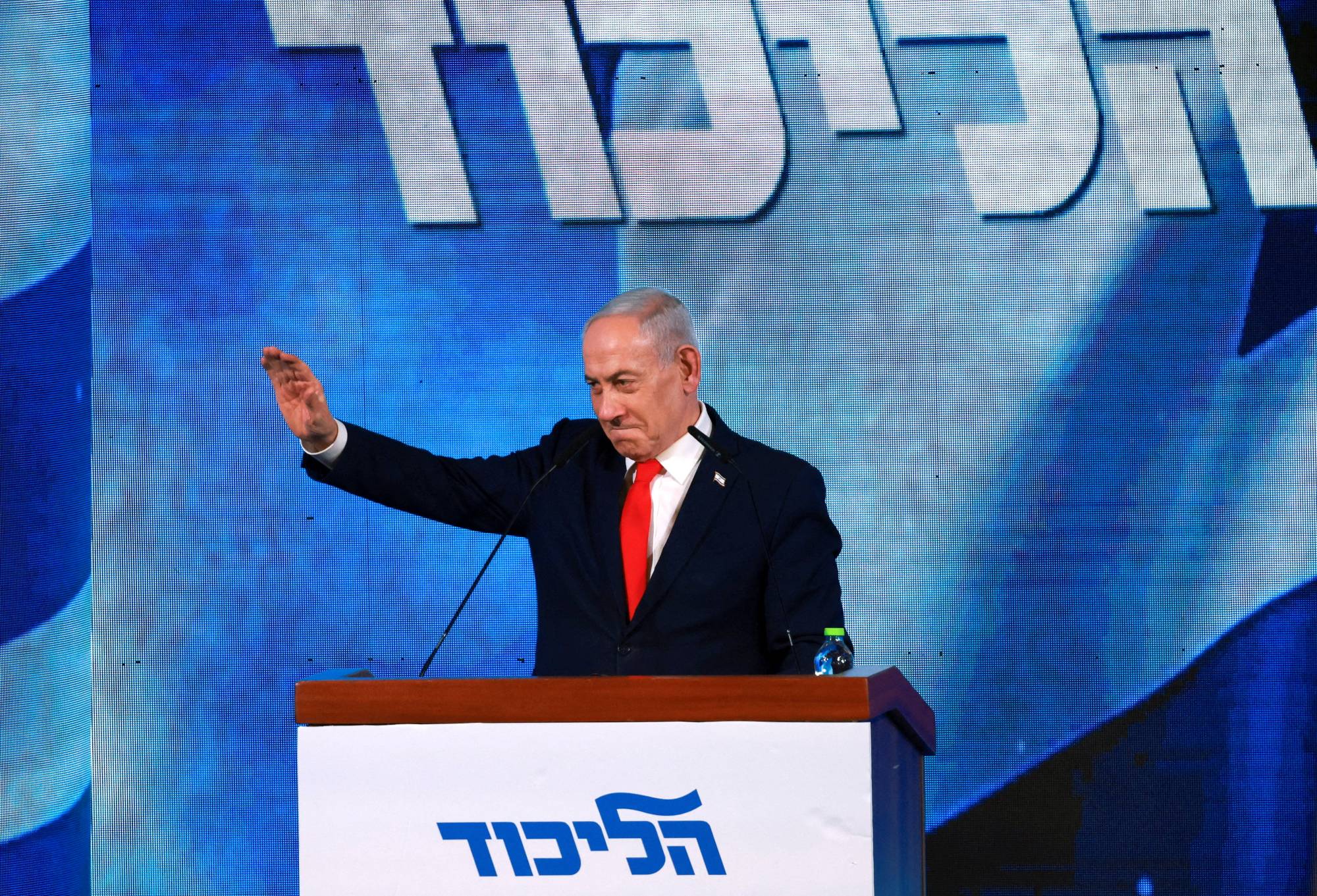
The election was widely seen as a referendum on Netanyahu, the country’s longest-serving prime minister, who gave a defiant speech to his supporters just after 3 a.m. on Wednesday in Jerusalem.
His party, Likud, appears to have gotten the most votes. But the exit polls by major Israeli TV stations indicate that support for his religious-national coalition dropped significantly.
The exit polls suggested his opponents — led by Netanyahu’s chief rival, Gadi Eisenkot, who also rallied exuberant supporters in Tel Aviv early on Wednesday — could secure a solid majority in the next parliament. But whether those disparate parties, which include Arab-led parties, can form a government is uncertain. It would likely take weeks of haggling or possibly new elections.
Here are some key points to know on Wednesday morning, hours after the polls closed in Israel.
Exit polls suggest no clear winner and complex power-jockeying ahead
In Israel, voters choose not individuals but parties. Since no party has ever captured a parliamentary majority on its own, party leaders must agree to come together in a governing coalition.
Exit polls indicate that Netanyahu's bloc of supporters won about 51 seats in parliament, approximately the same as the bloc led by Eisenkot, a former military chief of staff. That would leave each side well below the 61 seats needed to form a government with a parliamentary majority.
The exit polls suggested that Arab-led parties captured the remaining 19 seats.
Israeli Prime Minister and Likud party leader Benjamin Netanyahu gestures after exit polls, at his party headquarters during Israel's national election, in Jerusalem, October 28, 2026. (Reuters)
With just under a third of the ballots counted early on Wednesday morning, Israel’s Central Elections Committee reported 22.02% of the vote went to Likud, the party led by Netanyahu, and 15.46% to Eisenkot's Yashar party. The count does not indicate how many seats each party will win in the parliament.
Arab parties could play a key role in next coalition
Final official results aren't expected until later this week and they may vary from the exit polls, which, like all surveys, are subject to potential error.
If the Arab parties do as well as the exit polls suggest, they could play a decisive role in selecting Israel's next prime minister.
In his election night speech, Netanyahu repeated his refusal to create a government relying on Arab parties. Eisenkot has signaled he is ready to work with them under certain conditions, but that could risk alienating some of his partners.
Campaigns gave short shrift to Palestinian issues
Israelis are largely opposed to a Palestinian state. No major candidate advocated a return to the long-moribund peace process.
Even Mansour Abbas, a Palestinian Arab politician who leads Ra’am, the first Arab-led party to join a governing coalition in 2021, focused his campaign on concerns about crime in Arab communities.
As exit polls were shown on a screen at an Abbas election night event in Sakhnin, an Arab city in northern Israel, supporters of the small Arab-led party Ra’am erupted in celebration.
Enduring impact of Oct. 7 attacks
This election was held against the background of the enduring trauma of the Hamas-led attack on Oct. 7, 2023, when fighters killed 1,200 people, mostly civilians, and abducted 251 others, and the ensuing wars in Gaza and beyond.
The deadliest day in Israel’s history featured prominently in the campaigns. Israelis have focused on the security failures surrounding Oct. 7 and the enormous burden on their society, rather than on the humanitarian situation in war-devastated Gaza.
Leader of the Yashar party and former Israeli military chief, Gadi Eisenkot, celebrates with supporters the first election results, Tel Aviv, 27 October 2026. (EPA)
Netanyahu has rejected an investigation into Oct. 7 and blamed the army for the failures that day. His supporters say he led the country back from that difficult day and scored important achievements in wars in Gaza, Lebanon and Iran.
Netanyahu’s opponents said he should be held accountable for the security failures that occurred on his watch and have demanded a commission of inquiry.
Religious divide over military service
The country has also been deeply divided by exemptions from military service granted to ultra-Orthodox males. These exemptions are especially contentious after three years of wars.
Netanyahu’s governing coalitions have long relied on ultra-Orthodox Jewish parties that have demanded these exemptions remain in place.
Eisenkot — who lost his son and two nephews to combat in Gaza — has vowed to end the de facto exemptions. He repeated that promise speaking to supporters on Wednesday morning.
The exit polls, which also indicated a drop in support for ultra-Orthodox parties, signaled voter unhappiness over these exemptions.
High voter turnout
The final update from Israel’s Central Elections Committee put voter turnout at 77.7% of eligible voters as polls closed Tuesday night.
That’s the highest turnout since 1999, and just over seven percentage points higher than in the previous election in 2022, reflecting the high stakes of the election.
Cyclone Arnab Hits India’s Andhra Pradesh State as Tens of Thousands Are Evacuatedhttps://english.aawsat.com/world/5334555-cyclone-arnab-hits-india%E2%80%99s-andhra-pradesh-state-tens-thousands-are-evacuated
A vehicle damaged by a fallen tree following Cyclone Arnab, in Visakhapatnam, Andhra Pradesh, India, October 28, 2026. (Reuters)
TT
TT
Cyclone Arnab Hits India’s Andhra Pradesh State as Tens of Thousands Are Evacuated
A vehicle damaged by a fallen tree following Cyclone Arnab, in Visakhapatnam, Andhra Pradesh, India, October 28, 2026. (Reuters)
Cyclone Arnab dumped heavy rain across India ’s eastern Andhra Pradesh state and caused extensive damage in some areas Wednesday after tens of thousands of people were evacuated from vulnerable coastal areas.
Prakhar Jain, head of the state’s disaster management authority, said the cyclone had weakened slightly before landfall earlier in the day but brought heavy to very heavy rainfall to several coastal districts, triggering widespread disruption in affected areas. No casualties were reported and damage was being assessed.
State disaster management officials said late Wednesday morning that wind speeds were up to 135 kph (84 mph).
Officials said the cyclone was expected to weaken further as it moved inland, with wind speeds likely to ease later in the day.
The cyclone left a trail of destruction across the state’s fertile Konaseema district, which officials said was the worst hit so far.
Banana and coconut plantations suffered extensively and a large number of trees and electricity poles were uprooted, disrupting electricity across the district, officials said.
Fallen trees blocked several roads, and disaster management workers rushed to clear roads and restore connectivity. About 6,000 electric poles were uprooted in Konaseema alone, officials said.
The India Meteorological Department said the landfall process was complete and heavy rainfall as well as strong winds would continue under the cyclone's influence in coastal areas of Andhra Pradesh and parts of southern Odisha state. The rainfall flooded several low-lying areas of the port city of Visakhapatnam.
Cyclone Arnab weakened to a "severe" cyclonic storm Wednesday, the department said in an update.
Arnab’s outer bands began lashing parts of the Andhra Pradesh coast first late Tuesday as the storm intensified over the Bay of Bengal and moved toward an earlier-than-expected landfall.
Authorities began evacuating people from low-lying and flood-prone areas ahead of the cyclone's landfall. They also canceled some train services as heavy rain and gusty winds started lashing parts of the coast. At least 89,000 people were evacuated in Andhra Pradesh, according to an official statement.
The state’s disaster management authority said more than 12 million people live along the cyclone’s expected path.
Authorities set up over 2,000 cyclone shelters across 20 districts, while emergency alerts were being sent to the mobile phones of millions of residents, Jain said, according to the Press Trust of India news agency. More than 30,000 fishing boats were secured along the coast, while nearly 1,100 medical teams were deployed across affected areas to provide emergency assistance, he added.
In neighboring Odisha, officials planned to evacuate about 48,000 people from areas likely to be affected by the storm.
Hegseth Proposes ‘Ambitious’ US-ASEAN Defense Framework at Philippine Summithttps://english.aawsat.com/world/5334552-hegseth-proposes-%E2%80%98ambitious%E2%80%99-us-asean-defense-framework-philippine-summit
US Defense Secretary Pete Hegseth attends the Association of Southeast Asian Nations (ASEAN) Defense Ministers' Informal Meeting in Cebu, central Philippines, Wednesday, Oct. 28, 2026. (Jam Sta Rosa/Pool Photo via AP)
TT
TT
Hegseth Proposes ‘Ambitious’ US-ASEAN Defense Framework at Philippine Summit
US Defense Secretary Pete Hegseth attends the Association of Southeast Asian Nations (ASEAN) Defense Ministers' Informal Meeting in Cebu, central Philippines, Wednesday, Oct. 28, 2026. (Jam Sta Rosa/Pool Photo via AP)
US Defense Secretary Pete Hegseth proposed the creation of an "ambitious" new US-ASEAN defense framework on Wednesday, telling the bloc's leaders it could help them navigate "critically important" years ahead.
The United States has been seeking to boost its regional defense partnerships in recent years, citing the need to uphold what it terms a "free and open Indo-Pacific" as China has increasingly flexed its muscles in the region.
Hegseth, speaking before a meeting with defense chiefs from the Association of Southeast Asian Nations in Cebu, praised what he called the region's "pragmatism" and "proud nationalism".
"We're not going to agree on everything, nor do we need to," he said, calling for cooperation where shared interests overlap.
"As we look to the future in this region, I'd like us to be even more ambitious... we propose that we work together to develop a US-ASEAN Framework for Defense Cooperation," Hegseth said, without offering details.
"A practical framework that guides our cooperation over the next several years. I will note a critically important next several years."
He added that the United States was ready to begin the project as Singapore assumes the chairmanship of the ASEAN Defense Ministers' Meeting (ADMM)-Plus in the coming year.
The grouping includes not only the bloc's 11 member states but representatives from the United States, Japan, China, Australia and others.
Hegseth also called for the strengthening of "maritime domain awareness" and advanced cooperation among naval forces.
"These are not symbolic things; they are concrete demonstrations of what serious partners do, serious partners train together, learn together, plan together, and build the confidence and competence necessary to prevent conflict," he said.
US ally the Philippines has been engaged in years of confrontations with China over disputed areas of the South China Sea.
China's military and coast guard presence in contested areas of the critical waterway nearly doubled in September, Manila said this month.
Japanese defense chief Shinjiro Koizumi met Hegseth earlier on the sidelines of the Cebu event, where they discussed the need to implement "an effective denial defense in the First Island Chain", a reference to islands that lie between China and the open Pacific.
The two allies also committed to continued "close coordination" on munitions production.
لم تشترك بعد
انشئ حساباً خاصاً بك لتحصل على أخبار مخصصة لك ولتتمتع بخاصية حفظ المقالات وتتلقى نشراتنا البريدية المتنوعة