


Data Center Next Door Divides Old Massachusetts Mill Town

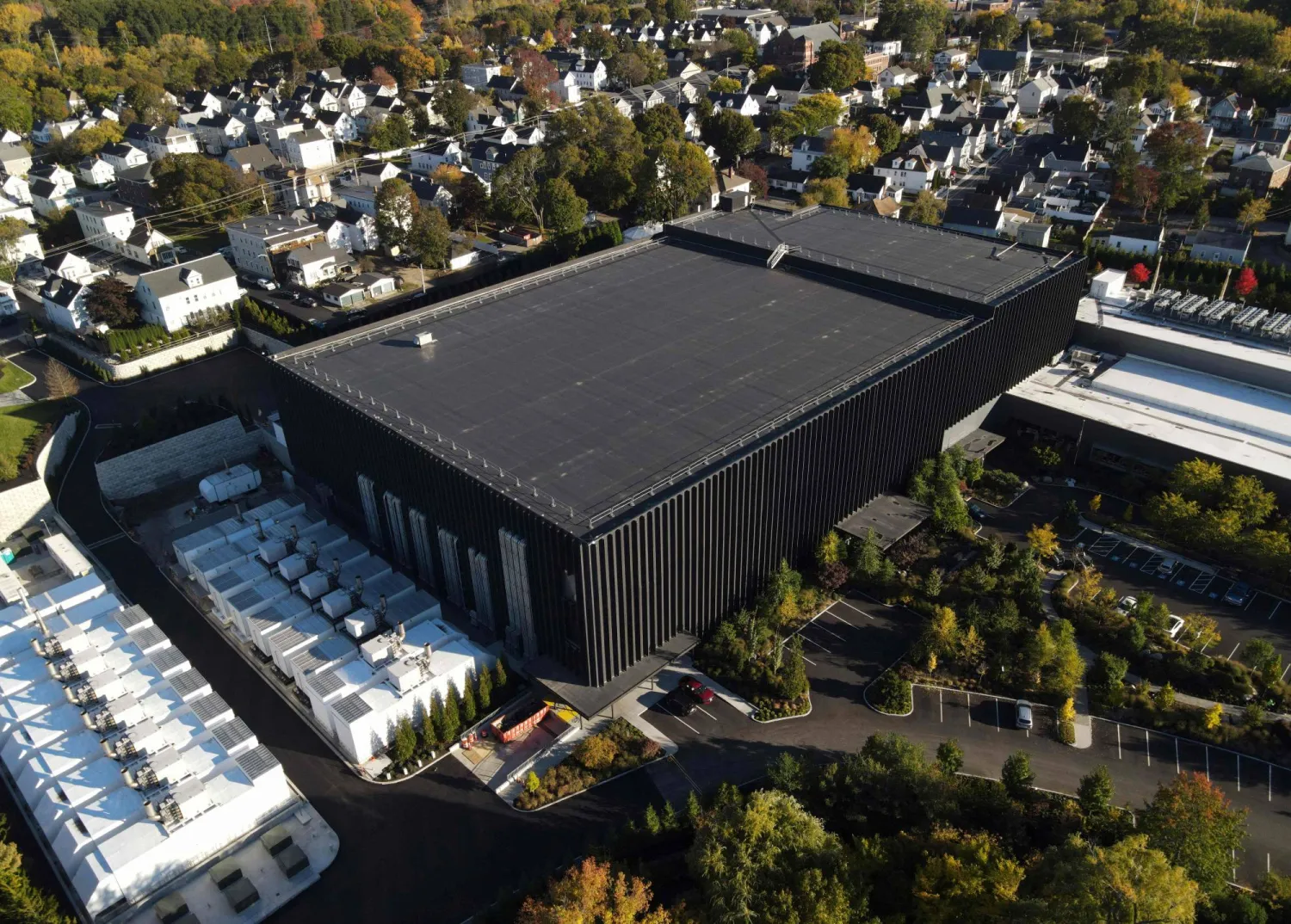
This aerial photo shows the Markley Lowell Data Center surrounded by residential neighborhood homes and apartment buildings in Lowell, Massachusetts, on October 15, 2026. (Photo by Lauren Owens Lambert / AFP)
TT

Data Center Next Door Divides Old Massachusetts Mill Town

This aerial photo shows the Markley Lowell Data Center surrounded by residential neighborhood homes and apartment buildings in Lowell, Massachusetts, on October 15, 2026. (Photo by Lauren Owens Lambert / AFP)

Retiree Eileen Castle hasn't been able to enjoy her backyard since a data center moved in next door in Lowell, Massachusetts, bringing noise, fumes, dust and water mist.

But a few streets away, contractor Louis Haas is grateful to Markley, the company running the facility, for redeveloping an abandoned site he says was rife with drug use.

Dubbed "the Dungeon" by some locals for the imposing black silhouette it casts over a residential neighborhood of this old milling city, those opposing views encapsulate how data centers are polarizing communities across the United States.

Republican-governed states, with their looser regulations, host most of the country's current AI build-out. But in liberal-leaning New England, some feel betrayed by their elected representatives, while others fear being left behind if the industry is curbed.

- 'Nothing but noise' -

Over the din of construction behind a spiked fence, Castle, 82, told AFP her great-great-grandparents bought the property.

But since the data center moved into a disused pasta factory a decade ago, "We have had nothing but noise.

We have dust, dirt. We have all kinds of mist" from the adjoining cooling towers, which she fears could carry Legionnaires' disease.

Noxious fumes made a long interview outdoors impossible, and she lamented that her grandchildren can no longer swim in her small pool.

"I think every once in a while that maybe I should sell my house," she says, but adds her property value has plummeted.

"The Markley Group serves more than 600 clients in Massachusetts and connects the digital infrastructure that powers our economy, our schools, and the everyday needs of our community," Markley Group CEO Jeff Markley said in a statement to AFP.

The company said its backup diesel generators run only for five minute tests each week and, thanks to abatement efforts, produce "about 44 decibels of sound, quieter than a soft conversation three feet away."

It said it tests its water twice a year for Legionnaires', and has planted 2,000 trees.

In 2015, the city council gave Markley a 20-year property and personal property tax break estimated at $77 million, the Lowell Sun newspaper reported at the time.

Enthusiasm has since cooled. In March, the council unanimously passed a 360-day moratorium on construction and expansion of commercial data centers, though Markley's 352,000-square-foot site was grandfathered in.

Residents represented by the Conservation Law Foundation (CLF) and others have sued to challenge its expansion, which included increasing the number of generators to 27, and won a temporary injunction in August.

CLF attorney Adam Reynolds told AFP that it is the "compounding effect of pollution that's really significant" in a historically industrial area.

- Community divisions -

Markley has supporters. Haas, 50, who supplies coffee to a major tech company, said the boom had been good to contractors like him.

"I'm a big liberal, I'm a Democrat. But I'm also pro-jobs and pro-economy," he told AFP.

Markley said it employs more than 100 full-time staff in Lowell, a third of them local. On top of that, over 100 unionized trades workers work on campus.

Another backer, Sarah Bibeau, a 43-year-old single mother of two who works in the defense sector, told AFP the company had been "kind and considerate," fixing roads and offering favors ranging from yard work to free Red Sox tickets.

Detractors include Jake Fortes, a 44-year-old travel agent who founded the group "Honest Future for Lowell" and whose property sits on the fence line.

"We're getting steamrolled by this company. So some of us have taken it to task," Fortes told AFP.

Like Castle, he feels let down by Democrats, including state Governor Maura Healey -- who signed a sales tax break for data centers into law but then paused new applications this year, a reversal that illustrates the party's dilemma.

Luz Marte, a 38-year-old lab technician, bought her house a year ago, without realizing the site was a data center.

"It sounds very loud, like an airplane is going to take off," she told AFP as her three-year-old son played.

Her home insurer recently moved to triple her premium, which she believes is linked to Markley buying a building even closer to her property.

"This is a home I bought for my son, to grow up, feel alive, and have a future," she said. "Now I'm doubting that idea."



Australia to Treat AI as Key Foreign Policy Challenge

The words "AI Artificial Intelligence" and a keyboard are shown in this illustration created on October 19, 2026. (Reuters)
TT

Australia to Treat AI as Key Foreign Policy Challenge

The words "AI Artificial Intelligence" and a keyboard are shown in this illustration created on October 19, 2026. (Reuters)

Australia will treat artificial intelligence ‌as a key challenge in its foreign policy, warning the technology was reshaping society's foundations and giving overseas actors new ways to interfere in its democracy.

In a major address to parliament on Tuesday setting out Australia's changing foreign policy approach, Foreign Minister Penny Wong is expected to name AI alongside forces, such as the growing influence of middle powers and strategic competition between the US and China.

"Technology is transforming the foundations and dimensions of economic and strategic power," Wong will say.

"Artificial intelligence and emerging technologies are spreading ‌and disrupting ‌faster than any previous revolutionary technologies -- reordering our ‌lives, ⁠economies and militaries in ⁠ways we cannot fully foresee."

It comes after the Australian government earlier this month announced it would toughen its AI regulation, mandating companies report breaches and establishing a dedicated regulator for the technology, following revelations an OpenAI agent breached the database of the country's health system.

Citing recent foreign disinformation operations, Wong will also warn in ⁠her speech, entitled "Securing Australia's future in a changing world: ‌Australian foreign policy for a ‌new era", that AI tools make interference in Australia's democracy by foreign actors ‌faster, cheaper, and harder to recognize.

"We are strengthening our ‌critical technology, infrastructure and cyber resilience, and legislating mandatory safety and security protections for every frontier AI company that operates in Australia," Wong is expected to say.

While welcoming investment and innovation in frontier AI, she will ‌say it must be "on terms that work for all Australians".

Australia intends to help shape the race ⁠to develop ⁠advanced models by ensuring it "does not reward speed over prudence", Wong is expected to say, drawing comparisons to nuclear non-proliferation and online safety.

"Australia is working with partners on AI safety, making it a shared, global endeavor... Australia has helped shape the international order before, in non-proliferation and in online safety. With artificial intelligence, we intend to do it again."

Wong will also outline five other key forces reshaping the international order.

These include the changes in how the US and China define and pursue their interests, the influence of middle powers, the growing threat or use of force and coercion, and increasing difficulty in achieving collective international action.


Defense, AI, High Tech: A Delicate Balance Between Armies and Industry

Activists from the Campaign to Stop Killer Robots, a coalition of non-governmental organizations opposing lethal autonomous weapons or so-called "killer robots", stage a protest at Brandenburg Gate in Berlin, Germany, March, 21, 2019. (Reuters)
TT

Defense, AI, High Tech: A Delicate Balance Between Armies and Industry

Activists from the Campaign to Stop Killer Robots, a coalition of non-governmental organizations opposing lethal autonomous weapons or so-called "killer robots", stage a protest at Brandenburg Gate in Berlin, Germany, March, 21, 2019. (Reuters)

The rapid integration of high tech and artificial intelligence into the armed forces presents a tricky dilemma: entrusting part of their future to private companies while risking their sovereignty.

On one side are digital and mission-critical technology specialists driven by market forces and controlled by private capital demanding profits, independent from any political control.

On the other are military leaders who answer only to political authority and are obsessed with strategy, hierarchy and the sacrosanct nature of defense secrecy.

Between them is the race to connect the battlefield, from troop coordination to real-time terrain analysis, generating terabits of data which can decide a war's outcome and the fate of many lives.

Beyond the even more complex issue of so-called killer robots, one example sums up the defense challenge: the civilian Starlink satellite network and its military counterpart, Starshield, which Ukraine desperately needs.

Since Russia's invasion in 2022, Kyiv has faced restrictions on access to Starshield, owned by Elon Musk's SpaceX, leaving a Sword of Damocles hanging over Ukraine's armed forces.

Musk has shifted his stance on Ukraine many times, insisting any disruption was the responsibility of Washington, not SpaceX.

- 'A fine line' -

The issue loomed over NATO Edge this week, a three-day conference on critical technologies and digital warfare where military chiefs, government officials and defense experts from NATO's 32 member states and Ukraine gathered in Izmir, Türkiye.

"This is a difficult issue, one many ministries of defense are grappling with," analyst Tom Barton with intelligence firm Janes told AFP.

For companies "to deliver the so-called 'networked battlefield', some access ideally needs to be given" to confidential data, he explained.

"From space to land-based sensors and military communications, defense establishments are experimenting with standalone exercises and varying levels of trust and access."

But militaries -- without safeguards -- cannot entrust their fate to developers, who are often focused primarily on civilian needs.

"There is a lot of push or advocacy for military and government to have a closer relationship with industry," a US company representative told AFP on condition of anonymity.

"But there's a fine line. You turn on the news and you see Elon Musk doing shit in Ukraine like slowing down the internet," he fumed.

With boundaries constantly shifting, military leaders have little choice but to compromise.

"You don't need to be 100 percent sovereign, but sovereign enough," he explained.

- Trust -

For Major General Rainer Beeck, one of NATO's top cyberspace commanders, it is "a hard nut to crack".

"You have to make choices about which classification you make, for which data... The problem is the trust," he said.

Admiral Pierre Vandier, NATO's Supreme Allied Commander Transformation (SACT), likewise insisted that "trust ... is the most important thing".

"Trust in architecture, in data sharing, in AI agents, in decision-making tools," he said.

"We need to close the fighter-factory gap. Ukraine did it."

Nearly five years of war have given Kyiv more experience than anyone else in NATO.

The dynamics also vary according to the size of national defense budgets.

For large powers, "data collection is not the problem... If war would start, we would get (it). The problem then is it's too late to organize," Beeck said, calling for a more proactive approach.

Smaller governments need "to build up their capacity", said Mitch Free, vice president of international government at Vantor, which provides satellite imagery for defense and intelligence agencies.

Many may only own a handful of satellites and must weigh their intelligence value against the cost of building and operating them.

"This is where commercial... helps fill the gap," he said.

Ultimately, the real debate is about the best way to use AI.

"The bottleneck is often not technology, but permission: classification boundaries, national rules and trust decisions," said Jean-Charles Ellermann-Kingombe, NATO's cyber and digital transformation chief.

The alliance must make "AI adoption possible at scale", with these capabilities "secure, interoperable and deployable within NATO's infrastructure... by personnel who understand their value and their limitations", he added.


Nvidia Faces US Accounting Probe amid Deepening Turmoil

FILE PHOTO: A silhouette of Jensen Huang, NVIDIA logo and decreasing stock graph are seen in this vertical illustration created on November 12, 2026. REUTERS/Dado Ruvic/Illustration/File Photo
TT

Nvidia Faces US Accounting Probe amid Deepening Turmoil

FILE PHOTO: A silhouette of Jensen Huang, NVIDIA logo and decreasing stock graph are seen in this vertical illustration created on November 12, 2026. REUTERS/Dado Ruvic/Illustration/File Photo

US securities regulators are investigating the accounting practices of Nvidia, according to US media, adding to the turmoil engulfing the artificial intelligence chip giant following the resignation of its chief executive.

The Securities and Exchange Commission (SEC) inquiry is in its early stages, The New York Times reported Saturday, citing people briefed on the confidential investigation.

The Wall Street Journal reported on the investigation earlier this week, although it was unable to establish its precise focus. The probe could end without any charges being brought against the company.

Questions about Nvidia's financial disclosures have intensified amid scrutiny of its dealings with Megaspeed, a Singapore-based company investigated by American authorities over suspected shipments of restricted AI chips to China.

Nvidia last year changed how it reported sales by geographical location, switching from customers' billing addresses to the countries where they are headquartered, US media reported.

The change removed Singapore from its geographical breakdown, despite the company's significant business there.

It remains unclear whether the SEC investigation is connected to those accounting changes or to the scandal surrounding former chief executive Jensen Huang.

Huang resigned earlier this month following revelations of extramarital affairs, including with Alice Huang, a former Megaspeed executive suspected by US intelligence of working for Beijing.

China has denied the espionage allegations, while Megaspeed has maintained that it operates lawfully.

Nvidia's board has appointed former chief financial officer Colette Kress as interim CEO and launched an investigation into the circumstances surrounding Huang's departure.

The upheaval has shaken investor confidence in one of the world's most valuable companies, whose advanced semiconductors have been central to the global AI boom.

Nvidia shares plunged 14 percent on Friday, bringing their losses for the week to more than 20 percent.

US President Donald Trump nevertheless called Friday for Huang to be reinstated.

"I think that I would love to see Jensen be given a second chance," Trump told reporters.

But Nvidia Chairman Harvey Jones has ruled out his return, saying board directors unanimously accepted his resignation.