

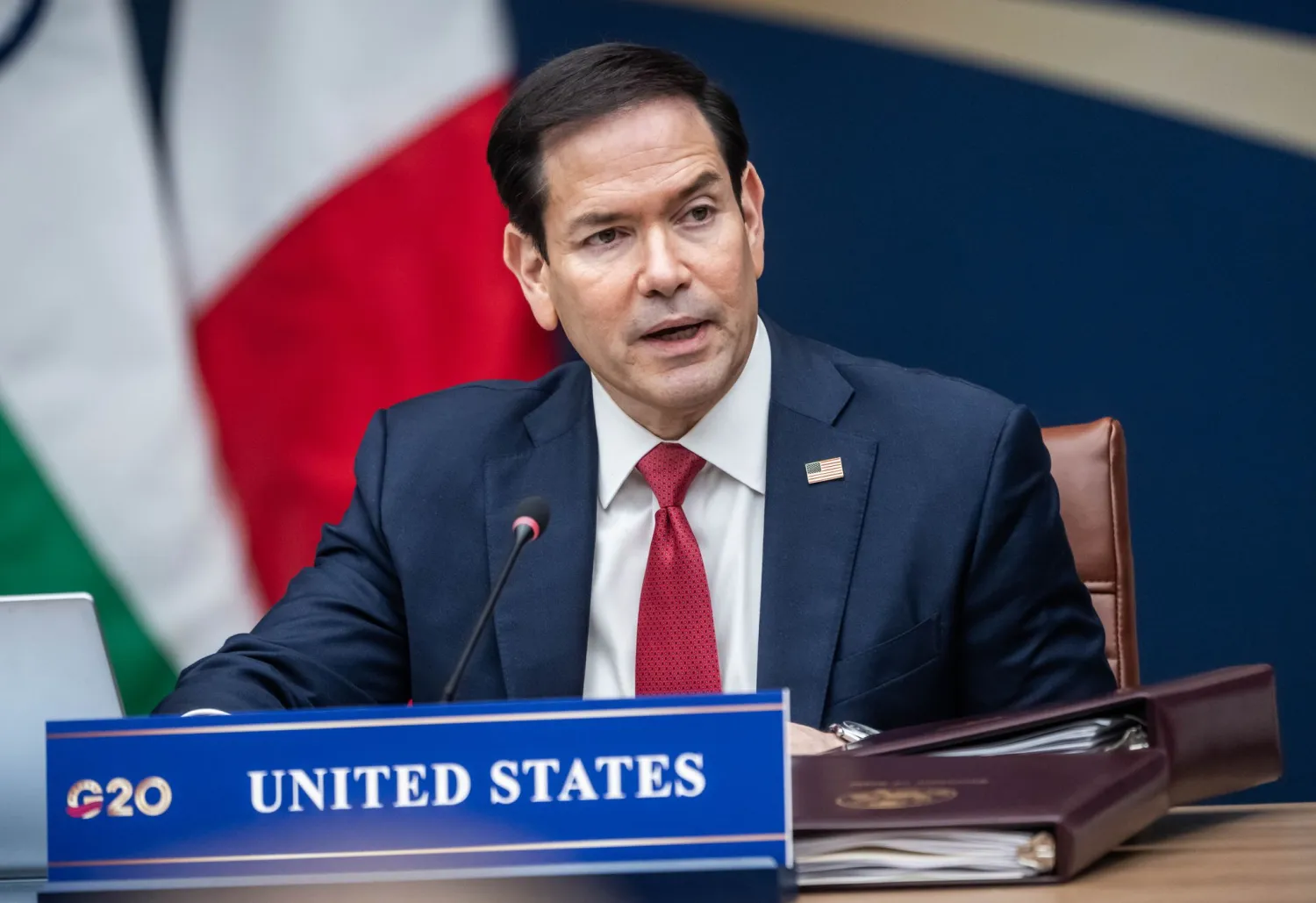

Rubio Urges G20 Cooperation Amid Rifts Over Wars in Ukraine, Middle East

30 October 2026, US, Atlanta: US Secretary of State Marco Rubio speaks at the start of the G20 foreign ministers' meeting in Atlanta. (dpa)
TT

Rubio Urges G20 Cooperation Amid Rifts Over Wars in Ukraine, Middle East

30 October 2026, US, Atlanta: US Secretary of State Marco Rubio speaks at the start of the G20 foreign ministers' meeting in Atlanta. (dpa)

US Secretary of State Marco Rubio urged fellow G20 foreign ministers on Friday to work together for greater geopolitical stability and economic prosperity, warning that a series of crises posed serious threats to the global economic order. 

But Russian Foreign Minister Sergei Lavrov's participation in the two-day gathering in Atlanta has roiled many G20 ministers, aggravating deep rifts over the wars in Ukraine and the Middle East that experts and diplomats say could thwart real progress at the meeting. 

Canada's foreign minister, Anita Anand, who has been critical of Lavrov's participation, missed the opening plenary session. Her spokeswoman said she was arriving late from a Canada-EU summit in Montreal. 

South Africa's minister was also absent, not invited by the US, which holds this year's rotating presidency. 

A traditional G20 family photo was left off Rubio's official schedule after some European officials said they would not be photographed with Lavrov. A third of the participants objected, including Australia and Canada, a Western diplomat said. 

German Foreign Minister Johann Wadephul told ‌reporters that he expected ‌the family photo to be scrapped entirely, adding, “In no case will there be a family photo ‌with ⁠European partners and Mr. ⁠Lavrov together because, as I said yesterday, there is no normalcy with Russia.” 

The US has sought to focus its allies on trade imbalances while building a coalition to counter China's control of critical minerals, but the wars and their economic impact remain the top concern for many G20 members. 

In his opening remarks, Rubio said the world faced various crises that threatened global energy and food supply, trade, and the freedom of navigation. 

"We are tasked, on behalf of the nations that we serve, to work together with one another to coordinate responses to emerging crises and to protect our shared interests," he said. "We can help set the context for expanded geopolitical stability and the broader economic prosperity agenda that our leaders will tackle." 

With G20 members Russia, China and middle powers such as Brazil and ⁠India trying to navigate US-China strategic competition, you have “much more of a split than we’ve ever had,” said ‌Heidi Crebo-Rediker, who was chief economist at the State Department during the Obama administration. 

Over the ‌past decade or so, G7 countries would at least “have agreed on a coordinated platform before they came to the G20, but now we don’t even really have ‌that,” she added. 

A State Department official told reporters that four G20 ministerial-level meetings held this year had achieved some consensus, but more work was ‌needed before the December 14 to 16 leaders' summit in Miami. 

Rubio has championed the Pax Silica initiative, aimed at uniting G20 countries concerned about China's dominance in rare earths and other critical minerals. 

But any movement on that front will probably come afterwards, experts said, pointing to a US-led statement on excess industrial capacity that some G20 trade ministers signed after the group failed to reach consensus. 

Elaine Dezenski of the Washington-based Foundation for Defense of Democracies said such statements by ad hoc groups could offer ‌a way forward in the current environment. 

"The right test is whether the US can build cooperation with partners when all-member consensus appears to be out of reach," she said. She noted the Quad — a security ⁠grouping of the US, India, Japan and ⁠Australia — would also meet in Atlanta in coming days. 

DISAGREEMENT OVER US ACTIONS TOWARD RUSSIA 

US President Donald Trump's recent decisions on Russia, including a deal to buy diesel and waiving some sanctions, could also weigh on discussions, along with Ukraine's problems with its Starshield satellite services. 

“If it’s not brought up, it’s certainly the elephant in the room that the US — and Trump in particular — has taken a very solid stance together with (Russian President) Vladimir Putin and against Ukraine," Crebo-Rediker said. 

European Union foreign policy chief Kaja Kallas said she would call for increased support for Ukraine, while pushing for progress on accountability measures through the Special Tribunal and Claims Commission. 

"Russia must be accountable," she wrote on X. 

Some countries may seek to avoid conflict, including Canada, Mexico, India and others still negotiating trade agreements with the US, said one G20 diplomat who declined to be named. "Everyone is trying to keep a low profile." 

The meetings take place a day after Commerce Department data showed the US economy grew at its fastest pace in a year in the third quarter, buoyed by AI investment, even as other countries face slower growth or even contractions. 

They also fall just days before the November 3 midterm elections, which polls indicate could leave Trump without majorities in either house of Congress. 

Although Ukraine has not been invited to join the G20 ministers in Atlanta, Trump is also pushing hard for a ceasefire in Russia's war in Ukraine. Russia, Ukraine and the US are expected to hold technical-level trilateral talks in Abu Dhabi next month. 


Iran Insists No Talks with the US Until Its Conditions Are Met

 Vessels at the Strait of Hormuz, as seen from Musandam, Oman, November 23, 2026. (Reuters)
Vessels at the Strait of Hormuz, as seen from Musandam, Oman, November 23, 2026. (Reuters)
TT

Iran Insists No Talks with the US Until Its Conditions Are Met

 Vessels at the Strait of Hormuz, as seen from Musandam, Oman, November 23, 2026. (Reuters)
Vessels at the Strait of Hormuz, as seen from Musandam, Oman, November 23, 2026. (Reuters)

Iran repeated Tuesday that there'll be no talks with the United States to end the conflict unless several conditions are met.

Iran’s chief negotiator and parliament speaker Mohammad Bagher Qalibaf said Tehran wouldn't negotiate with the US "until Iran’s seven conditions are met,” according to Iranian state television.

Iranian authorities haven't publicly stated what those conditions are. But Iranian state media have said they include the lifting of sanctions, the ending of the US naval blockade of Iranian ports and the release of seized Iranian assets.

He also warned that Iran would “shift the geographical scope of the conflict should the enemy make a mistake.”

Meanwhile, the naval arm of Iran’s Revolutionary Guard said the three oil tankers struck the naval mines because they were “in violation of regulations” regarding passage through the Strait of Hormuz.

The Guard’s navy said in a post on Telegram Monday that the strait “is not a place to test unauthorized routes or to disregard maritime warnings.”

It said the tankers were “engulfed in flames” after hitting the mines despite being under US aerial escort.


Iran Currency Plunges After Fresh US Sanctions

Iranians shop at a street market in Tehran, Iran, 23 November 2026, as the country faces an economic crisis amid ongoing US-Iran tensions. (EPA)
TT

Iran Currency Plunges After Fresh US Sanctions

Iranians shop at a street market in Tehran, Iran, 23 November 2026, as the country faces an economic crisis amid ongoing US-Iran tensions. (EPA)

Iran's currency plunged on the black market on Tuesday after Washington announced fresh sanctions, which the central bank governor said targeted a regular platform for registering transactions.

The US Treasury announced sanctions on Monday against more than two dozen Iranian exchange houses, alleged front companies and individuals said to be part of the country's "shadow banking" network. It said the network was "overseen" by the central bank.

By Tuesday afternoon, the US dollar was trading at around 2.82 million rials, up about five percent from around 2.68 million the day before, according to websites monitoring black market rates.

The euro also rose to around 3.07 million rials, up from 2.94 million on Monday, the websites said. Iranians use black market rates as the central bank rate is usually much lower.

Central Bank governor Abdolnaser Hemmati dismissed the sanctions, saying the US appeared to have "run out of targets" and had resorted to targeting a legitimate platform.

The sanctioned Iran Currency and Gold Exchange center "is merely a platform for registering transactions" and "is there for everyone to see," said Hemmati, according to Tasnim news agency.

The US Treasury's Office of Foreign Assets Control (OFAC) said it connects exporters earning foreign currency from overseas sales with importers seeking foreign currency to buy goods, facilitating tens of billions of dollars in trade annually.

"While Iran's shadow banking system moves the funds generated by Iran's international trade, the Iran Center for Exchange plays matchmaker and guides these funds to their ultimate destination inside Iran," OFAC said.

The latest sanctions were announced nearly nine months into the Middle East war, which broke out on February 28 when US-Israeli strikes killed Iran's supreme leader Ali Khamenei.

The conflict expanded after Iran retaliated with missile and drone strikes across the region, while armed groups it backs in Lebanon, Yemen and Iraq also entered the fray.

Washington has ramped up sanctions since August as part of an "economic asphyxiation" campaign, and launched a task force to disrupt land routes into Iran.

It has also maintained a naval blockade on Iranian ports to choke off the country's oil revenue in retaliation for Iran's effective blockade of the Strait of Hormuz, a vital global energy conduit.


Report: US Defense Chief Has Yet to Approve Patriot Missiles Already Allocated to Ukraine

 US Secretary of Defense Pete Hegseth attends a reception for "The President's Own" United States Marine Band on the South Lawn helipad at the White House in Washington, DC, US, November 20, 2026. (Reuters)
US Secretary of Defense Pete Hegseth attends a reception for "The President's Own" United States Marine Band on the South Lawn helipad at the White House in Washington, DC, US, November 20, 2026. (Reuters)
TT

Report: US Defense Chief Has Yet to Approve Patriot Missiles Already Allocated to Ukraine

 US Secretary of Defense Pete Hegseth attends a reception for "The President's Own" United States Marine Band on the South Lawn helipad at the White House in Washington, DC, US, November 20, 2026. (Reuters)
US Secretary of Defense Pete Hegseth attends a reception for "The President's Own" United States Marine Band on the South Lawn helipad at the White House in Washington, DC, US, November 20, 2026. (Reuters)

US Defense Secretary Pete Hegseth has yet to approve the transfer of about 60 Patriot air defense interceptors that Washington had already agreed to supply to Ukraine, the Financial Times reported on Tuesday, citing people familiar with the matter.

Ukraine has repeatedly said it urgently needs more missile interceptors to counter growing Russian missile and drone attacks.

The interceptors include US-made PAC-3 and PAC-2 missiles, some of which ‌are held ‌in European arsenals and are being financed ‌by ⁠Kyiv's Western allies, ⁠the newspaper said.

Reuters could not immediately verify the report. The Pentagon did not immediately respond to a request for comment.

The outstanding allocation includes PAC-3 interceptors scheduled for delivery between September and December, the FT said, adding that none of those shipments ⁠has yet been approved for transfer.

A further ‌20 or so PAC-2 ‌interceptors, an older Patriot missile variant, have also been ‌allocated to Ukraine but are awaiting approval for delivery, ‌FT added.

The FT also reported that a separate effort to secure US approval for Ukraine to produce its own Patriot interceptors has been delayed at the Pentagon.

A ‌Pentagon spokesperson told the newspaper there had been no change in US policy ⁠regarding support ⁠for Ukraine, while declining to comment further on the weapons.

"The Department of War has pursued multiple parallel lines of effort to accelerate transatlantic industrial co-operation on the Patriot air and missile defense system with European partners and Ukraine, and continues that work to this day," a Pentagon official told the FT.

Last month, the US approved a sale of 500 Patriot PAC-3 missiles to Ukraine valued at about $2.1 billion, although deliveries are not expected until the early 2030s.
