Surging Costs of Living Top US Voter Concerns

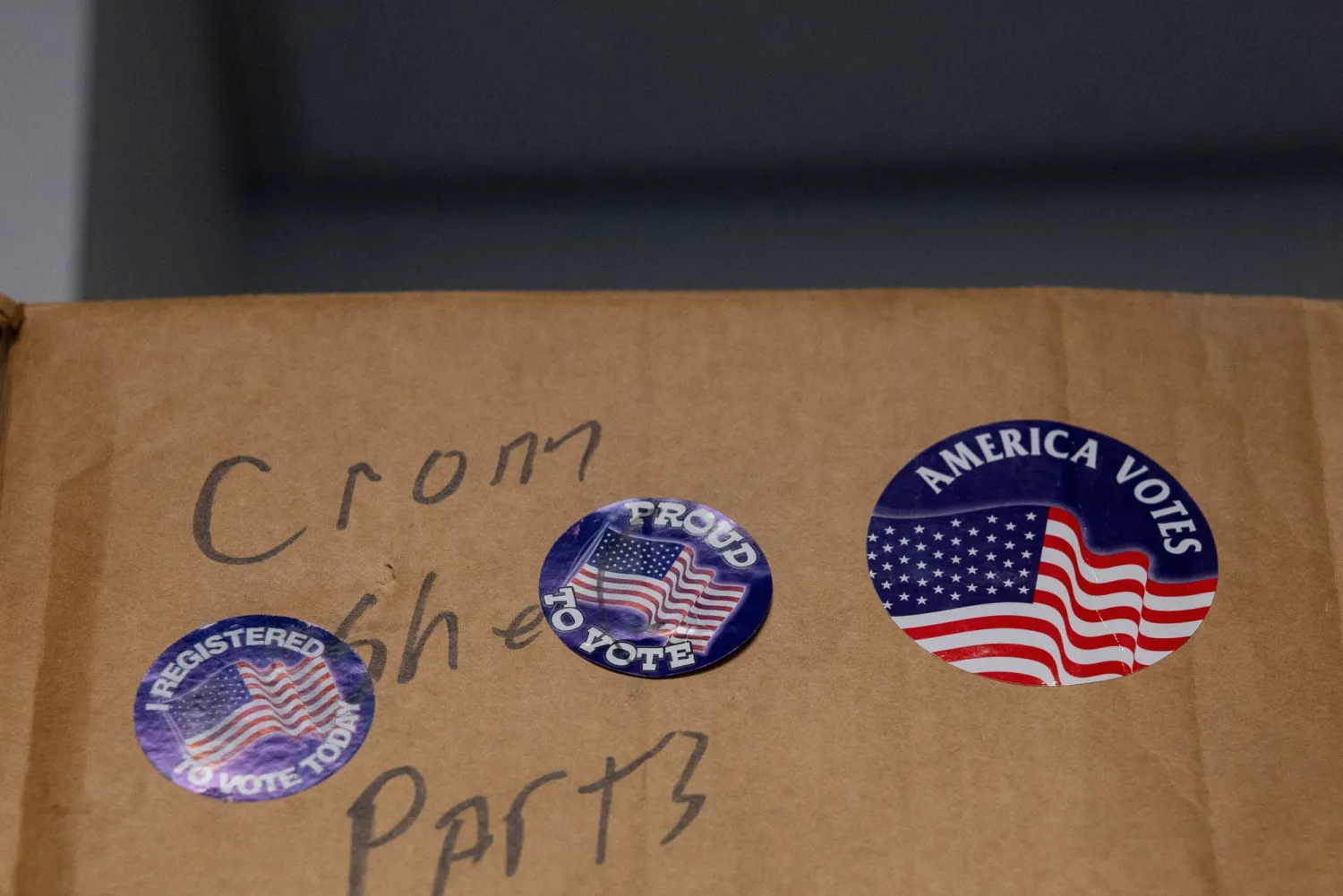
 Voting stickers are seen on spare parts boxes in a secure room at the Tom Green County Elections Office in San Angelo, Texas, US October 28, 2026. (Reuters)
Voting stickers are seen on spare parts boxes in a secure room at the Tom Green County Elections Office in San Angelo, Texas, US October 28, 2026. (Reuters)
TT

Surging Costs of Living Top US Voter Concerns

 Voting stickers are seen on spare parts boxes in a secure room at the Tom Green County Elections Office in San Angelo, Texas, US October 28, 2026. (Reuters)
Voting stickers are seen on spare parts boxes in a secure room at the Tom Green County Elections Office in San Angelo, Texas, US October 28, 2026. (Reuters)

Soaring prices for gas, medicine and other cost of living essentials are preoccupying Americans as they start to cast their ballots ahead of next week's midterm elections.

A whopping 84 percent of voters who have cast their ballots early listed the economy as their biggest concern this election cycle, according to a recent Pew Research Center survey.

Kyler Daugherty, a 43-year-old health care worker, summed up the sentiment as he filled up his gas tank in Fort Lauderdale, Florida.

"It's ridiculous. I mean, everything's gone up, from food to transportation to gas prices," he told AFP.

Fuel costs have skyrocketed around the world since the United States and Israel launched strikes on Iran in February.

US gas prices rose 9.1 percent in September alone, according to official figures, a headache for residents in a state like Florida, where most people rely on cars to get around.

"It affects transportation, it affects goods, it affects everything," Matthew Moore, a 63-year-old attorney, said after he cast his ballot early.

"We transport a lot by truck. Air prices have gone up. My tickets home for Christmas have doubled since last year," he said.

- Broken promises -

US President Donald Trump won reelection in 2024 in part because of his campaign promise to lower prices, which had also increased during the term of his predecessor Joe Biden.

"I didn't believe that promise then and I probably won't continue to believe (it)," said Melissa Reer, a 49-year-old social worker worried by her car and home insurance costs.

"But I think there's a lot more changes have to happen before prices can go down," she said.

William Galston, a senior fellow at the Brookings Institution think tank, said two of Trump's decisions this term have directly contributed to cost pressures: launching the war on Iran and slapping tariffs on trade partners.

"It's within the president's power to remove most of the tariffs that he's imposed. It's within the president's power to end the war that he began," Galston told AFP.

For some voters, however, it's too late.

"My vote was cast based upon my feelings about how they've handled the stewardship that the voters have given them," said Michael Childs, 62.

The White House for its part insists that Trump's policies are revitalizing the US economy and making life more affordable for Americans.

- Basic expenses -

But millions of households across the United States find it harder than ever to make ends meet.

"The financial hardship is creeping up in America, particularly the middle class," said Symeria Hudson, the CEO of United Way Miami, a nonprofit fundraising organization.

United Way's ALICE metric -- which stands for an Asset Limited, Income Constrained, Employed person -- measures working people whose income does not cover basic expenses, such as food, housing and health care.

Nearly 41 percent of the 132 million households in the United States fall below the threshold.

"We continue to encourage those policy makers to really understand the data," Hudson told AFP.

Many US voters are running out of ways to cut spending.

"I'm literally cutting back on certain meds because I'm like, 'I can't afford them.' I don't know what to do next," Daugherty said.


Trump Cancels Rallies in Kansas and Iowa, Opting for Telerallies to Reach more Voters

US President Donald Trump and US First Lady Melania Trump watch as the presidential aircraft, known as Air Force One when the president is on board, flies over during a Halloween party at the White House in Washington, DC, on October 29, 2026. (Photo by SAUL LOEB / AFP)
TT

Trump Cancels Rallies in Kansas and Iowa, Opting for Telerallies to Reach more Voters

US President Donald Trump and US First Lady Melania Trump watch as the presidential aircraft, known as Air Force One when the president is on board, flies over during a Halloween party at the White House in Washington, DC, on October 29, 2026. (Photo by SAUL LOEB / AFP)

President Donald Trump on Thursday canceled weekend rallies in Iowa and Kansas, opting instead to support Republican candidates with telerallies that his party said could reach more voters in nearly two dozen states in the final days of a midterm election that could cost the GOP control of Congress.

The president traveled to South Carolina Thursday for the second time in a month, a sign of Republican anxiety about Darline Graham's ability to fend off a robust challenge from Democrat Annie Andrews for a critical US Senate seat.

Voters in South Carolina have not sent a Democrat to the Senate in nearly three decades. But Andrews, a pediatrician who previously ran unsuccessfully for Congress, is urging voters seeking change to “try something new for once.”

That message could resonate in an election year defined by voter frustration with the economy, gas prices and the war in Iran, putting Trump's Republican Party on defense in territory where they have rarely had to compete in recent years.

Beyond South Carolina, Republicans are entering the final days of this year's midterm elections navigating tight contests in Texas, Kansas, Ohio, Iowa and Alaska. Both parties are also closely following developments in the Mississippi Senate race.

The president projected confidence as he returned to the White House, saying, “We're going to have a strong Tuesday night.”

Trump was scheduled to hold a rally in Kansas on Saturday and in Iowa on Sunday. But the Republican National Committee announced Thursday evening that he would instead spend a “72-hour sprint” doing rallies by phone rather than in person, a move the RNC said would maximize Trump's ability to speak to voters nationwide. The RNC said telerallies are planned for nearly 20 states, and more may be announced.

It was an abrupt shift in Trump’s pledge to push through the final days of the campaign doing rally after rally to galvanize his supporters. As of Thursday, he had done 25 rallies during the month of October, falling short of a goal he had once placed north of 30.

Trump says he doesn't need to go to Kansas There were signs the travel and long speeches have caught up with him. On Monday, in Corinth, Mississippi, Trump — whose voice has grown raspy — told the crowd, “God didn’t make your vocal cords to do a rally every day.”

But he bristled Thursday when a reporter asked whether he had canceled plans to travel to Kansas because of his health.

“You’ve been following me for two weeks. I feel perfect,” Trump snapped.

The president said he’s not traveling to Kansas, where GOP Sen. Roger Marshall faces Democrat Adam Hamilton, "because he’s doing very well,” an apparent reference to Marshall.

“I don’t feel I have to go to Kansas,” Trump said.

A campaign strategist with Republican Senate leadership said there was widespread curiosity about why the schedule was changing to telerallies. The strategist spoke on condition of anonymity to share the content of private conversations.

Trump, who revels in big crowds, has this month held rallies in smaller venues than many he once filled. The decision to switch to telerallies means he will be expected to speak for about 10 minutes instead of more than 90, as he does at in-person events.

Trump plans to travel to Daytona Beach, Florida, for a rally Friday. It’s not clear whether he will hold additional in-person events after that. The White House has not published his schedule for Monday, the final day of the campaign.

Democrats took notice.

Abdul El-Sayed, the Democratic Senate candidate in Michigan who's in a tight race against Republican Mike Rogers, said Thursday night that the president's goal of trying to gin up GOP voters has backfired and he has “given up." “He’s an old man, he’s a loser,” El-Sayed continued. “He now understands that he has fully lost the midterms for his party."

Graham has struggled to connect with voters In South Carolina, Graham has struggled to quickly build connections with voters. The sister of the late Sen. Lindsey Graham, she was appointed in July by Republican Gov. Henry McMaster to fill the remaining months of her brother’s term after his sudden death. In August, she became the party’s nominee to succeed him for a full six-year term.

“He was a great politician,” Trump said of Lindsey Graham, before promoting Darline Graham as his elected successor. “She’s got the gene.”

Darline Graham commended the president for having “delivered what Washington promised for decades.” She warned that Andrews “would just throw it all away."

Andrews appeared in nearby Fort Mill on Wednesday, where she said that if voters elect her and become unhappy with her performance on Capitol Hill, “you can fire me in six years.”

South Carolina Rep. Ralph Norman, who lost to Graham in the GOP Senate primary runoff, has criticized Graham as unqualified. Norman, who has refused to campaign with Graham, said the race is closer than it would have been had he been nominated.

Lonnie Dean Johnson of Sumter, South Carolina, supported Norman in the primary and was voting Graham out of party loyalty, albeit unenthusiastically.

“She’s on a Republican ticket. I, by and large, support the Republican platform," he said. "So, I support her and wish her well.”

Democrats are bullish about Senate races across the US Democrats, meanwhile, are optimistic about their chances of booting GOP incumbent senators, including in Ohio, with an American public frustrated by continued high costs.

“Families see more money going out the door and not enough money coming in,” said Sherrod Brown, the Democratic Senate nominee who's competing against Ohio Republican Sen. Jon Husted. At a rally in Toledo Thursday, Brown said Husted is “looking out for data centers and Wall Street."

Farther north, Alaska's Republican governor has ordered an investigation after The New York Times reported Wednesday that Democratic Senate candidate Mary Peltola's campaign appeared to be involved in recruiting another candidate with the same name as Republican incumbent Dan Sullivan.

The Justice Department escalated the investigation Thursday, issuing a raft of new grand jury subpoenas, a person familiar with the matter told The Associated Press.

The Justice Department also issued subpoenas to California officials in the latest effort to scrutinize local election administration. A federal judge in California earlier Thursday appointed a special master to evaluate claims by the Trump administration that the state has some 20,000 noncitizens on its voter rolls.

Trump called the development in Alaska a “conspiracy” and called for Peltola to be removed from the ballot. He has cast doubt on whether Peltola would be seated in the Senate even if she won the election.

Peltola’s campaign didn’t immediately respond to a message Thursday seeking comment on the governor's order. But during a campaign stop in Soldotna, Peltola, a former congresswoman, suggested the Times’ report was a “distraction” from issues such as Sen. Sullivan’s support of the war in Iran.

The revelation in Alaska was a reminder of the volatility of the midterm campaigns' final days as both parties make decisions about how to spend time and money with control of Congress on the line.


Kim Attends a North Korean Drone Exhibition and Calls for Boosting the Technology

This picture taken on October 29, 2026 and released by North Korea's official Korean Central News Agency (KCNA) on October 30, 2026 shows North Korean leader Kim Jong Un walking next to shelves of drones as he attends the "Unmanned Aeronautical Technology Development-2026" exhibition in the Wonsan Kalma Coastal Tourist Area in Kangwon Province in North Korea. Kangwon (KCNA via KNS / AFP)
TT

Kim Attends a North Korean Drone Exhibition and Calls for Boosting the Technology

This picture taken on October 29, 2026 and released by North Korea's official Korean Central News Agency (KCNA) on October 30, 2026 shows North Korean leader Kim Jong Un walking next to shelves of drones as he attends the "Unmanned Aeronautical Technology Development-2026" exhibition in the Wonsan Kalma Coastal Tourist Area in Kangwon Province in North Korea. Kangwon (KCNA via KNS / AFP)

North Korean leader Kim Jong Un attended a drone-only exhibition, apparently the first of its kind in the North, and called for rapidly expanding the country’s drone technology, state media reported Friday, as his military escalates threats against South Korea and the US.

Acquiring advanced drones is a top priority for Kim, who now wants to beef up both conventional and nuclear capabilities. Experts say his troops sent to Russia to support its war against Ukraine likely gained valuable expertise on drone warfare from Russian forces and their own battlefield experiences.

The North's official Korean Central News Agency said Kim on Thursday visited an exhibition of attack and other drones that show recent achievements in the field of uncrewed aeronautical technology.

In a speech at the exhibition, Kim stressed the need to seize “the absolute superiority in the drone technology” and announced unspecified steps needed to “rapidly expand and strengthen the unmanned aeronautical technology,” KCNA said.

South Korea’s Unification Ministry said it appeared to be North Korea's first exhibition exclusively dedicated to drone technology. South Korean media reported the exhibition displayed more than 30 kinds of drones including stealth drones and first-person-view attack drones.

To mark the event, KCNA said North Korea conducted test-launches of various drones, missiles and weapons from the 600 mm-caliber ultraprecision multiple rocket launchers. KCNA photos showed Kim watching soaring weapons or him clenching his fist while his teenage daughter was clapping her hands beside him. South Korea's spy agency assesses that the girl, reportedly about 13, is likely Kim's heir.

South Korea's military earlier said it detected the launches of about 10 short-range ballistic missiles off the North's east coast on Thursday. They were North Korea's first ballistic weapons firings in 17 days.

Tensions between the two Koreas are running high since last month's land mine blasts at their border that wounded three South Korean soldiers. Seoul accused North Korea of burying the mines south of the military demarcation line and demanded an apology. But Pyongyang has denied responsibility for the explosions and warned of retaliation if provoked.

Last week, North Korea threatened to resume propaganda loudspeaker broadcasts and place new weapons systems along the border.

North Korea's Defense Ministry on Friday slammed an ongoing US-South Korea combined aerial exercise as “provocative” and warned it was increasing the danger of an armed conflict. South Korea's military earlier said the two-week biannual Freedom Flag drill was to run until Nov. 6 and was meant to improve combined operational capabilities. It said aerial assets like fighter jets, helicopters and drones would be mobilized.

North Korea has pulled out of talks with the US and South Korea after Kim's high-stakes diplomacy with US President Donald Trump collapsed in 2019. In recent weeks, North Korea has dialed up weapons testing activities in a likely attempt to boost its leverage in potential diplomacy with the US after Trump expressed his eagerness to restore talks with Kim.

On Saturday, Kim made a surprise visit to a Chinese border town via a newly opened bridge and vowed to develop bilateral ties. Kim has recently taken steps to cement ties with China, North Korea's economic pipeline, after years of prioritizing ties with Russia, including by supplying thousands of troops and ammunitions likely in return for economic and military assistance.

Meanwhile, Switzerland’s Foreign Minister Ignazio Cassis arrived in North Korea on Thursday to see the reopening of Switzerland’s diplomatic office in Pyongyang and meet North Korean officials. He is travel on to South Korea on Friday.


French Centrists’ Feuding Increases Odds of Le Pen-Melenchon Runoff

 Leftist party La France Insoumise (LFI) candidate in France's 2027 presidential election Jean-Luc Melenchon gestures as he addresses the audience during a press conference in Paris on October 28, 2026. (AFP)
Leftist party La France Insoumise (LFI) candidate in France's 2027 presidential election Jean-Luc Melenchon gestures as he addresses the audience during a press conference in Paris on October 28, 2026. (AFP)
TT

French Centrists’ Feuding Increases Odds of Le Pen-Melenchon Runoff

 Leftist party La France Insoumise (LFI) candidate in France's 2027 presidential election Jean-Luc Melenchon gestures as he addresses the audience during a press conference in Paris on October 28, 2026. (AFP)
Leftist party La France Insoumise (LFI) candidate in France's 2027 presidential election Jean-Luc Melenchon gestures as he addresses the audience during a press conference in Paris on October 28, 2026. (AFP)

Infighting has broken out among centrist candidates for France's presidential race, splitting the mainstream vote and making a runoff between far-right Marine Le Pen and hard-left Jean-Luc Melenchon more likely.

Opinion polls before next April's presidential election show Le Pen is nearly certain to qualify for a second-round runoff in May and that Melenchon is consistently nudging ahead of mainstream candidates.

Centre-right Edouard Philippe, President Emmanuel Macron's former prime minister, has so far been the center's torchbearer.

But Philippe's lackluster campaign, voter weariness near the end of Macron's two terms, an explosive social and security context and the challenges he faces from within his own camp have hurt his polling, people in Macron's camp and political analysts say.

"There's panic on board because there was no scenario planned for this. They hadn't anticipated the cataclysm under way," said Philippe Moreau-Chevrolet, a political communications specialist at Sciences Po.

Philippe has also faced criticism over several awkward interventions — including suggesting ‌in a podcast ‌that ideally a newly elected president should have three months to rest before taking office — ‌and ⁠political analysts say ⁠he is struggling to connect with voters at a time of rising political tensions.

"The terrible thing is that he isn't cutting through," Moreau-Chevrolet told Reuters. "They didn't understand that you have to campaign. There's a kind of dilettantism."

The anxiety has sharpened tensions between Philippe and his main rival, Gabriel Attal, another former prime minister. They are locked in a battle over who should step aside for the centrist ticket.

Philippe fell to 15% support in an IFOP-Fiducial poll for Le Figaro newspaper, a six-point drop since September. That is below the 16.5% for Melenchon, who would have enough to qualify for a runoff against Le Pen.

Attal stood at ⁠13%, behind Melenchon and Raphael Glucksmann, a mainstream center-left candidate.

Under pressure from lawmakers in ‌his camp to abandon his presidential ambitions and rally to Philippe, Attal ‌irritated many Macron allies this week by reviving the idea of a broad centrist primary, a proposal critics say risks fueling division at ‌a time when moderates can least afford it.

Still, Attal has leverage. As leader of Macron's Renaissance party, he controls ‌the purse strings of the party machine.

CENTRIST VOTE FRAGMENTS

"It's catastrophic," said Jean-Baptiste Moreau, a former lawmaker from Macron's camp.

"They are attacking one another in the media and they are both collapsing in the polls. We're heading straight towards an RN-LFI second round," he said of Le Pen's National Rally (RN) and Melenchon's France Unbowed (LFI). "In the current state of opinion, I don't see how we avoid it."

The fragmentation stretches ‌beyond the Philippe-Attal feud.

On the center-left, Glucksmann has gained ground after winning the Socialist primary. On the right, Bruno Retailleau, a former interior minister, and David Lisnard, ⁠the free-market mayor of Cannes, are ⁠targeting the same moderate electorate.

Philippe's supporters say reports of his demise are premature. Laurent Marcangeli, a member of Philippe's party Horizons, acknowledged recent polling setbacks but said the former prime minister remained the only centrist candidate with a realistic path to the runoff.

"He's still in the race for the second round and to prevent a Le Pen-Melenchon duel," said Marcangeli, adding that in some polls Attal scored as low as single digits.

Some Macron allies, however, are openly questioning whether either man should carry on. They say any association with Macron, who is finishing his second term at record-low popularity, will weigh on a centrist candidate.

"The two of them are collapsing," said Perrine Goulet, a lawmaker from Macron ally MoDem. "Any candidate who has been in a Macron government is going to be struggling."

With Le Pen and Melenchon consolidating support at opposite ends of the spectrum, she said moderates needed to put aside personal ambitions and rally behind a single contender able to unite supporters of Glucksmann through to Retailleau.

"We're calling on everyone to put their egos aside and find the best candidate," Goulet said.

"If we keep Glucksmann on one side, Retailleau on the other, Edouard Philippe, Gabriel Attal, we'll end up with an LFI-RN second round. The danger is simply too great."