Long-Distance Flights Can Interfere with the Internal Clocks of Seabirds

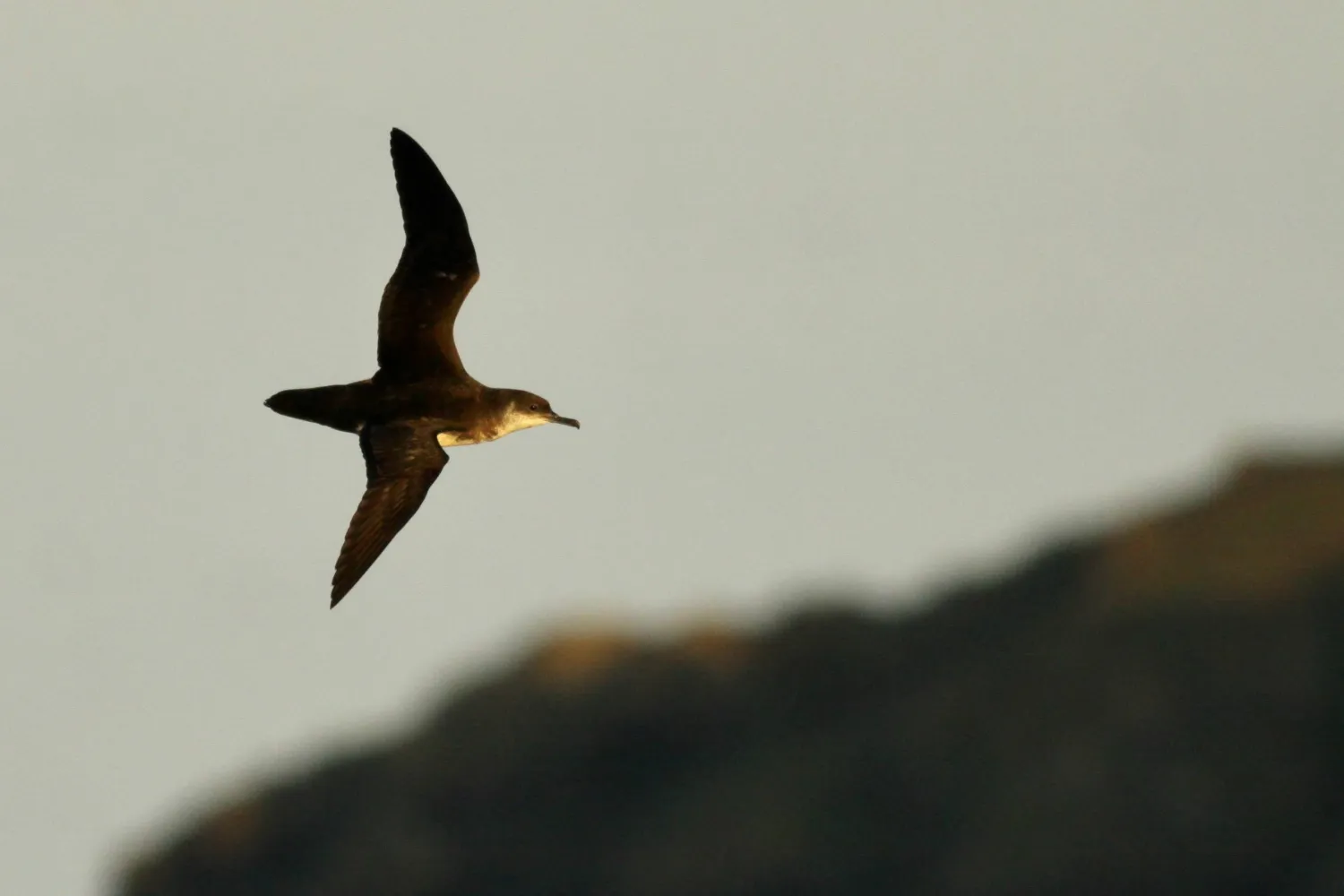
A Manx shearwater flies around Skomer Island, Pembrokeshire, Wales, Britain, in this handout image released on October 29, 2026. (Joe Wynn/Handout via Reuters)
TT

Long-Distance Flights Can Interfere with the Internal Clocks of Seabirds

A Manx shearwater flies around Skomer Island, Pembrokeshire, Wales, Britain, in this handout image released on October 29, 2026. (Joe Wynn/Handout via Reuters)

People who travel across many time zones, like a trip from London to Tokyo, may experience jet lag, with the body's internal 24-hour clock — the circadian rhythm — thrown out of sync with the local time at the arrival location. A new study shows that birds that fly long distances may experience a similar phenomenon that causes them to drift off course.

Research involving seabirds called Manx shearwaters found that crossing the Atlantic at speed can throw their internal clocks out of sync with local time, causing errors in the strategy they use to navigate their way home.

Birds can use several cues to find their way, including having the sun serve as a compass. A bird flying south sees the sun on its left at sunrise and on its right toward sunset, so it must keep adjusting its heading as the sun moves across the sky.

"Animals use an internal clock to do this, the ‌same one that tells ‌our bodies when to sleep, when to be active," said Patrick Lewin, a researcher ‌at ⁠the University of ⁠Oxford's Department of Biology and one of the leaders of the study published in the journal Science.

To investigate how the birds navigate across vast stretches of open ocean, researchers analyzed 20 years of GPS data from 1,045 breeding Manx shearwaters, birds that can travel as far as about 1,000 km (620 miles) west from colonies on islands off Britain on foraging trips.

Using the positions of the birds and the sun's movement across the sky, the researchers calculated the error each bird should make if its internal clock stayed set to the time at dawn. Across 335 homing flights made out of sight of land, the headings of the birds closely matched those ⁠predicted errors.

"The process behind what we're observing here — the mismatch between the internal clock ‌and external time caused by longitudinal movements — is exactly the same as what ‌causes jet lag in humans," Lewin said.

The researchers have not yet investigated whether the clock mismatch affects the birds beyond navigation. But internal clocks ‌influence behaviors including feeding and rest, raising the possibility that those too could be mistimed.

Shearwaters tend to hunt shortly ‌after dawn and before dusk, when fish and other prey are closer to the surface, meaning a mistimed rest period could cost them a feeding opportunity, Lewin said.

The study also showed that birds kept using their solar compass even when another source of information was readily available. Along coastlines, where familiar land could potentially guide them, their distance from shore still shifted in the direction predicted by clock-related sun-compass errors.

A ‌TWO-STEP PROCESS

"For most navigational tasks, it is thought that compass systems are used in conjunction with a map system in a kind of two-step process. In the map step, ⁠the animal determines where it is ⁠in relation to a goal, such as a home colony. Then in the compass step it uses a compass to translate that into movement," said Tim Guilford, a University of Oxford professor of animal behavior who was one of the study leaders.

The birds may continue to combine these systems even in familiar areas, rather than relying entirely on one or the other.

"If this only produces small deviations, there might not be strong selection against it," Lewin said.

Another possibility is that the sun compass helps the birds determine which way to go along the linear feature, Lewin said.

Even clouds may not render the sun compass useless. Evidence suggests that birds can sense polarized light and estimate the sun's position unless conditions are heavily overcast, Lewin said.

In people, jet lag can cause unpleasant short-term effects and has been linked to longer-term health problems in those who experience it frequently, such as airline pilots and flight attendants.

It is not yet known whether birds experience similar effects, but species such as shearwaters that regularly travel rapidly east-west may have evolved ways to cope with repeated disruption to their internal clocks, Lewin said.

"Knowing this phenomenon is occurring is only the first step, but perhaps these birds could teach us something about how to treat or avoid jet lag," Lewin said.


South Korea Education Chief Resigns Amid AI Cheating Scandal

South Korean Prime Minister Han Seongsook addresses the nation, announcing a series of measures to prevent cheating using AI in the nationwide college entrance exam, during a televised briefing at the Government Complex in Seoul, South Korea, Tuesday, Nov. 17, 2026. (Ahn Jung-won/Yonhap via AP)
TT

South Korea Education Chief Resigns Amid AI Cheating Scandal

South Korean Prime Minister Han Seongsook addresses the nation, announcing a series of measures to prevent cheating using AI in the nationwide college entrance exam, during a televised briefing at the Government Complex in Seoul, South Korea, Tuesday, Nov. 17, 2026. (Ahn Jung-won/Yonhap via AP)

South Korea's education minister resigned Sunday over an AI-assisted cheating scandal that erupted ahead of the country's key college entrance exams last week.

The country has been gripped by fears of AI-assisted exam cheating since last Sunday, when the top scorer in a national tax accountant exam confessed to using a miniature camera and smartphone to achieve a near-perfect score, just four days before the crucial college entrance exam known as the Suneung.

The annual nine-hour Suneung is widely seen as a ticket to prestigious universities, well-paid jobs and even better marriage prospects in the highly competitive country.

The confession sent officials scrambling to roll out a slew of preventive measures -- including blocking public Wi-Fi in testing areas and placing stickers over clothing buttons -- but Education Minister Choi Kyo-jin struggled to reassure the public, particularly after remarks he made three days before the exam.

"The exam concluded without any major incidents... However, as the minister in charge, I do not believe I am immune from public criticism that we failed to prepare adequately in advance," Choi wrote on X.

"Now that the exam is over, I take full responsibility and hereby offer my resignation," he added.

President Lee Jae Myung has accepted his resignation, the presidential office said.

Asked during a parliamentary hearing on Monday whether he was confident that authorities could catch would-be cheaters on exam day, the 72-year-old replied: "Due to my age, I am not confident I could."

His response quickly drew public backlash.

Choi did not appear at press conferences in the days leading up to Thursday's exam, where a vice minister instead announced the preventive measures.

Officials said 111 cases of misconduct involving electronic devices were identified during Thursday's exam, nearly half of which were detected through three emergency alerts sent by the government to identify smartphones that test takers had failed to hand over.


Japan-Europe Joint Probe Enters Mercury’s Orbit

This composite image provided by NASA/Johns Hopkins University Applied Physics Laboratory/Carnegie Institution of Washington on Oct. 22, 2013, shows Mercury as it appeared to the Messenger spacecraft following a flyby of the planet. (NASA/Johns Hopkins University Applied Physics Laboratory/Carnegie Institution of Washington via AP, File)
TT

Japan-Europe Joint Probe Enters Mercury’s Orbit

This composite image provided by NASA/Johns Hopkins University Applied Physics Laboratory/Carnegie Institution of Washington on Oct. 22, 2013, shows Mercury as it appeared to the Messenger spacecraft following a flyby of the planet. (NASA/Johns Hopkins University Applied Physics Laboratory/Carnegie Institution of Washington via AP, File)

After an eight-year-long trek through outer space, the Japanese-European joint BepiColombo probe has entered Mercury's orbit, the European Space Agency (ESA) said on Sunday.

On X, the ESA said that BepiColombo "achieved orbital capture" around the smallest and least understood planet in the Solar System after turning on the thrusters for more than half an hour.

The probe was already analyzing the data it had collected, the agency added.

Launched in 2018, the four-ton satellite had already crossed more than 10 billion kilometers and nine other planets en route to the closest planet to our Sun.

Earlier this year, ESA mission chief Santa Martinez told AFP that the mission was set to "offer humanity never-before-seen views of Mercury and open a new chapter in our understanding of the Solar System".

The European and Japanese portions of the probe are set to split from each other and go along their respective orbits on December 9 and 10, according to the mission plan.

The European portion is set to study the planet's surface, skimming just 480 kilometers (300 miles) above Mercury.

The Japanese part, meanwhile, will follow an elliptical orbit that will take it as far as 11,000 kilometers from the planet in a bid to learn more about Mercury's magnetic field.

Swinging between temperatures hitting as low as -180C and as high as 450C, Mercury is frequently bombarded by intense radiation from our Sun.

In 1974, NASA's Mariner 10 probe became the first to fly past the planet.


Scientists Report Strong New Evidence that Specially Bred Mosquitoes Can Fend Off Dengue

FILE - A mosquito feeds on a technician at the Salt Lake City Mosquito Abatement District on July 26, 2023, in Salt Lake City. (AP Photo/Rick Bowmer, File)
TT

Scientists Report Strong New Evidence that Specially Bred Mosquitoes Can Fend Off Dengue

FILE - A mosquito feeds on a technician at the Salt Lake City Mosquito Abatement District on July 26, 2023, in Salt Lake City. (AP Photo/Rick Bowmer, File)

Children who lived in Brazilian neighborhoods buzzing with a special kind of mosquito were far less likely to catch dengue or another worrisome virus, chikungunya, researchers reported Saturday.

The major study of more than 5,700 children in one of the world’s dengue hot spots offers new evidence that breeding mosquitoes unable to transmit these viruses can be a viable strategy rather than solely relying on pesticides and trying to avoid getting bitten.

In neighborhoods populated by these so-called Wolbachia-carrying mosquitoes, researchers found about a 69% reduction in dengue and chikungunya infections in schoolchildren compared to similar neighborhoods — an effect sustained even during Brazil’s severe 2024 dengue outbreak, said Dr. Sri Edupuganti of Emory University, part of the international research team.

According to The Associated Press, the researchers reported the findings at a meeting of the American Society of Tropical Medicine and Hygiene.

“This is really exciting,” said Dr. David Hamer, a global health expert at Boston University who wasn’t involved with the Brazilian study. He predicts that pairing more use of these Wolbachia mosquitoes with existing steps to fight mosquito-borne disease could “knock dengue down to much lower levels” in many places.

The latest research comes as Florida grapples with an unusually large outbreak of the virus, what appears to be the biggest in any US state since at least the 1940s.

Usually in the continental US, dengue is found mostly in people who traveled internationally. But as of Friday, Florida health officials had tallied more than 650 locally acquired cases, about three-quarters of them in Hillsborough County, home to Tampa.

Outside the US, the nonprofit World Mosquito Program has pioneered the Wolbachia strategy.

How it works: Scientists breed mosquitoes to carry a kind of bacteria called Wolbachia. It is harmless to people and common in many insects, although not dengue-carrying Aedes aegypti mosquitoes.

The bacteria dramatically reduce the mosquitoes’ ability to transmit certain viruses. Female mosquitoes spread the bacteria to their offspring, so releasing enough of the specially bred insects — males and females — into an area allows Wolbachia to gradually become established in the local mosquito population.

Field trials and other studies in Indonesia and elsewhere have shown the strategy can significantly lower dengue diagnoses. But because people with mild symptoms may not be diagnosed, the new study in Belo Horizonte, Brazil, went further. Researchers tested blood for signs of dengue, chikungunya or the Zika virus.

The four-year study compared children living in neighborhoods that all got the same pesticide and other mosquito-control interventions, but half were randomly assigned to have Wolbachia mosquitoes released into the area.

There were too few cases of Zika to calculate if the special mosquitoes had any effect on that disease.