Iraq's Intelligence Agency Faces Test of Political Rivalries

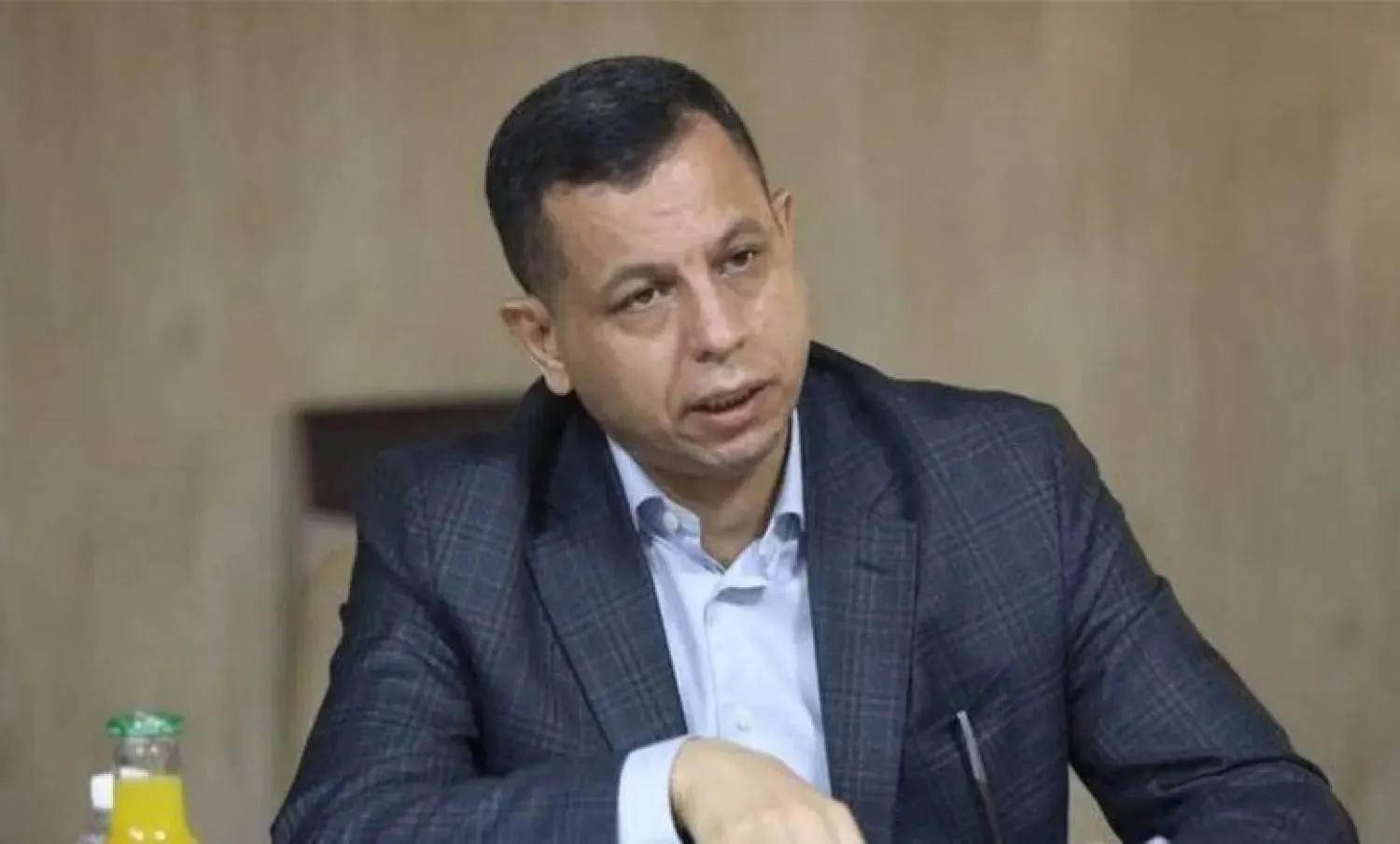
Dismissed Iraqi intelligence chief Hamid al-Shatri (Iraqi News Agency)
TT

Iraq's Intelligence Agency Faces Test of Political Rivalries

Dismissed Iraqi intelligence chief Hamid al-Shatri (Iraqi News Agency)

Iraqi Prime Minister Ali al-Zaidi's decision to take direct control of the country's intelligence agency after dismissing its chief, Hamid al-Shatri, has raised questions that go beyond a shake-up at one of Iraq's most powerful security institutions.

At stake is the distribution of sensitive posts among Iraq's political factions and the extent of their influence over the country's security establishment.

Al-Zaidi took charge of the agency on Thursday evening, three days after dismissing al-Shatri, who was appointed in December 2024 by former Prime Minister Mohammed Shia al-Sudani to replace Raed Jouhi.

The government said the dismissal was part of efforts to consolidate sovereignty and confront regional challenges, but gave no details about those challenges or how long al-Zaidi would remain at the helm.

The unusual move carries political implications that extend well beyond a change in leadership.

Al-Zaidi has declared that the intelligence agency "belongs to all Iraqis" and should be kept free from partisan, factional and sectarian quotas.

Yet by taking the top job himself rather than appointing a successor, he has effectively kept the position outside the political power-sharing arrangements that were expected to govern it, at least under unwritten agreements among Iraq's ruling factions.

Security restructuring

Political sources told Asharq Al-Awsat that the intelligence agency had been earmarked for Sunni Arabs under agreements to divide senior government posts, although no Sunni figure had yet been appointed to lead it.

The sources said al-Zaidi's decision to take charge could be aimed at shielding the agency's next chief from political infighting at a time of heightened regional tensions.

They said his "plans to restructure the security establishment are obstructing efforts to seize control of the agency."

Officials affiliated with Shi'ite political parties have led the agency for most of the period since 2003, apart from a brief stint under former officer Mohammed Abdullah al-Shahwani.

Sunni officials have held senior positions within the agency, however, including deputy director for operations, a post whose holder had faced incitement campaigns by Iran-aligned factions.

In March 2026, a drone struck the area around the agency's headquarters in Baghdad's Mansour district, killing one officer and causing damage inside the compound.

Unofficial security reports blamed outlawed armed factions for the attack, linking it to regional tensions between Iran and the United States.

A Sunni politician, speaking to Asharq Al-Awsat on condition of anonymity, said the intelligence agency belonged to the Sunni Arab share of senior posts under Iraq's sectarian and ethnic power-sharing system.

He said Sunni Arabs had "often been treated unfairly by the quota system, particularly in sensitive and security positions."

Their continued absence from such posts, he argued, exposed a gap between political rhetoric about citizenship and moving beyond the legacy of the past, and the reality of how power is exercised.

But the politician drew a distinction between al-Shatri's dismissal and al-Zaidi's takeover.

"The prime minister's decision to run the agency at this stage could prevent the dispute over the post from turning into a contest among political factions," he said.

Opening the position to nominations amid fierce political competition could have made agreement on a successor impossible, he added.

Intelligence agency caught between centralization and political quotas

Since 2003, Iraq's intelligence agency has been caught in the same struggle between professional and political interests that has shaped the country's state institutions.

Senior positions, including in security agencies, have frequently become bargaining chips in negotiations and rivalries among political factions, despite the different roles of security institutions and civilian bodies.

Political researcher Abbas Abboud said the blurring of administrative and political roles in Iraq's post-2003 state had weakened institutions and eroded their independence.

That overlap, he told Asharq Al-Awsat, had fueled partisan competition for control of institutions, from administrative offices to sensitive security agencies.

The intelligence agency had become another arena for that rivalry, he said, despite al-Zaidi's calls to keep it outside the political quota system.

The question now is whether al-Zaidi can turn his direct control of the agency into a broader effort to redefine the relationship between Iraq's political leadership and its security institutions.

The creation of an Office of the Commander-in-Chief of the Armed Forces, headed by former Interior Minister Lieutenant General Abdul Amir al-Shammari, signals a declared push to bring oversight of the security establishment more firmly under the prime minister.

But tighter central control does not necessarily mean greater professional independence, observers say.

That would also require clear rules on appointments, accountability and the limits of authority.

Talib Mohammed Karim, a political science professor at Al-Mustansiriya University, said protecting Iraq from regional and international conflicts required an intelligence agency capable of assessing the strategic landscape, anticipating shifts in conflicts and understanding their implications for national security, sovereignty and economic interests.

That, he told Asharq Al-Awsat, would require professional independence from partisan rivalries and coordination with security, diplomatic and economic institutions.

It would also require leadership with the authority and vision to run the agency in the national interest, rather than according to the calculations of competing political factions.


Putin Offers Burhan Help in Ending Sudan War

Russia's President Vladimir Putin, front left, and Abdel Fattah al-Burhan, front right, Chairman of the Transitional Sovereignty Council of Sudan, enter a hall for their talks on the sidelines of the Russia-Africa summit at the Grand Kremlin Palace in Moscow, Friday, Oct. 30, 2026. (Maxim Shipenkov/Pool Photo via AP)
TT

Putin Offers Burhan Help in Ending Sudan War

Russia's President Vladimir Putin, front left, and Abdel Fattah al-Burhan, front right, Chairman of the Transitional Sovereignty Council of Sudan, enter a hall for their talks on the sidelines of the Russia-Africa summit at the Grand Kremlin Palace in Moscow, Friday, Oct. 30, 2026. (Maxim Shipenkov/Pool Photo via AP)

Russian President Vladimir Putin announced Moscow's readiness to assist in ending the Sudanese war and establishing peace free of external dictates.

During their participation in the third Russia-Africa Summit in Moscow, Putin presented army commander and Chairman of the Transitional Sovereignty Council of Sudan Abdel Fattah al-Burhan with a roadmap to bolster bilateral cooperation across various economic and technical sectors.

Al-Burhan called for a strategic partnership with Russia, proposing the establishment of a free economic zone on the Red Sea coast.

This coincided with allegations by Sudanese Foreign Minister Mohieddin Salem that Ukrainian military personnel are participating in combat alongside the Rapid Support Forces.

In his address to the summit, al-Burhan said his government wants to achieve peace and stability in a manner that preserves the state's sovereignty, dignity, and unity, while fulfilling the aspirations of the Sudanese people.

Any solution must stem entirely from the will of the Sudanese themselves, he stressed.

He added that his government is working to pave the way for a civilian democratic transition through intra-Sudanese dialogue that aims to establish a sustainable foundation for political stability through a transitional period followed by free and fair elections under regional and international oversight.

Al-Burhan described the ongoing conflict in the country since April 2023 as a "war of aggression" waged by a "terrorist rebel militia."

He accused unnamed regional and international powers of providing political and logistical support to the RSF, while praising Russia's in support of Sudan's sovereignty, unity, and territorial integrity.

Noting that 70 years have passed since the establishment of diplomatic ties between the two countries, he reaffirmed his aspiration to develop them into a strategic partnership covering various fields.

For his part, Putin said that Russia values its historic ties with Sudan and attaches great importance to them, expressing Moscow's readiness to provide support to establish peace free of external dictates.

During a bilateral meeting on the sidelines of the summit, Putin stressed his country's backing for a cessation of hostilities and a transition to a political settlement.

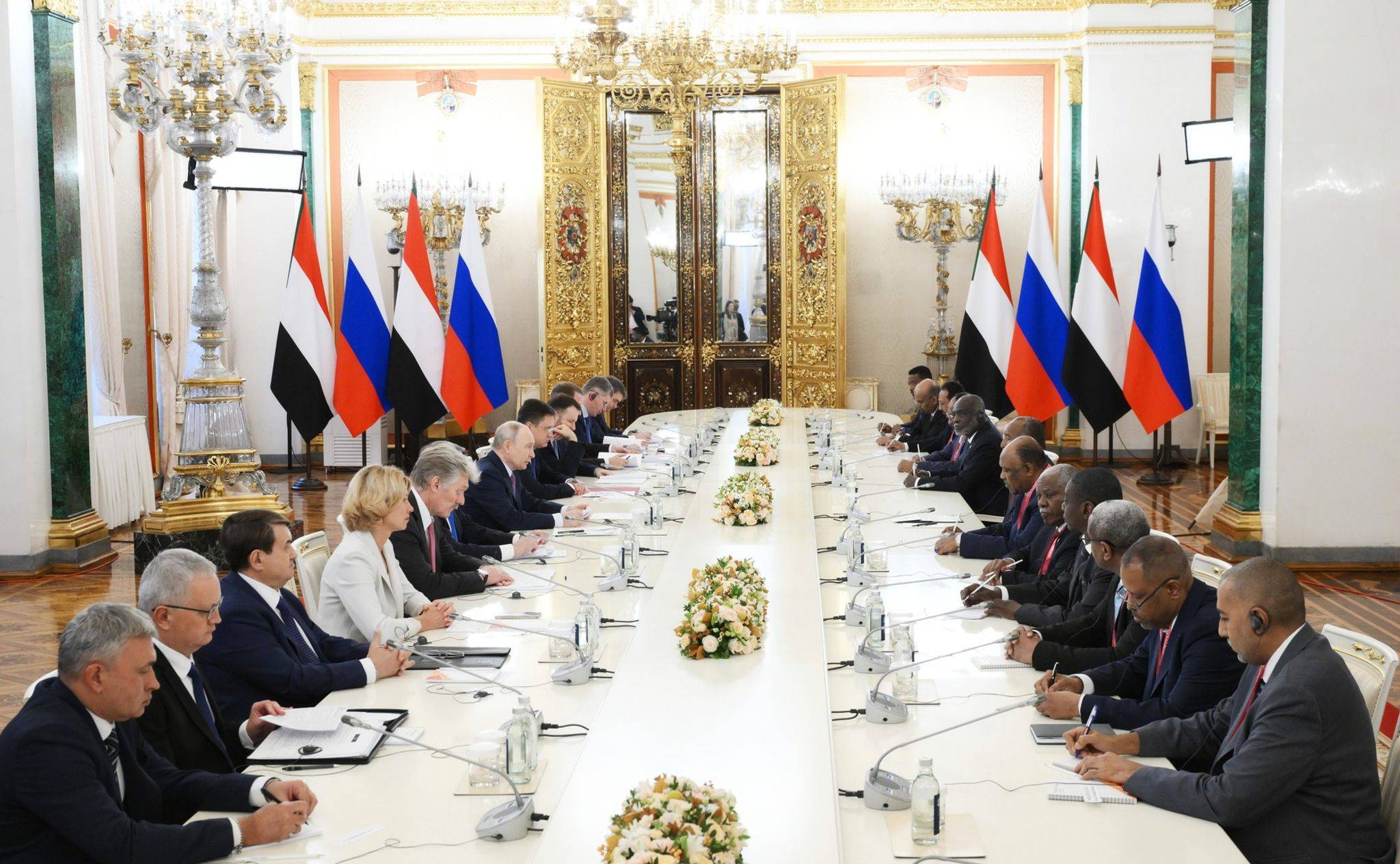
30 October 2026, Russia, Moscow: A general view shows talks between Russian President Vladimir Putin and Abdel Fattah al-Burhan, front right, Chairman of the Transitional Sovereignty Council of Sudan, on the sidelines of the third Russia-Africa summit. (Kremlin/dpa)

He pointed to the humanitarian repercussions of the conflict and the extensive damage inflicted on the Sudanese economy and infrastructure, according to the Russian news agency RIA Novosti.

Putin presented al-Burhan with what the Kremlin press office described as a "Russian roadmap" for bilateral cooperation, suggesting that the Sudanese government review it to identify projects aligning with its priorities.

The proposed sectors span trade, industry, and advanced technology, alongside the digital economy, healthcare, education, and logistics.

The Russian president also announced the allocation of 100 state-funded scholarships for Sudanese students at Russian universities for 2026, with plans to increase that figure to 140 next year.

No financial details or execution timelines were disclosed for the roadmap, which serves as a proposed framework rather than a final binding agreement.

In a move reflecting Khartoum's interest in expanding economic cooperation with Moscow, al-Burhan proposed the establishment of a free economic zone on the Red Sea coast, which Russia could utilize to set up fuel and wheat storage warehouses, reported Russian media.

Ukrainians taking part in war

Meanwhile, FM Salem accused Ukrainian military personnel of participating in combat alongside the RSF, revealing that Sudanese authorities detained some and killed others during military operations.

The Novosti news agency reported that Salem, who is accompanying al-Burhan on his visit to Moscow, claimed the detained Ukrainians included snipers and military trainers working with the RSF.

The minister accused Ukrainian specialists of training the RSF to operate drones, which he said are used to target civilian facilities and infrastructure.

Salem noted that Khartoum possesses evidence of Ukrainians, Colombians, and other foreign nationals participating in the fighting.

He also disclosed that he led a delegation to Washington last year, delivering documents to US officials that can prove American weapons reached Sudan through Ukraine and other sources.


Hezbollah and Lebanon's National Dialogue: 20 Years of Talks Over Its Weapons, No Deal on Implementation

Lebanon's national dialogue table (File photo)
TT

Hezbollah and Lebanon's National Dialogue: 20 Years of Talks Over Its Weapons, No Deal on Implementation

Lebanon's national dialogue table (File photo)

Former Progressive Socialist Party leader Walid Jumblatt's call for dialogue with Hezbollah on bringing all weapons under state control has reignited a long-running debate in Lebanon over whether another round of talks can resolve an issue that has defied successive national dialogue initiatives.

The divide is familiar: Supporters see dialogue as a way to avert confrontation, while critics argue it merely buys Hezbollah time. But the stakes have shifted, with the debate moving beyond the decades-old question of a "defense strategy" to government decisions asserting the state's exclusive authority over weapons.

The dispute dates back to the March 2006 national dialogue convened by Parliament Speaker Nabih Berri, when Hezbollah's arsenal became part of discussions over a national defense strategy. The July war interrupted those talks.

The issue resurfaced after the May 2008 clashes, when Hezbollah turned its weapons against domestic opponents. The subsequent Doha Agreement paved the way for the election of a president and a national unity government in which the opposition secured 11 of 30 cabinet seats, giving it the power to block decisions requiring a two-thirds majority.

The agreement included a pledge not to use weapons for political gains but stopped short of securing Hezbollah's disarmament.

Talks resumed under then-President Michel Suleiman, culminating in the June 2012 Baabda Declaration, which called for keeping Lebanon out of regional conflicts but left the weapons dispute unresolved.

In 2014, Hezbollah and the Future Movement launched bilateral talks in Ain al-Tineh to defuse sectarian tensions. Disagreements over the Baabda Declaration persisted through a meeting in Baabda in 2020.

The issue took a new turn in August 2025, when the government tasked the army with drafting a plan to bring weapons under exclusive state control. In March 2026, it banned Hezbollah's military and security activities and demanded that the group surrender its weapons.

Hezbollah Secretary-General Naim Qassem said on Oct. 6 that the group was ready to cooperate on bringing weapons under state control, provided the process followed the constitution and laws and was free of foreign dictates. He stressed that an Israeli withdrawal remained the priority.

Dialogue Entrenched the Imbalance of Power

Former lawmaker Fares Souaid argued that Lebanon's national dialogue initiatives had consistently worked in Hezbollah's favor, helping the group consolidate its arsenal and tighten its grip on political decision-making.

He said another round of domestic talks would be futile because the real decision-making power lay in Iran.

Any serious dialogue, he argued, should be with Tehran rather than Hezbollah as a Lebanese political actor.

Souaid told Asharq Al-Awsat that the Lebanese national dialogue that followed roughly 15 years of civil war and 150,000 deaths had produced constitutional changes and a new political and social compact embodied in the Taif Agreement.

Any subsequent dialogue, he said, should have focused on implementing Taif rather than undermining the foundations of Lebanon's postwar political system.

Souaid accused Hezbollah of exploiting regional and international power dynamics after May 7, 2008, when he said the group forcibly seized control of Lebanese political decision-making, to replace the Taif Agreement with the Doha Agreement.

While Taif rested on Muslim-Christian coexistence, he said, Doha entrenched the opposition's blocking third and veto power in the cabinet, allowing one political camp to obstruct government decisions.

He also criticized the national dialogue sessions held under then-President Michel Suleiman, saying they had become a vehicle for legitimizing an arrangement that contradicted both the constitution and Taif: allowing one Lebanese faction to retain its weapons under the banner of defending Lebanon against Israel.

Arab parties that had been expected to participate in those talks ultimately did not attend, he added.

Souaid dismissed subsequent initiatives, including the Baabda Declaration, as largely symbolic exercises that neither altered the balance of power nor restored sovereign decision-making to state institutions.

He offered a more specific explanation for the bilateral talks between Hezbollah and the Future Movement in Ain al-Tineh.

Their purpose, he said, was to shield Lebanon from escalating Sunni-Shi'ite tensions as sectarian divisions threatened to engulf the region.

The aim was to prevent that turmoil from spilling into Lebanon.

But Souaid argued that dialogue between Hezbollah and other Lebanese factions, including the Lebanese Forces, the Progressive Socialist Party, the Amal Movement and the Future Movement, had ultimately favored the armed group.

He maintained that any talks between the Lebanese state and Hezbollah today should, in reality, be conducted between Lebanon and Iran.

Repeating the domestic dialogue formula, he said, would be pointless because Hezbollah lacked the freedom to make its own decision on whether to negotiate.

That decision, he argued, rested with Tehran.

From 'Defense Strategy' to Executive Action

Political researcher and academic Hayat Hariri said the long-running debate over a national defense strategy had become an exercise in indecision, buying time and postponing decisive state action.

The fundamental mistake, she argued, was placing a question of national security in the hands of political party leaders and sectarian figures rather than the institutions responsible for defending the state.

"The Lebanese state and its institutions, not political parties, are responsible for formulating the defense strategy," Hariri told Asharq Al-Awsat.

She said that responsibility belonged to the constitutional authorities, the Defense Ministry and the army command.

Turning national security into a debate among political factions, she argued, had allowed those responsible to evade decisions and buy time.

Hariri said Hezbollah had never been troubled by discussions over its weapons. Far from resisting dialogue, the group had encouraged it, advancing proposals that made its arsenal a central pillar of any defense strategy and envisaged the state's military and security apparatus coordinating with Hezbollah on terms aligned with its interests.

The resulting documents, she argued, helped Hezbollah portray itself as open to cooperation with the state.

As long as opposition to its weapons remained verbal, dialogue posed little threat to the group.

Hariri said successive government policy statements had also provided Hezbollah with political cover for its arsenal under the banner of "resistance".

But she drew a distinction between those earlier debates and the decisions taken by Prime Minister Nawaf Salam's government.

The government, she said, had crossed a red line in its relationship with Hezbollah by moving from political discussion to executive decisions.

The decisions had yet to be implemented, she acknowledged, but their significance should not be confused with the state's ability to enforce them.

Hariri linked that shift to Hezbollah's increasingly fierce attacks on the government and accusations that its opponents were collaborating with Israel.

She said the group was seeking the reversal of the Aug. 5 and Aug. 7 decisions on exclusive state control over weapons, along with the ban on its military activities, as a precondition for renewed dialogue.

Accepting those demands, she warned, would send Lebanon back into lengthy discussions over a defense strategy without producing tangible results.

She also criticized proposals framed around "restricting", "freezing" or "containing" weapons unless they were backed by concrete steps.

For Hariri, the central dispute is not simply whether Hezbollah's arsenal can be incorporated into the state's defense structure, but who would control it.

She argued that Hezbollah wanted its weapons integrated into the state's system while retaining the authority to control them and decide when to use them, rather than surrendering exclusive military decision-making power to Lebanese state institutions.


Armed Faction Warns US Against Using Iraqi Airspace to Attack Iran

Fighters lift flags of Iraq and armed factions during a funeral in Baghdad for five militants killed a day earlier in a US strike in northern Iraq, on December 4, 2023. (AFP)
TT

Armed Faction Warns US Against Using Iraqi Airspace to Attack Iran

Fighters lift flags of Iraq and armed factions during a funeral in Baghdad for five militants killed a day earlier in a US strike in northern Iraq, on December 4, 2023. (AFP)

An armed Iraqi faction warned on Friday the US against using Iraqi airspace to attack Iran.

Harakat Ansar Allah al-Awfiya is led by Haidar al-Gharawi, a leading member of the Coordination Framework.

It warned that using Iraq to attack Iran “would be viewed as a violation that demands that the faction retaliate against the US.”

Faction spokesman Ali al-Fatlawi said it would remain neutral so long as Iraq is not used as a launchpad to attack any neighboring country.

Washington is demanded to refrain from violating Iraq’s airspace, he said, according to Shafaq News.

“Any violation of Iraqi sovereignty will be met with a response by the faction,” he warned.

The so-called “Islamic Resistance in Iraq” said it had registered dozens of US air force violations of Iraqi airspace in recent days.

Al-Fatlawi added that the faction has not handed over its weapons to the state, saying the government decision set the deadline for “organizing the arms” and not “surrendering” them to June 2027.

Prime Minister Ali al-Zaidi had in early October warned the Framework against failing to commit to the deadline.