G20 Foreign Ministers to End Atlanta Meeting without Consensus on Key Issues

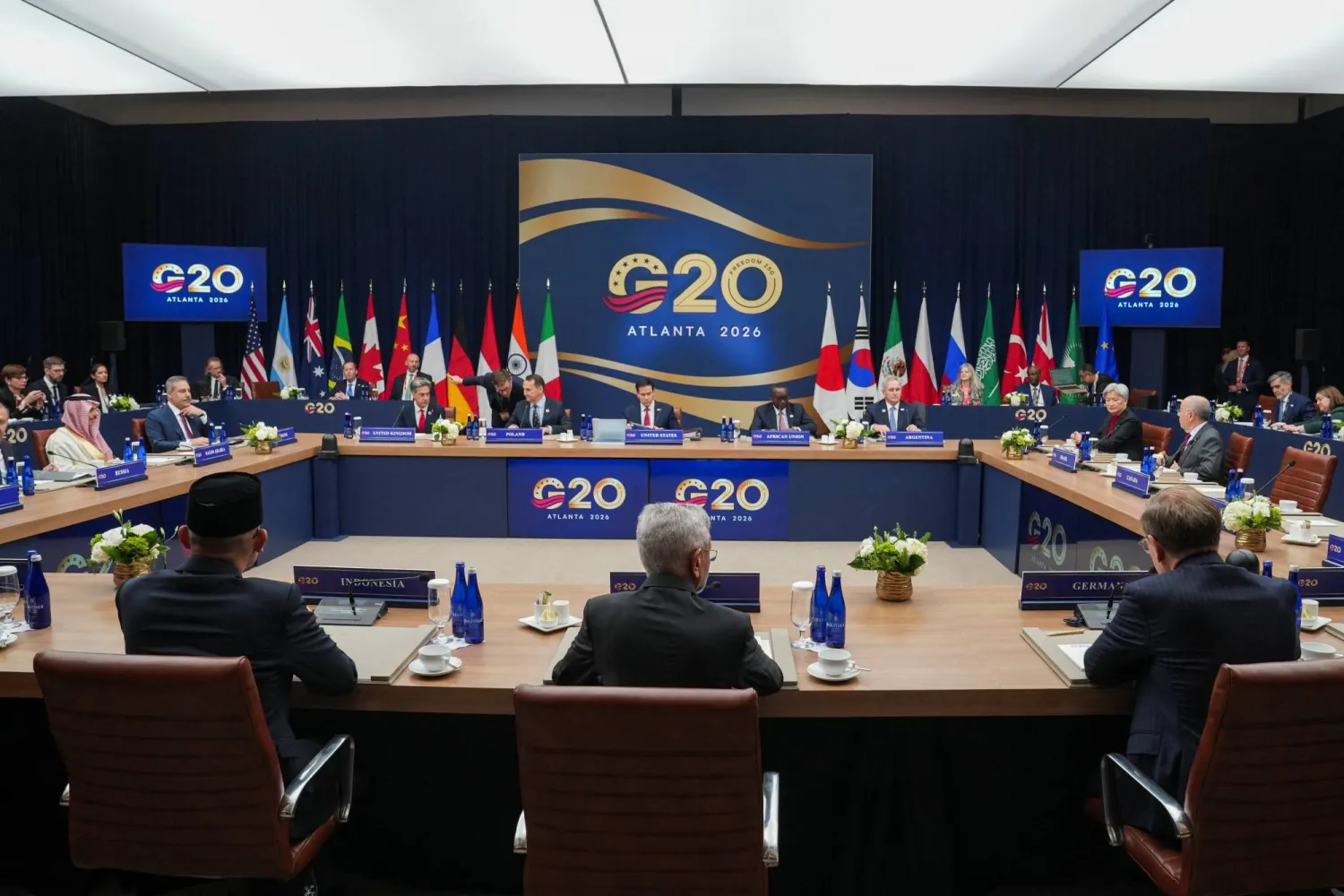
Saudi Arabia's Foreign Minister Faisal bin Farhan, Turkey's Foreign Minister Hakan Fidan, Britain's Foreign Secretary Ed Miliband, Poland's Foreign Minister Radoslaw Sikorski, US Secretary of State Marco Rubio, Chair of the African Union Executive Council Edouard Bizimana and others attend the G20 Foreign Ministers' Meeting in Atlanta, Georgia, US, October 30, 2026. REUTERS/Megan Varner/Pool
TT

G20 Foreign Ministers to End Atlanta Meeting without Consensus on Key Issues

Saudi Arabia's Foreign Minister Faisal bin Farhan, Turkey's Foreign Minister Hakan Fidan, Britain's Foreign Secretary Ed Miliband, Poland's Foreign Minister Radoslaw Sikorski, US Secretary of State Marco Rubio, Chair of the African Union Executive Council Edouard Bizimana and others attend the G20 Foreign Ministers' Meeting in Atlanta, Georgia, US, October 30, 2026. REUTERS/Megan Varner/Pool

Top diplomats from the Group of 20 largest world economies will wrap up two days of talks in Atlanta on Saturday without reaching consensus on several critical global security issues after divisions, notably over Russia's war with Ukraine, overshadowed the start of the meeting.

As a result, the group will not release a joint communique but will rather rely on a chairman’s statement summarizing the talks, which Secretary of State Marco Rubio will release at the conclusion, according to diplomats who attended.

Rubio, who opened the talks with an appeal for unity, had canceled the traditional group photo of the foreign ministers on Friday after European diplomats objected to the inclusion of Russian Foreign Minister Sergey Lavrov and threatened to boycott or walk out of the snapshot that often kicks off such gatherings, The Associated Press said.

Polish Foreign Minister Radosław Sikorski, who was representing his country for the first time as a guest at a G20 meeting, said Friday he was not surprised by the failure to reach consensus.

“We have wars going on, and we have participants in those wars around the table, so it’s very difficult to agree on a common line,” he told reporters.

Other participants in the meetings, who spoke on condition of anonymity because they weren’t authorized to discuss the closed-door talks, said all had agreed to try to overcome their differences despite the long odds and to work to make next month’s G20 leaders summit hosted by President Donald Trump in Florida a success.

These diplomats said a chairman's statement had long been the plan due to the deep differences among the attendees, including over the Russia-Ukraine conflict, the US-Israeli war against Iran, US tariffs and Chinese machinations in the South China Sea. All have contributed to spikes in the global cost of fuel as well as uncertainty about trade.

They described the opening session as cordial but said Russia’s position on Ukraine is unyielding — as is its opposition to Poland’s membership in the G20. And they said the disagreements also include the Trump administration’s not inviting G20 member South Africa over the objections of others.

Russia’s presence at G20 gathering roils Europeans

Some G20 countries had already expressed concern that the US invited Russia during its heightened attacks on Ukraine, especially after Trump pushed ties with Ukraine to new lows by waiving fresh sanctions on Moscow and temporarily limiting logistical and intelligence assistance.

However, the State Department announced Friday that it had approved a proposed $2.1 billion sale of Patriot air defense interceptors for Ukraine.

Lavrov said Moscow will not allow a situation in which Ukraine poses a “military threat to legitimate security interests of the Russian Federation."

Lavrov has traveled only infrequently to NATO member states since Russia invaded Ukraine in February 2022 and resulting severe sanctions were imposed on Moscow, and it is unclear if Russian President Vladimir Putin will accept Trump’s invitation to attend the G20 leaders summit at his Miami golf club in December.

The Iran war hangs over the G20 event

The US has said a top priority for the meeting is resolving differences over issues related to freedom of navigation, particularly in the Strait of Hormuz, the Red Sea, the Black Sea and the South China Sea. The topic will include discussions on Iran, Russia-Ukraine and China and its smaller neighbors.

But hanging over the meeting is the prospect of new US military intervention in Iran, which has put the region on edge. Rubio met on the sidelines with his Saudi counterpart, Prince Faisal bin Farhan, as well as Turkish Foreign Minister Hakan Fidan, whose country has been a key mediator.

The Associated Press has reported that US officials have told several Middle East countries and regional allies to be prepared for potential renewed military strikes against Iran after Tuesday’s midterm elections and the possibility that Iran will retaliate against them.


France Heads into Third Weekend of Protests as Youth-led Rallies Sweep Europe

FILE PHOTO: Protesters taking cover behind a plywood board face off with French gendarmes amid clashes during demonstration organized by labor unions in Paris as part of nationwide protests called by the "Yellow Vests" movement joined by French high school and university students against the cost of living and rising fuel prices, in France, October 24, 2026. REUTERS/Abdul Saboor/File Photo
TT

France Heads into Third Weekend of Protests as Youth-led Rallies Sweep Europe

FILE PHOTO: Protesters taking cover behind a plywood board face off with French gendarmes amid clashes during demonstration organized by labor unions in Paris as part of nationwide protests called by the "Yellow Vests" movement joined by French high school and university students against the cost of living and rising fuel prices, in France, October 24, 2026. REUTERS/Abdul Saboor/File Photo

France prepared Saturday for a third consecutive weekend of protests over living costs and education, deploying 70,000 police and gendarmes and pushing the Paris march to the capital’s edge as youth-led demonstrations spread across Europe.

Interior Minister Laurent Nuñez warned of a “very high risk” of disorder, especially after dark on Halloween.

Paris police banned union and yellow vest marches through the city center Friday, ordering demonstrations to follow a single route along the capital’s outer boulevards, from Porte de Bagnolet to Porte de Charenton. Unions and student groups challenged the restrictions in court, said The Associated Press.

President Emmanuel Macron said Monday marches would stay out of city centers to protect shops.

Police also barred entry to the Place de la Republique and Les Halles, both hit by rioting and looting on Oct. 17, from 11 p.m. to 6 a.m. Saturday and Sunday nights.

Unaccompanied minors face a separate 9 p.m. curfew around the Champs-Elysees. A Paris court on Wednesday suspended an earlier curfew on minors as a serious and illegal infringement of freedom of movement.

The movement began with high school students protesting school conditions and broadened into anger over living costs.

Authorities counted about 550,000 marchers on Oct. 17, when rioters looted hundreds of shops, and 410,000 last Saturday, when protests were largely peaceful but police made more than 1,300 arrests.

In Germany, a youth initiative called “Gen Z regelt” — roughly “Gen Z’s got this” — urged protests in some 30 cities “for education, health, climate protection and an affordable life,” and against any return of military conscription. Organizers said more than 140,000 people signed up online.

Berlin police expect about 10,000 people at the Brandenburg Gate. Some shops on the Kurfuerstendamm boulevard boarded up windows, although authorities said they were unaware of specific threats of violence.

In Barcelona, Spain, Catalan police planned their highest-level alert after an anonymous TikTok network called Blocus urged new gatherings. Rioting there last Saturday led to about 130 arrests, mostly of minors.

Italian police were on alert after clashes in Milan, Turin and Bologna, and calls to protest circulated on TikTok in Belgium, the Netherlands, Austria, Switzerland and Portugal.


US Approves $2.1 Billion Patriot Missile Sale to Ukraine

Surface-to-air missile launcher of the Patriot system, newly added to the Integrated Battle Command System (IBCS) stands at an army base in Sochaczew, Poland, December 18, 2024. (Reuters)
TT

US Approves $2.1 Billion Patriot Missile Sale to Ukraine

Surface-to-air missile launcher of the Patriot system, newly added to the Integrated Battle Command System (IBCS) stands at an army base in Sochaczew, Poland, December 18, 2024. (Reuters)

The US State Department said on Friday it had approved the sale of 500 Patriot PAC-3 missiles to Ukraine for an estimated $2.1 billion, in what would be one of the most significant steps to supply defensive weapons to Kyiv since the start of the second Trump administration.

Delayed missile deliveries have added to Ukraine's tensions with the US after President Donald Trump announced a diesel deal with Russia and criticized Ukrainian President Volodymyr Zelenskiy for Ukraine's unwillingness to stop attacks on Russian refineries.

Ukraine has long said it urgently needs more missile interceptors to knock down the growing waves ‌of missiles Russia's military ‌fires at the country. The Patriot missile system is the most effective ‌weapon ⁠to counter fast-moving ballistic ⁠missiles.

On Thursday, a Russian drone strike killed at least 14 people on a crowded rail platform in the Ukrainian city of Dnipro, while five died in daytime strikes on two other provincial cities and a late-evening missile strike killed 1 person in the capital Kyiv, officials said.

Zelenskiy said on Monday that Ukraine had been waiting for almost a month for the US to sign off on critical missile supplies, as Russia stepped up attacks on energy and civilian infrastructure.

But despite Ukraine's urgency, it will likely not receive the missile ⁠interceptors quickly. Weapons sales typically take years to fulfill, and two people ‌briefed on the US decision said the missiles — which are ‌yet to be manufactured — are not expected to be delivered until a couple of years into the 2030s.

One ‌of the people said Ukraine's Ministry of Defense is encouraging the Pentagon to bring forward the ‌delivery date, possibly by giving Kyiv missiles already in the US arsenal and backfilling with the new Patriot interceptors.

Ukraine will pay for the missiles with contributions from Canada, Germany and Norway routed through a program called US JUMPSTART, along with national funds financed by the European Union's Ukraine Support Loan, the State Department said in a statement.

The program ‌uses donations from allies to buy weapons, services and training for Ukraine to support its self-defense following Russia's invasion, according to a Pentagon website.

The ⁠JUMPSTART program was used ⁠in August to buy 3,350 air-launched cruise missiles worth $825 million made by Zone 5 Technologies and CoAspire.

Lockheed Martin is the principal contractor for the sale of the Patriot interceptors.

The US has supplied large quantities of weapons to allies while also using munitions in its own military operations in Iran, raising concerns about inventories of key air defense and precision-guided weapons.

In July, the US Army awarded Lockheed a contract worth up to $58.6 billion to produce Patriot interceptor missiles.

Lockheed has said that deal would allow it to follow through on a promise to triple PAC-3 MSE production capacity by the end of 2030 and increase jobs at its Camden, Arkansas, plant by 50%, to about 1,850 from 1,200. Lockheed previously announced Patriot PAC-3 missile interceptor production would go to 2,000 units annually.

Pentagon negotiators are pressing contractors to move much faster, with tentative production agreements struck earlier this year at the center of efforts to increase missile output.


US, S.Korea, Japan Vow ‘Complete’ N.Korea Denuclearization

 South Korea Foreign Minister Cho Hyun arrives for the G20 Foreign Ministers meeting Friday, Oct. 30, 2026, in Atlanta. (AP)
South Korea Foreign Minister Cho Hyun arrives for the G20 Foreign Ministers meeting Friday, Oct. 30, 2026, in Atlanta. (AP)
TT

US, S.Korea, Japan Vow ‘Complete’ N.Korea Denuclearization

 South Korea Foreign Minister Cho Hyun arrives for the G20 Foreign Ministers meeting Friday, Oct. 30, 2026, in Atlanta. (AP)
South Korea Foreign Minister Cho Hyun arrives for the G20 Foreign Ministers meeting Friday, Oct. 30, 2026, in Atlanta. (AP)

The United States, South Korea and Japan reaffirmed their commitment to the "complete denuclearization" of North Korea on Saturday, as Pyongyang continues to reject disarmament ahead of possible talks with Washington.

Speculation is mounting over a potential meeting between US President Donald Trump and North Korean leader Kim Jong Un at next month's APEC summit in China, with Trump making repeated overtures to Pyongyang for nuclear talks.

US Secretary of State Marco Rubio, South Korean Foreign Minister Cho Hyun and his Japanese counterpart Toshimitsu Motegi "reaffirmed their resolute commitment to the complete denuclearization" of North Korea during talks on Friday on the sidelines of a Group of 20 (G20) meeting in Atlanta in the US state of Georgia, the US State Department said.

They also pledged "full implementation" of UN Security Council resolutions, including a ban on supporting revenue for North Korea's nuclear and ballistic missile programs.

Despite long-running UN sanctions, North Korea, which is backed by Russia and China, has enshrined its status as a nuclear-armed state in law, with its regime repeatedly declaring its atomic arsenal permanent and irreversible.

- Open to meeting -

Trump has made repeated overtures to Pyongyang for nuclear talks, while scaling back joint military drills with ally South Korea.

The mercurial US leader even bucked long-held US policy last year by conceding that North Korea was already "sort of a nuclear power", while reaching out to Pyongyang for talks, saying he was "100 percent" open to a meeting -- a suggestion that went unanswered.

Analysts and South Korea's spy agency say Kim may have conveyed Pyongyang's position on potential talks with Trump to Beijing during a recent visit to the Chinese border city of Dandong.

South Korea's dovish President Lee Jae Myung -- who has repeatedly offered Pyongyang talks without preconditions -- suggested in September that Washington seek a freeze, rather than the immediate elimination, of the North's nuclear program in return for sanctions relief.

Critics have said such an approach risks tacitly accepting North Korea as a nuclear-armed state while allowing Pyongyang to win sanctions relief without giving up its arsenal.

Analysts say China may also be moving towards tacit acceptance, pointing to the omission of North Korean denuclearization from statements after Kim and Chinese President Xi Jinping met in June.

Pyongyang denounced a joint statement on Saturday by a group of nations monitoring sanctions implementations against it, vowing that "the stereotyped sanctions racket of the US and the West can neither influence the position of the DPRK (North Korea) as a nuclear weapons state".