


US Oil Companies Aim to Squeeze More Out of Refineries

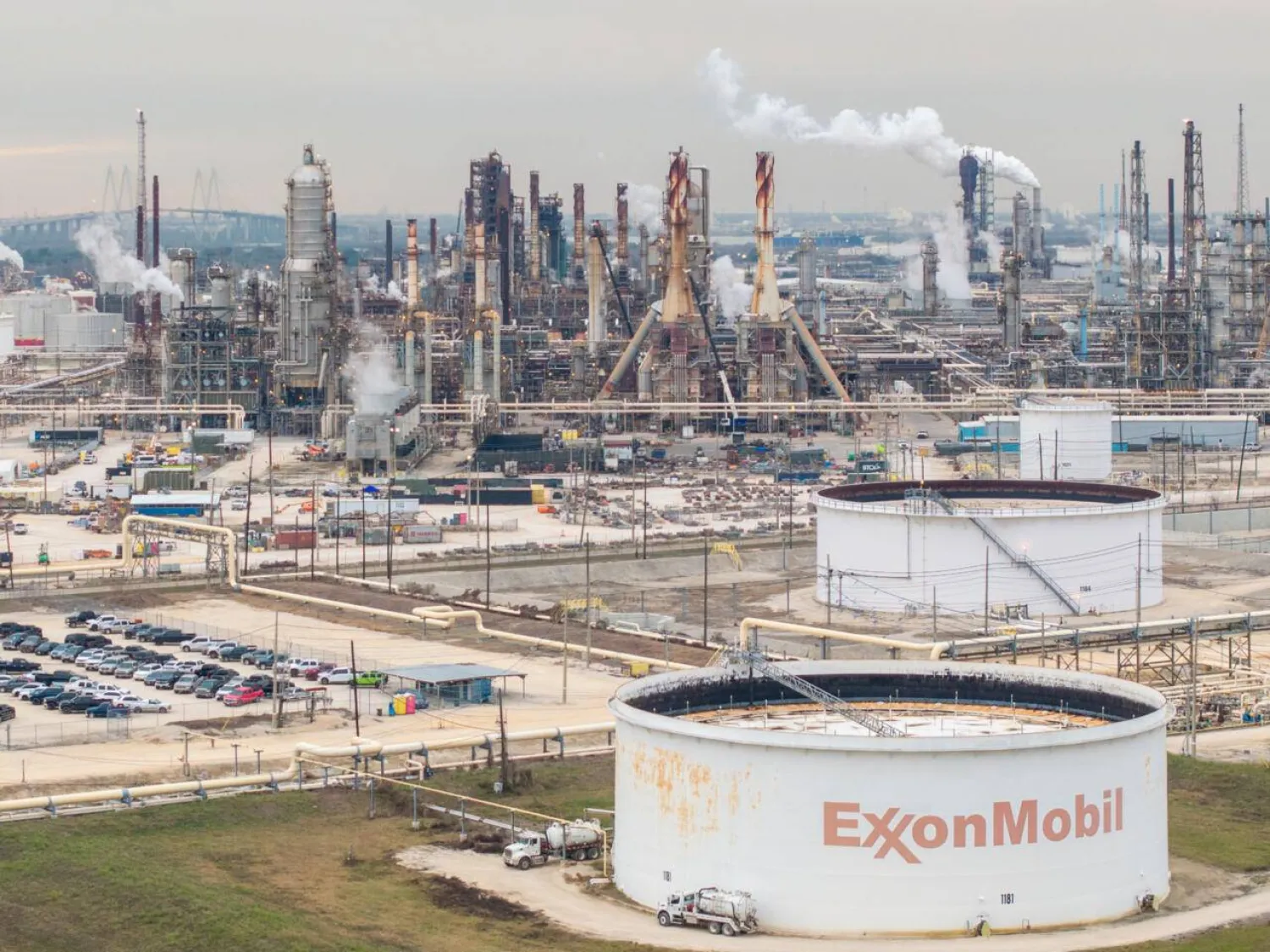
ExxonMobil said its refinery in Baytown, Texas is one of the plants being targeted to boost supply of petroleum products. Brandon Bell / GETTY IMAGES NORTH AMERICA/AFP/File
TT

US Oil Companies Aim to Squeeze More Out of Refineries

ExxonMobil said its refinery in Baytown, Texas is one of the plants being targeted to boost supply of petroleum products. Brandon Bell / GETTY IMAGES NORTH AMERICA/AFP/File

US oil companies are investing to squeeze out more fuel from refineries and bringing shuttered plants back online in response to conflicts in Russia and Iran that have crimped supplies.

ExxonMobil Chief Executive Darren Woods said Friday the company had achieved "record fuels utilization" outside of the Middle East, pointing to 100 percent crude utilization at US Gulf Coast refineries.

The statements come as US gasoline prices remain above the politically sensitive $4 per gallon level and as diesel prices linger near all-time highs above $6 per gallon.

"In the third quarter, we continued to rise to the challenge of meeting global energy needs," Woods said in a press release.

But Woods told analysts on an earnings conference call that there were a "lot of variables" behind the crunch in supply of diesel and other key refined items. Besides lost capacity in the Middle East and Russia from Ukrainian drone strikes, Woods cited a decline in Chinese refined output.

"My guess would be it will take certainly well through to next year before we see things getting back closer to normal," he said. "But it could be longer than that."

US rival Chevron said it achieved record throughput at refineries during the quarter.

"We're reinvesting to bring more energy to a supply-constrained market," said Chief Executive Mike Wirth.

But about 10 percent of the world's refining capacity remains off line, said Chevron Vice Chairman Mark Nelson.

"I would expect margins to eventually moderate as refinery runs recover and export flows increase," Nelson said on a conference call. "But that will take some time."

Both companies reported a more than doubling of quarterly profits Friday as oil giants reap financial rewards from spiking commodity prices and refinery margins. Steep price increases and supply shortfalls in some cases have sparked protests in parts of Asia, Latin America and Europe.

- Russian refining hit -

Executives have pointed to a cutback in output from Asian plants as Iran's blockage of shipments through the Strait of Hormuz has taken key crude oil off the market.

Another factor has been attacks by Ukraine on Russian plants, which had accounted for 6.5 percent of global refining capacity in 2025, according to KPMG.

The International Energy Agency said in September that just five Russian refineries remain unaffected by a barrage of drone attacks launched by Ukraine since the Russian invasion in 2022.

Russia's normal volume of 6.5 million barrels a day at 32 refineries had fallen to just 3.8 million barrels per day, its lowest level in 20 years, according to the IEA.

An October 21 report from Rystad Energy warned that Russia could become a net importer of gasoline and diesel in 2027.

On Friday, Russia's deputy prime minister for energy issues, Alexander Novak, told a reporter from state TV that Ukraine had resumed attacks on Russian plants, hitting three oil refineries and one gas-chemical complex.

On Friday, ExxonMobil's profits for the third quarter came in at $15.4 billion, slightly more than double the $7.5 billion in the year-ago period, while Chevron's profits were $9.9 billion, compared with $3.5 billion in the year-ago quarter.

But surging prices of gasoline and diesel have become a political albatross for US President Donald Trump, whose administration has pressed oil companies to take actions to soften the blow on consumers.

The US oil companies pointed Friday to steps to boost capacity. ExxonMobil spent around $17 billion on refining to boost capacity, including expansions at a plant in Beaumont, Texas, with work ongoing at another plant in Baytown, Texas.

Such investments are expected to add 100,000 barrels per day of additional distillate capacity, Woods said.

US refiner Valero Energy announced Friday that it reached a deal to acquire a shuttered Houston refinery from LyondellBasell for $320.5 million. It plans an initial restart by the end of 2027.

"This acquisition is a unique opportunity to strategically expand Valero's US Gulf Coast footprint at a fraction of replacement value and enhance the long-term strength of our refining system," said Valero CEO Lane Riggs.



Oil On Track for First Weekly Gain in November on Supply Fears

 Flames emerge from flare stacks at the oil fields in Kirkuk, Iraq October 18, 2017. REUTERS/Alaa Al-Marjani/File Photo
Flames emerge from flare stacks at the oil fields in Kirkuk, Iraq October 18, 2017. REUTERS/Alaa Al-Marjani/File Photo
TT

Oil On Track for First Weekly Gain in November on Supply Fears

 Flames emerge from flare stacks at the oil fields in Kirkuk, Iraq October 18, 2017. REUTERS/Alaa Al-Marjani/File Photo
Flames emerge from flare stacks at the oil fields in Kirkuk, Iraq October 18, 2017. REUTERS/Alaa Al-Marjani/File Photo

Oil prices were set to snap a three-week losing streak on Friday, on track for their first weekly gain in November.

Brent crude futures fell $1.42 to $95.20 a barrel by 10:16 a.m. ET (1516 GMT). Brent hit its highest since November 9 earlier in the session, but stayed shy of the $100 mark.

US West Texas Intermediate crude futures at $83.74 a barrel were up 5 cents, or 0.06%, from Wednesday's close. There was no Thursday settlement for WTI because of the US Thanksgiving holiday.

"Attacks on Middle Eastern energy facilities and tankers have brought supply disruption back into focus," said Mark Schaefer, a director at brokerage Liquidity Energy, Reuters reported.

Prices retreated in recent weeks as investors were relieved that US President Donald Trump did not step up military action against Iran after the midterm elections.

However, Iran has continued to attack ships transiting the key Strait of Hormuz, disrupting oil exports, while Yemen's Houthis have struck Saudi Arabian infrastructure.

Saudi Aramco's Jazan refinery temporarily halted some operations after a projectile struck it on Thursday, killing a worker, Saudi Arabia's Energy Ministry said.

OPEC+ is set to keep first-quarter 2027 output targets unchanged when the group meets on Sunday, three people with knowledge of the talks said.


Taiwan's Economy Expected to Grow at its Fastest Rate in Nearly 50 Years

A woman rides past poster of Taipei Mayor Chiang Wan-an displayed on a public transport bus in Taipei on November 27, 2026. (Photo by Punit PARANJPE / AFP)
TT

Taiwan's Economy Expected to Grow at its Fastest Rate in Nearly 50 Years

A woman rides past poster of Taipei Mayor Chiang Wan-an displayed on a public transport bus in Taipei on November 27, 2026. (Photo by Punit PARANJPE / AFP)

Taiwan's tech-reliant economy is expected to expand at its fastest rate in almost half a century this year thanks to continued strong AI demand, the government said on Friday, but US export controls and AI regulation could cloud the outlook.

Gross domestic product is now expected to be 13.28% higher than a year earlier, up from a forecast of 11.05% in August, the Directorate General of Budget, ⁠Accounting and Statistics ⁠said, according to Reuters. That would be the fastest growth since 1978, when GDP grew 13.56%.

Taiwan plays a leading role in fulfilling the demand for AI chips and technology from firms like Nvidia and Apple, with the island being home to the world's largest contract chip manufacturer, Taiwan Semiconductor Manufacturing Co.

For next year, it said it ⁠expected Taiwan's economy to grow 6.51%, upgrading its August prediction of 6.04%.

The agency warned of key uncertainties, including possible tighter US AI regulation and export controls, and the impact of rising financing costs.

There is also uncertainty over US tariff policy, it added.

Demand for AI already drove Taiwan's economy in 2025 to expand 8.76%.

While exports have shown no sign of weakening, there will be a greater risk next year because of a possible slowdown in demand from US clients, President Capital Management Chief Economist Lu ⁠Cheng-tao said.

"Based ⁠on current orders, there is no major problem. However, purchasing momentum in the first half of next year could very likely change," he added.

The statistics agency expects 2026 exports to rise 46.67% from a year earlier, versus a previously forecast 41.07% expansion, and said for next year exports would increase 18.63%, slightly below the prior prediction of 18.7%.

It revised up slightly its third-quarter 2026 economic growth view to 14.39% from a preliminary reading of 14.36%. It also kept its 2026 consumer price index forecast at 2.07%, slightly above the central bank's 2% target.


Gold Gains Nearly 3% as Dollar Rally Stalls, Equities Stabilize

FILE PHOTO: UK gold bullion bars are stacked at Baird & Co in Hatton Garden in London, Britain, October 8, 2025. REUTERS/Hiba Kola/File Photo/File Photo
TT

Gold Gains Nearly 3% as Dollar Rally Stalls, Equities Stabilize

FILE PHOTO: UK gold bullion bars are stacked at Baird & Co in Hatton Garden in London, Britain, October 8, 2025. REUTERS/Hiba Kola/File Photo/File Photo

Gold prices rose nearly 3% on Friday, recovering from a more than one-year low, supported by a pause in the dollar's advance and calmer equity markets.

Spot gold rose 2.9% to $3,670.69 per ounce by 0835 GMT, after it touched its lowest level since August 2025 on Wednesday.

US gold futures for December delivery gained 3.9% to $3,669.30, Reuters reported.

"After days of declines, buyers returned to the market. Technology ⁠and AI stocks ⁠seem to have stabilized after the recent selloff, which is positive for gold because the market rout had forced some investors to liquidate bullion positions to raise cash and cover losses in other positions," said Carlo Alberto De Casa, external analyst for Swissquote.

"I don't see gold ⁠easily back to $5,000, but I see good chances that the price could return to $4,000-$4,200."

The US dollar took a breather after scaling a 22-month peak earlier this week. A softer dollar makes dollar-priced metals less expensive for holders of other currencies.

Equities steadied as they neared the end of a bruising month, with a US holiday lull giving some respite from AI jitters.

The US economy grew much faster than initially estimated in the third quarter, while inflation ⁠accelerated in ⁠October, data showed on Wednesday. These reinforced expectations that the Federal Reserve will raise rates next month and again in early 2027.

Rising interest rates diminish gold's appeal by boosting returns on competing interest-bearing assets.

Meanwhile, physical gold demand in key Asian hubs improved this week, with jewelry and investment buying picking up in India, while strong retail purchases in China kept local premiums firm.

Spot silver climbed 6.6% to $44.25 per ounce, platinum gained 5.4% to $1,360.82 and palladium rose 4.6% to $913.07. All three metals were on track for weekly gains.