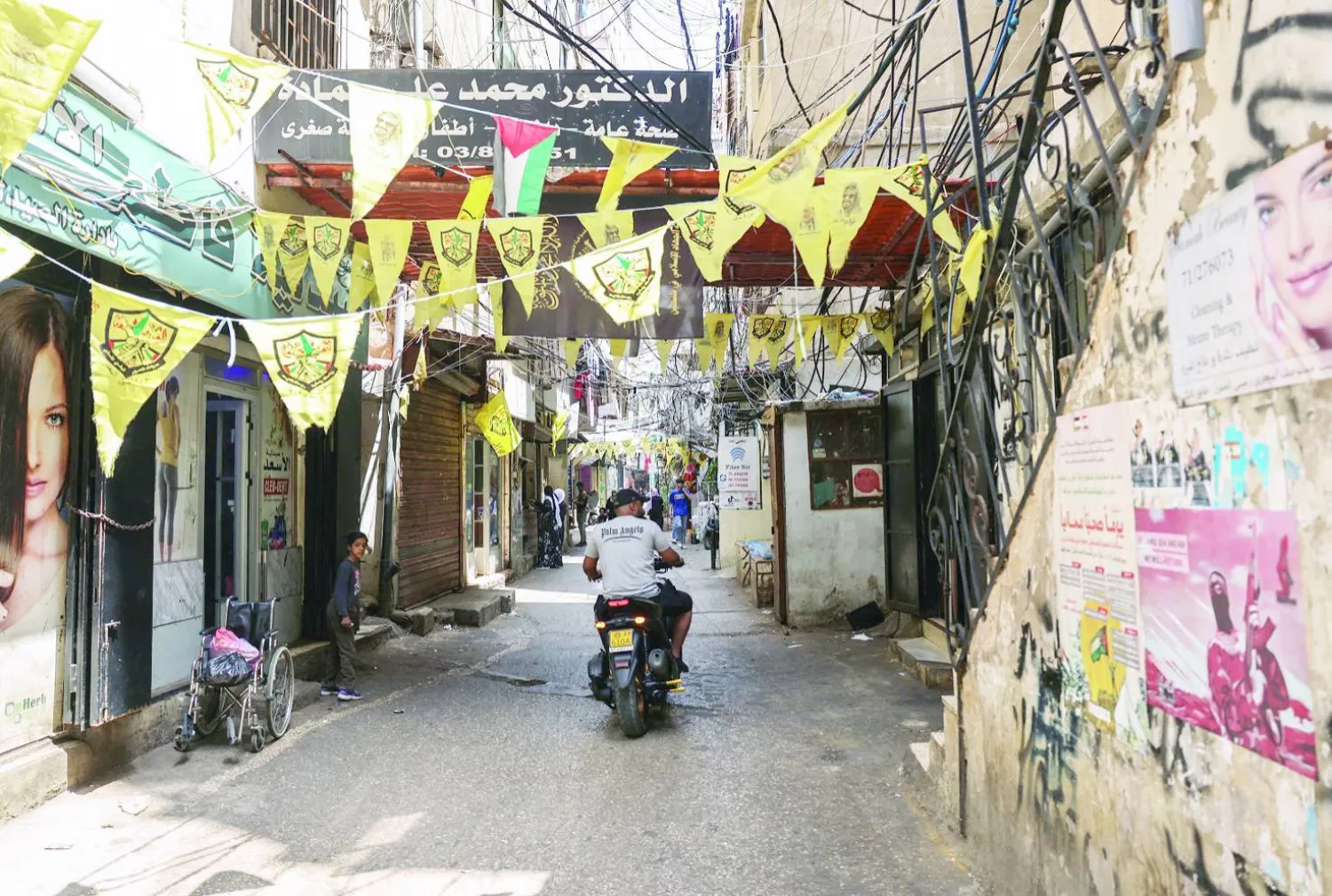
Lebanon Draws Up Plan to Govern 12 Palestinian Refugee Camps

The Shatila Palestinian refugee camp in southern Beirut. (AFP file)
TT

Lebanon Draws Up Plan to Govern 12 Palestinian Refugee Camps

The Shatila Palestinian refugee camp in southern Beirut. (AFP file)

Lebanon has begun addressing the governance of its Palestinian refugee camps, seeking to establish a framework for security, administration and services in a system where responsibilities overlap among Palestinian factions, popular committees, state institutions and the UN agency for Palestinian refugees (UNRWA).

Prime Minister Nawaf Salam on Friday launched consultations on a plan prepared by the Lebanese-Palestinian Dialogue Committee, headed by Ambassador Ramez Dimashkieh, before its final version is submitted to the Cabinet.

Salam stressed that Palestinian refugee camps fall under Lebanese sovereignty and are subject to Lebanese law.

“The presence of state institutions in the camps must become clear and consistent,” he declared.

He linked the governance initiative to the National Accord Document, the state’s exclusive control over weapons and its sole authority to decide on war and peace.

Salam also referred to the understanding reached between Lebanese President Joseph Aoun and Palestinian President Mahmoud Abbas in May 2025, as well as steps already taken to address the issue of Palestinian weapons.

He stressed that the initiative would cover security, the rule of law, and social, economic and service-related conditions.

The prime minister revealed that a draft law was being prepared to regulate refugees’ rights and obligations, including employment and social security.

He reaffirmed Lebanon’s commitment to the Palestinian right of return and its rejection of permanent resettlement, stressing that UNRWA and the international community must continue to bear responsibility for refugee services, without the Lebanese state replacing the agency.

For his part, Dimashkieh described the launch of consultations on a national plan to govern Palestinian refugee camps as an unprecedented step toward establishing a unified Lebanese state vision for their management and administration.

The camps are located on Lebanese territory and fall under Lebanese sovereignty, and that any new arrangements would be developed through partnership and dialogue with all Palestinian groups, without exception, he stressed.

Speaking to Asharq Al-Awsat, Dimashkieh explained that the initiative could be the first of its kind in Lebanon’s history of dealing with Palestinian refugee camps.

“For the first time, consultations are being launched to develop a unified Lebanese state plan for managing and governing the camps, rather than having each institution continue to deal with the issue separately, according to its own area of responsibility,” he noted.

The main problem, according to Dimashkieh, has been the absence of coordination and a common vision among the institutions involved, including the security services and Lebanese Army, governorates and municipalities, the ministries of health and labor, and UNRWA.

“Each institution viewed conditions in the camps from its own perspective, without an overarching framework to organize responsibilities and mechanisms for addressing the various issues,” he explained.

Dimashkieh revealed that consultations would continue over the next six months, bringing together the relevant Lebanese and Palestinian parties to reach the best possible formula for governing the camps.

Discussions will cover security, administrative and legal matters, including the role of security forces, the possible adoption of community policing and issues falling within the jurisdiction of the Justice Ministry and other relevant institutions.

He stressed that Palestinians would be key partners throughout the process, with no group excluded.

“The aim is to listen to everyone and reach a formula that commands the broadest possible consensus.”

Dimashkieh further underscored the growing urgency of reorganizing camp administration, particularly as the demographic composition of some camps has changed considerably.

“In some camps, Palestinians now account for only around 30% of residents, compared with approximately 70% who are Syrians or people of other nationalities,” he pointed out.

These demographic shifts require both Lebanese and Palestinian authorities to reconsider how the camps are administered and how their circumstances are addressed, he explained.

As for the next steps, Dimashkieh said that the proposal agreed upon after consultations and the identification of mechanisms for addressing the issue would be submitted to the Lebanese Cabinet for a decision.

12 camps and a legacy dating back to the Cairo Agreement

Lebanon’s 12 official Palestinian refugee camps are spread across several regions.

Five are in the south: Ain al-Hilweh, Mieh Mieh, Rashidieh, Burj al-Shemali and Al-Buss.

Four are in Beirut and Mount Lebanon: Burj al-Barajneh, Shatila, Mar Elias and Dbayeh.

Two are in the north, Beddawi and Nahr al-Bared, while the Bekaa Valley hosts the Jalil camp in Baalbek.

The number of registered Palestinian refugees differs considerably from the number actually residing in Lebanon.

UNRWA had approximately 488,000 refugees registered as of June 2025, while a 2017 Lebanese-Palestinian census counted around 174,000 Palestinians living in camps and gatherings, using a different methodology.

The UN agency’s registration figures do not constitute a census of current residents.

The roots of the camps’ special security arrangements date to the 1969 Cairo Agreement, which the Lebanese parliament annulled in 1987.

Nevertheless, Palestinian popular committees and factions have continued to play roles in the camps.

In 2025, factions affiliated with the Palestine Liberation Organization handed over weapons to the Lebanese Army. However, the issue of arms held by all Palestinian organizations has yet to be fully resolved.


From Coexistence to Reclaiming Sovereignty: How Has Lebanon’s Approach to Hezbollah Changed?

 Hezbollah supporters wave the group's flags in Beirut's southern suburbs (AFP)
Hezbollah supporters wave the group's flags in Beirut's southern suburbs (AFP)
TT

From Coexistence to Reclaiming Sovereignty: How Has Lebanon’s Approach to Hezbollah Changed?

 Hezbollah supporters wave the group's flags in Beirut's southern suburbs (AFP)
Hezbollah supporters wave the group's flags in Beirut's southern suburbs (AFP)

Lebanon is shifting its approach to Hezbollah after decades of political and institutional coexistence with the group's influence and weapons, as military and regional upheaval brings the question of exclusive state authority back to the fore.

From the 1989 Taif Agreement to recent government decisions, the shift marks a move away from political compromises toward tighter oversight, greater accountability and attempts to restore the authority of state institutions.

What has changed?

Hezbollah's alleged influence once reached deep into sensitive areas of the Lebanese state, from cargo shipments and customs inspections to the judiciary and security agencies.

Beirut airport was a major flashpoint. In May 2008, a government decision to dismiss its security chief, coupled with a move against Hezbollah's telecommunications network, triggered armed clashes that exposed the limits of the government's ability to enforce its decisions.

At Beirut port and land border crossings, repeated allegations pointed to shipments moving through channels exempt from routine inspections. Former officials described containers marked in red as belonging to the "resistance" and therefore off-limits to customs inspectors.

The judiciary faced similar pressure. In 2021, alleged threats by Hezbollah liaison official Wafiq Safa against judicial investigator Tarek Bitar renewed concerns over interference in judicial investigations.

The picture is different today.

Authorities say they have tightened inspections at the airport, port and border crossings and pursued weapons and explosives cases, including the 2026 Dahr al-Baidar case and the Bsharri cell.

A more assertive presidency and government decisions to place weapons under exclusive state control have accompanied the measures.

The change is also evident in official rhetoric. Where the debate once focused on special cargo routes and exemptions, officials now increasingly demand inspections, accountability and equal enforcement of the law.

Along the Syrian border, the change in power in Damascus has disrupted communication and supply routes Hezbollah once relied on.

But tighter controls do not mean Hezbollah's former influence has disappeared or that the state has regained full authority. The real test remains whether Lebanon can enforce its rules equally and consistently.

From Taif to the erosion of political coexistence

Former lawmaker Fares Souaid traces the roots of the arrangement to the 1989 Taif Agreement, which called for the Lebanese state to extend its sovereignty through its own forces and for militias to disband.

Israel's occupation of southern Lebanon and the influence of Syrian President Hafez al-Assad, who was entrusted with implementing the agreement with US approval, effectively "upgraded Hezbollah from a militia to a resistance movement," Souaid said.

Other militias surrendered their weapons. Hezbollah kept its arsenal.

"Coexistence began under Syrian influence and continued under Iranian influence," he said.

After Israel withdrew from most of southern Lebanon in 2000, Souaid recalled Walid Jumblatt's choice between "Hanoi or Hong Kong" as a defining question about Lebanon's future.

The Syrian army's withdrawal in 2005 did not end foreign influence, he argued. Hezbollah stepped into the vacuum with Iranian backing, benefiting from Tehran's expanding regional reach after the 2003 US invasion of Iraq.

Souaid links that period to the death of Yasser Arafat, the assassination of Rafik Hariri and the execution of Saddam Hussein, as well as Iran's influence across Syria, Iraq and Lebanon through Hezbollah and its alliance with the political movement represented by former Lebanese President Michel Aoun.

The balance began to shift with the confrontations that erupted in October 2023, followed by the 2024 pager explosions and the assassination of Hezbollah Secretary-General Hassan Nasrallah, and then the fall of Bashar al-Assad's government, Souaid said.

Together, those developments weakened the regional alliance that had sustained Hezbollah's position and protected the previous political arrangement.

Souaid sees Arab support for Joseph Aoun's election as president and Nawaf Salam's appointment as prime minister in 2025 as carrying a clear message: aid would depend on the Lebanese state restoring its sovereignty.

The change, he says, goes beyond the country's political leadership. State institutions are increasingly willing to exercise their powers over the judiciary, security agencies and public facilities.

Arab and international demands for Lebanese sovereignty have also grown more explicit, replacing earlier compromises that repeatedly deferred confrontation over Hezbollah's weapons, he said.

Souaid points to cabinet decisions on Aug. 5 and 7, 2025, aimed at establishing exclusive state control over weapons, and a March 2, 2026, decision banning Hezbollah's military and security activities and requiring it to surrender its arsenal.

He also cites a shift in presidential rhetoric, with the Lebanese president now naming Hezbollah directly.

In the judiciary, Souaid praises "the courage of Judge Claude Ghanem at the Military Court." Recalling the 2008 killing of pilot Samer Hanna, he alleges that Hezbollah handed over a person who was not the perpetrator.

Souaid also acknowledges improved controls at the airport, port and borders, despite sporadic security incidents.

"Contrary to the prevailing public mood, we must be patient with the army," he said.

He argues that restoring state authority requires "Shiite political and social support" for the constitution and the Taif Agreement, rather than "putting an entire sect, its mothers and fathers, on trial for the conduct of one party."

Disarming Hezbollah, he insists, is "a purely Lebanese national demand rooted in the country's political covenant," not a matter tied to the Strait of Hormuz, Bab al-Mandeb, Israeli elections or the calculations of Trump and China.

It is a demand Lebanon failed to fulfill in both 1989 and 2005, he said.

Souaid advocates a sustained campaign fought through "smart judicial, political, security, military and media" efforts.

"This is a necessary and unavoidable battle, but it cannot be won by a knockout. It must be won on points."

A stronger state, but authority remains incomplete

Former lawmaker Wehbe Katisha says Hezbollah's influence was once rooted in its political strength inside state institutions.

"In the past, the state was on Hezbollah's side. Most ministers and lawmakers supported it. Hezbollah was therefore not weak within state institutions. It had a political majority that provided influence and protection," he said.

"That reality has changed. Most ministers and lawmakers are now against Hezbollah, shifting the balance of power within the state," he added, describing his assessment of the political landscape.

Katisha says the confrontations destroyed much of Hezbollah's military and political leadership and devastated large parts of southern Lebanon.

He estimates the group's losses at "around 10,000 dead and 30,000 wounded."

Funding and logistical support routes have also narrowed, he says, pointing to the closure of the Syrian supply route and Iran's declining strength.

"Together, these factors have weakened Hezbollah inside Lebanon, while the state has grown stronger at its expense," he said.

The judiciary offers another measure of that shift, Katisha argues.

"Lebanese people used to watch Wafiq Safa threatening a public prosecutor," he said, recalling what he describes as earlier pressure on judicial officials.

He cites the Lebanese Forces party's demand to refer the Dahr al-Baidar explosives case to the Judicial Council after Judge Claude Ghanem brought charges against 13 people in October 2026.

"In the past, who would have dared to discuss such cases and demand their referral to the Judicial Council?" he asked.

Katisha says Hezbollah's former sources of influence at the airport, port, judiciary, land border crossings and public administration have weakened as military and political conditions have shifted.

Security and judicial cases are now handled differently, he argues.

"Hezbollah had what amounted to a military fast-track lane at the airport and port, and officials running those facilities were largely under its sway," he said.

Katisha recalled testimony given by a customs director-general while he was serving in parliament.

"The customs director-general told us plainly that there were containers no one was allowed to approach or inspect because they belonged to the resistance. Other containers were subject to inspection," he said.

"Containers marked in red were classified as belonging to the resistance and therefore could not be inspected."

According to the account Katisha cites, those containers were linked to weapons, ammunition, money and goods.

"That situation no longer exists today as it once did," he said.

Katisha points to Hezbollah's diminished influence across government departments, land border crossings and the judiciary. But he cautions that the state cannot fully reclaim its authority through political declarations alone.

Those declarations must be translated into action.


Yemen Govt: Houthis Fully Responsible for Turning Hodeidah Ports into Arms Smuggling Platforms

Traffic moves along a street in the southern port city of Aden, Yemen November 16, 2026. (Reuters)
TT

Yemen Govt: Houthis Fully Responsible for Turning Hodeidah Ports into Arms Smuggling Platforms

Traffic moves along a street in the southern port city of Aden, Yemen November 16, 2026. (Reuters)

The Yemeni government stressed on Friday that the strikes carried out by the Coalition to Restore Legitimacy against some facilities at the port of Hodeidah, conducted in accordance with international law, hit legitimate targets used by terrorist Houthi militia to receive smuggled Iranian weapons and turn the port into a launchpad threatening international peace and security.

The Coalition announced on Friday that it carried out an operation to neutralize sources of threat used by the Houthis to support their military efforts to attack civilians in Yemen and Saudi Arabia.

Official Coalition Spokesperson Major General Turki Al-Malki operational capabilities at the Yemeni port of Hodeidah, which facilitated the smuggling and transport of weapons and ballistic missiles, were targeted.

In a statement, the Yemeni government said that “turning ports and civilian infrastructure into arms smuggling routes and hubs for directing military operations is a crime against the interests of the Yemeni people and poses a threat to regional and international security and stability.”

“These actions expose the practices of the terrorist Houthi militia in exploiting vital state facilities to serve its military agenda linked to the Iranian regime, at the expense of citizens' lives, needs, and national interests,” it added.

“Protecting civilians remains an absolute priority, and that the advance evacuation warning reflects full commitment to the rules of international law,” it continued.

“The responsibility to protect civilian facilities is inseparable from the need to prevent their exploitation in military activities and arms smuggling operations that threaten the security of Yemen, the region, and international navigation in the Red Sea and Bab al-Mandeb,” it went on to say.

It added the government has previously revealed the presence of members from the Iranian General Staff in Hodeidah, operating out of certain port facilities and overseeing the smuggling of weapons and raw materials used in manufacturing missiles and drones.

“This is an extension of Iran's destructive role in arming the militia, developing its military capabilities, and expanding its threats to regional security and international maritime lanes,” it warned.

The government stressed that these activities and their networks “will not be immune from accountability and prosecution.”

Countering attempts to exploit these developments to mislead the public or fuel fears over living conditions, the government reassured citizens that the flow of basic commodities, humanitarian aid, and commercial activity will continue under approved arrangements.

It confirmed that ports and land, sea, and air crossings in liberated areas are operating regularly and at sufficient capacity to maintain the movement of commercial and humanitarian supplies and meet citizens' needs, underlining that safeguarding the interests and livelihoods of the Yemeni people remains at the forefront of the government's responsibilities.

The government, together with the Coalition to Restore Legitimacy, renewed its commitment to the principles of international humanitarian law, calling on the international community to shoulder its responsibilities regarding Houthi practices that exploit civilian facilities and vital infrastructure for military activities and arms smuggling.

The government held the Houthi militia “fully accountable for militarizing the port of Hodeidah, embroiling its civilian facilities in arms smuggling and military operations, and the resulting risks and repercussions.”

“Yemeni ports belong to the Yemeni people and exist to serve their interests, not as tools for a military agenda or launchpads threatening the security of Yemen and the wider region,” it said.


Yemen Urges UN Action to Confront Houthi Violations

A Yemeni woman displaced by the Houthis receives aid at a camp near Aden. (AP)
TT

Yemen Urges UN Action to Confront Houthi Violations

A Yemeni woman displaced by the Houthis receives aid at a camp near Aden. (AP)

The Yemeni government has stepped up diplomatic efforts to confront Houthi attacks on civilians, urging the United Nations Security Council to take concrete measures to halt the assaults and hold those responsible accountable. Meanwhile, a human rights report revealed that nearly 1,500 civilians had been detained or abducted on roads leading to the Taiz governorate.

The developments come amid warnings of a worsening humanitarian crisis as the siege of the city continues.

In a letter addressed to UN Secretary-General Antonio Guterres and Security Council President Ambassador Sanita Pavļuta-Deslandes, the Yemeni government warned of continued military escalation by the Iran-backed Houthi militia, including missile, shell and drone attacks targeting residential neighborhoods and civilian gatherings in the interim capital Aden and the governorates of Lahj and Taiz.

The letter said Aden came under missile attack on the evenings of Nov. 11 and 13, while shelling targeted the Kharaz refugee camp in Lahj province on Nov. 12, killing a Somali refugee woman.

The government said the attack threatened refugee safety and exposed vulnerable groups to serious risks.

Calls for accountability

The Yemeni government held the Houthis fully responsible for the attacks and the resulting casualties and damage, saying the latest incidents were not isolated but part of a series of assaults in recent weeks targeting Aden International Airport, healthcare facilities, public markets and residential neighborhoods.

The government also accused the group of targeting civilians and civilian infrastructure in Saudi Arabia, as well as international shipping lanes.

It said deliberate attacks on civilians and civilian infrastructure, along with indiscriminate strikes, constituted serious violations of international humanitarian law and amounted to war crimes, requiring those responsible to be held accountable and victims to receive justice and compensation.

The government urged the Security Council to explicitly condemn the attacks, pressure the Houthis to halt them immediately, comply with their obligations under international law and take measures to prevent further assaults.

It warned that continued attacks on residential areas and refugee camps demanded an international response that went beyond statements of concern and condemnation to concrete action to protect civilians, refugees and displaced people and end impunity.

The government also called for full implementation of relevant Security Council resolutions, especially provisions concerning the cessation of military escalation and arms embargoes.

It stressed the importance of strengthening cooperation between the Yemeni government and UN member states, including information-sharing, technical assistance and capacity-building, to prevent weapons, ballistic missiles, drones, their components and military technology from reaching the Houthis.

1,477 civilians abducted or detained

Separately, the Taiz Human Rights Center reported that 1,477 civilians had been subjected to arbitrary detention or abduction at Houthi-controlled checkpoints in southern and western Taiz between Nov. 14 and 18.

The center said in a report that 830 civilians were detained for hours, interrogated and subjected to searches of their mobile phones, while another 446 were forced to sign so-called "returnee forms."

A further 201 civilians were abducted and taken to undisclosed detention facilities, the report said.

The center held the Houthis fully responsible for the safety of those detained or abducted, demanding that the militia disclose their whereabouts and release them immediately.

It also called for an end to arbitrary detention, forced searches of mobile phones and the practice of compelling civilians to make statements or sign documents under duress.

The center urged the UN and international human rights organizations to intervene urgently to safeguard civilians' freedom of movement and hold those responsible for the violations accountable, as restrictions on travel along roads and access routes to the city intensify.

Taiz Governor Nabil Shamsan discussed the repercussions of the continuing Houthi siege with European Union Ambassador to Yemen Patrick Simonnet during a video call, highlighting rapidly deteriorating living conditions and shortages of essential supplies.

Shamsan outlined the challenges facing residents as a result of road closures and restrictions on the delivery of food, medicine and fuel supplies.

He warned of the consequences for the humanitarian situation as food and medicine stocks dwindle and the water crisis worsens.