


'Air-con Nation' Singapore Eyes Alternatives to Cool Down

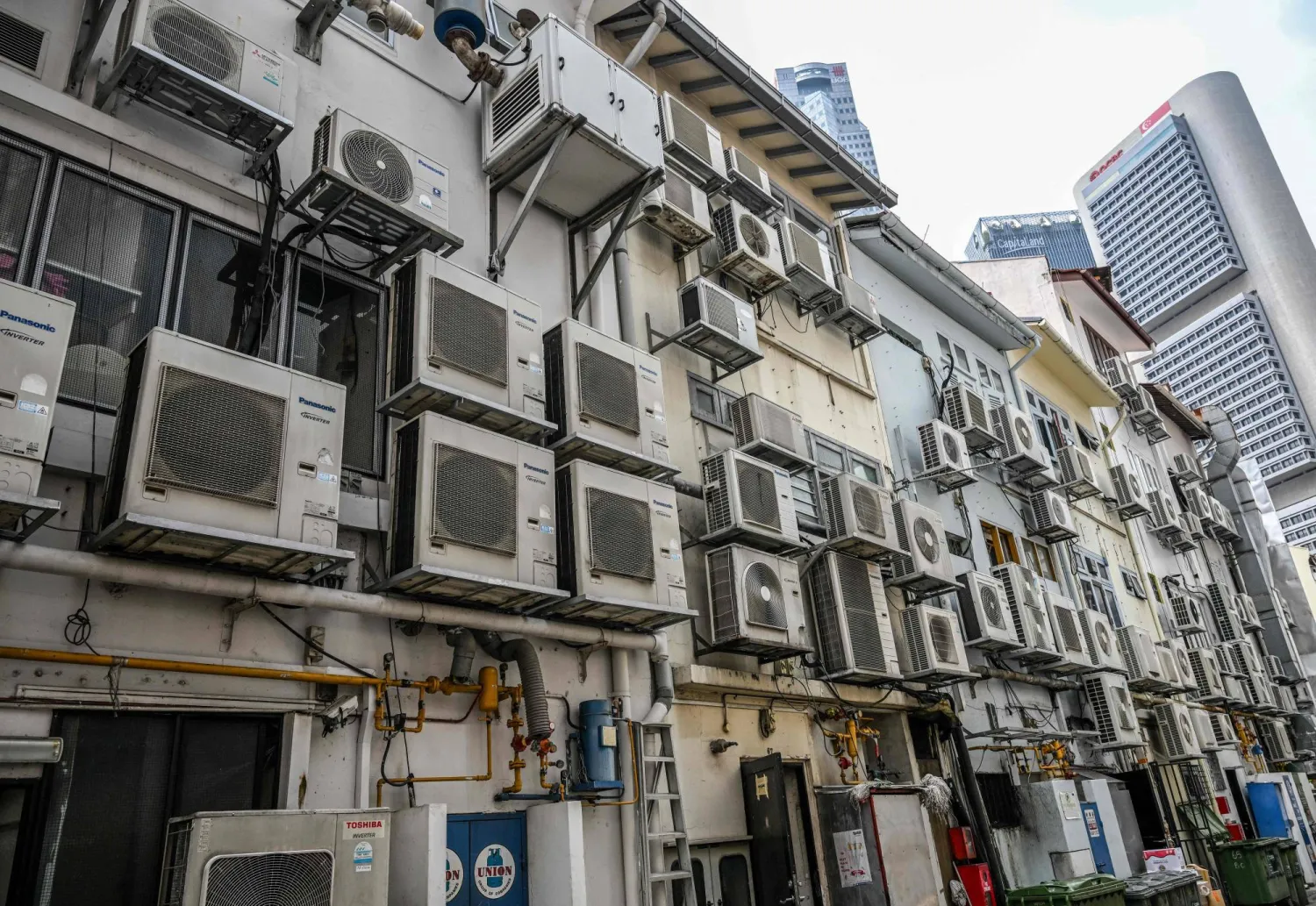
This photo taken on August 26, 2026, shows rows of the air conditioning compressors installed on the rear of buildings at Boat Quay in Singapore. (Photo by Roslan RAHMAN / AFP)
TT

'Air-con Nation' Singapore Eyes Alternatives to Cool Down

This photo taken on August 26, 2026, shows rows of the air conditioning compressors installed on the rear of buildings at Boat Quay in Singapore. (Photo by Roslan RAHMAN / AFP)

Long dubbed an "air-conditioned nation", Singapore is experimenting with cooling alternatives from chilled beams to "passive displacement" to curb its thirst for energy-guzzling air conditioning.

The city-state has the highest per-capita air conditioner ownership rate in Southeast Asia, with about 99 percent of private residences equipped with cooling units.

Singapore's local building sector accounts for one-fifth of its emissions, while cooling itself accounts for 40 to 60 percent of a building's energy consumption, according to studies.

A stroll down renowned thoroughfare Orchard Road highlights that dependence. Shoppers are greeted by blasts of cool air that waft into the street as doors swing open -- a major draw given daytime highs hover between 31C and 33C year-round.

But air conditioning can make the heat problem worse. Compressor units belch hot air back out into the environment, and the electricity that powers the systems can contribute to climate change if generated from fossil fuels.

Some buildings in Singapore are looking at other options, including active chilled beams, which are perforated panels equipped with cooling coils that are mounted on ceilings.

A chiller plant on the building's top floor cools water down to 9C, then pumps it into the coils. Simultaneously, air is blasted through small nozzles inside the beams.

The jets of air create a low-pressure zone that sucks up warmer air from the room below so it passes over the coils and is cooled before recirculating.

The technology keeps the offices at the eight-story Paya Lebar Green building in eastern Singapore at a comfortable 24C.
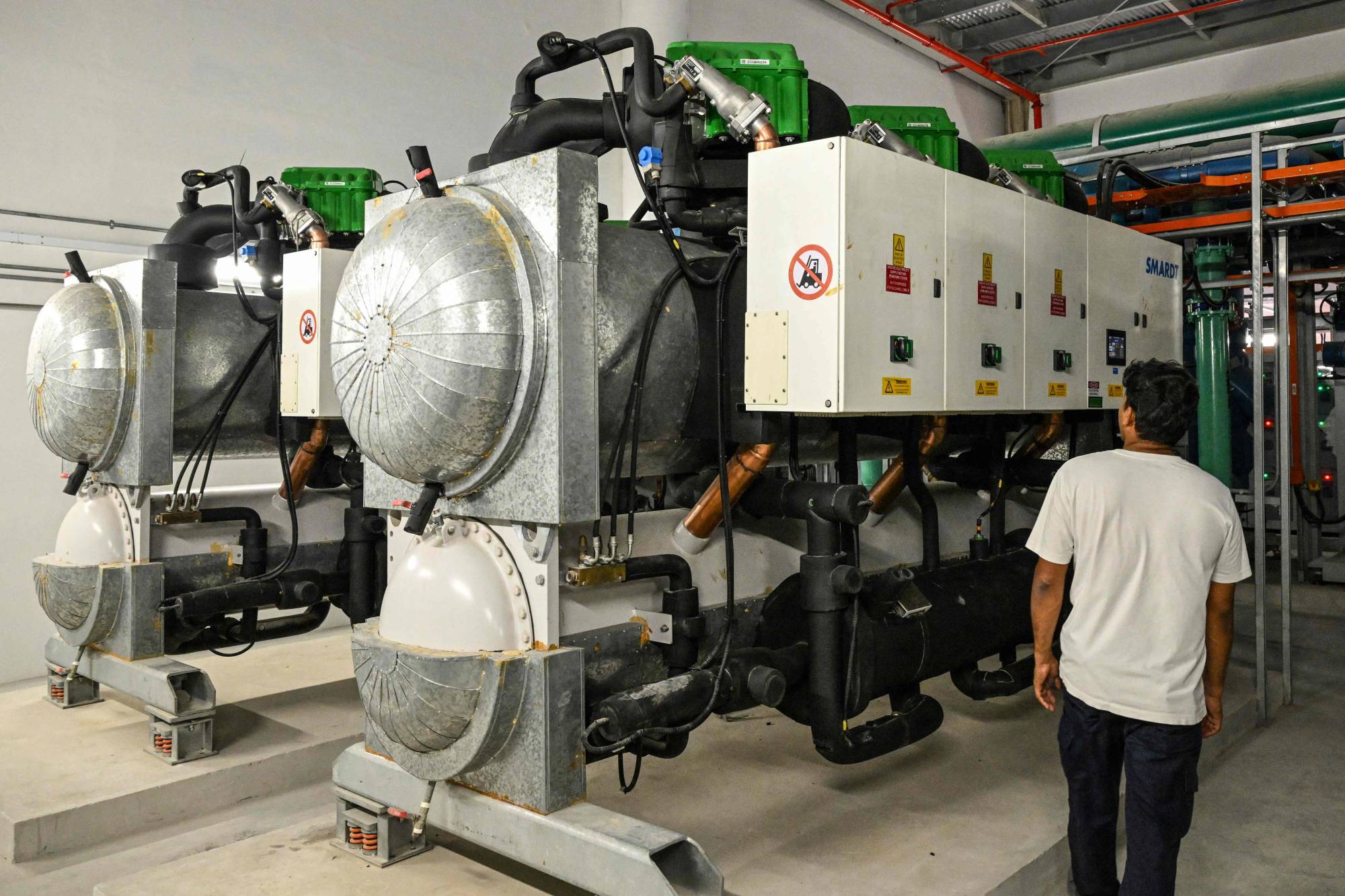
This photo taken on August 21, 2026, shows a technician checking the chillers that produce a hybrid cooling method at an office building in Singapore. (Photo by Roslan RAHMAN / AFP)

A visiting AFP team felt noticeably cooler air flowing from the sleek white panels on the ceiling of the building, described as one of Singapore's "greenest".

The system is also quiet, without the constant hum of air conditioning units.

When HR professional Renuga Shekar first moved into an office space at Paya Lebar Green last November, the 30-year-old and her colleagues just thought the exposed pipes and panels on the ceiling was a "warehouse kind of look".

"We didn't really think much about it. No one really commented about it," she told AFP.

It was only months later, after noticing how quiet the office was and hearing technicians mention "ACB" during maintenance, that they realized it was cooled by active chilled beams.

"We didn't even realize how different the air cooling system is because it was very seamless, and in terms of the temperature, ideal for everybody in the office," she said.

Together, the system cut energy use by more than 30 percent compared with conventional air conditioning, according to the building's designers, DP Architects.

A similar system is in use at Singapore's ports authority maintenance building at western Tuas harbor.
The building uses passive displacement cooling, which taps natural airflow to reduce reliance on mechanical fans.

Ceiling cooling coils chill the air, which sinks before naturally rising back to the coils as it warms. This continuous cycle reduces the need for fans, cutting energy use and noise.

Another alternative is radiant cooling, where water chilled to between 14C and 18C flows through pipes or panels and absorbs heat radiating from people or objects to reduce ambient temperatures.

The push to find new cooling solutions has government backing.

A 2024 government study identified alternative cooling technologies (ACTs) as a key strategy which found they could save the city up to 48 percent in energy.

By mid-2026, at least 33 public and 14 private buildings had adopted ACTs, Singapore's building authorities said. The city-state has an ambitious goal to achieve net-zero carbon emissions by 2050.

The figures are still relatively small, and it can be challenging to find an ACT that is acceptable to users familiar with tried-and-tested air conditioners.

Supporters of alternative systems acknowledge that they cost more to install than conventional air-conditioning, but say they more than make up for it over time with much lower running costs thanks to big energy savings.

This photo taken on August 21, 2026, shows a technician monitoring remotely the chillers operation that produce a hybrid cooling method at an office building in Singapore. (Photo by Roslan RAHMAN / AFP)

The most popular alternative method remains hybrid cooling -- simply turning up air conditioning to a higher temperature of 25.5C to 27C, and pairing it with fans.

"Everybody's more used to having air-conditioned office spaces, so for them to suddenly accept 26 degrees, I think the mindset shift has not reached a threshold where it's generally accepted yet," said Chua Zi Jun, director at DP Architects.

Demand for cooling is only increasing as climate change raises temperatures and humidity in Singapore and beyond.

Traditional air-conditioning systems rely on vapor compression, using refrigerants to move heat from one place to another.

ACTs use the same basic principle, but either spend less energy moving cool air or reduce run-time by leaning on people's ability to adapt to slightly higher temperatures.

"The technologies are a step in the right direction and should eventually incorporate more sophisticated controls, including predictive systems that adjust temperatures before rooms become too hot or cold," said Wan Man Pun, a cooling tech expert at Nanyang Technological University.

But "we still haven't found any alternative cooling methods that have a higher coefficient of performance, or efficiency, than vapor compression", Wan said.



Denmark to Propose Mobile Phone Ban in Schools in 2027

22 October 2026, Schleswig-Holstein, Kiel: A man's hand reaches for a smartphone. (dpa)
TT

Denmark to Propose Mobile Phone Ban in Schools in 2027

22 October 2026, Schleswig-Holstein, Kiel: A man's hand reaches for a smartphone. (dpa)

Denmark will propose a ban on mobile phones in its primary and lower secondary school system as well as content filtering on the schools' network starting from the new academic year in 2027, the Danish education ministry said ‌on Monday.

Countries ‌including the Netherlands, ‌South ⁠Korea and Italy have ⁠banned smartphones in schools due to concerns over their impact on concentration and behavior, while Poland and the Czech Republic in June proposed ⁠a similar ban.

"Children ‌should be ‌able to go to school ‌without constantly being distracted by ‌things like social media, online shopping, and gaming," Education Minister Magnus Heunicke said in a statement.

The ‌ban also includes other private electronic devices with internet ⁠access.

⁠Content filters will be implemented to block websites that have no educational or pedagogical relevance, including social media, gaming and shopping sites, during lesson time.

It will be up to each municipality and school to decide which websites should be blocked.


Kuala Lumpur Otters Raise River Revival Hopes

This picture taken on October 19, 2026, shows a smooth-coated otter eating a fish along the bank of the Klang River in Kuala Lumpur. (AFP)
TT

Kuala Lumpur Otters Raise River Revival Hopes

This picture taken on October 19, 2026, shows a smooth-coated otter eating a fish along the bank of the Klang River in Kuala Lumpur. (AFP)

Beneath a tangle of highway in the Malaysian capital Kuala Lumpur, a family of otters rolls around in a patch of riverside sand, delighting the few passersby who notice them.

Small groups of otters are now being seen regularly in parts of the city, including along the once heavily polluted Klang River.

Theories vary on whether the smooth-coated otters, classed as vulnerable by the International Union for Conservation of Nature, have returned to the city or were hiding in plain sight all along.

But their presence has raised hopes that efforts to clean up the Klang may be bearing fruit, and could inspire further improvement.

The Klang was once one of the world's dirtiest waterways, designated a Class 5 severely polluted river under Malaysia's rankings.

Years of work improved it to Class 3, or moderately polluted, which seems to have encouraged the otters to move in, said Malaysian wildlife ecologist Woo Chee Yoong.

"Wherever there are otters, there are fish. Wherever there are fish it means the whole river system... (is) clean, it's healthy for all the communities around. So that's one of the importance of otters," he said.

In recent years, the animals have been filmed sunbathing on the river's concrete banks and swimming in front of elevated metro stations, winning viral fame.

Retired soldier Hasan Ujang, who lives in a riverside apartment, enjoys watching their antics.

"We feel really happy when we watch them playing and playing, like kids swimming," he said.

- 'They have to survive' -

But unlike otters in neighboring Singapore, which are closely monitored by a network of citizen scientists, little is known about Kuala Lumpur's otters.

Woo learned about them from local media reports on sightings in 2019 and the following year co-founded the Malaysian Otter Network (MON) conservation group.

"We don't know how many groups are there, we don't know how actually the otters are moving around," he said.

Even the question of whether the otters have returned to the capital or were simply in less visible city environments before remains a "mystery."

MON hopes to set up a citizen science system for people to report sightings.

Otters have been spotted elsewhere in the city, including at the Tropicana Golf & Country Resort, a high-end housing estate where they are less welcome visitors.

They are accused of raiding at least 12 houses in the past year. Their target: fish ponds.

Resident Yee Sze Mun, 89, said otters killed the beloved -- and expensive -- arowana fish he had nurtured for 15 years.

"They are a nuisance, but I can't blame them, because they are just like us, they have to survive," he said.

Residents say the incursions began last year after a company began clearing forest next door for a new development.

"We have an issue because they're losing their habitat," said residents' association president Joy Appukuttan, who called the otter attacks a "grave concern."

Tropicana's security team believes there are around 25 otters in the forest and the estate brought in Woo to teach residents how to deal with them.

The species is protected in Malaysia, so Woo urges residents to block entry points to their yards and install fences or netting over ponds.

- 'An asset' -

Maimunah Mohd Sharif, a former Kuala Lumpur mayor and now advisor to the city on sustainable urbanization, call the otters an "asset."

"Otters are one of the benchmarks for clean cities," she said.

Like others, she hopes a growing awareness of the Klang River otters can be harnessed to help improve the river further.

Hundreds of garbage traps were installed as part of the government's River of Life project, and solar-powered "interceptors" deployed by a Dutch NGO have collected tens of thousands of tons of waste.

Now Maimunah wants to see more done to stop waste entering the river in the first place, and efforts to make the Klang Class 2B status, clean enough for body contact.

"One day, I want to swim in the Klang River," she said.

Scarlett Koon Si Qi, a community architect and co-organizer of the annual Klang River Festival hopes the waterway can be restored to its natural banks without concrete lining.

"Some parts, maybe yes, you do need concrete to kind of protect and control for floods," she said.

"But I think wherever we can, we should leave it as natural as possible."

That would further benefit the otters, who need some vegetation and natural crevices to hide in, experts said.

The otters are already shifting views on the river, said Faith Foo, who runs the festival.

Growing up, "the teachers would always say that this is a very unsanitary place," he said.

But seeing the otters, "it's a reminder that that is a river."


JFK Anniversary Draws History Buffs to Movie Theater Where Oswald Was Arrested

A moviegoer sits in the seat associated with Lee Harvey Oswald's arrest before a screening of "War Is Hell" at the Texas Theatre in Dallas, Texas, on November 22, 2026, marking the 63rd anniversary of President John F. Kennedy’s assassination. (AFP)
TT

JFK Anniversary Draws History Buffs to Movie Theater Where Oswald Was Arrested

A moviegoer sits in the seat associated with Lee Harvey Oswald's arrest before a screening of "War Is Hell" at the Texas Theatre in Dallas, Texas, on November 22, 2026, marking the 63rd anniversary of President John F. Kennedy’s assassination. (AFP)

Every November 22, Duncan McQueen visits the Texas Theatre as part of his pilgrimage to sites associated with the assassination of President John F. Kennedy in Dallas.

But he never manages to sit in its most famous seat: the one occupied by assassin Lee Harvey Oswald when police arrested him.

"Every time I'm here too late, there's always somebody sitting there," he told AFP.

Located in Dallas's bohemian Oak Cliff neighborhood, the Texas Theatre became entwined with the tragedy through the highly publicized arrest, which took place shortly after the presidential motorcade came under fire a few miles away.

It embraces that connection by organizing "JFK Day," a time capsule marking the somber anniversary.

"That day... we do sort of lean into what happened here and commemorate it," Barak Epstein, who runs the Texas Theatre, told AFP.

In an effort to preserve this piece of American and film history, the theater screens the only surviving fragment of "War Is Hell," along with "Cry of Battle" -- the two movies showing that day, which might otherwise have been forgotten had they not been immortalized in photographs and video footage.

The double feature begins at 1:20 pm (1920 GMT), a few minutes before Oswald entered the theater to hide.

It is preceded by a video in which Johnny Brewer, the man who told police where Oswald was in 1963, warns the audience about the risks of entering without paying.

- 'Much more real' -

The Texas Theatre, which dates to 1931, is an essential stop on tours retracing the day that shook the nation.

It is a few kilometers from Elm Street, where two white X marks on the asphalt indicate where Kennedy was shot, and where dozens of people gathered Sunday to pay tribute on the 63rd anniversary of his death.

The historic building has undergone several alterations, Epstein explained during a tour of its two auditoriums.

Epstein said that, "in theoretical terms," both the second and fifth seats in row S have been identified as Oswald's based on photographs from that day.

But seat number five seems to have claimed that status among history buffs.

"It's symbolic," said Richard Pruett, who was waiting with his son to enter before the doors opened.

"It's a strange feeling because it makes it seem so much more real," Pruett said.

"You no longer have to rely on your imagination so much."

Pruett praised the theater's preservation after years of challenges posed by the growth of streaming, the pandemic and competition from major movie theater chains.

- Silver screen history -

"Today we're seeing this -- the same movie that Oswald was watching at the time he was arrested -- and... it's going to be airing at the same time as it did 63 years ago," he said.

"Most remarkably at the same price that it was airing 63 years ago," he added.

Tickets cost 90 cents, as they did in 1963, and visitors buy them at the original box office at the front of the building, just as audiences did then.

The Texas Theatre features in films such as Oliver Stone's "JFK." Stone sat in the same seat during a screening of his film on the anniversary in 2024.

It also appears in the new film "November 1963," which recounts the assassination from the Mafia's perspective and, as part of the special programming, premiered there on Saturday, with director Roland Joffe in attendance.

"What's very beautiful here is that this movie theater is very much alive," Joffe told AFP. "It has its own history, which makes it even more remarkable."

The theater makes one realize that "we're suddenly aware that history hasn't gone," the two-time Oscar nominee told the audience.

"We're just a part from it, with a slightly different stage, and it's therefore completely alive."