


War Widens in the Black Sea in a Test of NATO Red Lines

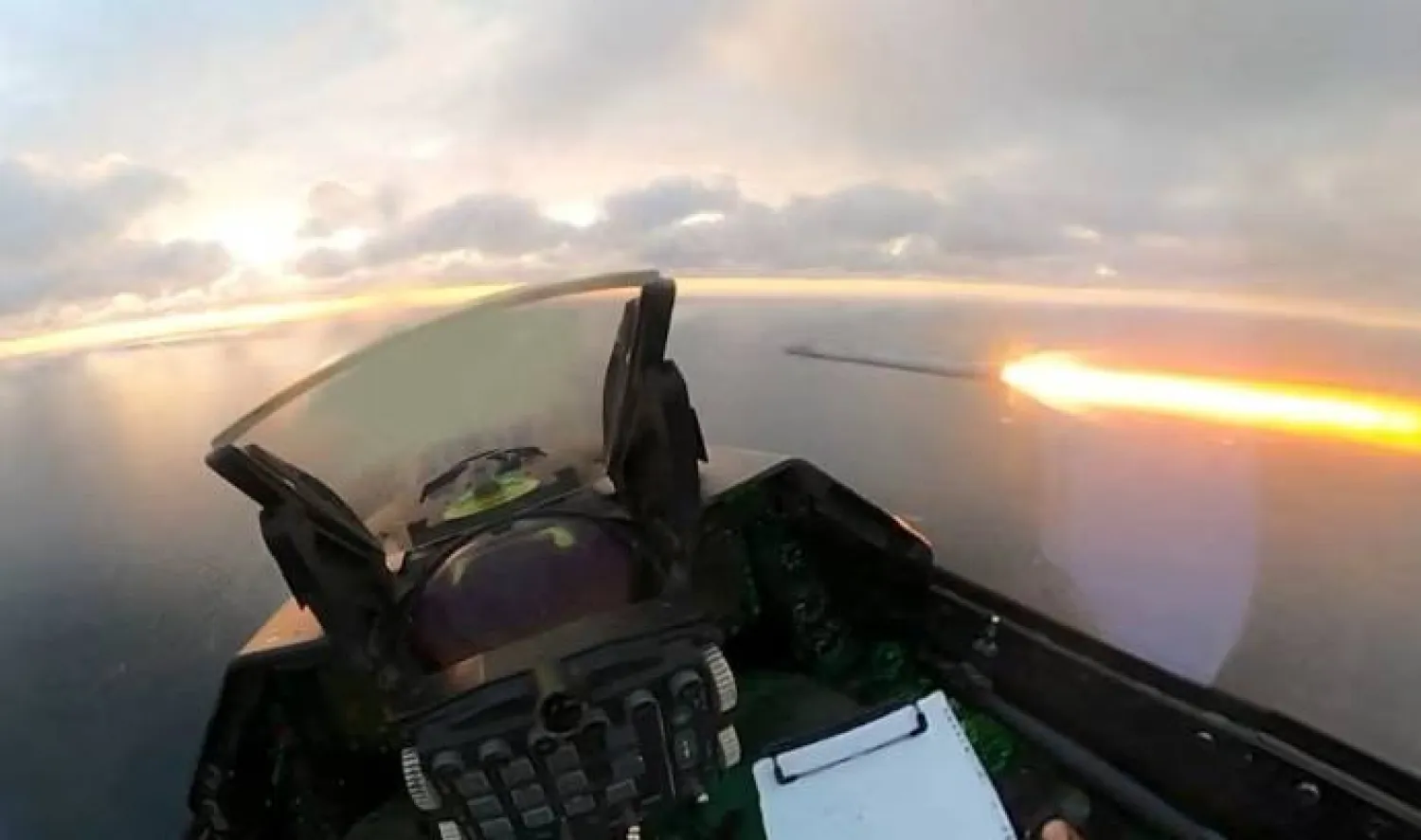
A view from the cockpit of a Romanian F-16 fighter jet during a mission to intercept and neutralize two drones that entered Romanian airspace without authorization on October 17, in this handout image provided by the Borcea 86th Air Base and released on October 18, 2026 by the Romanian Defense Ministry, in location given as Romania. Romanian Ministry of National Defense/Handout via REUTERS
TT

War Widens in the Black Sea in a Test of NATO Red Lines

A view from the cockpit of a Romanian F-16 fighter jet during a mission to intercept and neutralize two drones that entered Romanian airspace without authorization on October 17, in this handout image provided by the Borcea 86th Air Base and released on October 18, 2026 by the Romanian Defense Ministry, in location given as Romania. Romanian Ministry of National Defense/Handout via REUTERS

After seven strikes on cargo ships near NATO members Romania and Bulgaria last month, the US-led military alliance said it would deploy maritime patrol aircraft, radars and drones to bolster its eastern flank in the Black Sea.

Three days later, on October 23, another ship was struck just outside Romanian waters. And last week a Greek container ship was sunk by naval drones in Bulgaria's exclusive economic zone, reported Reuters.

Unabating attacks show how the escalating maritime war between Russia and Ukraine is expanding into a major challenge for NATO in the Black Sea that has left littoral member states such as Romania and Bulgaria exposed.

Military analysts said they had little doubt that these were Russian attacks. A naval drone seen on video of the last strike resembled a Russian variant, according to shipping security firm Ambrey.

"I think it's undeniably an escalation," said Sidharth Kaushal, a senior fellow at the London-based RUSI think-tank.

Russia denies targeting Ukraine's neighbors with drones and says that European governments are the ones escalating the war in Ukraine by supplying military aid. Russia's defense ministry did not respond to a request for comment for this article.

ANALYST SAYS RUSSIA IS TESTING RED LINES

Many of the ships hit in October were anchored near or sailing to or from a key Romanian canal used by Ukraine for exports. One was in Romanian territorial waters, while the other eight were in its or Bulgaria's exclusive economic zone.

Iulia Joja, director of the Black ‌Sea program for the Washington-based ‌Middle East Institute think-tank, said Russia's attacks were taking into account the West's aversion to escalation.

"This is about testing these red lines, ‌with full ⁠awareness that we will ⁠do everything possible to take the most minimal measures," Joja said, drawing a comparison with Russian drone incursions into NATO airspace in recent years.

A NATO official said Russian actions aimed at dissuading NATO allies from supporting Ukraine were a serious security threat and that the alliance's commitment to defending all its members, including those on the Black Sea, was "ironclad".

The official said there was a clear need for cost-effective counter-drone capabilities, but that the alliance had already committed to investing more than $40 billion in counter-drone capabilities in the next five years.

BLACK SEA IS CRUCIAL WATERWAY

For Romania, the Black Sea is a crucial waterway for trade and home to its offshore Neptun Deep project that will make it the European Union's largest gas producer next year. Neptun Deep was approached by a naval drone in August.

Bucharest has accused Russia of "systematic" strikes on civilian ships but stopped short of attributing individual attacks, citing the need for forensic evidence. Sofia has not blamed Russia, but said some of the attacks seem to benefit it.

The strikes come ⁠at a time when Washington is reassessing its military presence in Europe as it focuses on China. The US withdrew 1,000 troops ‌from Romania last year.

"It's a moment in the transatlantic relationship that Putin likely wants to use," said a senior Romanian ‌official. "The EU and NATO's attention is important and their forces are currently focusing towards the north and the Baltics."

While NATO has reinforced its "enhanced forward presence" for the Baltics and Poland, Joja said it had not ‌done the same in Romania despite Bucharest's requests.

"Brussels and Washington still don't seem to have decided whether the Black Sea is fully part of the NATO commitment."

The Romanian official ‌highlighted Romania's pressing need for surface-to-air interceptors and radar systems to counter threats.

Joja said the limited availability of cheap interceptor weapons, exacerbated by the war in Iran, was a central problem for the West.

NEARLY 400 VESSELS HIT IN PAST YEAR

The surge in strikes on Black Sea shipping has strangled a major conduit for exports of grain and oil used by Russia and Ukraine.

The two sides hit 317 merchant and other vessels in the Black Sea and Sea of Azov between May and October, a more than fourfold rise on the 74 vessels they struck in the previous half-year, according to Tomas Alexa, a senior analyst at Ambrey Analytics.

The tempo ‌of attacks has fluctuated ahead of the fifth anniversary of Russia's full-scale invasion in February.

Ukraine carried out 137 attacks on ships compared with 92 Russian ones in the third quarter, while in October, Russia hit 38 compared with 5 Ukrainian strikes, Ambrey said.

GRAIN ⁠EXPORTS FROM UKRAINE AND RUSSIA SLUMP

Ports have been ⁠battered and exports have shriveled, forcing Russia and Ukraine to seek alternative export routes.

Russia exported just 0.3 million metric tons of grain in September through the Black Sea and Sea of Azov, down from 4.74 million metric tons in the same month last year, according to Russian export data seen by Reuters.

Ukraine suspended operations at its Black Sea ports in late July due to Russian attacks, prompting it to divert volumes to river ports on the Danube and onwards through Romania's Sulina Canal and southwards through Romania's section of the Black Sea.

Even with this alternative route, Ukraine's port exports of grain slumped to 0.81 million metric tons in September compared with 2.1 million in September last year, government data showed.

Further reducing these volumes remains Russia's primary goal with testing NATO as the secondary objective, said Andriy Ryzhenko, a naval analyst and former senior Ukrainian naval officer.

ZELENSKIY WARNS OF FOOD CRISIS

Last week's attack took place as the defense ministers and military chiefs of Romania, Bulgaria and fellow NATO littoral state Türkiye met in Sofia to discuss the situation.

The defense minister of Türkiye, which is waiting for a response from Moscow and Kyiv on a narrow maritime ceasefire proposal, used the meeting to warn Russia and Ukraine against further attacks.

Türkiye controls the transit of warships through the Bosphorus and Dardanelles under the Montreux Convention.

Several countries, including Egypt, Türkiye and India, have pushed for maritime ceasefires to avert fallout from the disruption of shipping at a time when global fuel and grain prices have soared.

US Secretary of State Marco Rubio said on Saturday there was growing international interest in a limited ceasefire.

Russia has rejected the idea of a narrow maritime ceasefire that it says would provide respite to Kyiv. Ukrainian President Volodymyr Zelenskiy has sounded the alarm.

"Everyone is talking about diesel and forgetting about grain. In a month or two, everyone will start talking about an agricultural crisis," he said last month.



UN Rapporteur Albanese Arrives in Mexico After Costa Rica Barred Her Entry

United Nations Special Rapporteur on the Palestinian Territories, Francesca Albanese, speaks to the press upon her arrival at Benito Juarez International Airport in Mexico City on November 28, 2026, following her two-days stay at the airport in Costa Rica. (AFP)
TT

UN Rapporteur Albanese Arrives in Mexico After Costa Rica Barred Her Entry

United Nations Special Rapporteur on the Palestinian Territories, Francesca Albanese, speaks to the press upon her arrival at Benito Juarez International Airport in Mexico City on November 28, 2026, following her two-days stay at the airport in Costa Rica. (AFP)

Francesca Albanese, the United Nations' special rapporteur on the Israeli-occupied Palestinian territories, arrived in Mexico City on Saturday after she was barred from Costa Rica, a move which drew UN concern but praise from the United States.

Albanese arrived at Mexico City's international airport around 10:30 a.m. local time (1630 GMT), where supporters with Palestinian flags offered her a bouquet of flowers and met her with a regional musical band.

Albanese, an Italian national who had traveled on Thursday to receive ‌an honorary ‌doctorate at the University of Costa Rica, was denied ‌entry ⁠at the country's ⁠airport on "national security grounds," according to the UN human rights office.

Albanese has become one of the most outspoken international critics of Israel's conduct in Gaza, making her a frequent target of pro-Israel officials and governments.

The UN's human rights chief Volker Turk was "deeply concerned" by Costa Rica's decision to deny Albanese entry, his office said, adding he found this "difficult to reconcile with Costa Rica's longstanding commitment to ⁠human rights."

Costa Rica has joined several Latin American countries ‌in a rightward political shift and deepening ‌ties with Washington, which gives military aid to Israel and sanctioned Albanese in 2025 over ‌her criticisms of US and Israeli policies in Gaza.

Jeff Bartos, the ‌US' ambassador to the UN for management and reform, said he was "grateful to Costa Rica for keeping this liar and lunatic out of their beautiful country."

Albanese had been scheduled to spend about five days in Mexico, where she is expected at a ‌Palestinian solidarity event, a talk at the capital's human rights commission and a university lecture on responsibility in times ⁠of genocide.

Palestinian ⁠authorities say more than 74,000 people have been killed in Israel's assault on Gaza, launched after Hamas-led fighters killed about 1,200 people in southern Israel on October 7, 2023.

The assault has also caused a hunger crisis and internally displaced Gaza's entire population. Scholars and a UN inquiry have assessed that Israel's conduct in Gaza amounts to genocide.

Israel and the US reject those assessments. Israel says its military campaign is an act of self-defense against Hamas.

Held for two nights at Costa Rica's San Jose airport, Albanese delivered Friday's university keynote lecture remotely.

"Goodbye, for now," Albanese said in a social media post early Saturday, posting a photo of herself on a plane holding her passport. "I'll be back, I promise, when Costa Rica is again free."


Two Migrants Die, Hundreds Rescued off Greek Islands

Migrants who arrived from North Africa walk towards a controlled area at the port of Heraklion, on the island of Crete, Greece, Saturday, Nov. 28, 2026. (Image On Line via AP)
TT

Two Migrants Die, Hundreds Rescued off Greek Islands

Migrants who arrived from North Africa walk towards a controlled area at the port of Heraklion, on the island of Crete, Greece, Saturday, Nov. 28, 2026. (Image On Line via AP)

Two migrants died and more than 400 others were rescued in less than 24 hours off the islands of Gavdos and Crete, the Greek coastguard said Saturday.

South of Gavdos, rescuers found two bodies and rescued 41 people trying to reach the European Union in a joint operation by the Greek authorities and the EU border agency Frontex, according to the ANA news agency and port officials.

The coastguard also reported six rescue operations since Friday evening off Gavdos and Crete, in which 391 migrants were brought to safety.

In one operation on Saturday, 102 migrants, including 16 women and five minors, were transferred to the port of Heraklion, Crete's main city.

Authorities gave no details on the migrants' nationalities or point of departure, though most crossings in the area originate from Libya.

Shipwrecks and accidents have become increasingly common off Crete as migrants attempt the dangerous sea crossing, often in rough weather and high winds.

Earlier this month, at least 22 people died in migrant boats trying to reach the island, according to port authorities.

The UN's International Organization for Migration has said the growing number of attempted crossings from Libya to Crete has exposed gaps in search and rescue capabilities.


At Risk of Losing Power, Netanyahu Makes Long-Shot Unity Appeal to Rival Eisenkot

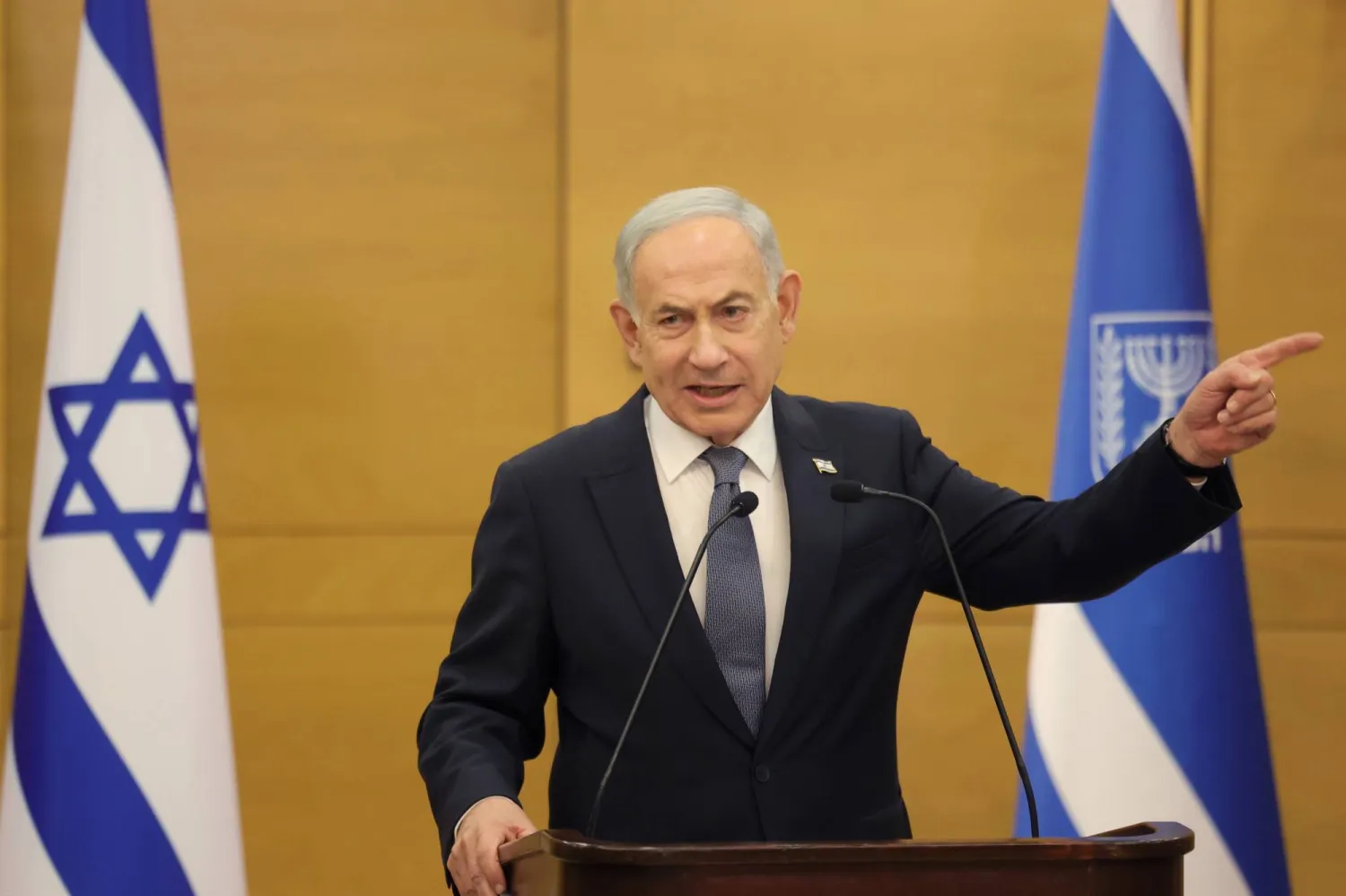
Israeli Prime Minister Benjamin Netanyahu delivers a media statement at the Knesset, the Israeli parliament, in Jerusalem, 25 November 2026. (EPA)
TT

At Risk of Losing Power, Netanyahu Makes Long-Shot Unity Appeal to Rival Eisenkot

Israeli Prime Minister Benjamin Netanyahu delivers a media statement at the Knesset, the Israeli parliament, in Jerusalem, 25 November 2026. (EPA)

Israeli Prime Minister Benjamin Netanyahu said on Saturday he would be willing to relinquish his role in a unity government led first by ‌Gadi Eisenkot, the ‌latest sign that the former ‌military ⁠chief may be close ⁠to forming an opposition-backed coalition intent on ousting Netanyahu. 

Netanyahu’s announcement underscores the pressure Israel’s longest-serving leader is under as Eisenkot wins support from potential partners that could hand him a governing majority or allow him to form ⁠a coalition government. 

Netanyahu offered to ‌go second in ‌a rotation agreement with Eisenkot in a proposed unity ‌government agreement between their two parties. 

Eisenkot was ‌tapped by Israel’s president to try to form a government after an inconclusive October 27 election that left neither him nor Netanyahu with a ‌clear path to power. 

This week, Eisenkot signed coalition deals with two ⁠left- and ⁠right-wing partners whose support could bring him closer to a majority. 

A spokesperson for Eisenkot's Yashar party did not immediately respond to a request for comment. 

Netanyahu said in a statement that he should lead the Israeli government but "given the magnitude of the existential threat and the possibility that a government could be formed that isn’t able to deal with this danger," his "responsibility as a leader" required he "put everything aside."