

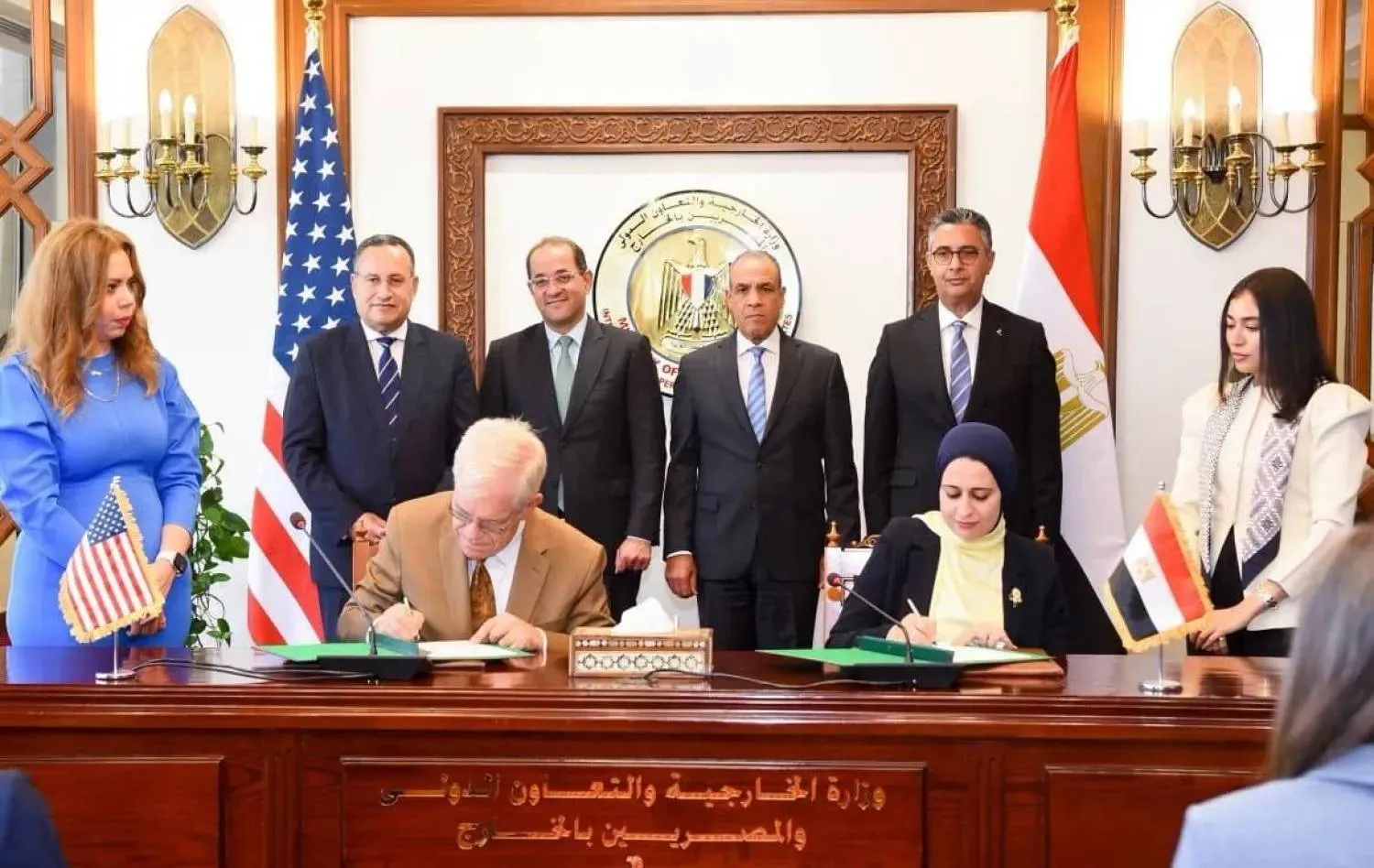

Egypt, US Sign Strategic Objective Agreement to Expand Cooperation

Egypt and the US seek greater cooperation across multiple sectors (Egyptian Foreign Ministry). 
TT

Egypt, US Sign Strategic Objective Agreement to Expand Cooperation

Egypt and the US seek greater cooperation across multiple sectors (Egyptian Foreign Ministry). 

Egypt and the United States signed a Strategic Objective Framework Agreement on Enhancing Mutual Prosperity on Wednesday, aimed at expanding cooperation across several sectors, according to the Egyptian Foreign Ministry.

Egyptian Foreign Minister Badr Abdelatty attended the signing ceremony alongside the ministers of finance, supply and internal trade, and higher education and scientific research.

The agreement was signed by Egypt’s Deputy Foreign Minister for International Cooperation, Dr. Samar El-Ahdal, and US Chargé d’Affaires in Cairo Robert Silverman.

Foreign Ministry spokesman Ambassador Nader Zaki said the framework agreement aims to strengthen cooperation with the United States to achieve tangible economic growth in Egypt.

He explained that its objectives include expanding cooperation in key sectors and adopting US institutional and technological innovations to improve the efficiency of Egypt’s water, energy and infrastructure systems.

The agreement also seeks to modernize education, healthcare and governance, develop the skills of Egyptian professionals and create more jobs, particularly in areas of shared strategic interest such as water management, artificial intelligence and energy.

Another objective is to strengthen Egypt’s food security through science-based agriculture.

The signing comes amid repeated statements by both sides emphasizing the strategic nature of relations between Cairo and Washington and their longstanding ties.

Former US Ambassador David Satterfield identified three main reasons behind Washington’s strategic view of Egypt: preserving the Egyptian-Israeli peace treaty, ensuring access to and transit through the Suez Canal, and maintaining stability within Egypt itself.

Satterfield told Asharq Al-Awsat that the peace treaty “remains, even in light of the Abraham Accords, the cornerstone and fundamental pillar of stability and peace in the broader Middle East.”

He explained that the United States considers its engagement with and support for Egypt vital to preserving the treaty.

“Egypt’s geographical location gives it particular importance to the United States because of the Suez Canal,” he added.

A Congressional Research Service report updated on February 25, 2026, supports this assessment, linking Egypt’s importance to US national security to its geographical position, population and diplomatic influence.

The report notes that facilitating the passage of US naval vessels through the Suez Canal provides Washington with a significant advantage when it needs to deploy forces rapidly to the Gulf and Indian Ocean.

US interests, however, extend beyond the canal and the peace treaty.

Satterfield warned that instability in Egypt, whether driven by economic or political factors or both, “would threaten not only US interests but those of the broader Middle East.”

In his assessment, Egypt’s stability is therefore a strategic interest in its own right, rather than merely a desired outcome of bilateral cooperation.

Ben Fishman, a researcher at the Washington Institute for Near East Policy and former director for North Africa at the US National Security Council, agreed.

He told Asharq Al-Awsat that the United States maintains a longstanding strategic relationship and strong military partnership with Egypt, while the peace agreement with Israel “remains a pillar of regional stability.”

The two countries’ interests also converge in Gaza. Washington needs a regional partner to help negotiate and implement security arrangements, while Cairo requires US cooperation to support a resolution to a crisis affecting its borders and security.

The Congressional Research Service notes that Egypt played a key role, alongside other partners, in mediating the October 2025 Gaza ceasefire and hosted the Sharm el-Sheikh summit in support of the agreement.

Despite the importance of their relationship, Cairo and Washington do not agree on every issue.

Fishman explained that US and Egyptian interests converge in some conflicts and diverge in others, which is natural in a relationship based on mutual interests.

Satterfield echoed that assessment, stressing that such differences do not undermine the strategic nature of bilateral ties.

“Disagreements also exist between the United States and NATO countries, but they do not diminish the fact that both sides view the relationship as strategic,” he said. “That is the nature of international relations.”

In a related development, Abdelatty discussed the latest regional developments with Massad Boulos, senior adviser to the US president for Arab and African affairs, during a telephone call on Wednesday.

According to the Egyptian Foreign Ministry spokesman, the discussion addressed intensive efforts to promote de-escalation.

Abdelatty stressed “the importance of all parties showing the necessary flexibility to reduce tensions and allow a return to the political track, rather than moving toward a resumption of military operations, whose grave dangers to the region and the world President Sisi has warned against.”

The call also covered “the need to maintain full support for efforts to unify the Libyan government in a way that achieves the security and stability sought by the Libyan people.”

The two officials also discussed the situation in Sudan, emphasizing the importance of ending the ongoing war and launching a Sudanese-owned political process.



Salam Says a Proposal Is Underway to Have UN Peacekeepers Stay in Lebanon

 Lebanese Prime Minister Nawaf Salam speaks during an interview with The Associated Press in Beirut, Lebanon, Friday, Nov. 27, 2026. (AP)
Lebanese Prime Minister Nawaf Salam speaks during an interview with The Associated Press in Beirut, Lebanon, Friday, Nov. 27, 2026. (AP)
TT

Salam Says a Proposal Is Underway to Have UN Peacekeepers Stay in Lebanon

 Lebanese Prime Minister Nawaf Salam speaks during an interview with The Associated Press in Beirut, Lebanon, Friday, Nov. 27, 2026. (AP)
Lebanese Prime Minister Nawaf Salam speaks during an interview with The Associated Press in Beirut, Lebanon, Friday, Nov. 27, 2026. (AP)

Lebanon’s prime minister said Friday that a new proposal is in the works that could have the UN Security Council allow the peacekeeping force in southern Lebanon to continue working after its nearly 50-year mandate expires at the end of the year.

Prime Minister Nawaf Salam told The Associated Press that the plan would see the peacekeeping force known as UNIFIL continuing its work after Dec. 31 and as the Security Council debates what should replace it.

France is preparing to introduce a resolution, Salam said, which would allow UNIFIL to continue some of its functions — such as clearing mines, escorting humanitarian convoys, and monitoring violations — in southern Lebanon during a drawdown period after the peacekeepers' mandate ends.

US officials have indicated that Washington is “open to considering” such an arrangement, he said.

“This would not resolve the problem of so-called post-UNIFIL, but it will give us some extra time to agree on a new architecture in southern Lebanon,” Salam said in an exclusive interview with the AP at the government palace in Beirut.

No plan in place for what comes next

The UN Security Council voted last year to terminate UNIFIL’s mandate at the end of 2026, bowing to demands from the United States and its close ally Israel, which argued that the force had failed to stop Hezbollah's buildup in southern Lebanon.

UNIFIL officials say they were never charged with disarming Hezbollah and that the force helped to preserve calm in the border region for 17 years before Hamas’ 2023 attack on southern Israel ignited a regional war.

The 7,500 peacekeepers currently stationed in southern Lebanon are expected to gradually withdraw over about six months after their mandate expires. The force has a year to fully end its operations.

Much of southern Lebanon, meanwhile, is occupied by Israeli forces after a war broke out in March between Israel and the Lebanese group Hezbollah, linked to the wider Iran war. Hezbollah has refused to give up its weapons, and Israel says it will not withdraw before the group is disarmed.

France has not publicly commented on the proposal that Salam cited.

However, a Western diplomat with knowledge of the matter said one option under discussion is to slow down the withdrawal process and “maintain certain UNIFIL missions” to avoid a power vacuum. The diplomat spoke on condition of anonymity to discuss the matter.

Lebanese officials have called for an extension of UNIFIL's mandate or, failing that, for a new UN-mandated force to be formed.

US officials have expressed willingness for some sort of international force to remain, but not in its current form. They have suggested that it could be a civilian force or private defense contractor.

Salam said that “any force to be deployed will have to be endorsed by the Security Council."

“I was very clear about it," he said. Any presence of forces "in the south will have to be endorsed by the Security Council."

‘In flux’

Salam said that with the wider Middle East and especially his region "in flux,” it's hard to make definitive plans.

Efforts are still underway to form a new government in Israel following last month's elections, and it remains unclear whether the US-Iran war is heading toward a new escalation or a negotiated solution. Iran is Hezbollah's main backer.

While the Lebanese government has insisted that its negotiations with Israel are separate from any US-Iran deal, Salam acknowledged that “the relation between the US and Iran directly affects the situation in Lebanon.”

“Lebanon is not an isolated island in the Mediterranean,” he said. “We are very much influenced by developments in the region. The whole region is in turmoil.”

Lebanon and Israel reached an agreement in June under which Israeli forces are supposed to gradually withdraw from Lebanon and hand over control to the Lebanese army, while Hezbollah is to be disarmed.

But implementation has stalled, as have talks between the two countries.

Salam denied that the talks have collapsed but said the “formal negotiations were put on hold” because of the Israeli elections and uncertainty around the composition of the next Israeli government.

It is unclear how an Israeli government potentially headed by opposition politician Gadi Eisenkot instead of current Prime Minister Benjamin Netanyahu would differ in its approach to Lebanon, Salam said.

Salam's firm stand on Iran and Hezbollah

The Lebanese prime minister said that his government has open lines of communication with Hezbollah and Iran but will not “allow the future of the country to be contingent on Iran’s wishes.”

Hezbollah, which has suffered a series of major blows in two recent wars with Israel, seems to be “more and more dependent on Iran" and continues to receive military and financial assistance from Tehran, Salam said.

That's despite attempts to clamp down on the group's ability to move money and weapons into the country.

Since the ouster of Syria's Iran-allied former President Bashar Assad two years ago, the flow of arms from Iran to Lebanon via Syria has slowed but not stopped.

Lebanon remains in a difficult position. Hezbollah has threatened to fight any attempt to forcibly disarm it, and the Lebanese army has so far moved cautiously.

“Definitely we are not seeking confrontation with Hezbollah," Salam said. "But we will not succumb to the intimidation of Hezbollah.”


UN Peacekeepers Are Preparing to Leave Southern Lebanon with No Plan for What Comes Next

 This picture, taken from northern Israel, shows a United Nations Interim Force in Lebanon (UNIFIL) armored vehicle driving past destroyed buildings in southern Lebanon on November 24, 2026. (AFP)
This picture, taken from northern Israel, shows a United Nations Interim Force in Lebanon (UNIFIL) armored vehicle driving past destroyed buildings in southern Lebanon on November 24, 2026. (AFP)
TT

UN Peacekeepers Are Preparing to Leave Southern Lebanon with No Plan for What Comes Next

 This picture, taken from northern Israel, shows a United Nations Interim Force in Lebanon (UNIFIL) armored vehicle driving past destroyed buildings in southern Lebanon on November 24, 2026. (AFP)
This picture, taken from northern Israel, shows a United Nations Interim Force in Lebanon (UNIFIL) armored vehicle driving past destroyed buildings in southern Lebanon on November 24, 2026. (AFP)

Among the few buildings still standing in the Lebanese border town of Naqoura are an abandoned hotel occupied by Israeli soldiers, its walls draped with anti-drone netting, and the compound housing the headquarters of the UN peacekeeping force.

The roads passing through the once-idyllic seaside town, now largely reduced to rubble, are empty except for the occasional military patrol or convoy of peacekeepers escorting civilians or supplies.

The end of the nearly 50-year mandate of the UNIFIL peacekeeping force is looming in just over a month, and still there is no plan for what comes after it.

The peacekeepers' impending exit, in parallel with an ongoing occupation by Israeli forces and a debate over the disarmament of the Hezbollah group, leaves the future of southern Lebanon in limbo.

Lebanon wants the UN force to stay. But the UN Security Council voted last year to terminate UNIFIL’s mandate at the end of 2026, bowing to demands from the United States and its close ally Israel.

Israel says the mission was a failure, citing Hezbollah’s military buildup over the years. The peacekeepers say they helped preserve calm for 17 years before Hamas’ 2023 attack on southern Israel ignited a regional conflict.

“My mandate is not to disarm Hezbollah,” UNIFIL’s commander, Maj. Gen. Diodato Abagnara, told The Associated Press in an interview. “My mandate is to support the Lebanese Armed Forces, to create the best conditions for the Lebanese Armed Forces to take full control here in the south. It’s not to fight against Hezbollah.”

UNIFIL is set to begin a gradual drawdown of its 7,500 peacekeepers on Jan. 1. Whatever comes after that, he said, “It’s very important to avoid a security vacuum in the south.”

Lebanese civilians fear a future without UNIFIL

UNIFIL wasn’t able to stop Hezbollah from launching missiles or Israel from carrying out airstrikes in two recent wars. But many residents of southern Lebanon say they still feel safer with its presence.

Mohammed Aoun was late to start harvesting his olive groves this year in the village of Halta, just outside of the Israeli-occupied area. On the first day of harvest earlier this month, as a UNIFIL patrol stopped at the orchard, an Israeli drone was buzzing overhead. The thud of a distant airstrike echoed through the valley.

Aoun said he was hesitant to start picking, but he had already lost out on the previous two years’ harvests. He is apprehensive about the impending departure of UNIFIL forces.

“Of course, we feel more secure when we see patrols coming and going; it’s a sort of protection,” he said. “Their presence is important with regards to the security situation. We don’t know what will happen after they leave.”

A decades-long presence

The UN Interim Force in Lebanon was created in 1978 after Israel invaded southern Lebanon to fight Palestinian militants. Israel invaded again in 1982 and didn't withdraw until 2000. During that period, Hezbollah, backed by Iran, emerged as a guerrilla force.

After a monthlong war between Israel and Hezbollah in 2006, UNIFIL was tasked with monitoring violations of UN Security Council Resolution 1701, which ended the fighting. When a ceasefire ended another Israel-Hezbollah war in 2024, UNIFIL was part of the mechanism overseeing its implementation.

The Lebanese army was to take over security in southern Lebanon after the UN force's exit.

But then another war broke out between Israel and Hezbollah in March, linked to the wider Iran war. Israel now occupies large swaths of southern Lebanon, where its soldiers have emptied and demolished dozens of villages.

About 11,000 people remain in a handful of mostly Christian villages in the occupied area, Abagnara said. They depend on UNIFIL to escort the convoys that keep them connected with the rest of the country.

An agreement between Lebanon and Israel for Israeli forces to withdraw in exchange for the disarmament of Hezbollah has floundered, and negotiations between the two countries have stalled.

No clear solution

Lebanese President Joseph Aoun said in a statement Wednesday that “Israel continues to engage in hostile acts in the south” and his government and France — a Security Council member with close ties to Lebanon — both want an extension of UNIFIL's mandate. Any alternative force should continue to operate under the 1701 framework, with some possible amendments, he said.

On Friday, Lebanon’s Prime Minister Nawaf Salam told the AP that a proposal is in the works to let UNIFIL continue some of its functions during the drawdown period after its mandate ends, as the Security Council debates what should replace it. But it's not clear if Washington will accept the plan.

US officials have expressed willingness for some sort of international force to remain, but not in its current form. They have suggested that it could be a civilian force or private defense contractor.

Israel wants its military to coordinate directly with the Lebanese army to remove what remains of Hezbollah’s weapons.

Israel’s ambassador to the UN, Danny Danon, said earlier this month that Hezbollah had "exploited UNIFIL’s presence."

“We do not rely on any international force," he said. "We trust only our own soldiers.”

Lebanon opposes the idea of a civilian contractor and has rejected direct military coordination with Israel.

France is working on a Security Council resolution that would authorize a new international force, a UN diplomat said. A Western diplomat said there are also discussions of slowing down UNIFIL's withdrawal and maintaining certain missions to avoid a “power vacuum.”

They spoke on condition of anonymity because they were not authorized to comment publicly.

The question of Hezbollah's weapons remains

In January, the Lebanese army announced that it had finished removing Hezbollah weapons caches from the border area south of the Litani River.

Hezbollah did not actively oppose the effort but has refused to give up its weapons elsewhere in the country and threatened to fight any attempt to forcibly disarm it.

The Lebanese army has been cautious about any move that might provoke a civil conflict. A Lebanese security official, who spoke on condition of anonymity to discuss sensitive matters, said the army’s current policy is to stop weapons shipments from moving around the country — a change from the past, when Hezbollah freely transported arms — but not to raid the group’s storage sites.

Hezbollah supporters in the past accused UNIFIL of spying for Israel and sometimes attacked peacekeepers. Now the group says it would accept UNIFIL or another UN-mandated force, but not a private security contractor or a force seen as supporting Israel's occupation.


Military Sources: Sudanese Army Recaptures Strategic Town in Blue Nile

Members of the army-allied Sudan Shield Forces in Ed Damazin, Blue Nile region (Sudan Shield Forces' Facebook page)
TT

Military Sources: Sudanese Army Recaptures Strategic Town in Blue Nile

Members of the army-allied Sudan Shield Forces in Ed Damazin, Blue Nile region (Sudan Shield Forces' Facebook page)

Sudanese military sources said the army recaptured the strategic town of Maqanza in the Blue Nile region on Friday, about 22 kilometers from the regional capital, Ed Damazin, after the Rapid Support Forces (RSF) announced taking control of it last week.

The fighting has triggered waves of displacement, with residents fleeing after the RSF and its allies entered Maqanza on November 21.

Pro-army platforms quoted military sources as saying the army had recaptured Maqanza in Bau locality, without providing details of the operation.

The platforms circulated a video showing soldiers celebrating what they described as the recapture of the town, with a sign bearing the name of its health center visible behind them. The army has not issued an official statement confirming the recapture.

The RSF announced on November 21 that it had seized Maqanza, approximately 22 kilometers south of Ed Damazin.

The army did not comment on the announcement at the time, while pro-army platforms denied that the RSF had taken the town. On Friday, those same platforms quoted military sources as saying the army had regained control.

Meanwhile, fighters wearing RSF uniforms released a video Thursday showing them celebrating inside a house they said was in Maqanza.

Waves of Displacement

The Emergency Lawyers group estimated Friday that between 1,620 and 1,890 people had been displaced from Maqanza.

It said women, children and the elderly were among those most urgently in need of assistance and warned of further displacement as military operations continued.

The group called on the RSF and its allies to protect civilians and refrain from intimidating residents or endangering their lives and property.

Military operations in Blue Nile have caused widespread displacement.

The International Organization for Migration (IOM) estimated that 119,782 people were displaced between January 11 and October 15, 2026.

Ed Damazin received 45,815 displaced people, while El Roseires received 36,950. The remainder sought refuge in Bau, Wad al-Mahi, Geissan, Kurmuk and Al-Tadamon.

The Blue Nile Civil Society Initiative said on November 22 that more than 51,000 people had been newly displaced within the region, while over 15,000 others had left Ed Damazin and El Roseires for other Sudanese states.

Military Reinforcements in Ed Damazin

The RSF made significant territorial gains in Blue Nile during October and November, capturing several towns and localities, including Kurmuk, Geissan, Bau and Wad al-Mahi, and advancing toward Ed Damazin.

The group also intensified drone attacks on the regional capital, with reports indicating that dozens of civilians had been killed or wounded.

In response, the Sudanese army reinforced its positions across the region, including at the headquarters of the Fourth Infantry Division in Ed Damazin.

Sudanese military sources said more than 15,000 army personnel had arrived in the city.

Abu Aqla Keikel, commander of the army-allied Sudan Shield Forces, was also seen in Ed Damazin alongside members of his force. Keikel previously defected from the RSF and joined the army.

Maqanza is known for artisanal gold mining. The Sudanese Mineral Resources Company had previously identified the town as one of the locations where it planned to establish gold markets, according to local reports at the time.

The Sudan People's Liberation Movement, led by Malik Agar, had also used Maqanza as its main headquarters during its war against government forces.

The family of the current governor of the Blue Nile region comes from the town.

Relative Calm in Kordofan

On the Kordofan fronts, the pace of ground operations has slowed following a rapid army advance that saw it recapture large areas of North Kordofan state and several towns in West Kordofan, most notably Al-Khuway, one of the state's largest towns.

Army forces have also advanced toward En Nahud, one of West Kordofan's most important commercial and agricultural centers.

The region has not witnessed major ground clashes for several days, although military clearing operations have continued, with both sides still using various types of drones.

On Thursday, the army said its air defenses had shot down a hostile FH-95 drone west of Kadugli, the capital of South Kordofan state.