

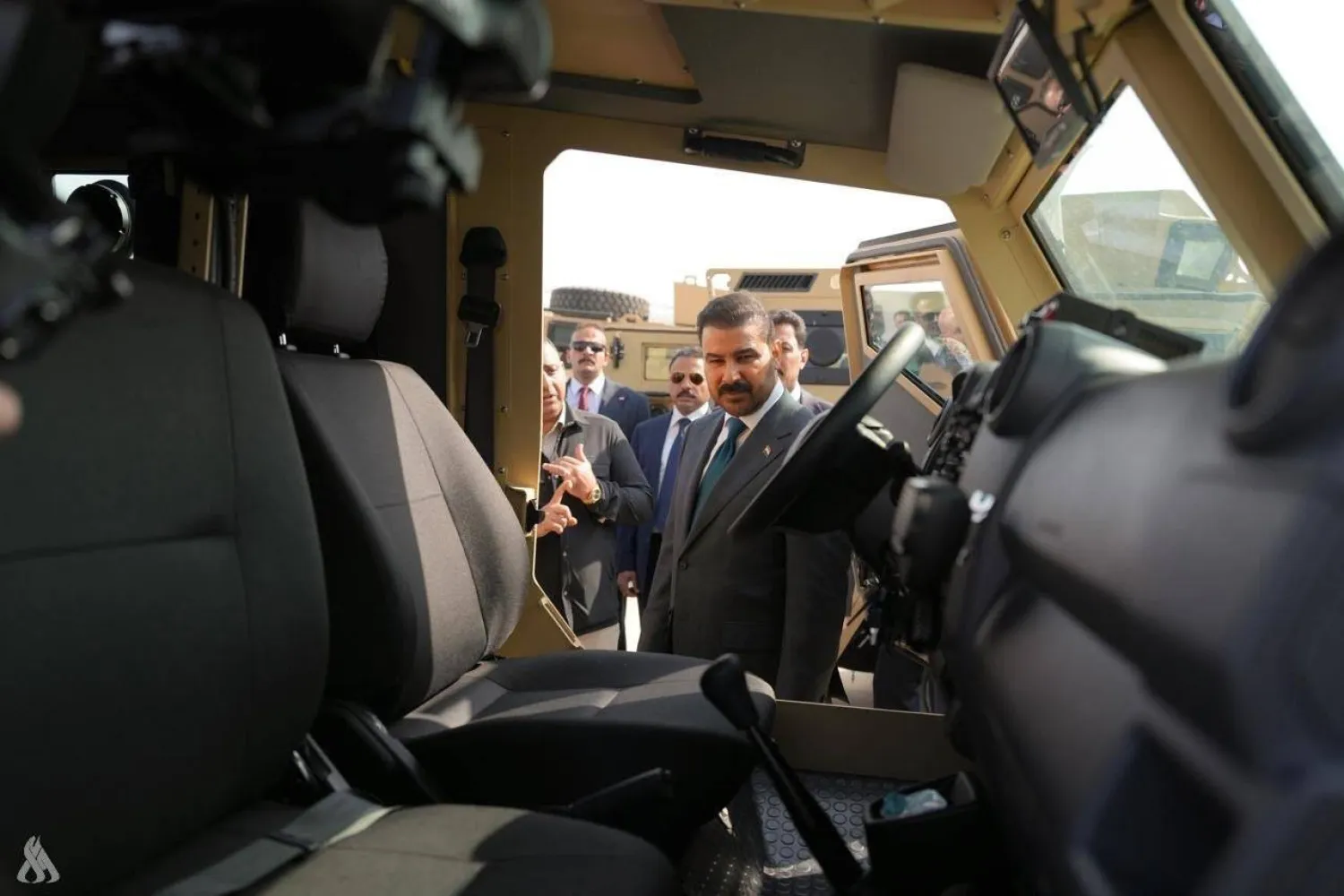

Al-Zaidi Targets 'Intermediary Companies' in Defense Industry Contracts

PM Ali Al-Zaidi during his visit to the Defense Industries Commission. (INA)
TT

Al-Zaidi Targets 'Intermediary Companies' in Defense Industry Contracts

PM Ali Al-Zaidi during his visit to the Defense Industries Commission. (INA)

Iraqi Prime Minister Ali Al-Zaidi has ordered the Defense Industries Commission to bypass intermediary firms and contract directly with manufacturing companies, aiming to curb funding channels linked to armed factions.

The directive seeks to tighten oversight on government procurement by eliminating middlemen networks, which informed sources state serve as vital economic pipelines for various armed groups.

The policy shift arrives amid mounting tension between the government and certain factions, driven by Al-Zaidi’s broader push to restructure the relationship between state institutions and armed formations, including their commercial ventures. Sources familiar with the matter noted that the restriction has sparked significant concern among stakeholders who rely on intermediary networks tied to lucrative state contracts.

During a visit to the Defense Industries Commission on Thursday, Al-Zaidi stressed the "necessity of dealing directly with parent manufacturing companies, and absolutely not dealing with intermediary companies."

According to a statement from his media office, the directive is designed to ensure contract transparency while eliminating intermediary loops and vulnerabilities to corruption.

Al-Zaidi affirmed that Iraq possesses the capability to manufacture its weapons and equipment needs through national expertise, stating that building an advanced defense industry represents a fundamental pillar of national sovereignty. He stressed the importance of research and development, as well as keeping pace with technological advancements in military industries.

The Defense Industries Commission, which replaced the Military Industrialization Commission established by the former regime during the Iran-Iraq War, is one of the state institutions responsible for producing and developing military equipment.

Shadow companies

The government directive has renewed focus on the network of intermediary companies active in state contracting. Sources said that these firms are linked to the economic interests of factions and exploit political and administrative influence to expand their operations inside state institutions.

Some of these companies operate within a network linked to Al-Muhandis Company - one of the formations of the Popular Mobilization Forces (PMF) - or its front companies. Sources said that these entities are used to secure government contracts and provide financial resources to armed groups.

An informed source told Asharq Al-Awsat that these companies serve as "part of a financing mechanism for armed factions operating through two tracks: first, generating revenue from contracting and state procurement, and second, laundering funds to legitimize income derived from illicit activities, including oil and drug smuggling."

The source added that the operations of these firms are not confined to a specific authority or ministry. Instead, they extend across various state institutions, leveraging political and administrative clout to secure government contracts that provide their commercial transactions with official cover.

In the political context, disputes have begun to escalate between certain armed factions and parties within the Coordination Framework. Amid these tensions, factions are accusing political and government forces of cooperating with Al-Zaidi to reduce their economic and security influence in response to external pressures.

A recent wave of reports has emerged highlighting the commercial activities of figures and leaders within armed factions, including Kataib Hezbollah, though the accuracy of these accounts could not be independently verified.

Public debate is intensifying over the shifting role of these factions from their self-proclaimed status as "resistance forces" to entities managing economic interests and commercial influence networks.

This evolution raises questions regarding the exact nature of these commercial ventures, their relationship to the groups' weapons, and the strategic cost Iraq might ultimately incur should these factions decide to drag the country into a broader regional conflict.

Hussein Allawi, an expert in political affairs, said Al-Zaidi's visit to the Defense Industries Commission carried a message regarding the need to protect public funds and developing Iraqi defense capabilities through direct engagement with international companies.

Allawi told Asharq Al-Awsat that the PM is seeking to "strengthen the defense industry file," describing it as one of the sensitive areas that demand transparency and governance to ensure the quality of weapons and equipment used in Iraq.

He added that adopting direct contracts with international corporations, in accordance with applicable commercial laws and regulations, would curb the additional costs borne by the state due to multiple intermediary loops.

Security affairs researcher Mukhlad Hazem said Al-Zaidi's decision is a major step in confronting corporate networks that exploit the influence of political or armed factions to secure government contracts.

Hazem told Asharq Al-Awsat that these networks are not a new phenomenon, but rather have extended their activities over several years.

He revealed that certain groups monopolize massive state contracts to finance their economic entities, without necessarily delivering a corresponding return in terms of product quality or adherence to execution terms.



Abdelatty to Asharq Al-Awsat: Egypt Is in Contact with Russia and Ukraine to Reduce Tensions

 Egyptian Minister of Foreign Affairs, Dr. Badr Abdelatty speaks at a Congressional Gold Medal in honor of Anwar Sadat, former President of Egypt, at the US Capitol in Washington, US, DC, November 18, 2026. (Reuters)
Egyptian Minister of Foreign Affairs, Dr. Badr Abdelatty speaks at a Congressional Gold Medal in honor of Anwar Sadat, former President of Egypt, at the US Capitol in Washington, US, DC, November 18, 2026. (Reuters)
TT

Abdelatty to Asharq Al-Awsat: Egypt Is in Contact with Russia and Ukraine to Reduce Tensions

 Egyptian Minister of Foreign Affairs, Dr. Badr Abdelatty speaks at a Congressional Gold Medal in honor of Anwar Sadat, former President of Egypt, at the US Capitol in Washington, US, DC, November 18, 2026. (Reuters)
Egyptian Minister of Foreign Affairs, Dr. Badr Abdelatty speaks at a Congressional Gold Medal in honor of Anwar Sadat, former President of Egypt, at the US Capitol in Washington, US, DC, November 18, 2026. (Reuters)

Egypt has stepped in to mediate between Ukraine and Russia, with Kyiv expressing gratitude for what it described as "Cairo's active role" toward a ceasefire.

Egyptian Foreign Minister Dr. Badr Abdelatty told Asharq Al-Awsat on Saturday that, under the directives of President Abdel Fattah al-Sisi, Egypt is communicating with Ukraine and Russia to ensure freedom of navigation and de-escalation in the Black Sea, given its impact on freedom of navigation and wheat shipments.

He stressed that efforts in this regard are ongoing, hoping that they will yield results soon.

During a press briefing with Egyptian media on Saturday, Abdelatty noted that the international community appreciates Egyptian leadership and diplomacy, pointing out that Cairo is engaged across all regional and international files based on its policy of strategic balance.

He added that as the world's largest grain importer, Egypt is pushing for freedom of navigation through all maritime corridors, Hormuz, Bab al-Mandeb, and the Black Sea, especially as this directly affects its national interests.

On Friday, Ukrainian Foreign Minister Andrii Sybiha stated that Ukraine is ready for a ceasefire and expressed gratitude to India, Türkiye, and Egypt for playing an active and vital role in easing tensions in the Black Sea region and advancing mediation efforts.

Kyiv is currently awaiting a response from Russia, he added.

The Black Sea region has seen an escalation in Russian and Ukrainian attacks, with strikes expanding to hit ports, commercial vessels, and energy and grain export facilities.

Former Egyptian Assistant Foreign Minister Ambassador Mohamed Hegazy viewed Ukrainian praise for Egypt's role as a reflection of confidence in Cairo's diplomacy and its capacity to bolster international de-escalation efforts.

He told Asharq Al-Awsat that Egypt operates from a vision rooted in the belief that dialogue and diplomacy remain the most effective means of preventing conflicts from widening, particularly in the Black Sea region, which carries strategic weight for European and global security, as well as international trade, energy, food, and supply chains.

He added that Egypt's role is built on a foundation of trust and credibility, alongside a foreign policy anchored in respecting state sovereignty, steering clear of confrontational alignments, and encouraging political solutions that account for all parties' interests and pave the way for sustainable settlements.

This is not the first time Kyiv has highlighted Cairo's role; Ukrainian President Volodymyr Zelenskyy previously pointed to proposals submitted by Egypt, Türkiye, and India on September 23, during meetings on the sidelines of the UN General Assembly in New York, aimed at reaching a maritime truce to ensure the resumption of safe navigation in the Black Sea.


France, UK and Six Other Countries Call for Palestinian Elections in Early 2027

An elderly Palestinian man walks along a street in the West Bank village of Abu Falah, north of Ramallah, 20 November 2026. (EPA)
TT

France, UK and Six Other Countries Call for Palestinian Elections in Early 2027

An elderly Palestinian man walks along a street in the West Bank village of Abu Falah, north of Ramallah, 20 November 2026. (EPA)

France, the UK, Australia, Canada and four other countries on Saturday issued a joint statement calling for postponed Palestinian legislative elections to take place in the first three months of 2027.

The vote was "essential" for a "democratic renewal" in the Palestinian territories and "is inseparable from the preservation of the two State solution, which we remain steadfastly committed to", they said.

The other countries behind the joint statement were Belgium, Luxembourg, Norway and Poland.


‘Millions Starving’ in Yemen’s Houthi-Held North, NGO Head Warns

Secretary-General of the Norwegian Refugee Council (NRC) Jan Egeland, speaks during an interview with Agence-France Presse (AFP), in Sanaa on November 27, 2026. (AFP)
TT

‘Millions Starving’ in Yemen’s Houthi-Held North, NGO Head Warns

Secretary-General of the Norwegian Refugee Council (NRC) Jan Egeland, speaks during an interview with Agence-France Presse (AFP), in Sanaa on November 27, 2026. (AFP)

Millions of Yemenis in areas under Houthi control are suffering from hunger as a result of restrictions on humanitarian organizations and their lack of funding, Norwegian Refugee Council head Jan Egeland told AFP.

In an interview on Friday in Sanaa, the Yemeni capital controlled by the Iran-backed group, Egeland spoke of a "big difference" between the government-controlled south, where numerous international organizations are active, and the north, where "we are so few".

But "the needs are all over. And we are all underfunded as humanitarians in Yemen".

"Well over 20 million people" in the north "are lacking the aid they need to have a minimum (standard) of living," he said. "Millions and millions are starving and have desperate needs."

"I have never ever in my many years as a humanitarian worker seen so few humanitarian groups faced with so desperate needs among so many millions of people as in northern Yemen."

"Millions and millions got food every single month until the UN pause in operations in the north after their aid workers were detained," Egeland said.

At the end of last month, the United Nations announced the death of employee Mohammed Al-Shami, who had been detained by Houthi militia since 2024.

UN spokesman Farhan Haq said last month that 71 UN employees were still being held by the Houthis.

- Desperate situation -

Egeland highlighted the difficult political dynamics that humanitarian groups need to navigate, including sanctions on the Houthis.

"Sanctions from some of the donor countries meant that some organizations left because they were afraid to be punished for the sanctions," he said. "Others lost aid completely overnight because they were reliant on the United States and Germany and others who cut their aid" budgets.

And still other organizations "felt that the humanitarian space was not there. There was too much interference, and their aid workers were detained".

He called on the international community to do more to facilitate a return of the UN's agencies.

"Without the UN, we cannot reach everybody in the north. Only the World Food Program has the capacity to feed everybody."

But despite all the obstacles, Egeland stressed that the main issue remains a lack of funds, not access.

- 'Neglected crisis' -

He said the UN's 2026 appeal for basic assistance is only 20 percent funded and its appeal for emergency shelter has reached just 13 percent, calling the gap "catastrophic".

Yemen's frozen civil conflict reignited in July amid the regional Middle East war and has displaced more than 340,000 people in recent months, according to the International Organization for Migration.

Egeland said he would head to government-controlled Taiz, which has been suffering from a worsening food crisis for weeks due to a Houthi siege on the city.

"Both in the north and in the south, I saw people who are without shelter against the elements," he said, citing people living under leaves and branches in Abyan in the south.

"It's much worse now than I have seen it at any point in my years visiting Yemen," he said. "It is a forgotten and neglected crisis already."

Egeland expects the number of deaths resulting from acute malnutrition in Yemen to rise within six months.

"When children are as malnourished as they are now, they die from diseases. And when they drink polluted water, they get diarrhea and they die. Others get cholera and die."