


Washington Offers $20 Million Reward for Information on Iran's Nuclear Program

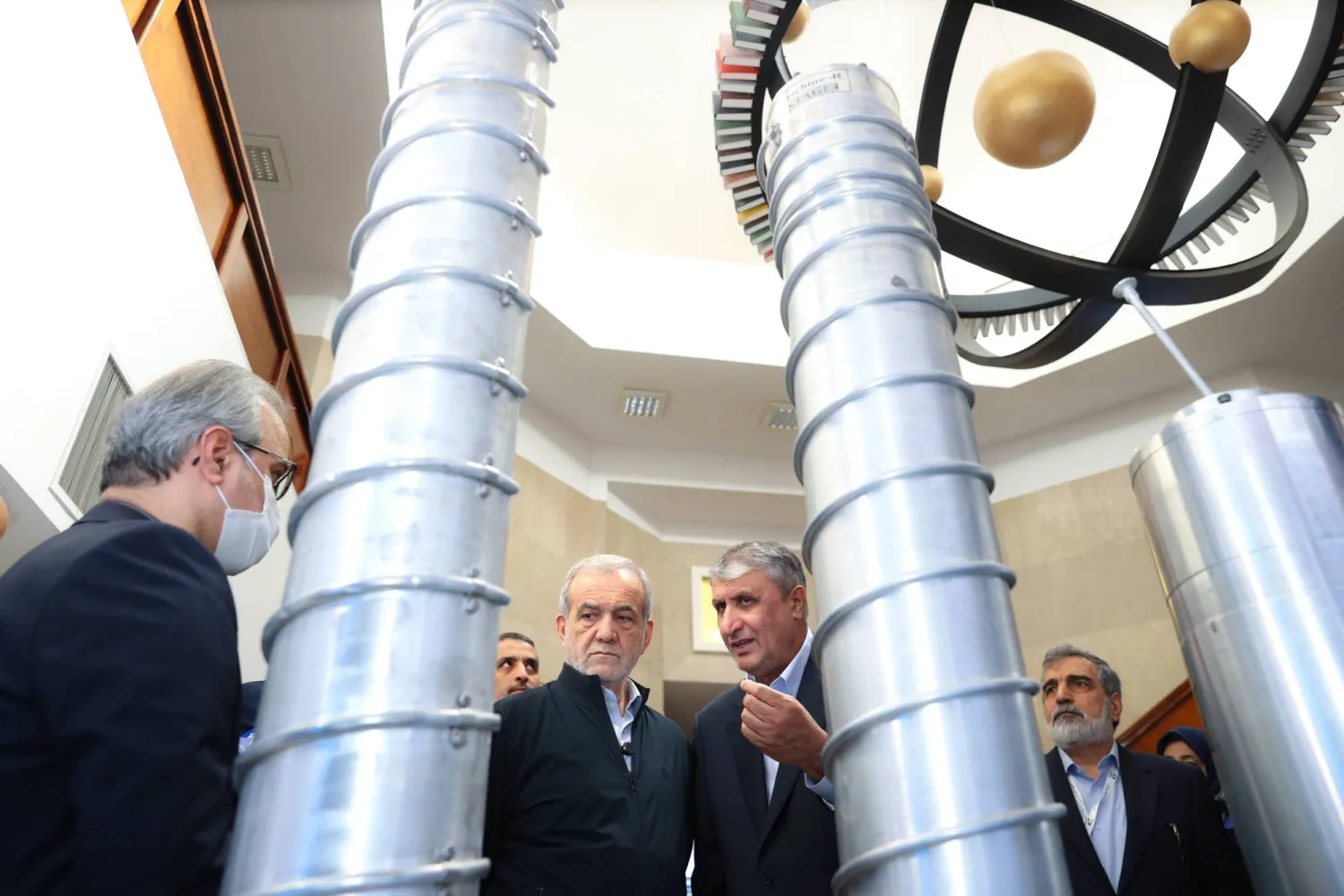
The Iranian president visiting a centrifuge facility as part of Iran's nuclear program (Archive - Iranian Presidency)
TT

Washington Offers $20 Million Reward for Information on Iran's Nuclear Program

The Iranian president visiting a centrifuge facility as part of Iran's nuclear program (Archive - Iranian Presidency)

Washington is offering a $20 million reward “and possible relocation” for information about Iran’s nuclear program, the US military said Friday, as President Donald Trump reiterated Tehran wants to make a deal to end the war.

The US Department of State’s Rewards for Justice program said in an announcement posted to X that the “government remains committed to countering any attempt by Iran to develop a nuclear weapons program.”

The State Department agency said it was seeking information on “nuclear scientists and staff, nuclear program-related technologies, and capabilities, associated organizations and personnel.”

“If you have information on Iran’s nuclear program, assets, or associated individuals, send it to us via Signal or our Tor-based tip line. You may be eligible for a reward and relocation,” it added.

Anticipating Trump’s Decision

The announcement came a day after Trump said he would decide “soon” on whether to resume the war on Iran following a meeting with his top national security advisers.

“I would rather not destroy the rest of the country if possible, but maybe I will have to. You'll know soon enough,” Trump told reporters in the Oval Office.

US-Iran negotiations remain deadlocked over Iran's stockpile of near-weapons-grade uranium. Trump has said Iran must give up the stockpile, which he has referred to as “nuclear dust.” But Iranian officials have been adamant that they will not ship the uranium outside the country.

Earlier on Friday, two Middle East government officials told AP that Iran was reviewing proposals presented by Qatar to address differences with Washington over Tehran's nuclear program.

The Qatari draft involves lifting the US blockade on Iran's ports and releasing some of Tehran's frozen funds in exchange for allowing International Atomic Energy Agency inspectors to visit sites bombed by the US and Israel, according to regional officials cited by AP.

Mohsen Rezaei, secretary of Iran's Supreme National Security Council, said on Thursday that the Strait of Hormuz would not reopen to Washington and no negotiations would take place until Tehran’s “seven conditions” were met.
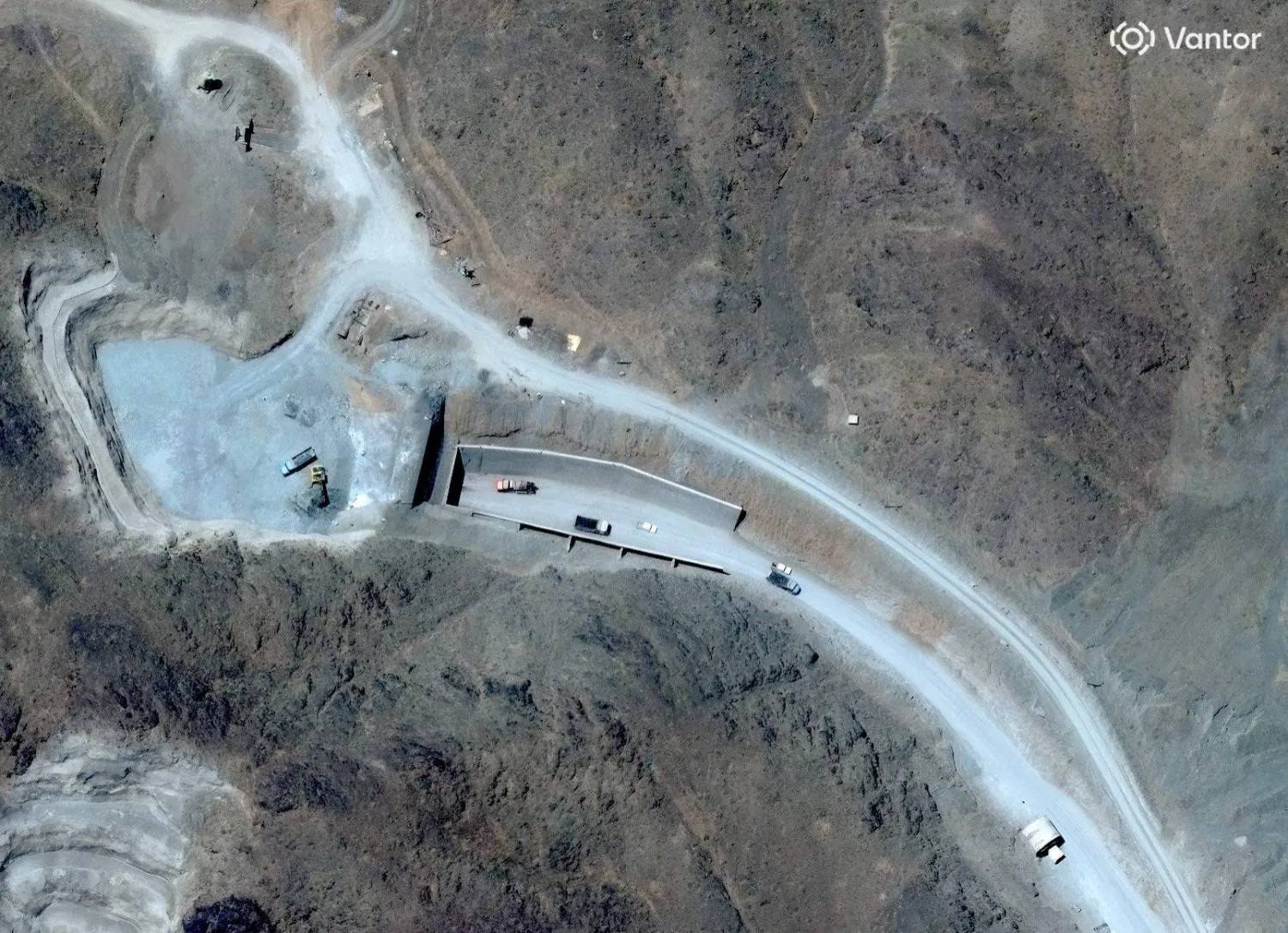
SATELLITE VIEW shows vehicles at an entrance to Pickaxe Mountain tunnels, near Natanz nuclear facility, in Iran, June 21. (VANTOR/HANDOUT VIA REUTERS)

Reviewing Nuclear Doctrine

In Iran, calls are growing for a reassessment of the country’s nuclear doctrine and a withdrawal from the Treaty on the Non-Proliferation of Nuclear Weapons (NPT).

Despite those demands, Rezaei said earlier this month that Iran has made no official decision to change its nuclear doctrine.

“So far, no official decision has been made by the government or the Supreme National Security Council to change the nuclear doctrine,” Rezaei said, according to remarks carried by the semi-official Tasnim News Agency.

Last week, Mohammad-Javad Haj-Ali-Akbari, Tehran’s interim Friday prayer leader, called for a revision of Iran’s nuclear doctrine and a move toward acquiring nuclear weapons. He claimed that the issue has now become a “national demand.”

Few days later, Nasrollah Pejmanfar, head of the Iranian parliament’s Article 90 Commission, called for Iran to seriously consider withdrawing from the Nuclear Non-Proliferation Treaty, intensifying the debate over Tehran’s nuclear policy amid escalating tensions with Western powers.

On Thursday, Iranian lawmaker Mohammad Taghi Naghdali said that public demands had shifted from nuclear energy to nuclear warheads, calling on parliament to prioritize Iran's withdrawal from the Nuclear Non-Proliferation Treaty.

The New York Times wrote on Thursday that senior Iranian officials and clerics are also debating whether Iran should withdraw from the NPT, which prohibits the development of a nuclear weapon.

Iran’s Leader Mojtaba Khamenei has not taken a clear public position on the issue. His father, former Leader Ali Khamenei had stated that nuclear weapons are forbidden.

Late last month, International Atomic Energy Agency chief Rafael Grossi said there were no signs of suspicious activity at Iranian nuclear sites bombed by the United States in June.

“We do not see anything that would give rise to hypotheses of any substantive work going on there,” Grossi said in New York.

Grossi told reporters that inspectors had no access to the two sites stricken in June, but confirmed that some inspection was under way.

“We are trying to build it back, and we are inspecting in Iran,” he said.

On Friday, a BBC report said Iran appears to be undertaking significant new construction near at least two of its major missile sites and repairing bases damaged by months of US and Israeli air strikes, according to analysis of satellite images.

It said evidence of digging and new buildings are visible in satellite imagery taken in November at the Garmdareh military base in Karaj near the capital Tehran and the Shahroud base in the north, analysts at British intelligence company MAIAR, who reviewed the photos, told BBC Verify.



JMIC: 17 Tankers Hit in Strait of Hormuz in November

In this handout photo provided by the Lewis Pugh Foundation, taken from a boat accompanying endurance swimmer Lewis Pugh, smoke rises from a burning liquefied petroleum gas tanker in the Strait of Hormuz off the Musandam Peninsula, Oman, Tuesday, Nov. 17, 2026. (Lewis Pugh Foundation via AP)
TT

JMIC: 17 Tankers Hit in Strait of Hormuz in November

In this handout photo provided by the Lewis Pugh Foundation, taken from a boat accompanying endurance swimmer Lewis Pugh, smoke rises from a burning liquefied petroleum gas tanker in the Strait of Hormuz off the Musandam Peninsula, Oman, Tuesday, Nov. 17, 2026. (Lewis Pugh Foundation via AP)

Seventeen tankers have been struck in the Strait of Hormuz since Nov. 1, according to an advisory update issued Sunday by the Joint Maritime Information Center (JMIC).

In Update 118 covering maritime security through Nov. 29, JMIC reported no confirmed attacks or disruptions in the Strait of Hormuz during the latest 72-hour period, though it maintained the waterway's threat level at "severe," indicating that deliberate attacks remain highly likely.

The center stated that Iranian Revolutionary Guard Corps (IRGC) activity, including drone overflights, targeted surveillance of merchant shipping, and occasional VHF radio hailing, persisted along key transit lanes.

JMIC added that Iranian claims regarding naval mine strikes on tankers have not been confirmed by any official or national authorities.

Citing data from the US Naval Cooperation and Guidance for Shipping (NCAGS), the report noted that US-assisted commercial transits through the Strait of Hormuz averaged approximately 36 per day between Nov. 26 and Nov. 28, totaling 109 transits over the three-day window, up from an average of 32 per day between Nov. 22 and Nov. 25.

Overall commercial traffic in the waterway remained significantly below the 2025 historical baseline of roughly 138 vessels per day.

Non-facilitated cargo vessels above 1,000 deadweight tons broadcasting on Automatic Identification Systems (AIS) accounted for only three transits between Nov. 26 and Nov. 28, while approximately 217 commercial ships remained stationary at major anchorages east of the strait.


Iran's Currency Reaches Another Record Low

Iranians drive in front of a billboard featuring a missile and carrying a sentence in Persian, 'The way of honor,' in a street in Tehran, Iran, 25 November 2026.  EPA/ABEDIN TAHERKENAREH
Iranians drive in front of a billboard featuring a missile and carrying a sentence in Persian, 'The way of honor,' in a street in Tehran, Iran, 25 November 2026. EPA/ABEDIN TAHERKENAREH
TT

Iran's Currency Reaches Another Record Low

Iranians drive in front of a billboard featuring a missile and carrying a sentence in Persian, 'The way of honor,' in a street in Tehran, Iran, 25 November 2026.  EPA/ABEDIN TAHERKENAREH
Iranians drive in front of a billboard featuring a missile and carrying a sentence in Persian, 'The way of honor,' in a street in Tehran, Iran, 25 November 2026. EPA/ABEDIN TAHERKENAREH

Iran’s currency on Sunday hit a record low again as the US dollar traded at 3 million rials in exchange shops.

Tehran continues to feel the economic pain of an American military blockade of its ports during the war, along with the closure of some border crossings with neighboring countries.

Iran’s official Central Bank rate has been showing about 1.96 million rials to the dollar, but the market rate is what most Iranians pay.

Iran’s economy has struggled for years because of international sanctions and mismanagement. It experienced some relief under a 2015 nuclear deal that lifted many sanctions, but US President Donald Trump unilaterally withdrew from the accord in 2018.

Since returning to office, Trump has expanded sanctions targeting Iran’s financial sector and energy exports.


Netanyahu and Eisenkot Met but ‘Substantial Differences’ Remain

(FILES) This combination of pictures created on October 28, 2026, shows Prime Minister Benjamin Netanyahu (L) speaking to the media after voting in Jerusalem on October 27, 2026, and Yashar party leader Gadi Eisenkot addressing his supporters at the election night rally in Tel Aviv early on October 28, 2026. (Photo by Jewel SAMAD and Maya LEVIN / various sources / AFP)
TT

Netanyahu and Eisenkot Met but ‘Substantial Differences’ Remain

(FILES) This combination of pictures created on October 28, 2026, shows Prime Minister Benjamin Netanyahu (L) speaking to the media after voting in Jerusalem on October 27, 2026, and Yashar party leader Gadi Eisenkot addressing his supporters at the election night rally in Tel Aviv early on October 28, 2026. (Photo by Jewel SAMAD and Maya LEVIN / various sources / AFP)

Israeli Prime Minister Benjamin Netanyahu on Sunday sat down with opposition leader Gadi Eisenkot hours after Netanyahu offered to allow him to serve first as PM if the two formed a unity government.

Eisenkot hasn't said whether he would sign on to a rotation arrangement. He has less than a week to form a government, though he could ask Israel’s president for a two-week extension.

After the meeting, the two leaders didn't announce any progress. In a statement, they called it “businesslike” and said that both sides sought to “bridge the substantial differences between them.”

Israel has been in political limbo since last month’s election gave neither Eisenkot nor Netanyahu a sufficient majority to lead the next government. Eisenkot’s bloc won 48 of the 120 seats in the parliament, or Knesset, and Netanyahu’s won 53. Israel’s Palestinian citizens turned out in historic numbers to vote and secured the other 19 seats for the Arab-led parties.

Eisenkot has decried Netanyahu as unfit for office. But he could ultimately form a partnership with him to establish a unity government made up of Jewish-led parties. Or he could unite his bloc of parties that pledged to oust Netanyahu with the Arab-led parties.

Another option is to work with the ultra-Orthodox parties, though that approach would face substantial opposition from Eisenkot’s voters and political allies.