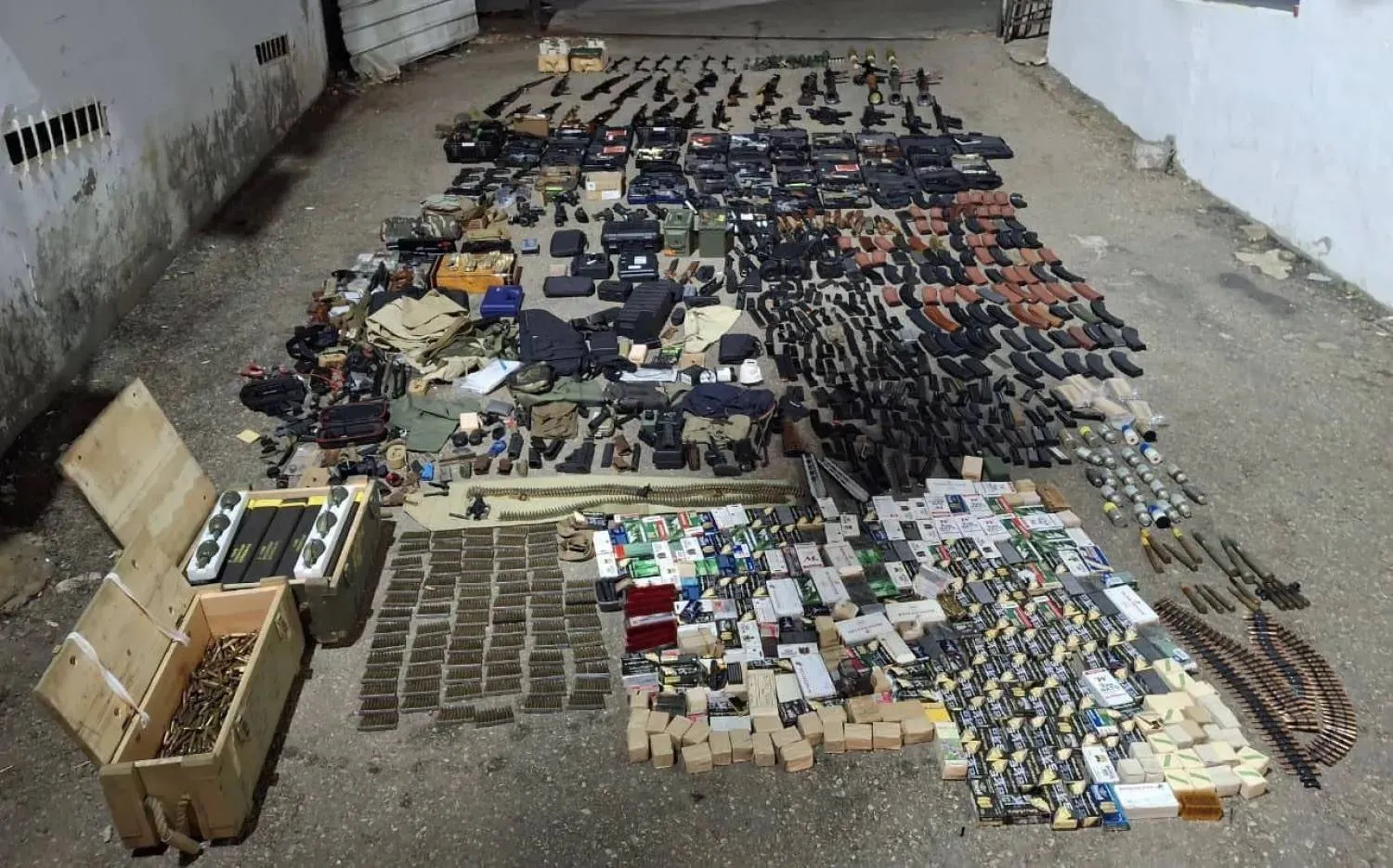
An Iraqi security committee began investigating suspected fuel smuggling in Jurf al-Sakhar, north of the Babil province, on Friday, amid mounting tensions between the government and Kataib Hezbollah over the area and efforts to bring weapons under state control.
Troops deployed around the area to secure the committee’s entry, but political mediation reportedly halted their advance amid disagreements over how the investigation would proceed.
Footage showed a large military deployment before committee members met commanders believed to be from the pro-Iran Kataib Hezbollah. Sabereen News, an outlet close to armed factions, broadcast a Kataib Hezbollah commander addressing Interior Ministry officers.
Security Media Cell chief Saad Maan denied that political groups or armed factions were represented on the committee, saying it had begun fieldwork early Friday.
A security source told Shafaq News that the committee conducted an initial inspection after agreeing with faction representatives on investigative procedures and field visits.
Prime Minister Ali al-Zaidi formed the committee Thursday, placing it under the Popular Mobilization Forces (PMF). Its members represent the prime minister’s office, intelligence and anti-corruption bodies, the Oil Ministry, security agencies, forensic authorities and the Energy Police.
The November 12 order was signed by Lt. Gen. Abdul Amir al-Shammari, director of the commander-in-chief’s office.
The decision followed a three-hour meeting between al-Zaidi, Badr Organization leader Hadi al-Amiri, PMF chairman Falih al-Fayyadh and chief of staff Abdul Aziz al-Muhammadawi, known as Abu Fadak.
According to Shafaq News, al-Zaidi demanded enforcement of Iraqi law against offenders, while al-Amiri and al-Fayyadh proposed giving the parties concerned time to reorganize and resume dialogue over weapons.
The proposal included continuing negotiations through a four-member committee seeking to resolve disputes and preserve stability.
A government adviser told Asharq Al-Awsat that Baghdad’s changing approach reflected the armed groups’ growing political influence.
“The state is not merely confronting forces that possess weapons; these forces have also become capable of influencing political decision-making,” the adviser said.
The government prioritizes restoring sovereignty without confronting society or its communities, he stressed.
Disputes over Kataib Hezbollah had already disrupted a planned Monday meeting between al-Zaidi and Coordination Framework leaders, while negotiations over bringing weapons under state control had produced no progress.
Separately, Babil Governor Ali Turki, affiliated with Asaib Ahl al-Haq, resigned after publicly denying oil smuggling in Jurf al-Sakhar.
Informed sources said his remarks were made without the federal government’s knowledge or coordination with Asaib’s leadership, prompting movement chief Qais al-Khazali to order his resignation.
Jurf al-Sakhar has been a major armed-faction stronghold since 2014. It is believed to contain military camps, prisons, weapons depots and rocket and drone manufacturing facilities.
Many also believe the area serves as an operations center for Iran’s Revolutionary Guard Corps, an allegation denied by faction representatives and parties in Iraq’s governing coalition.