


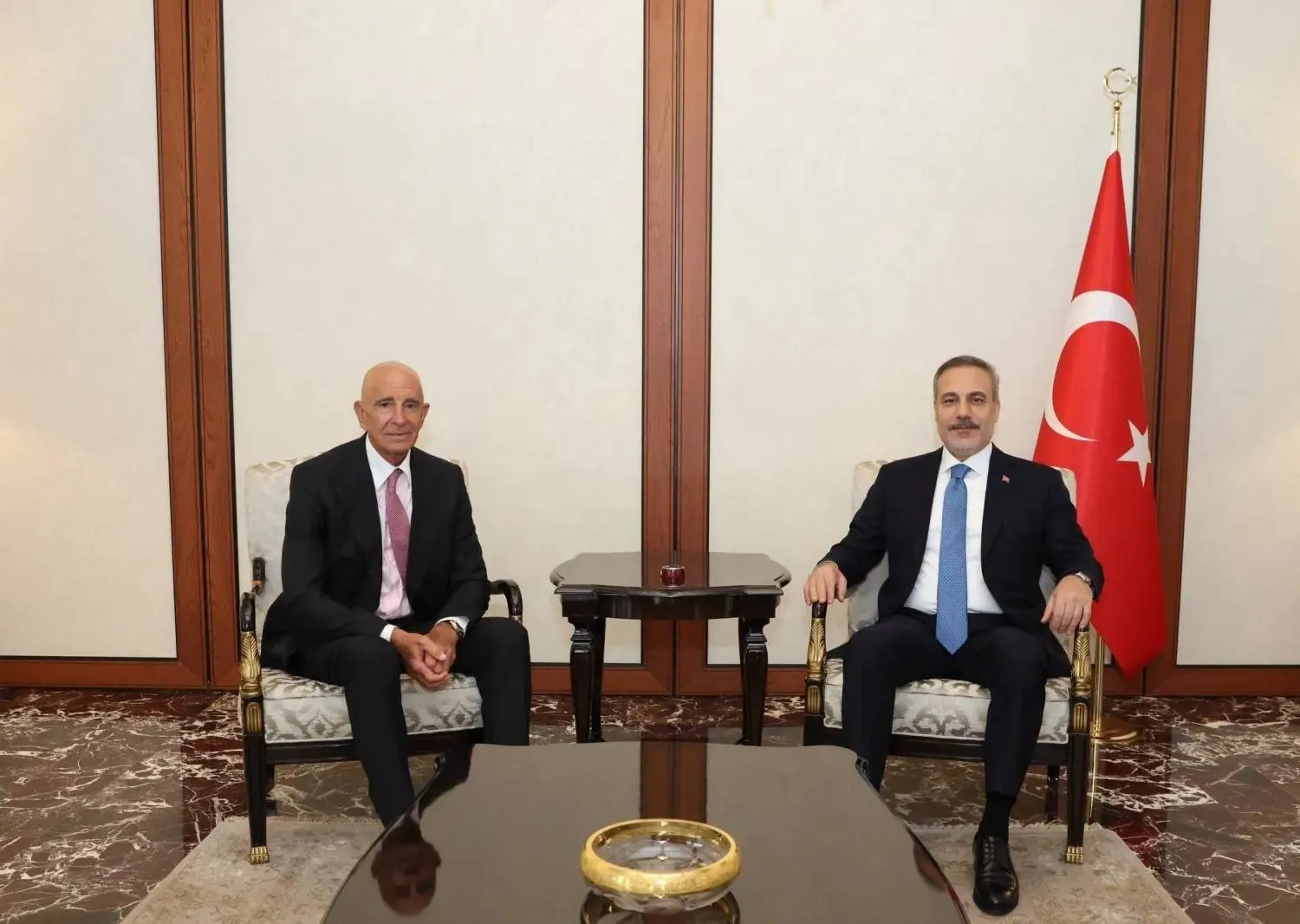

Syria and Türkiye are moving to forge a strategic partnership, deepening political and security coordination while expanding economic ties.
The two countries’ foreign and defense ministers held talks in Ankara on Tuesday on counterterrorism, defense cooperation and regional developments. They also reviewed final preparations for launching a joint high-level committee to oversee bilateral relations.
Strategic Coordination
Turkish Foreign Minister Hakan Fidan outlined plans to strengthen cooperation against terrorism and organized crime based on shared interests.
Fidan and Syrian Foreign Minister Asaad al-Shaibani, joined by Turkish Defense Minister Yasar Guler and his Syrian counterpart Murhaf Abu Qasra, also examined the integration of the Syrian Democratic Forces (SDF) into Syrian state institutions.
Fidan reaffirmed Türkiye’s support for the process under the principle of “one state, one army,” arguing that it would strengthen Syria’s sovereignty and territorial integrity.
He emphasized the need to end terrorism in Türkiye, Syria and Iraq, put an end to the denial of identities and allow everyone to participate in political life in an atmosphere of peace and stability.
Ankara remains committed to working closely with Damascus to ensure the process succeeds while extending bilateral cooperation into new areas, he added.
Türkiye is pursuing a process aimed at dissolving and disarming the Kurdistan Workers’ Party (PKK), including organizations Ankara considers affiliated with it, particularly the SDF, and withdrawing PKK elements from areas of northern Iraq.
The initiative, which Ankara calls “Terror-Free Türkiye,” also envisions what it describes as a “terror-free region.”
Talks with Barrack
On Wednesday, Fidan met US Ambassador to Türkiye and President Donald Trump’s envoy to Syria and Iraq, Tom Barrack, at the Turkish Foreign Ministry.
Diplomatic sources indicated that the meeting covered SDF integration and developments in Syria, Iraq and the wider region.
Al-Shaibani had met Barrack in Ankara on Tuesday. According to the Syrian Foreign Ministry, both officials underscored the importance of coordination and consultation to strengthen regional security and stability.
At a press conference following Tuesday’s talks, Fidan expressed confidence in Syria’s future, citing the determination of its people and the country’s growing contribution to regional stability, development and counterterrorism.
He detailed plans for cooperation between the two countries’ defense and security institutions to counter threats facing Syria, including attempts to divide the country and terrorist activity.
Türkiye was also working to help restructure the Syrian army and strengthen its security institutions, he noted.
Fidan cautioned that threats from terrorist organizations, particularly ISIS, and continued security unrest could disrupt trade and regional connectivity.
Expanding Economic Cooperation
Fidan highlighted the deepening bilateral relationship, pointing to numerous healthcare and education projects completed in Syria and an agreement to establish a joint Turkish-Syrian university in Damascus.
He also reiterated Ankara’s position that regional countries should take responsibility for addressing challenges in their own strategic and geographic surroundings rather than relying on outside powers.
Fidan accused Israel of seeking to destabilize Syria and urged an end to Israeli attacks on Syrian territory and compliance with the 1974 Disengagement Agreement.
For his part, al-Shaibani described Syria as a cornerstone of Middle East stability and Türkiye as an indispensable partner in maintaining it.
He put bilateral trade at nearly $3.7 billion in 2025, an increase of more than 40%.
Efforts were underway to ease Syrian product entry into the Turkish market, establish a legal framework to protect them, accelerate the rehabilitation of border crossings and prepare for the Qamishli crossing to begin operating soon, he explained.
Al-Shaibani announced an agreement to accelerate a railway project linking Türkiye to the Gulf through Syria and Jordan.
The electricity interconnection between Aleppo and the Turkish city of Cicek had also been rehabilitated, with work underway to increase its capacity.
Turning to strategic cooperation, al-Shaibani outlined discussions on expanding training and capacity-building, improving coordination against terrorism and organized crime, and creating conditions for the voluntary and sustainable return of Syrian refugees.
He stressed that these efforts were based on the principle of Syrian sovereignty over the country’s entire territory.


