Mascot-mad Fans Flock to Meetup of 200 Characters in Japanhttps://english.aawsat.com/varieties/5343916-mascot-mad-fans-flock-meetup-200-characters-japan
Mascot-mad Fans Flock to Meetup of 200 Characters in Japan
Visitors take a picture with a mascot character during the annual World Mascot Summit in Hanyu in Saitama prefecture, north of Tokyo, on November 21, 2026. (Photo by Rie KIKUCHI / AFP)
Mascot-mad Fans Flock to Meetup of 200 Characters in Japan
Visitors take a picture with a mascot character during the annual World Mascot Summit in Hanyu in Saitama prefecture, north of Tokyo, on November 21, 2026. (Photo by Rie KIKUCHI / AFP)
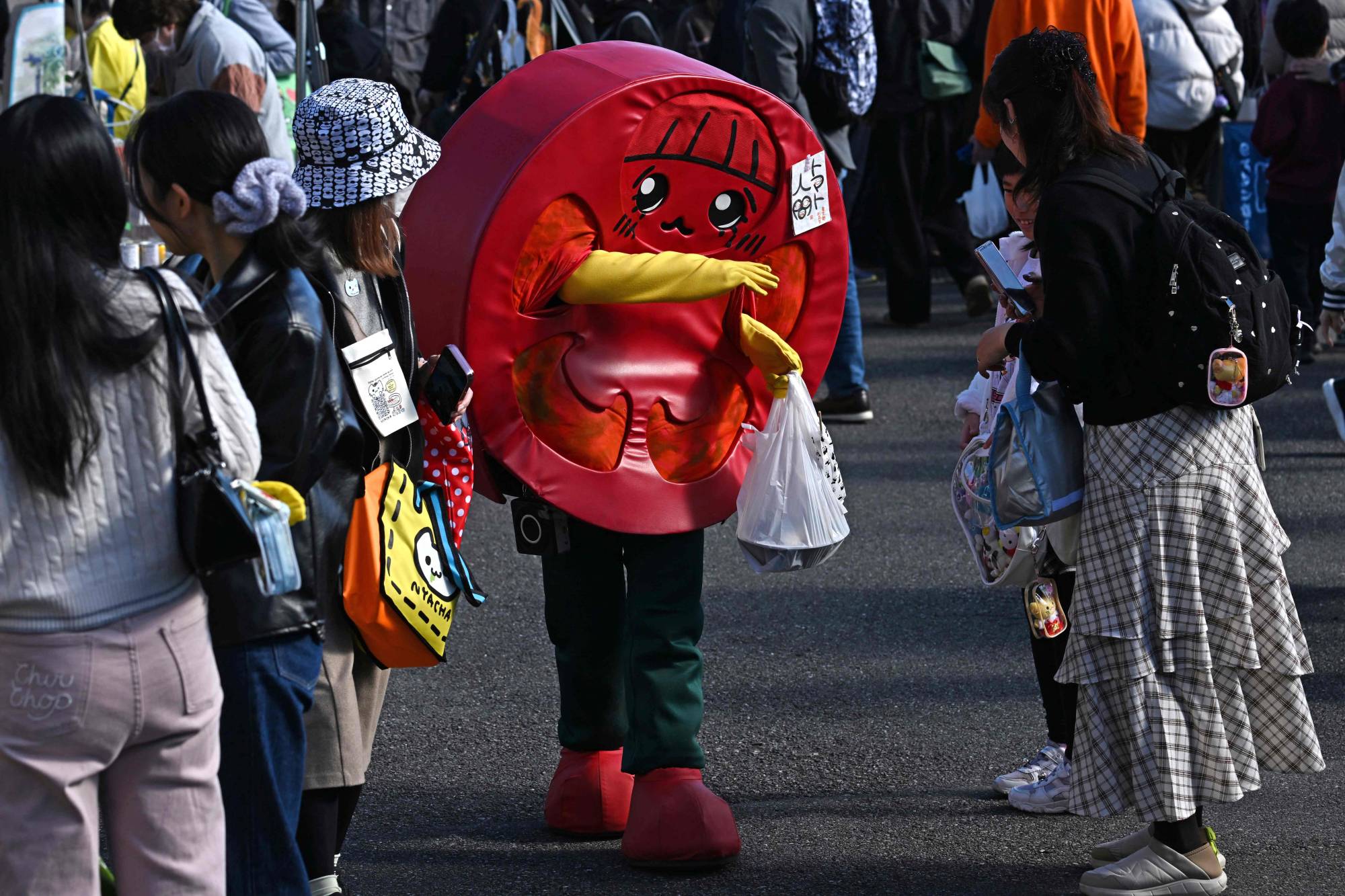
Tens of thousands of mascot fans gathered in a city near Tokyo on Saturday to meet and greet more than 200 life-size cuddly characters that promote local towns and businesses.
In the land of Hello Kitty and Pokemon, mascots are used to promote everything from prison to railways to private businesses, and popular ones gain full-on celebrity status.
"This is the first time I've ever come to an event like this, so I'm kind of excited," Yuriko Okamori, 51, told AFP at the annual meetup event.
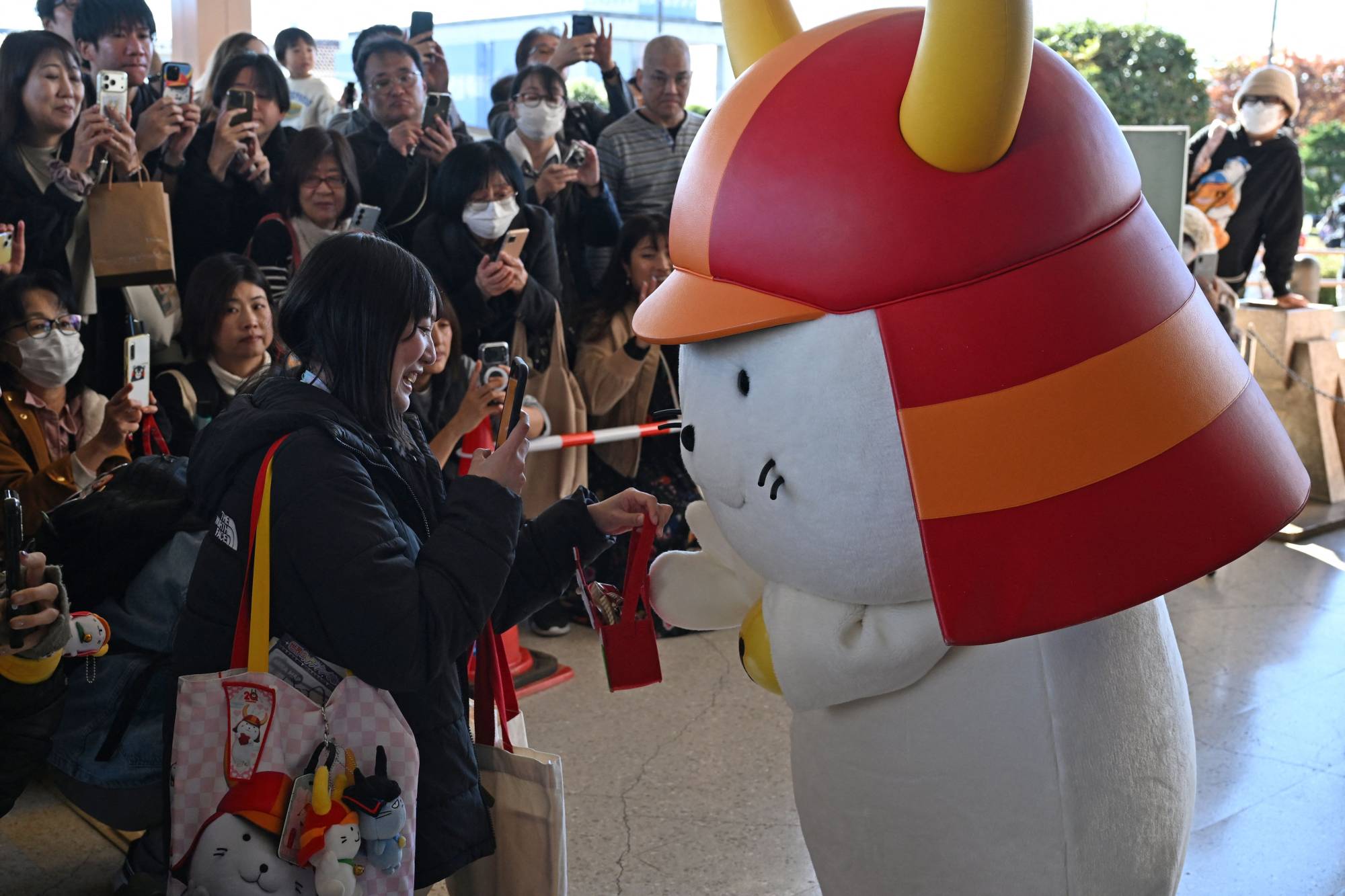
A woman hands a gift to a mascot character during the annual World Mascot Summit in Hanyu in Saitama prefecture, north of Tokyo, on November 21, 2026. (Photo by Rie KIKUCHI / AFP)
The mascot meetup has been held in the city of Hanyu since 2010 and nearly 220 mascots were invited to join this year, according to organizers.
On a stage, a troupe of animal mascots danced to upbeat pop music as a large crowd filmed them on smartphones and clapped along.
Elsewhere, a popular pony mascot representing Gunma prefecture was surrounded by fans eager for selfies, while a cat mascot was pushed through the packed crowd on a cart to make its way across the venue.
City official Shogo Dei, who oversees the event, said 80,000 people attended the two-day meetup last year and that organizers expect a similar turnout this year.
"These local mascot characters representing regions are part of Japanese culture. Our aim is to help revitalize towns across Japan through these characters," Dei told AFP.
Mascots in Japan can generate millions of dollars in revenue if they become successful, even without the global recognition of major intellectual property brands such as Pikachu.
A mascot character greets visitors during the annual World Mascot Summit in Hanyu in Saitama prefecture, north of Tokyo, on November 21, 2026. (Photo by Rie KIKUCHI / AFP)
Another popular character, Hikonyan, a samurai helmet-wearing cat mascot associated with Hikone Castle in western Japan, has helped draw tourists to the area. The character even received around 10,000 New Year's greeting cards from across Japan this January.
"There are so many different characters representing different places, and it's not uncommon to see even adults carrying mascot goods on their bags," Okamori said.
Mascot-mad Fans Flock to Meetup of 200 Characters in Japanhttps://english.aawsat.com/varieties/5343916-mascot-mad-fans-flock-meetup-200-characters-japan
Visitors take a picture with a mascot character during the annual World Mascot Summit in Hanyu in Saitama prefecture, north of Tokyo, on November 21, 2026. (Photo by Rie KIKUCHI / AFP)
Mascot-mad Fans Flock to Meetup of 200 Characters in Japan
Visitors take a picture with a mascot character during the annual World Mascot Summit in Hanyu in Saitama prefecture, north of Tokyo, on November 21, 2026. (Photo by Rie KIKUCHI / AFP)
Tens of thousands of mascot fans gathered in a city near Tokyo on Saturday to meet and greet more than 200 life-size cuddly characters that promote local towns and businesses.
In the land of Hello Kitty and Pokemon, mascots are used to promote everything from prison to railways to private businesses, and popular ones gain full-on celebrity status.
"This is the first time I've ever come to an event like this, so I'm kind of excited," Yuriko Okamori, 51, told AFP at the annual meetup event.
A woman hands a gift to a mascot character during the annual World Mascot Summit in Hanyu in Saitama prefecture, north of Tokyo, on November 21, 2026. (Photo by Rie KIKUCHI / AFP)
The mascot meetup has been held in the city of Hanyu since 2010 and nearly 220 mascots were invited to join this year, according to organizers.
On a stage, a troupe of animal mascots danced to upbeat pop music as a large crowd filmed them on smartphones and clapped along.
Elsewhere, a popular pony mascot representing Gunma prefecture was surrounded by fans eager for selfies, while a cat mascot was pushed through the packed crowd on a cart to make its way across the venue.
City official Shogo Dei, who oversees the event, said 80,000 people attended the two-day meetup last year and that organizers expect a similar turnout this year.
"These local mascot characters representing regions are part of Japanese culture. Our aim is to help revitalize towns across Japan through these characters," Dei told AFP.
Mascots in Japan can generate millions of dollars in revenue if they become successful, even without the global recognition of major intellectual property brands such as Pikachu.
A mascot character greets visitors during the annual World Mascot Summit in Hanyu in Saitama prefecture, north of Tokyo, on November 21, 2026. (Photo by Rie KIKUCHI / AFP)
Another popular character, Hikonyan, a samurai helmet-wearing cat mascot associated with Hikone Castle in western Japan, has helped draw tourists to the area. The character even received around 10,000 New Year's greeting cards from across Japan this January.
"There are so many different characters representing different places, and it's not uncommon to see even adults carrying mascot goods on their bags," Okamori said.
"I think that's something uniquely Japanese."
Exam Shows that the Hat Fiona the Hippo Ate Was Deep in her Small Intestinehttps://english.aawsat.com/varieties/5343913-exam-shows-hat-fiona-hippo-ate-was-deep-her-small-intestine
Flowers, handwritten notes, watermelons and other items are displayed at a memorial for Fiona the hippo at the Cincinnati Zoo in Cincinnati, Friday, Nov. 20, 2026. (AP Photo/Obed Lamy)
Exam Shows that the Hat Fiona the Hippo Ate Was Deep in her Small Intestine
Flowers, handwritten notes, watermelons and other items are displayed at a memorial for Fiona the hippo at the Cincinnati Zoo in Cincinnati, Friday, Nov. 20, 2026. (AP Photo/Obed Lamy)
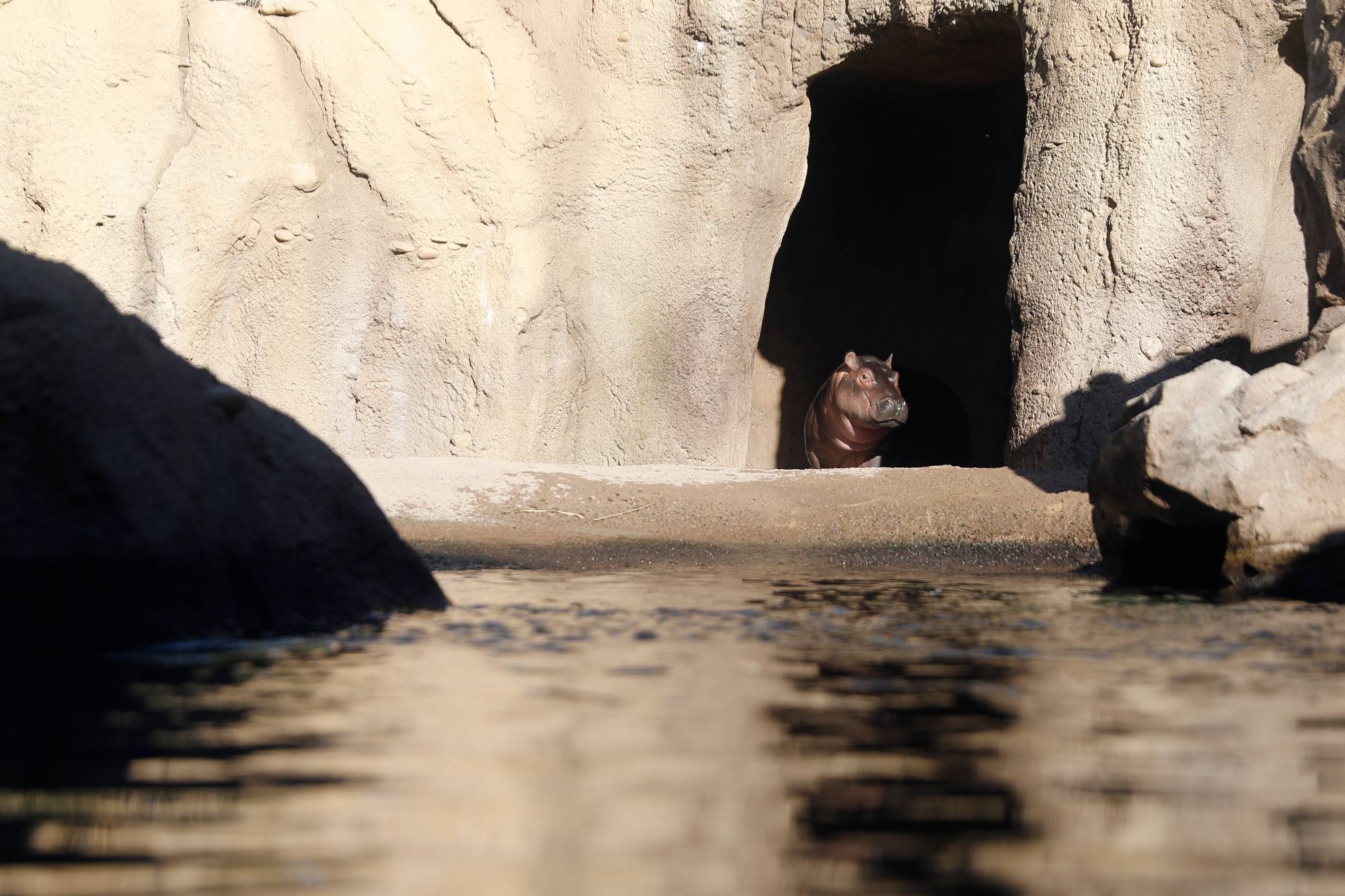
A necropsy on Fiona the hippo showed that the hat she swallowed nearly two weeks ago was caught in the middle of her small intestine, causing her death this week, the Cincinnati Zoo said Friday.
Fiona, whose premature birth and fight for survival captured hearts nearly a decade ago, died Thursday after an attempt to locate the blockage. She was 9 years old.
The hat Fiona ate after it was accidentally flung into her enclosure was so far into her digestive system that no supportive care could have saved her, the zoo said in a statement.
Since her death, Fiona's fans have covered a hippo statue at the zoo with flowers and notes written in crayon. Others left behind watermelons and pumpkins, some of her favorite treats. “She brought so much love in her lifetime,” said one note.
Born prematurely almost a decade ago and given slim odds of survival, Fiona became not only a source of hometown pride but also a worldwide symbol of hope and inspiration for many — from teachers to parents to children.
During her visit to the zoo Friday morning, Jessica Grieshop, who often brought her daughters to see Fiona, called the hippo an inspiration for “anyone that was going through hard times.”
According to The Associated Press, Zoo leaders said Fiona will be remembered for many years.
“The support that we’re feeling from all over the world reminds me of the time when everyone pulled together to root for her to survive," said Cincinnati Zoo director Dave Jenike. "She did, and she gave us almost a decade of smiles.”
One of Fiona's keepers, Jenna Wingate, posted a heartbreaking message on Instagram, saying it was like losing a family member.
“It has always felt like we grew up together, and I often used to smile thinking about growing old with her and her still being around when I retire,” Wingate wrote. “We lost her in the most horrific and tragic way.”
She ended: “She was our family. I love you Fiona and I am so sorry.”
FILE - Fiona, a Nile hippopotamus, appears in her enclosure at the Cincinnati Zoo & Botanical Gardens in Cincinnati, Oct. 26, 2017. (AP Photo/John Minchillo, File)
Fiona wasn’t the first hippo to die at the zoo after ingesting a foreign object.
In 1923, a hippo “came to an untimely death due to a small boy who threw a rubber ball into its mouth,” according to records at the Field Museum in Chicago, which confirmed Friday that it received that hippo’s remains from the Cincinnati Zoo.
The Cincinnati Enquirer reported at the time that Zeekoe had a habit of opening his mouth wide to chomp cake and other treats tossed by guests. He died after swallowing a tennis ball, which zoo officials believed a child had dropped into the hippo’s mouth without realizing the harm it could cause.
Unlike the watermelons and pumpkins she easily devoured, Fiona's digestive system wasn't meant to break down synthetic fibers, experts said.
Hippos have a multichambered stomach for digesting plants and a very large gastrointestinal tract that swallowed material must pass through.
Blood work showed her health was failing Thursday, so the zoo’s animal care team tried to locate the hat using a scope and an ultrasound, said Mike Wenninger, the zoo’s director of animal health. Removing the hat surgically was impossible based on its location and the hippo’s anatomy, he added.
Fiona died during recovery from the procedure, he said.
The necropsy found the hat was 25 feet (7.6 meters) beyond her final stomach compartment and 50 feet (15.2 meters) from the end of her intestines.
“No treatment aside from supportive care had any chance for success, and the necropsy confirmed that no amount of supportive care would have worked,” Wenninger said.
Jenike called the zoo's staff heroic in their efforts to save her.
Spectacular But Squawky, Starlings Get Icy Welcome in Romehttps://english.aawsat.com/varieties/5343881-spectacular-squawky-starlings-get-icy-welcome-rome
Starlings fly by the moon before spending the night in the trees of Rome during their autumn migration on November 19, 2026. (Photo by Filippo MONTEFORTE / AFP)
Spectacular But Squawky, Starlings Get Icy Welcome in Rome
Starlings fly by the moon before spending the night in the trees of Rome during their autumn migration on November 19, 2026. (Photo by Filippo MONTEFORTE / AFP)
All roads lead to Rome, including for raucous starlings whose noisy, messy habits have left residents of the capital determined to send them flying.
Known for their spectacular aerial displays, a behavior known as murmuration, and for their exceptional vocal mimicry, starlings migrate in the millions to Italy from northern Europe in winter in search of warmth.
For years, the city has tried in vain to chase the unwelcome visitors from the trees in busy areas where they rest to build up strength before the breeding season.
A three-day experiment this week in a northeast Roman neighborhood may have worked, with shopkeepers and citizens blaring an ear-shattering noise simulating a starling distress call from their windows, in the hope it would deter them from settling in.
"It's nature. They're birds flying in trees, so I don't think we can claim the right to get rid of them," Matteo Zocchi, the councilor charged with environmental issues for Rome's third administrative borough, told AFP.
Zocchi said officials were realistic about what could be done about the "hundreds of thousands" of starlings in his neighborhood, with the goal being just to "push them away a bit to give this area some breathing space".
"The problem has been huge because we've had to clean the streets constantly," he said.
Mesmerizing in the air but disruptively loud at bedtime, the social, polka-dotted birds swoop down from the sky at dusk to roost in leafy trees, their cacophonous chatter impossible to ignore.
When the birds fly off at dawn to feed in open fields, pavements and cars are covered by slippery guano, an unpleasant by-product of their visit.
Some residents and shoppers on Rome's hard-hit Viale Jonio have taken to using umbrellas as protection.
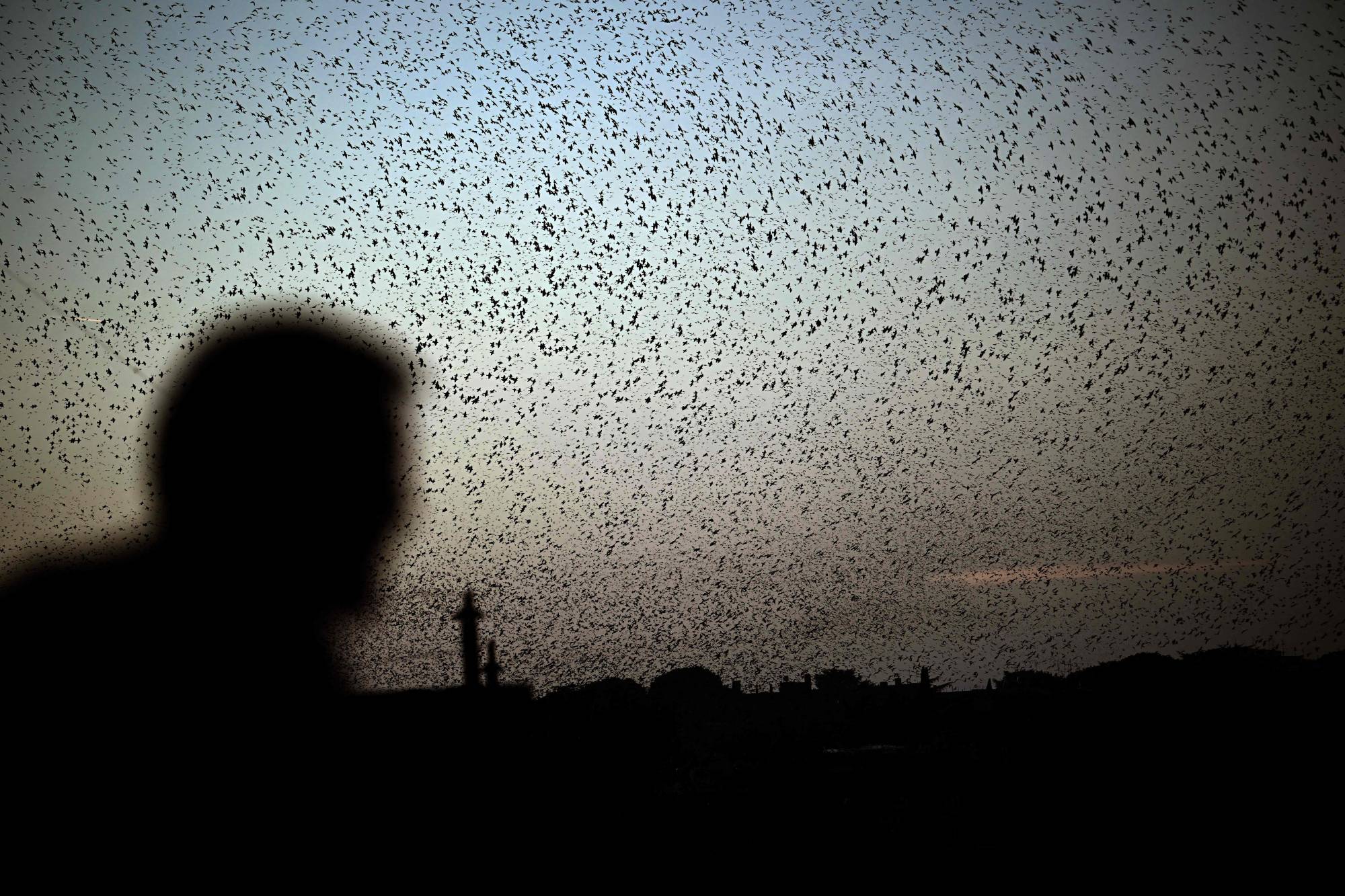
Residents look at starling flocks that come to spend the night in the trees of their neighborhood, in Rome on November 19, 2026. (Photo by Filippo MONTEFORTE / AFP)
Roberto Benenato, 29, who works at a pastry shop underneath the avenue's line of plane trees, said it's been impossible to park on the street for fear of returning to a guano-covered vehicle.
"But the worst thing... is really the horrible stench of guano we've had these past weeks. It would get right up your nose, into your head. You couldn't breathe properly. Really unpleasant, let's say," he said.
Timing is everything when it comes to disrupting the starlings.
Once snug on their branches to rest overnight, the birds don't budge -- meaning that the moment to dissuade them from settling in is immediately after arrival.
In the past, city officials used just the distress call to ward off the starlings.
But given the perceived increase in their numbers this year, they chose a multi-pronged effort, including lights from lasers directed into the trees.
More impressive was a raptor named Geronimo who was calmly promenaded on the arm of his falconer beneath the trees, never once leaving his perch.
For three days this week, city residents and shopkeepers were invited to tune into the live broadcast of the distress calls and point their stereo speakers, laptops or cellphones towards the trees for an hour beginning at 4:15 local time (1515 GMT).
Starlings in Rome are a draw for tourists and photographers mesmerized by their murmurations.
They choose the city to roost because it affords better protection from predators than open countryside.
But no one knows exactly how many arrive in the city each winter -- either from northern and eastern Europe or from other parts of Italy.
A 2021 study by conservation coalition BirdLife International found their numbers were decreasing moderately in the country as a whole.
Starling expert Alessandro Montemaggiori of Rome's Sapienza University says they have been migrating to Rome for 80 years.
A decade ago, there were an estimated one million in the city at night in winter. By some accounts, that number may have fallen by half now.
From a rooftop on Thursday at sunset, one could see several murmurations weaving through the sky and then gathering in the distance.
Suddenly the birds were directly overhead, the sky nearly black as the piercing noise from distress calls blasted out from rooftops and balconies.
As Zocchi and other officials held their breath during the dramatic display, some starlings who had dived into the tops of nearby trees quickly took off again.
The murmurations reformed and gradually moved away, appearing to settle somewhere in the distance.
"This is the greatest result we could have hoped for," smiled Zocchi.
لم تشترك بعد
انشئ حساباً خاصاً بك لتحصل على أخبار مخصصة لك ولتتمتع بخاصية حفظ المقالات وتتلقى نشراتنا البريدية المتنوعة