


US Tech Stock Rebound Opens Opportunities for Saudi Companies, with HUMAIN in Spotlight

A stock market screen displays Nvidia shares (Reuters)
TT

US Tech Stock Rebound Opens Opportunities for Saudi Companies, with HUMAIN in Spotlight

A stock market screen displays Nvidia shares (Reuters)

Rapid developments in the US technology sector, led by Nvidia, have restored momentum to global stock markets following Jensen Huang's return as the company's chief executive. The move has revived confidence in artificial intelligence stocks and raised questions about how the new wave of investment could affect Gulf markets, particularly Saudi Arabia.

The announcement sparked a strong rally in Nvidia shares, with gains spreading across US equity markets as optimism over AI investment and digital infrastructure returned. The rebound has also brought renewed attention to companies and sectors linked to the AI ecosystem worldwide.

The recovery has extended to the Saudi stock market, where the benchmark Tadawul All Share Index (TASI) rose in early Tuesday trading as investors monitored global market developments and assessed how improving risk appetite could affect local equities.

Mohammed Al Farraj, Senior Director and Head of Asset Management at Arbah Capital, said the renewed momentum in US technology stocks should not be viewed merely as a temporary rebound in share prices, but as a clear indication of a revival in the global investment cycle associated with digital infrastructure.

Speaking to Asharq Al-Awsat, Al Farraj explained that the momentum would not necessarily translate into an automatic rise in Saudi Arabia's benchmark index, given the market's dependence on domestic drivers, including oil prices, government spending and corporate earnings.

He said the impact would be felt through three main channels: improved global liquidity and risk appetite, increased capital expenditure on infrastructure, and a revaluation of local companies connected to the AI ecosystem.

HUMAIN and the AI Value Chain

Discussing the Saudi sectors most likely to benefit from renewed global investment in artificial intelligence, Al Farraj said opportunities span interconnected industries that together form an integrated value chain.

He explained that this would allow Saudi Arabia to move beyond consuming technology toward securing a share in its production.

The opportunities begin with telecommunications and technology services companies such as solutions by stc and extend to the data center sector, driven by major initiatives including Public Investment Fund-backed HUMAIN, which is developing an integrated cloud ecosystem.

Al Farraj added that the benefits would also extend to the energy and electricity sectors, including ACWA Power, Saudi Electricity Company and Saudi Aramco, given the substantial need for reliable power supplies and advanced cooling systems to operate data centers.

Other potential beneficiaries include digital companies such as Elm and supporting industrial sectors that stand to gain from the localization of manufacturing for transformers, cables and backup power equipment.

Contracts and Cash Flow Key to Sustaining Gains

On the sustainability of the rally, Al Farraj stressed the importance of distinguishing between sustained investment in artificial intelligence and continued increases in stock valuations.

He noted that sharp gains in US markets reflect investors' sensitivity to developments in the sector but are not, on their own, sufficient evidence that returns will be sustainable.

He said the real measure of Saudi companies' performance in the sector would not be their announcements of AI adoption, but their ability to meet three fundamental financial conditions.

These include converting contracts into genuine earnings growth, generating returns on invested capital that exceed the cost of capital, and, most importantly, producing tangible free cash flow that is not consumed by substantial capital expenditure.

Ultimately, Al Farraj believes Saudi Arabia has a strategic opportunity to localize supply chains and translate the global investment cycle into added value for its domestic economy.

He emphasized that the strongest investment opportunities would not necessarily lie with companies that merely promote their AI strategies, but with those that possess the infrastructure and assets needed to turn the technological transformation into sustainable profits and cash flows.



US Tech Stock Rebound Opens Opportunities for Saudi Companies, with HUMAIN in Spotlight

A stock market screen displays Nvidia shares (Reuters)
TT

US Tech Stock Rebound Opens Opportunities for Saudi Companies, with HUMAIN in Spotlight

A stock market screen displays Nvidia shares (Reuters)

Rapid developments in the US technology sector, led by Nvidia, have restored momentum to global stock markets following Jensen Huang's return as the company's chief executive. The move has revived confidence in artificial intelligence stocks and raised questions about how the new wave of investment could affect Gulf markets, particularly Saudi Arabia.

The announcement sparked a strong rally in Nvidia shares, with gains spreading across US equity markets as optimism over AI investment and digital infrastructure returned. The rebound has also brought renewed attention to companies and sectors linked to the AI ecosystem worldwide.

The recovery has extended to the Saudi stock market, where the benchmark Tadawul All Share Index (TASI) rose in early Tuesday trading as investors monitored global market developments and assessed how improving risk appetite could affect local equities.

Mohammed Al Farraj, Senior Director and Head of Asset Management at Arbah Capital, said the renewed momentum in US technology stocks should not be viewed merely as a temporary rebound in share prices, but as a clear indication of a revival in the global investment cycle associated with digital infrastructure.

Speaking to Asharq Al-Awsat, Al Farraj explained that the momentum would not necessarily translate into an automatic rise in Saudi Arabia's benchmark index, given the market's dependence on domestic drivers, including oil prices, government spending and corporate earnings.

He said the impact would be felt through three main channels: improved global liquidity and risk appetite, increased capital expenditure on infrastructure, and a revaluation of local companies connected to the AI ecosystem.

HUMAIN and the AI Value Chain

Discussing the Saudi sectors most likely to benefit from renewed global investment in artificial intelligence, Al Farraj said opportunities span interconnected industries that together form an integrated value chain.

He explained that this would allow Saudi Arabia to move beyond consuming technology toward securing a share in its production.

The opportunities begin with telecommunications and technology services companies such as solutions by stc and extend to the data center sector, driven by major initiatives including Public Investment Fund-backed HUMAIN, which is developing an integrated cloud ecosystem.

Al Farraj added that the benefits would also extend to the energy and electricity sectors, including ACWA Power, Saudi Electricity Company and Saudi Aramco, given the substantial need for reliable power supplies and advanced cooling systems to operate data centers.

Other potential beneficiaries include digital companies such as Elm and supporting industrial sectors that stand to gain from the localization of manufacturing for transformers, cables and backup power equipment.

Contracts and Cash Flow Key to Sustaining Gains

On the sustainability of the rally, Al Farraj stressed the importance of distinguishing between sustained investment in artificial intelligence and continued increases in stock valuations.

He noted that sharp gains in US markets reflect investors' sensitivity to developments in the sector but are not, on their own, sufficient evidence that returns will be sustainable.

He said the real measure of Saudi companies' performance in the sector would not be their announcements of AI adoption, but their ability to meet three fundamental financial conditions.

These include converting contracts into genuine earnings growth, generating returns on invested capital that exceed the cost of capital, and, most importantly, producing tangible free cash flow that is not consumed by substantial capital expenditure.

Ultimately, Al Farraj believes Saudi Arabia has a strategic opportunity to localize supply chains and translate the global investment cycle into added value for its domestic economy.

He emphasized that the strongest investment opportunities would not necessarily lie with companies that merely promote their AI strategies, but with those that possess the infrastructure and assets needed to turn the technological transformation into sustainable profits and cash flows.


EU Officially Limits Imports of Chinese Hybrid Vehicles

Vehicles identified as a Chinese-manufactured Chery Jaecoo J5 EV and an Omoda 9 plug-in hybrid are parked at a lot in Toronto, Ontario, Canada, May 4, 2026. (Reuters)
TT

EU Officially Limits Imports of Chinese Hybrid Vehicles

Vehicles identified as a Chinese-manufactured Chery Jaecoo J5 EV and an Omoda 9 plug-in hybrid are parked at a lot in Toronto, Ontario, Canada, May 4, 2026. (Reuters)

The European Union on Tuesday officially put in place import quotas on hybrid vehicles to protect domestic industry, following a deal struck with China last month.

Brussels and Beijing agreed to limit exports of Chinese plug-in hybrids and other hybrid vehicles to the 27-nation bloc as part of a deal to avoid a trade war.

The EU said the import cap would kick in from December 1.

"These restrictions are needed to protect EU industry against a sharp recent increase in imports of such vehicles," the European Commission said.

While mainly aimed at Chinese cars, the measure will apply to all hybrid imports regardless of their origin, in compliance with international trade rules.

Brussels has long accused China of unfair trade practices, including price dumping, currency manipulation and state subsidies.

Officials and companies say the measures undermine EU companies and lead to job losses.

"The surge in imports of hybrid passenger vehicles into the EU has been driven by growing global production overcapacity," the commission said.

"It is also prompted by increased use of trade-restrictive measures in other major markets."

Hybrid vehicles are among the most popular EV models for European consumers, and Chinese makers have profited from their lower-price models to gain huge market shares at the expense of European producers.

For major exporters the EU import quota was set at just over 15 percent above the level of imports from those countries in 2025.

Brussels said in October that hybrid vehicles from China would be capped to 350,000 a year, after previously forecasting imports of up to 800,000 units in 2026.


West Africa’s Rush to Refine Its Own Gold Unleashes Flood of Capacity

A worker washes off excess impurities during a gold smelting process at a facility in Accra, Ghana August 22, 2024. (Reuters)
TT

West Africa’s Rush to Refine Its Own Gold Unleashes Flood of Capacity

A worker washes off excess impurities during a gold smelting process at a facility in Accra, Ghana August 22, 2024. (Reuters)

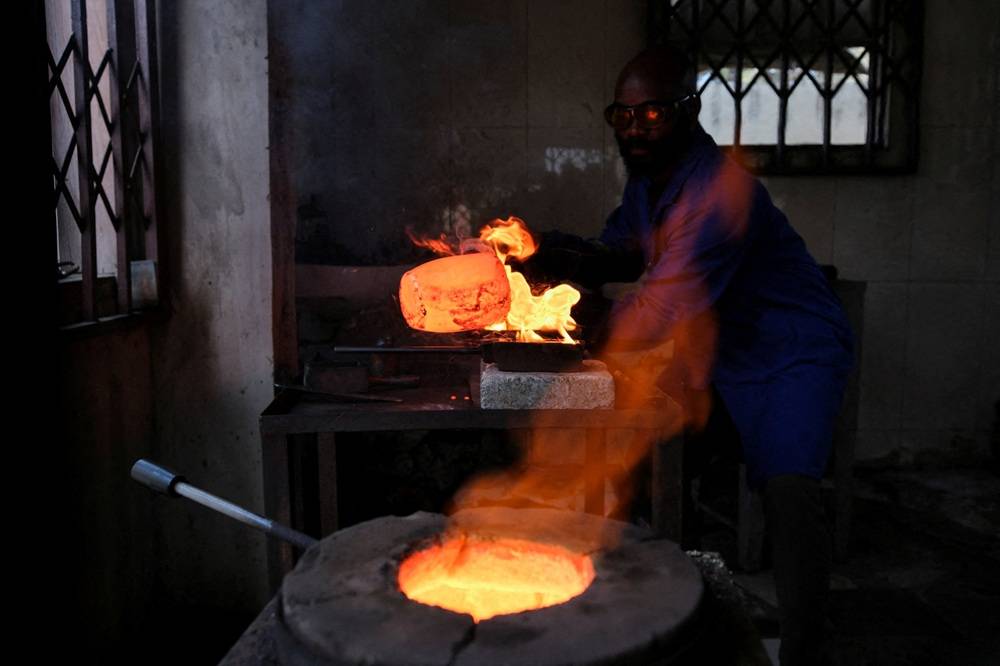
West African governments are racing to refine gold at home to capture more mining revenue from soaring prices and reduce reliance on foreign hubs.

But miners and investors warn the region may be building more refining capacity than it has gold to process, raising the risk of idle plants and weaker returns for investors and governments. Producers could face lower prices if local refineries lack access to major bullion markets.

Since 2024, Ghana, Guinea, Mali and Burkina Faso have launched or announced projects with combined annual capacity that is nearly double West Africa's gold output.

Unlike bauxite or ‌iron ore, where ‌processing can significantly increase value, gold's worth is largely realized before refining. ‌Four ⁠mining executives said ⁠that leaves refiners competing in a low-margin business where commercial success depends more on scale, accreditation and access to global markets.

A worker smelts gold at a facility in Accra, Ghana August 22, 2024. (Reuters)

MORE REFINERIES THAN GOLD

"There is already overcapacity in terms of gold refining across Africa and globally," Rand Refinery chief executive Dean Subramanian told Reuters.

"The risk is additional processing capacity competing for the same accessible, responsibly sourced feedstock."

Since 2024, West African governments have launched or commissioned at least four major gold refineries with combined annual capacity of more than 1,000 metric tons, compared with estimated regional output of about 585 ⁠tons.

Despite operating several underutilized refineries, Ghana, Africa's largest gold producer, plans a ‌new 600-ton-per-year refinery in 2027.

The CEO of the Ghana Chamber ‌of Bullion Traders, Dan Krampah, said there is no "economically compelling case for another refinery."

THERE'S MORE TO DOMESTIC REFINING ‌THAN MARGINS

Governments argue that refining projects should be judged on broader economic and strategic objectives rather ‌than refining margins alone.

Supporters of local refining argue it could help formalize artisanal mining, gold mining carried out by individual miners or small groups, and give central banks greater access to domestic gold supplies.

Ghana has expanded domestic gold purchases as part of efforts to strengthen foreign-exchange reserves, an approach other African governments are studying.

Yet investors caution ‌that localization does not guarantee commercial viability.

"Governments are increasingly pushing for local processing and refining, which is a noble goal, but many countries still lack ⁠the power, infrastructure, skills ⁠and capital required to support it at scale," said Appian Capital Advisory CEO Michael Scherb.

A worker washes off excess impurities during a gold smelting process at a facility in Accra, Ghana August 22, 2024. (Reuters)

CERTIFICATION HEADACHES

Another issue facing some of the new refiners is their lack of certification under the London Bullion Market Association (LBMA), complicating access to key markets.

LBMA Good Delivery accreditation allows refiners to access the world's largest bullion-trading networks and is often a prerequisite for selling to major banks, traders and central banks.

In Guinea, miners are already stockpiling gold as they adapt to new local refining requirements.

Three executives said refining fees, settlement terms and marketing arrangements remain unclear, raising fears locally refined gold could trade at a discount.

Guinea's Mines Minister Bouna Sylla remains bullish, saying the country is aiming to build a broader domestic gold ecosystem centered on traceability and central-bank reserves, in order to compete with the region's dominant gold market, Dubai.

"We need to make Guinea competitive and create a transparent system that can attract business," he said.