


Even Pizza is Eaten with a Fork… Dutch Butler School Promises Entry Into Gilded World

The eight-week program promises entry into a gilded world (Pexels)
TT

Even Pizza is Eaten with a Fork… Dutch Butler School Promises Entry Into Gilded World

The eight-week program promises entry into a gilded world (Pexels)

The students wear dark suits and white gloves. They call each other “Mr.” and “Ms.” even outside school hours. They sleep in single beds and share bathrooms in the long hallways of a 19th-century Dutch monastery.

At mealtimes, they sit together at a long rectangular table under eight chandeliers where everything, even pizza, is eaten with a fork and knife.

This is the International Butler Academy in the Netherlands, where — in the school’s words — “dreams take flight and professionalism is cultivated,” according to The New York Times.

This month, 29 students finished an intensive course to learn how to be full-fledged butlers.

Salvatore Fenu was among those in a recent cohort at the International Butler Academy.

The butlers-to-be, ages 21 to 65, came from all over — Bulgaria, Germany, Guadeloupe, the United States — to a 135-room estate.

The eight-week program promises entry into a gilded world.

The International Butler Academy is betting that in a world where the rich are getting richer, the demand for butlers will only increase.

“Statistically, there have never been this many people who are this rich,” said Niels Deijkers, 37, the academy’s general manager, who finished the course with high marks in 2023. Many of them, he reasoned, need people to run their households.

To get into the academy in Simpelveld, a town near the borders with Belgium and Germany, applicants have to be at least 18, have a solid grasp of English and nearly $14,000 to pay for the program. No prior butling experience is required.
Roughly 60 people graduate each year from the International Butler Academy.

Salvatore Fenu, 32, a Spanish student, said he came to learn “how to be a gentleman” and to “become a better person.”

Having worked as a butler in villas on the Spanish island of Ibiza, he hoped for a job with an “old-money family” with the goal of retiring at 50.

Days at the academy start early and end late. Deijkers’s comments are often harsh. Pressures mount each week as students clean, iron, arrange flowers, host dinners and measure exact distances between dinner plates, napkins and cutlery. Over the eight weeks, the students have a total of seven days off.

“I’m surprised at how strict they are,” said Eva Barnard, 22, from Indiana, during a flower arranging class.

Impassive professionalism is a must, but Barnard said she was not always able to keep her facial expressions in check. “I have a big personality,” she said. And she was “not used to getting yelled at.”

But the program was worth it to her for the ultimate goal of working in a luxury setting.

“I want to meet new people, discover more of the world,” she said.

Eva Barnard said that keeping the calm demeanor of a butler can be a challenge.

The school was founded by Robert Wennekes, a longtime butler, in 2000. Wennekes had started recruiting butlers for rich and sometimes royal clients and found that he had trouble finding qualified candidates.

The school, citing privacy considerations, generally does not disclose where its graduate butlers go on to work.

But Deijkers said that the school receives requests from retired couples in Europe, executives who travel for business and want help with their wardrobe and packing, and “noble families.”

Butlers can command high salaries (often six figures) and access to a world of luxury, but that does not diminish the workload, Wennekes added. “It isn’t a shortcut to the good life.”

By this point, you may be wondering: Can you fail butler school?

Yes, you definitely can. During a late-night room check, Deijkers inspected each student’s room for violations such as food, alcohol or unmade beds.

Graduation from the academy is based on points. A thousand points is the maximum. Six hundred are needed for a diploma. Between 500 and 600, a student receives a certificate of attendance.

Anything lower than 500 and you’ve flunked right out of butler school.

Students start with the full 1,000 points. They lose them for transgressions and can earn them back with good work. Most of them do not know their score until graduation, when they hear their final result. On average, about 70% of students who do the eight-week course receive a diploma, Deijkers said.

Deijkers keeps score, scribbling his observations in a notebook over the course of the eight weeks. “The points keep you nervous,” Barnard said.

Arnold Ilucz, of Romania, who graduated from the academy in April and took a teaching job as the school’s executive head butler, said, “People are not here to make friends, people are here to learn how to behave.”

Being away from home and separated from his wife doesn’t faze Ilucz, 29. “I’m a product of communism,” he said. “This is not suffering.”

For some students, though, the reality of butling is tougher than it seemed.

“This is the hardest I’ve worked in my life,” said Maximilian Campos, a 21-year-old from Texas. “I had the idea of butler in my head. I didn’t know if it was real.”


Even Pizza is Eaten with a Fork… Dutch Butler School Promises Entry Into Gilded World

The eight-week program promises entry into a gilded world (Pexels)
TT

Even Pizza is Eaten with a Fork… Dutch Butler School Promises Entry Into Gilded World

The eight-week program promises entry into a gilded world (Pexels)

The students wear dark suits and white gloves. They call each other “Mr.” and “Ms.” even outside school hours. They sleep in single beds and share bathrooms in the long hallways of a 19th-century Dutch monastery.

At mealtimes, they sit together at a long rectangular table under eight chandeliers where everything, even pizza, is eaten with a fork and knife.

This is the International Butler Academy in the Netherlands, where — in the school’s words — “dreams take flight and professionalism is cultivated,” according to The New York Times.

This month, 29 students finished an intensive course to learn how to be full-fledged butlers.

Salvatore Fenu was among those in a recent cohort at the International Butler Academy.

The butlers-to-be, ages 21 to 65, came from all over — Bulgaria, Germany, Guadeloupe, the United States — to a 135-room estate.

The eight-week program promises entry into a gilded world.

The International Butler Academy is betting that in a world where the rich are getting richer, the demand for butlers will only increase.

“Statistically, there have never been this many people who are this rich,” said Niels Deijkers, 37, the academy’s general manager, who finished the course with high marks in 2023. Many of them, he reasoned, need people to run their households.

To get into the academy in Simpelveld, a town near the borders with Belgium and Germany, applicants have to be at least 18, have a solid grasp of English and nearly $14,000 to pay for the program. No prior butling experience is required.
Roughly 60 people graduate each year from the International Butler Academy.

Salvatore Fenu, 32, a Spanish student, said he came to learn “how to be a gentleman” and to “become a better person.”

Having worked as a butler in villas on the Spanish island of Ibiza, he hoped for a job with an “old-money family” with the goal of retiring at 50.

Days at the academy start early and end late. Deijkers’s comments are often harsh. Pressures mount each week as students clean, iron, arrange flowers, host dinners and measure exact distances between dinner plates, napkins and cutlery. Over the eight weeks, the students have a total of seven days off.

“I’m surprised at how strict they are,” said Eva Barnard, 22, from Indiana, during a flower arranging class.

Impassive professionalism is a must, but Barnard said she was not always able to keep her facial expressions in check. “I have a big personality,” she said. And she was “not used to getting yelled at.”

But the program was worth it to her for the ultimate goal of working in a luxury setting.

“I want to meet new people, discover more of the world,” she said.

Eva Barnard said that keeping the calm demeanor of a butler can be a challenge.

The school was founded by Robert Wennekes, a longtime butler, in 2000. Wennekes had started recruiting butlers for rich and sometimes royal clients and found that he had trouble finding qualified candidates.

The school, citing privacy considerations, generally does not disclose where its graduate butlers go on to work.

But Deijkers said that the school receives requests from retired couples in Europe, executives who travel for business and want help with their wardrobe and packing, and “noble families.”

Butlers can command high salaries (often six figures) and access to a world of luxury, but that does not diminish the workload, Wennekes added. “It isn’t a shortcut to the good life.”

By this point, you may be wondering: Can you fail butler school?

Yes, you definitely can. During a late-night room check, Deijkers inspected each student’s room for violations such as food, alcohol or unmade beds.

Graduation from the academy is based on points. A thousand points is the maximum. Six hundred are needed for a diploma. Between 500 and 600, a student receives a certificate of attendance.

Anything lower than 500 and you’ve flunked right out of butler school.

Students start with the full 1,000 points. They lose them for transgressions and can earn them back with good work. Most of them do not know their score until graduation, when they hear their final result. On average, about 70% of students who do the eight-week course receive a diploma, Deijkers said.

Deijkers keeps score, scribbling his observations in a notebook over the course of the eight weeks. “The points keep you nervous,” Barnard said.

Arnold Ilucz, of Romania, who graduated from the academy in April and took a teaching job as the school’s executive head butler, said, “People are not here to make friends, people are here to learn how to behave.”

Being away from home and separated from his wife doesn’t faze Ilucz, 29. “I’m a product of communism,” he said. “This is not suffering.”

For some students, though, the reality of butling is tougher than it seemed.

“This is the hardest I’ve worked in my life,” said Maximilian Campos, a 21-year-old from Texas. “I had the idea of butler in my head. I didn’t know if it was real.”


In Costa Rica, Simple Rope Bridges Offer Sloths a Lifeline as Forests Disappear

A sloth hangs from the branch of a tree Tuesday, Nov. 3, 2026, in Puerto Viejo, Costa Rica. (AP Photo/Ivan Valencia)
TT

In Costa Rica, Simple Rope Bridges Offer Sloths a Lifeline as Forests Disappear

A sloth hangs from the branch of a tree Tuesday, Nov. 3, 2026, in Puerto Viejo, Costa Rica. (AP Photo/Ivan Valencia)

Behind a beachfront hotel on Costa Rica’s Caribbean coast, conservationists are installing rope bridges between trees, creating pathways for sloths in a landscape increasingly shared with tourists, hotels and other development.

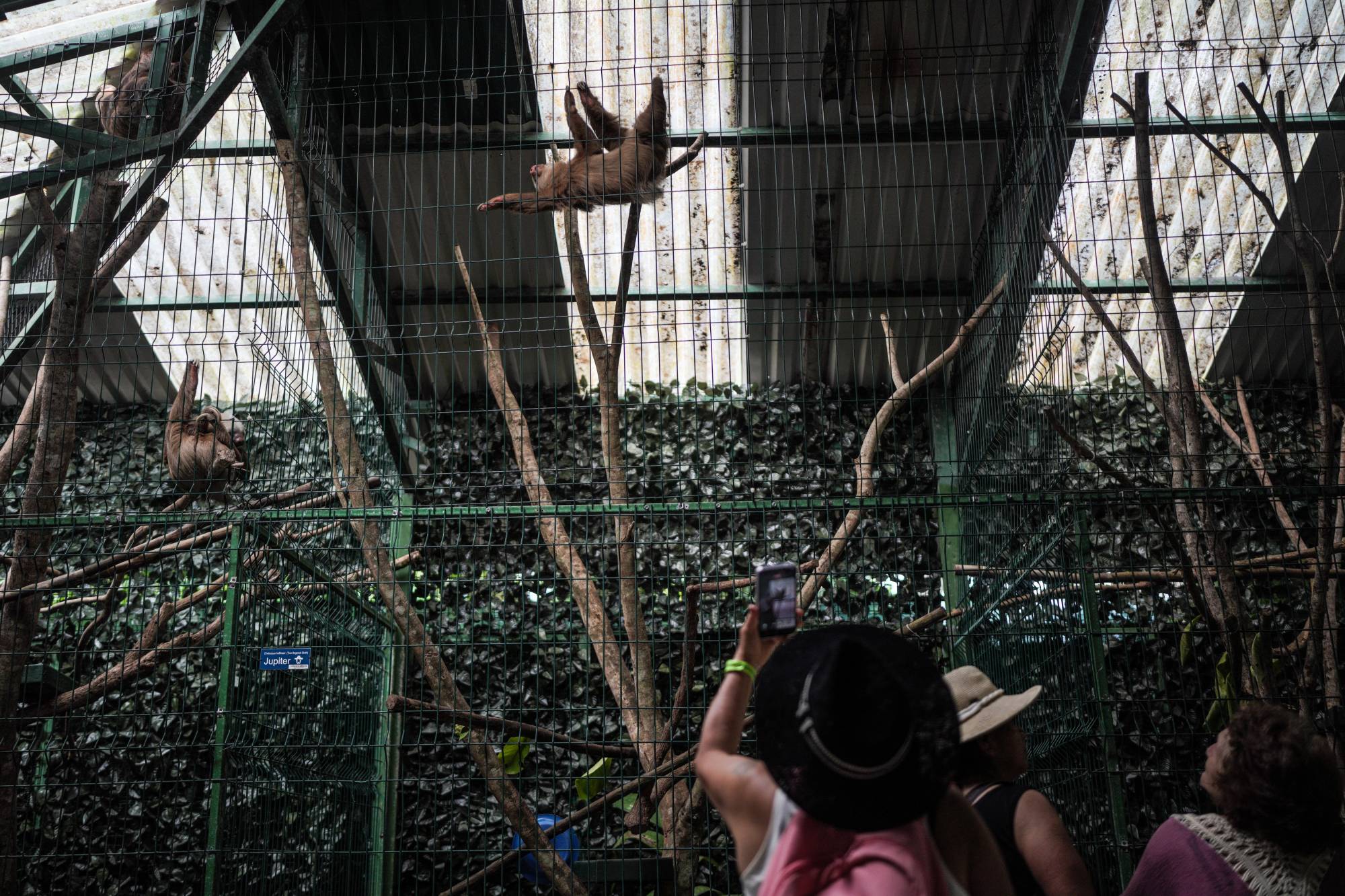
For sloths, even a small gap in the forest canopy can be dangerous. Unable to jump between trees like monkeys, the slow-moving mammals are often forced to descend to the ground, where they risk being attacked by dogs, struck by vehicles or electrocuted on power lines.

To help them move safely through the treetops, the Sloth Conservation Foundation has installed approximately 410 rope bridges often across areas divided by roads and buildings.

“The wildlife bridges that we install are just made from single ropes, which don’t look very elaborate, but for arboreal species, they work,” said Rebecca Cliffe, a British zoologist who founded the organization and has spent nearly two decades studying sloths.

“It is a lifeline to cross a gap that they otherwise couldn’t cross.”

Tourists observe sloths rescued at the Sloths Sanctuary of Costa Rica, Tuesday, Nov. 3, 2026, in Penshurst, Costa Rica. (AP Photo/Ivan Valencia)

Costa Rica has been celebrated for reversing decades of deforestation, with forest cover increasing from an estimated 21% of its territory in 1987 to 59%, according to a 2023 report by the Organization for Economic Cooperation and Development. But the recovery has not eliminated habitat fragmentation, as development and tourism infrastructure continue to put pressure on coastal ecosystems.

Helping sloths avoid roads and power lines Sloths spend much of their lives suspended from branches, relying on familiar routes between trees to find food and shelter.

Even a gap of 2 or 3 meters (about 7 to 10 feet) between neighboring tree canopies can force a sloth to find another way across, a phenomenon Cliffe calls “microfragmentation.”

“They’re creatures of habit,” she said, explaining that sloths tend to follow routes learned early in life, even as their surroundings change.

Cliffe began experimenting with wildlife bridges after working at the Sloth Sanctuary nearly two decades ago, where she repeatedly saw animals arriving with injuries from dog attacks, vehicles and electrical cables.

“I thought, well, the sloths just need a safer way to get somewhere,” she said.

With little funding, she began installing single ropes between trees. Cameras monitoring some of the bridges have since recorded more than 22,000 wildlife crossings, including animals other than sloths, The Associated Press quoted Cliffe as saying.

Today, her team travels to sites where sloths have been spotted, including hotels and other properties along the Caribbean coast. At one beachfront hotel in Puerto Viejo, workers installed bridges among trees near an area frequented by tourists.

The project also involves planting trees and working with property owners to restore natural connections between neighboring plots. But the bridges are not permanent. Cliffe said ropes deteriorate after about four or five years in tropical conditions, requiring replacement.

Forest recovery doesn’t guarantee connectivity Although Costa Rica has regained substantial forest cover, much of that growth has occurred on former pastureland within landscapes fragmented by decades of agricultural expansion, said Carlos Morera Beita, a geographer at the National University of Costa Rica.

Morera said sloths have demonstrated greater adaptability than previously believed, using tree-lined pastures, living fences and riverside vegetation to move between forest patches.

But these connections remain essential. Without them, even recovering forests can leave sloth populations isolated, limiting their access to food, mates and shelter.

Rope bridges can help animals cross specific obstacles, Morera said, but long-term conservation requires protecting existing forests, restoring biological corridors and ensuring new development does not further fragment habitats.

Laynara Do Santos, a member of The Sloth Conservation Foundation, looks for sloths Tuesday, Nov. 3, 2026, in Puerto Viejo, Costa Rica. (AP Photo/Ivan Valencia)

At the Sloth Sanctuary of Costa Rica on the outskirts of the small town of Penshurst, tourists observe sloths that cannot return to the wild because of severe injuries, disabilities or the loss of their mothers before they learned the skills needed to survive independently.

Inside, founder Judy Avey-Arroyo’s bedroom is filled with sloth memorabilia, from stuffed animals and paintings to lamps and ornaments. She and her daughter even have sloth tattoos.

Just beyond a connecting door is a nursery where rescued and orphaned baby sloths are cared for in separate enclosures. Many arrive after their mothers are killed by cars, electrocuted on power lines or attacked by dogs.

The youngest are kept in incubators and fed milk, while older babies are given leaves, outdoor exercise and opportunities to learn to climb.

But Avey-Arroyo said replacing a mother is nearly impossible. Young sloths spend about a year learning which leaves are safe to eat, which plants to avoid and how to navigate the forest along familiar routes. Mothers also teach them which leaves to seek out when suffering from parasites, she said.

Without that knowledge, even apparently healthy orphaned sloths can struggle to survive in the wild.

For Avey-Arroyo, whose work began after she and her husband rescued an orphaned sloth named Buttercup, knowing that some animals will never return to the forest is the hardest part of running the sanctuary.

Climate change could worsen the effects of fragmentation, as rising temperatures and prolonged droughts alter the conditions sloths depend on.

Small forest patches are more exposed to heat, wind and lower humidity than continuous forests, Morera said, reducing habitat quality even where trees remain standing.

Sloths rely on their surroundings to regulate body temperature and metabolism, moving between shaded and sunlit areas of the forest. Cliffe said prolonged periods of extreme heat can deplete their limited energy reserves, while cold conditions can disrupt digestion.

The concern has prompted conservationists to look beyond rope bridges toward broader habitat restoration, including planting trees that provide shade.

“It’s not just bridges that are going to save sloths,” Cliffe said. “You’ve got to provide the connectivity, you also have to provide the thermal refuges.”

Despite their popularity as symbols of Costa Rica’s wildlife, scientists lack reliable estimates of how many sloths live in the country’s forests or how their populations are changing.

Cliffe’s organization is experimenting with thermal imaging drones, trained detection dogs and field surveys to improve estimates. She said two rescue centers in the region receive approximately three sloths a day, although historical data is needed to determine whether rescues are increasing.

In coastal communities like Puerto Viejo de Talamanca, conservationists hope the bridges will eventually be replaced by trees growing close enough together for sloths to move freely through the canopy.

For Cliffe, protecting sloths ultimately comes down to the collective impact of small actions, whether planting a tree, preserving a branch or installing a simple rope bridge.

“It’s the cumulative power of many individual actions,” she said. “That’s what really gives me hope.”


Astronomers Spot Record-setting Quasar in the Early Universe

An artist's impression shows a quasar, the bright core of a galaxy powered by a central supermassive black hole, in this image released on November 24, 2026. European Space Agency/Handout via REUTERS
TT

Astronomers Spot Record-setting Quasar in the Early Universe

An artist's impression shows a quasar, the bright core of a galaxy powered by a central supermassive black hole, in this image released on November 24, 2026. European Space Agency/Handout via REUTERS

A quasar, one of the universe's most energetic and luminous objects, is the enormously bright core of a galaxy, powered by a central supermassive black hole. Astronomers have now found the oldest-known quasar, one that formed so early in cosmic history that they are still trying to decipher how it happened.

They identified a quasar dating to more than 13.1 billion years ago when the cosmos was less than 5% of its current age, some 630 million years after the Big Bang event that initiated the universe. The quasar dates to 40 million years earlier than the previous record holder, disclosed in July.

"I think it adds to the evidence that some objects in the early universe developed remarkably quickly. Just 630 million years after the Big Bang, this black hole had already grown to about 360 million times the mass of the sun and was shining as a quasar," said astronomer Julien Wolf of the European Southern Observatory in Germany, lead author of the research published in the journal Astronomy and Astrophysics.

Black holes are extraordinarily dense objects with ⁠gravity so strong that ⁠not even light can escape.

The quasar was first detected by the European Space Agency's Euclid orbiting telescope and then further characterized using a combination of ground- and space-based telescopes.

The researchers gave the quasar the nickname Dún Aonghasa, the name of an ancient stone fort in Ireland that is perched atop a cliff overlooking the vast expanse of the Atlantic Ocean.

A supermassive black hole that powers a quasar is typically billions of times more massive than the sun.

"As enormous amounts of gas, dust and matter fall toward the black hole, they form a swirling accretion disk that heats up to extreme temperatures and radiates tremendous amounts of energy, outshining the entire rest of the ⁠galaxy by factors of hundreds or even thousands," said astronomer and study co-author Silvia Belladitta of the Max Planck Institute for Astronomy in Germany and the INAF Bologna Observatory of Astrophysics and Space Science in Italy.

"This makes quasars visible across billions of light-years, allowing us to observe them from the very early universe.

Studying quasars helps astronomers understand how the first galaxies formed and evolved, and how the supermassive black holes at their hearts grew to such enormous sizes," Reuters quoted Belladitta as saying.

The Dún Aonghasa supermassive black hole is about 90 times more massive than the one at the center of our Milky Way.

It dates to one of the universe's most dramatic and transformative epochs. After the Big Bang, the cosmos cooled into a dark and neutral fog of hydrogen gas. The first stars and galaxies then began to ignite, and their intense radiation slowly burned through the fog, making the universe transparent to light for the first time.

"This process was still unfolding at the time this quasar and its host galaxy were forming. It is a remarkable epoch ⁠to find such an object. The ⁠supermassive black hole powering this quasar had already grown to an enormous mass in an extremely short time, which challenges our understanding of how black holes can grow so large so quickly in the early universe," Belladitta said.

One possibility is that this black hole started out small after the demise of a star that was part of the first stellar generation, but the observations indicated it was consuming material at a rate too slow to have achieved its great mass so quickly.

Another possibility is that it may have been born big in a formation scenario called direct collapse.

"Normally, a large cloud of gas cools and breaks up into smaller clumps that form stars. Under the right conditions, the gas could stay warm enough to limit that fragmentation, allowing much of it to flow towards the center. That gas can build up a single enormous star that quickly collapses into a black hole. That black hole would start out far more massive than the remnant of a typical first-generation star," Wolf said.

The researchers said Euclid may yet spot quasars at farther distances — meaning older — than Dún Aonghasa, with theoretical models suggesting that the first quasars could potentially date to 270 million to 470 million years post-Big Bang.

"So in short: this is the furthest quasar we have ever seen, but maybe not the furthest there is to find," Belladitta said.