


What Are the Expected Gains from Scrapping Egypt–Iraq Entry Visas?

Iraqi Prime Minister Ali al-Zaidi meets Egypt's President Abdel Fattah al-Sisi, in Cairo, Egypt, November 23, 2026. (Iraqi Prime Minister's Media Office/Handout via Reuters)
TT

What Are the Expected Gains from Scrapping Egypt–Iraq Entry Visas?

Iraqi Prime Minister Ali al-Zaidi meets Egypt's President Abdel Fattah al-Sisi, in Cairo, Egypt, November 23, 2026. (Iraqi Prime Minister's Media Office/Handout via Reuters)

Egypt and Iraq announced an agreement to scrap entry visas between the two countries as Iraqi Prime Minister Ali al-Zaidi made his first visit to the country where he met with President Abdel Fattah al-Sisi and senior officials.

Following the announcement, Iraq’s ambassador to Cairo Dr. Qahtan Taha Khalaf revealed to Asharq Al-Awsat that "the agreement stipulates granting visas upon arrival and lifting the security clearance requirement for Iraqis traveling to Egypt."

Speaking during a press conference with the Egyptian president on Monday, al-Zaidi said the two countries agreed to cancel entry visas to facilitate movement and communication between their citizens.

Neither side has yet specified when the agreement will take effect.

Visa upon arrival

Khalaf told Asharq Al-Awsat that authorities in both countries are currently taking the necessary measures to implement the agreement on a visa-on-arrival basis.

"Implementation may take some time, which we are striving to keep brief - similar to what happened with Jordan, where the same measure was announced between Jordan and Iraq about a month ago," he added.

He stressed that implementing the agreement would yield substantial returns. It would open a major avenue for reviving Iraqi tourism to Egypt, while allowing Egyptians to visit Iraq for tourism, in addition to facilitating investment and business exchanges between the two nations.

The visit marked al-Zaidi’s first trip to Egypt since taking office. He and Sisi discussed several files related to regional security and stability, and signed agreements and memoranda of understanding in the fields of economy, medicine, and science. However, the visa-cancellation decision resonated widely as the visit's most prominent outcome.
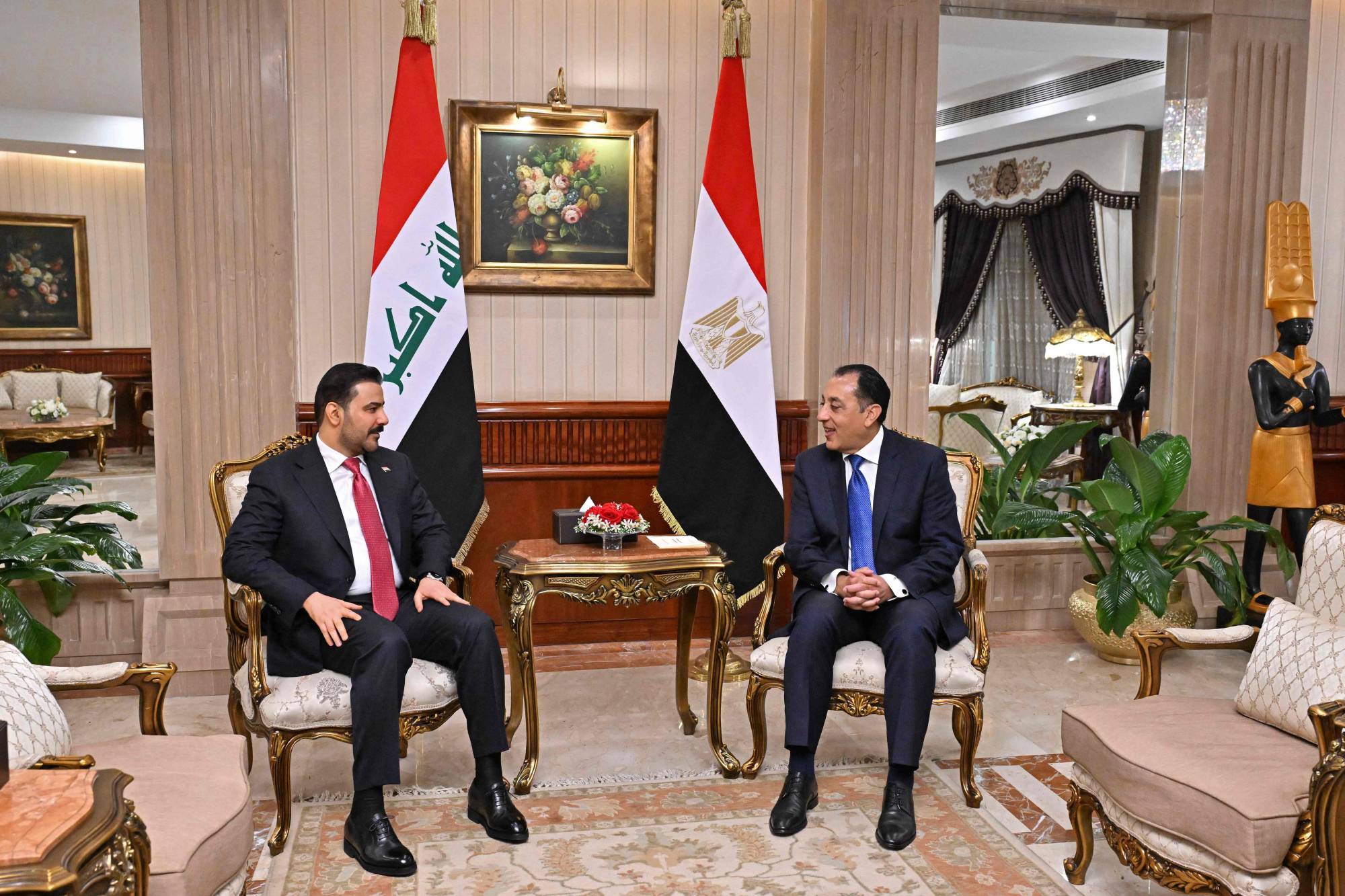
Egypt's Prime Minister Mostafa Madbouly (R) speaks with his Iraqi counterpart Ali al-Zaidi during their meeting in Cairo on November 23, 2026. (AFP)

The move sparked debate on social media between supporters, who view it as strengthening ties between the two peoples and delivering major benefits to both sides, and critics, particularly some Iraqis, who argue it will benefit Egyptians more because Egypt requires security clearance for any Iraqi wishing to visit, whereas Baghdad imposes no such requirement on Egyptians.

However, Ambassador Khalaf confirmed that "the agreement provides for visas upon arrival for both sides without security clearances or other hurdles, though standard requirements will apply depending on the purpose of the visit."

"The decision comes within the framework of the Iraqi government's efforts to boost Iraq's openness to its Arab surroundings and strengthen its relations with countries in the region, and these steps will be followed by further moves in this direction," he added.

Tourism expert and board member of the Egyptian Federation of Investors Associations Samy Soliman praised the decision to scrap entry visas.

He told Asharq Al-Awsat that it "comes at a very important and decisive time following a period of wars and major instability in Iraq and the region."

"Undoubtedly, the people of Iraq are eager for tourism, and Egypt will be a preferred destination for them because there are historical relations and deep bonds between the two countries and peoples," he remarked.

Mutual benefits

He stressed that "this will bring major returns for Egyptian tourism and will also achieve significant benefits for Iraq in terms of increasing the number of Egyptian tourists, as well as the number of investors."

During the 2024–2025 fiscal year, Egyptian investments in Iraq rose to $72.1 million, while Iraqi investments in Egypt reached $5 million. Remittances from Egyptians working in Iraq stood at $52.5 million, according to Egypt's Central Agency for Public Mobilization and Statistics (CAPMAS).

Egyptian labor enjoyed a privileged status in Iraq during the regime of Saddam Hussein, though conditions declined following his fall and as the country endured economic crises and wars against terrorism that lasted for years.

Egyptian MP Mostafa Bakry said that "the visa cancellation decision will open the door for Egyptian labor."

Speaking to Asharq Al-Awsat, he stressed that "this will pave the way for more deeply rooted relations between the two countries and make Egyptians an important factor in Iraq's development."

"Egypt will likewise work to facilitate the entry of Iraqis, elevating the relationship to a level befitting the shared history of both countries," he noted.



Libya: 2 LNA Naval Officers Die of Wounds from Ukrainian Attack in Benghazi

A satellite image shows fires near a cargo ship with vehicles onboard after an explosion aboard a Russian ship docked at the Benghazi naval base, in Benghazi, Libya, November 22, 2026. Vantor/Handout via REUTERS
TT

Libya: 2 LNA Naval Officers Die of Wounds from Ukrainian Attack in Benghazi

A satellite image shows fires near a cargo ship with vehicles onboard after an explosion aboard a Russian ship docked at the Benghazi naval base, in Benghazi, Libya, November 22, 2026. Vantor/Handout via REUTERS

Two Libyan naval officers died from wounds sustained in a Ukrainian drone attack on a Russian warship moored in eastern Libya, the Libyan National Army (LNA) said.

The two men were pronounced dead Tuesday evening.

They were wounded in the Sunday drone attack at the Benghazi Naval Base, the LNA said in a statement late Tuesday.

The LNA’s General Command vowed to retaliate “at the appropriate time and place, and by the appropriate means.”

Ukraine’s President Volodymyr Zelenskyy said forces deployed seven drones in the operation that struck the Russian navy corvette on Sunday.


New Defections Among Ranks of Sudan’s Rapid Support Forces

Armed members of the Rapid Support Forces surrender to the Sudanese army in Omdurman on November 18. (AFP)
TT

New Defections Among Ranks of Sudan’s Rapid Support Forces

Armed members of the Rapid Support Forces surrender to the Sudanese army in Omdurman on November 18. (AFP)

Defections within the Rapid Support Forces (RSF) increased over the past few hours with five field commanders announcing they were breaking away from the group to join the Sudanese army.

On Tuesday, an intelligence official in the special protection force of the RSF commander in Sudan announced his defection and expressed readiness to fight with the army, hours after four commanders arrived in Khartoum and declared they were joining the armed forces.

The latest defections extend from support forces and civil administrations to the security circle surrounding RSF commander Mohamed Hamdan Dagalo, known as "Hemedti."

In a video recording, Al-Tayeb Jabara Mohamed said he headed the counter-intelligence department and served within Hemedti’s special protection force.

He urged his former comrades to leave the RSF and take advantage of the amnesty he said was issued by Sovereignty Council Chairman and army commander Abdel Fattah Al-Burhan.

Jabara noted that he belongs to the Mahariya, a branch of the Rizeigat tribe from which the RSF commander also hails.

Prior to Jabara’s announcement, four commanders arrived at Khartoum airport on Monday, including Major General Ammar Mohamed Zein Rabeh, a commander in the support forces, and Mohammed Ali Abdullah, head of the RSF-affiliated civil administration in the city of Al-Fulah in West Kordofan State.

Speaking at a press conference at the airport, Rabeh said arrangements to secure the group's exit from RSF-controlled areas in Darfur had delayed the announcement of their defection, stressing that the group will fight with the army.

Rabeh attributed the group’s decision to killings and looting he said the RSF committed against civilians in Al-Jazirah, Khartoum, and Darfur.

He revealed that he was aware of mass graves near the airport in el-Fasher, the capital of North Darfur, claiming they contain thousands of victims.

He also alleged that the RSF enlisted Israeli experts to train officers in Nyala, and that other officers received military and intelligence training in countries in the region.

Rabeh said his group had previously fought in central Khartoum under the command of Mishaal Abdulrahman Al-Nour, who announced on November 18 that he was defecting and joining the army with a force under his command.

For his part, Abdullah attributed his defection to alleged crimes committed by the RSF across the country.

The army has not published a comprehensive tally of the number of defectors who have joined its ranks since the start of the war. Lieutenant Colonel Mohamed Azraq Al-Fanjari said upon defecting in October that he left the RSF with about 300 officers and soldiers.


What Are the Expected Gains from Scrapping Egypt–Iraq Entry Visas?

Iraqi Prime Minister Ali al-Zaidi meets Egypt's President Abdel Fattah al-Sisi, in Cairo, Egypt, November 23, 2026. (Iraqi Prime Minister's Media Office/Handout via Reuters)
TT

What Are the Expected Gains from Scrapping Egypt–Iraq Entry Visas?

Iraqi Prime Minister Ali al-Zaidi meets Egypt's President Abdel Fattah al-Sisi, in Cairo, Egypt, November 23, 2026. (Iraqi Prime Minister's Media Office/Handout via Reuters)

Egypt and Iraq announced an agreement to scrap entry visas between the two countries as Iraqi Prime Minister Ali al-Zaidi made his first visit to the country where he met with President Abdel Fattah al-Sisi and senior officials.

Following the announcement, Iraq’s ambassador to Cairo Dr. Qahtan Taha Khalaf revealed to Asharq Al-Awsat that "the agreement stipulates granting visas upon arrival and lifting the security clearance requirement for Iraqis traveling to Egypt."

Speaking during a press conference with the Egyptian president on Monday, al-Zaidi said the two countries agreed to cancel entry visas to facilitate movement and communication between their citizens.

Neither side has yet specified when the agreement will take effect.

Visa upon arrival

Khalaf told Asharq Al-Awsat that authorities in both countries are currently taking the necessary measures to implement the agreement on a visa-on-arrival basis.

"Implementation may take some time, which we are striving to keep brief - similar to what happened with Jordan, where the same measure was announced between Jordan and Iraq about a month ago," he added.

He stressed that implementing the agreement would yield substantial returns. It would open a major avenue for reviving Iraqi tourism to Egypt, while allowing Egyptians to visit Iraq for tourism, in addition to facilitating investment and business exchanges between the two nations.

The visit marked al-Zaidi’s first trip to Egypt since taking office. He and Sisi discussed several files related to regional security and stability, and signed agreements and memoranda of understanding in the fields of economy, medicine, and science. However, the visa-cancellation decision resonated widely as the visit's most prominent outcome.

Egypt's Prime Minister Mostafa Madbouly (R) speaks with his Iraqi counterpart Ali al-Zaidi during their meeting in Cairo on November 23, 2026. (AFP)

The move sparked debate on social media between supporters, who view it as strengthening ties between the two peoples and delivering major benefits to both sides, and critics, particularly some Iraqis, who argue it will benefit Egyptians more because Egypt requires security clearance for any Iraqi wishing to visit, whereas Baghdad imposes no such requirement on Egyptians.

However, Ambassador Khalaf confirmed that "the agreement provides for visas upon arrival for both sides without security clearances or other hurdles, though standard requirements will apply depending on the purpose of the visit."

"The decision comes within the framework of the Iraqi government's efforts to boost Iraq's openness to its Arab surroundings and strengthen its relations with countries in the region, and these steps will be followed by further moves in this direction," he added.

Tourism expert and board member of the Egyptian Federation of Investors Associations Samy Soliman praised the decision to scrap entry visas.

He told Asharq Al-Awsat that it "comes at a very important and decisive time following a period of wars and major instability in Iraq and the region."

"Undoubtedly, the people of Iraq are eager for tourism, and Egypt will be a preferred destination for them because there are historical relations and deep bonds between the two countries and peoples," he remarked.

Mutual benefits

He stressed that "this will bring major returns for Egyptian tourism and will also achieve significant benefits for Iraq in terms of increasing the number of Egyptian tourists, as well as the number of investors."

During the 2024–2025 fiscal year, Egyptian investments in Iraq rose to $72.1 million, while Iraqi investments in Egypt reached $5 million. Remittances from Egyptians working in Iraq stood at $52.5 million, according to Egypt's Central Agency for Public Mobilization and Statistics (CAPMAS).

Egyptian labor enjoyed a privileged status in Iraq during the regime of Saddam Hussein, though conditions declined following his fall and as the country endured economic crises and wars against terrorism that lasted for years.

Egyptian MP Mostafa Bakry said that "the visa cancellation decision will open the door for Egyptian labor."

Speaking to Asharq Al-Awsat, he stressed that "this will pave the way for more deeply rooted relations between the two countries and make Egyptians an important factor in Iraq's development."

"Egypt will likewise work to facilitate the entry of Iraqis, elevating the relationship to a level befitting the shared history of both countries," he noted.