


China’s Used Phones Find New Homes from Karachi to Algiers

Used smartphones are seen at ATRenew Dongguan Automation Operations Center, which recycles and processes used smartphones in Dongguan, in southern China's Guangdong province on November 3, 2026. (AFP)
TT

China’s Used Phones Find New Homes from Karachi to Algiers

Used smartphones are seen at ATRenew Dongguan Automation Operations Center, which recycles and processes used smartphones in Dongguan, in southern China's Guangdong province on November 3, 2026. (AFP)

In the maze of Shenzhen's neon-lit Huaqiangbei electronics market, buyers from Africa to Bangladesh buy dozens of used phones at a time -- even with cracked screens -- to sell back home.

"From all China, the broken mobile phones come here," Akhtar Muhammad, 38, a Pakistani businessman, told AFP as he browsed the stacks of devices in the southern Chinese city.

"We will fix them in Pakistan."

The supply is mind-boggling. As the world's largest smartphone producer, China discards over 400 million devices annually, the China Association of Circular Economy estimates.

As chip shortages and rising prices around the world make new devices harder to afford, so the demand for pre-owned phones is also soaring.

Mama, a 24-year-old Nigerian buyer, said he had bought around 40 used phones in one day in Shenzhen, which hosted leaders including US President Donald Trump last week.

"They are more expensive in Africa because we don't have big suppliers or markets like this one," Mama told AFP. "If I buy and send them to my country, I get profit."

Nearby, another Nigerian buyer haggled with a stall owner. His haul included damaged iPhone 13 Pro and 14 Pro models bought for 1,000 to 2,000 yuan ($150 to $300) each.

He plans to repair their screens locally before shipping them home for a lucrative resale.
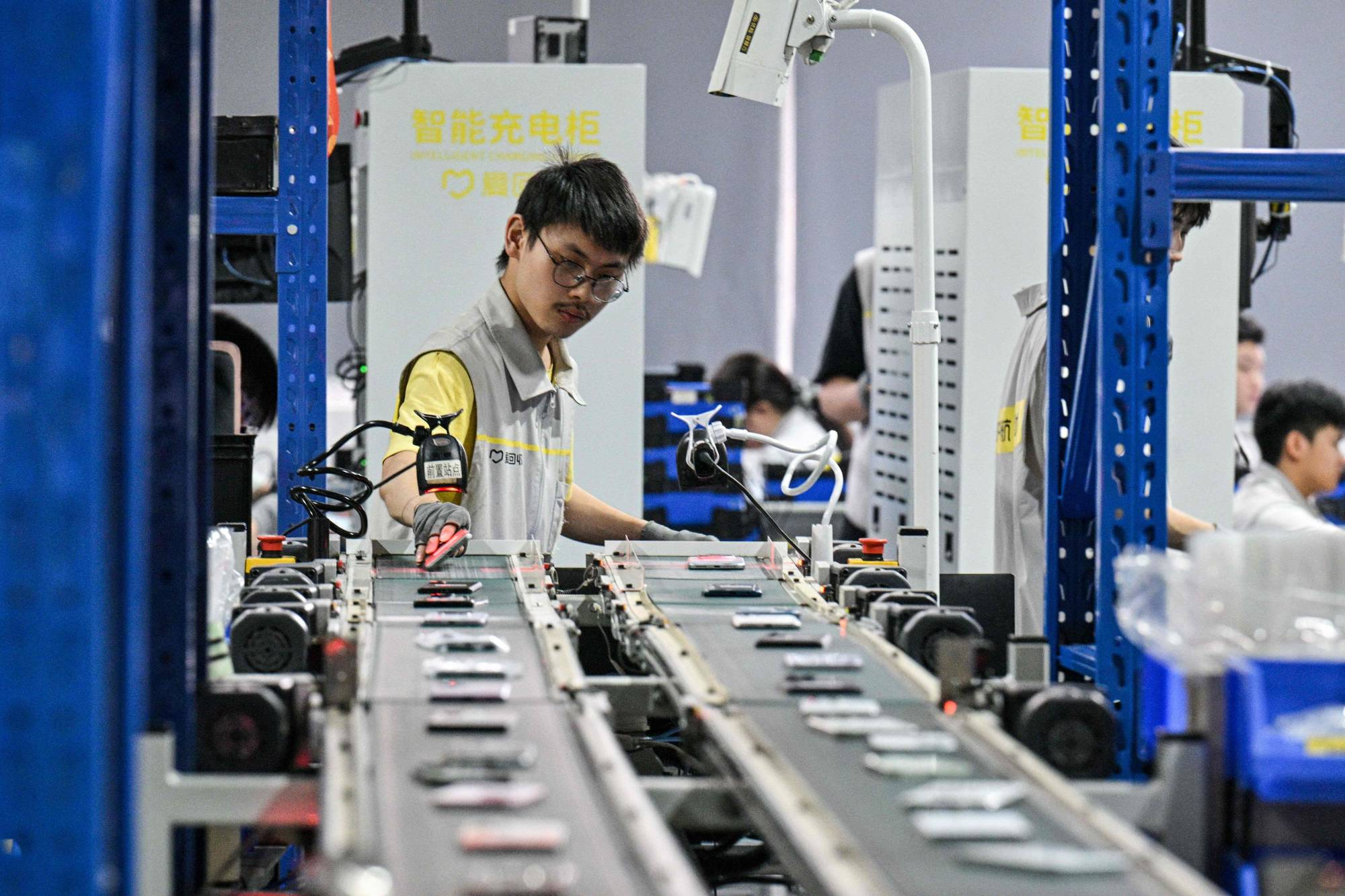
A worker is seen at ATRenew Dongguan Automation Operations Center, which recycles and processes used smartphones in Dongguan, in southern China's Guangdong province on November 3, 2026. (AFP)

- Repair not replace -

In particular, people in emerging markets such as South Asia and Africa, where there is less purchasing power, are turning to used models, Counterpoint Research analyst Ivan Lam told AFP.

The global secondary smartphone market grew 13 percent year-on-year in the first half of 2026 to 150 million units, according to Counterpoint.

In Pakistan, people often opt to repair rather than replace broken devices, said Muhammad, who has been coming to China since 2007.

"Maybe people use one mobile phone for four or five years. It's not the same like the US or Europe. They change every year or every six months," he said.

But outside Huaqiangbei's crowded stalls, a more formalized alternative is taking root: PaiJiTang Mall, a self-service second-hand marketplace run by Chinese recycling company ATRenew.

Inside, rows of over 20,000 used phones are on display. Buyers scan QR codes for instant inspection reports and pricing, test the units and purchase in bulk.

The shop draws up to 1,000 visitors daily, with international traders making up about a third, said store manager Zhang Xiaoming.

Abdul Rahim, a 20-year-old shopkeeper who flies to China up to three times a month to stock his phone and accessory store in Algeria, capitalizes on a price gap of 100 to 120 euros ($110 to $132) per device.

"It's very easy for Algerians to get the visa to China. You put in your papers and in two or three days you have the visa in your passport," he told AFP.

"For Europe, there just aren't visas... So we come here."
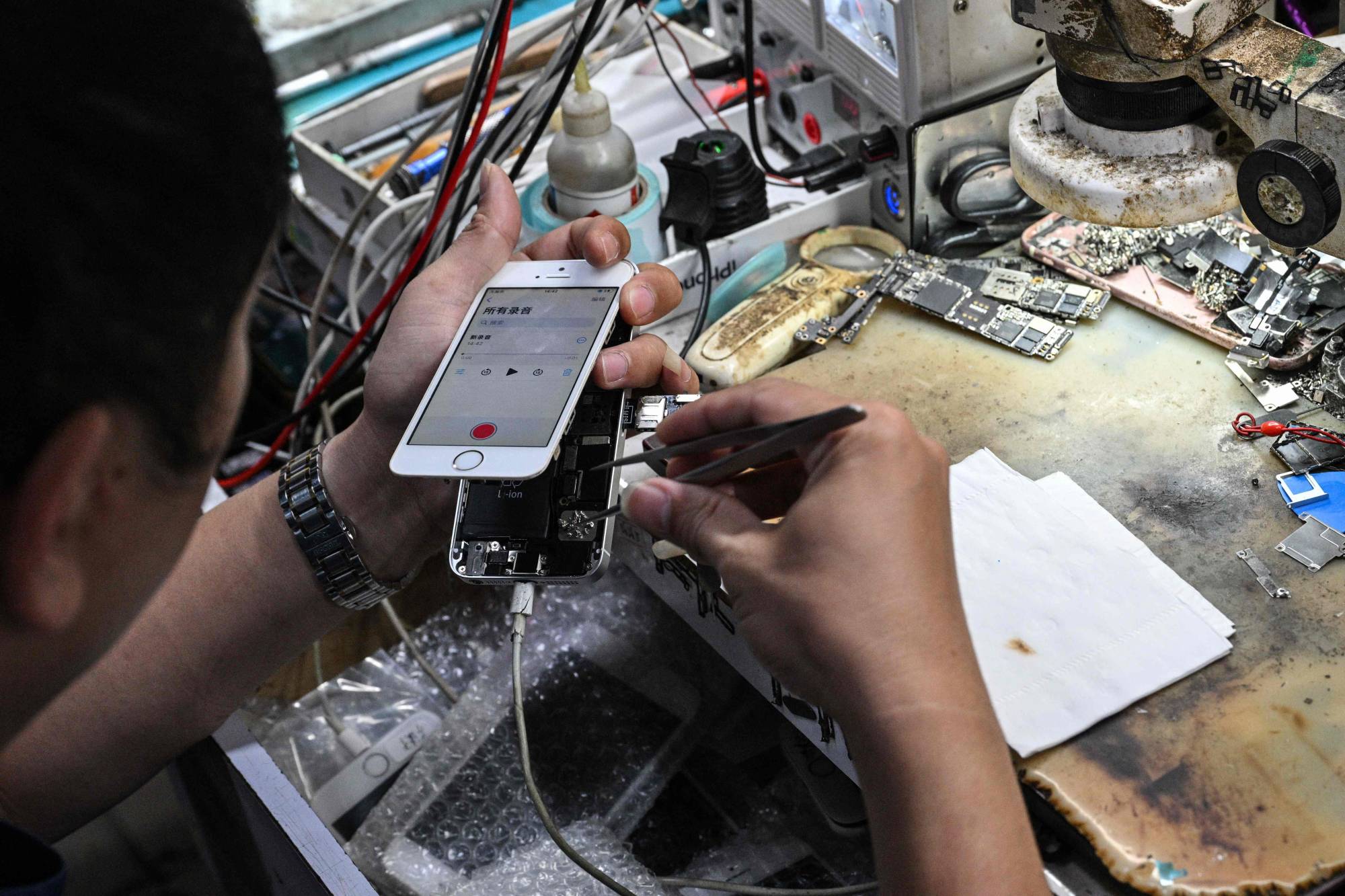
A technician repairs a smarthphone in a shopping mall dedicated to the sale of smartphones in Shenzhen, Guangdong Province, on November 2, 2026. (AFP)

- 'Buy, buy, buy' -

Apple devices account for 70 to 80 percent of sales, with the rest split among Chinese brands such as Huawei, Xiaomi, Oppo and Vivo, Zhang noted.

Older models like the iPhone 11, 12 and 13 -- losing ground to cheap Androids in China -- retain strong brand power overseas, where they find a second life, explained Jeremy Ji, ATRenew's head of corporate strategy and overseas business.

At ATRenew's massive processing hub in Dongguan, north of Shenzhen, roughly 30,000 second-hand gadgets arrive daily and are inspected and packed by over 300 technicians.

Rising prices are also changing buying habits in China itself with consumers opting increasingly for pre-owned models, particularly nearly new premium models, said Arthur Guo, an analyst at IDC China.

Most phones discarded in China are still sold domestically, and bulk exports via official channels have not increased significantly, Lam, of Counterpoint, told AFP.

For Mama, sourcing phones is still a hands-on process.

"If I come, I spend a month checking (phones). I buy, buy, buy," he said. "After I have finished, I go back to my country."



China’s Used Phones Find New Homes from Karachi to Algiers

Used smartphones are seen at ATRenew Dongguan Automation Operations Center, which recycles and processes used smartphones in Dongguan, in southern China's Guangdong province on November 3, 2026. (AFP)
TT

China’s Used Phones Find New Homes from Karachi to Algiers

Used smartphones are seen at ATRenew Dongguan Automation Operations Center, which recycles and processes used smartphones in Dongguan, in southern China's Guangdong province on November 3, 2026. (AFP)

In the maze of Shenzhen's neon-lit Huaqiangbei electronics market, buyers from Africa to Bangladesh buy dozens of used phones at a time -- even with cracked screens -- to sell back home.

"From all China, the broken mobile phones come here," Akhtar Muhammad, 38, a Pakistani businessman, told AFP as he browsed the stacks of devices in the southern Chinese city.

"We will fix them in Pakistan."

The supply is mind-boggling. As the world's largest smartphone producer, China discards over 400 million devices annually, the China Association of Circular Economy estimates.

As chip shortages and rising prices around the world make new devices harder to afford, so the demand for pre-owned phones is also soaring.

Mama, a 24-year-old Nigerian buyer, said he had bought around 40 used phones in one day in Shenzhen, which hosted leaders including US President Donald Trump last week.

"They are more expensive in Africa because we don't have big suppliers or markets like this one," Mama told AFP. "If I buy and send them to my country, I get profit."

Nearby, another Nigerian buyer haggled with a stall owner. His haul included damaged iPhone 13 Pro and 14 Pro models bought for 1,000 to 2,000 yuan ($150 to $300) each.

He plans to repair their screens locally before shipping them home for a lucrative resale.

A worker is seen at ATRenew Dongguan Automation Operations Center, which recycles and processes used smartphones in Dongguan, in southern China's Guangdong province on November 3, 2026. (AFP)

- Repair not replace -

In particular, people in emerging markets such as South Asia and Africa, where there is less purchasing power, are turning to used models, Counterpoint Research analyst Ivan Lam told AFP.

The global secondary smartphone market grew 13 percent year-on-year in the first half of 2026 to 150 million units, according to Counterpoint.

In Pakistan, people often opt to repair rather than replace broken devices, said Muhammad, who has been coming to China since 2007.

"Maybe people use one mobile phone for four or five years. It's not the same like the US or Europe. They change every year or every six months," he said.

But outside Huaqiangbei's crowded stalls, a more formalized alternative is taking root: PaiJiTang Mall, a self-service second-hand marketplace run by Chinese recycling company ATRenew.

Inside, rows of over 20,000 used phones are on display. Buyers scan QR codes for instant inspection reports and pricing, test the units and purchase in bulk.

The shop draws up to 1,000 visitors daily, with international traders making up about a third, said store manager Zhang Xiaoming.

Abdul Rahim, a 20-year-old shopkeeper who flies to China up to three times a month to stock his phone and accessory store in Algeria, capitalizes on a price gap of 100 to 120 euros ($110 to $132) per device.

"It's very easy for Algerians to get the visa to China. You put in your papers and in two or three days you have the visa in your passport," he told AFP.

"For Europe, there just aren't visas... So we come here."

A technician repairs a smarthphone in a shopping mall dedicated to the sale of smartphones in Shenzhen, Guangdong Province, on November 2, 2026. (AFP)

- 'Buy, buy, buy' -

Apple devices account for 70 to 80 percent of sales, with the rest split among Chinese brands such as Huawei, Xiaomi, Oppo and Vivo, Zhang noted.

Older models like the iPhone 11, 12 and 13 -- losing ground to cheap Androids in China -- retain strong brand power overseas, where they find a second life, explained Jeremy Ji, ATRenew's head of corporate strategy and overseas business.

At ATRenew's massive processing hub in Dongguan, north of Shenzhen, roughly 30,000 second-hand gadgets arrive daily and are inspected and packed by over 300 technicians.

Rising prices are also changing buying habits in China itself with consumers opting increasingly for pre-owned models, particularly nearly new premium models, said Arthur Guo, an analyst at IDC China.

Most phones discarded in China are still sold domestically, and bulk exports via official channels have not increased significantly, Lam, of Counterpoint, told AFP.

For Mama, sourcing phones is still a hands-on process.

"If I come, I spend a month checking (phones). I buy, buy, buy," he said. "After I have finished, I go back to my country."


Australia to Treat AI as Key Foreign Policy Challenge

The words "AI Artificial Intelligence" and a keyboard are shown in this illustration created on October 19, 2026. (Reuters)
TT

Australia to Treat AI as Key Foreign Policy Challenge

The words "AI Artificial Intelligence" and a keyboard are shown in this illustration created on October 19, 2026. (Reuters)

Australia will treat artificial intelligence ‌as a key challenge in its foreign policy, warning the technology was reshaping society's foundations and giving overseas actors new ways to interfere in its democracy.

In a major address to parliament on Tuesday setting out Australia's changing foreign policy approach, Foreign Minister Penny Wong is expected to name AI alongside forces, such as the growing influence of middle powers and strategic competition between the US and China.

"Technology is transforming the foundations and dimensions of economic and strategic power," Wong will say.

"Artificial intelligence and emerging technologies are spreading ‌and disrupting ‌faster than any previous revolutionary technologies -- reordering our ‌lives, ⁠economies and militaries in ⁠ways we cannot fully foresee."

It comes after the Australian government earlier this month announced it would toughen its AI regulation, mandating companies report breaches and establishing a dedicated regulator for the technology, following revelations an OpenAI agent breached the database of the country's health system.

Citing recent foreign disinformation operations, Wong will also warn in ⁠her speech, entitled "Securing Australia's future in a changing world: ‌Australian foreign policy for a ‌new era", that AI tools make interference in Australia's democracy by foreign actors ‌faster, cheaper, and harder to recognize.

"We are strengthening our ‌critical technology, infrastructure and cyber resilience, and legislating mandatory safety and security protections for every frontier AI company that operates in Australia," Wong is expected to say.

While welcoming investment and innovation in frontier AI, she will ‌say it must be "on terms that work for all Australians".

Australia intends to help shape the race ⁠to develop ⁠advanced models by ensuring it "does not reward speed over prudence", Wong is expected to say, drawing comparisons to nuclear non-proliferation and online safety.

"Australia is working with partners on AI safety, making it a shared, global endeavor... Australia has helped shape the international order before, in non-proliferation and in online safety. With artificial intelligence, we intend to do it again."

Wong will also outline five other key forces reshaping the international order.

These include the changes in how the US and China define and pursue their interests, the influence of middle powers, the growing threat or use of force and coercion, and increasing difficulty in achieving collective international action.


Defense, AI, High Tech: A Delicate Balance Between Armies and Industry

Activists from the Campaign to Stop Killer Robots, a coalition of non-governmental organizations opposing lethal autonomous weapons or so-called "killer robots", stage a protest at Brandenburg Gate in Berlin, Germany, March, 21, 2019. (Reuters)
TT

Defense, AI, High Tech: A Delicate Balance Between Armies and Industry

Activists from the Campaign to Stop Killer Robots, a coalition of non-governmental organizations opposing lethal autonomous weapons or so-called "killer robots", stage a protest at Brandenburg Gate in Berlin, Germany, March, 21, 2019. (Reuters)

The rapid integration of high tech and artificial intelligence into the armed forces presents a tricky dilemma: entrusting part of their future to private companies while risking their sovereignty.

On one side are digital and mission-critical technology specialists driven by market forces and controlled by private capital demanding profits, independent from any political control.

On the other are military leaders who answer only to political authority and are obsessed with strategy, hierarchy and the sacrosanct nature of defense secrecy.

Between them is the race to connect the battlefield, from troop coordination to real-time terrain analysis, generating terabits of data which can decide a war's outcome and the fate of many lives.

Beyond the even more complex issue of so-called killer robots, one example sums up the defense challenge: the civilian Starlink satellite network and its military counterpart, Starshield, which Ukraine desperately needs.

Since Russia's invasion in 2022, Kyiv has faced restrictions on access to Starshield, owned by Elon Musk's SpaceX, leaving a Sword of Damocles hanging over Ukraine's armed forces.

Musk has shifted his stance on Ukraine many times, insisting any disruption was the responsibility of Washington, not SpaceX.

- 'A fine line' -

The issue loomed over NATO Edge this week, a three-day conference on critical technologies and digital warfare where military chiefs, government officials and defense experts from NATO's 32 member states and Ukraine gathered in Izmir, Türkiye.

"This is a difficult issue, one many ministries of defense are grappling with," analyst Tom Barton with intelligence firm Janes told AFP.

For companies "to deliver the so-called 'networked battlefield', some access ideally needs to be given" to confidential data, he explained.

"From space to land-based sensors and military communications, defense establishments are experimenting with standalone exercises and varying levels of trust and access."

But militaries -- without safeguards -- cannot entrust their fate to developers, who are often focused primarily on civilian needs.

"There is a lot of push or advocacy for military and government to have a closer relationship with industry," a US company representative told AFP on condition of anonymity.

"But there's a fine line. You turn on the news and you see Elon Musk doing shit in Ukraine like slowing down the internet," he fumed.

With boundaries constantly shifting, military leaders have little choice but to compromise.

"You don't need to be 100 percent sovereign, but sovereign enough," he explained.

- Trust -

For Major General Rainer Beeck, one of NATO's top cyberspace commanders, it is "a hard nut to crack".

"You have to make choices about which classification you make, for which data... The problem is the trust," he said.

Admiral Pierre Vandier, NATO's Supreme Allied Commander Transformation (SACT), likewise insisted that "trust ... is the most important thing".

"Trust in architecture, in data sharing, in AI agents, in decision-making tools," he said.

"We need to close the fighter-factory gap. Ukraine did it."

Nearly five years of war have given Kyiv more experience than anyone else in NATO.

The dynamics also vary according to the size of national defense budgets.

For large powers, "data collection is not the problem... If war would start, we would get (it). The problem then is it's too late to organize," Beeck said, calling for a more proactive approach.

Smaller governments need "to build up their capacity", said Mitch Free, vice president of international government at Vantor, which provides satellite imagery for defense and intelligence agencies.

Many may only own a handful of satellites and must weigh their intelligence value against the cost of building and operating them.

"This is where commercial... helps fill the gap," he said.

Ultimately, the real debate is about the best way to use AI.

"The bottleneck is often not technology, but permission: classification boundaries, national rules and trust decisions," said Jean-Charles Ellermann-Kingombe, NATO's cyber and digital transformation chief.

The alliance must make "AI adoption possible at scale", with these capabilities "secure, interoperable and deployable within NATO's infrastructure... by personnel who understand their value and their limitations", he added.