


Libya Steps Up Efforts in East and West to Expand Partnership with Türkiye

Erdogan receives Haftar in the Turkish capital, Ankara, on Wednesday. (Turkish Presidency)
TT

Libya Steps Up Efforts in East and West to Expand Partnership with Türkiye

Erdogan receives Haftar in the Turkish capital, Ankara, on Wednesday. (Turkish Presidency)

Libya is pursuing parallel efforts to strengthen its partnership with Türkiye, reflecting Ankara’s growing rapprochement with the country’s main centers of power in the east and west.

Turkish President Recep Tayyip Erdogan received Libyan National Army (LNA) commander Field Marshal Khalifa Haftar in the Turkish capital on Wednesday, as the Tripoli-based Government of National Unity (GNU) pressed ahead with preparations to host the fourth Türkiye-Africa Partnership Summit next month.

The developments coincide with a shift in the House of Representatives’ position on the maritime agreement between the two countries.

The bilateral agenda, spanning military and security cooperation, economic interests, maritime boundary delimitation and regional and African affairs, underscores Türkiye’s willingness to engage with Libya’s rival factions despite persistent political and institutional divisions.

Haftar’s meeting with Erdogan was preceded by talks with Foreign Minister Hakan Fidan at the Foreign Ministry headquarters during an official visit to Türkiye.

Participants included Haftar’s sons — his deputy, Lt. Gen. Saddam Haftar; his chief of staff, Lt. Gen. Khaled Haftar; and the head of the Libya Development and Reconstruction Fund, Belqasim Haftar — alongside Turkish Defense Minister Yasar Guler, intelligence chief Ibrahim Kalin and Chief of General Staff Selcuk Bayraktaroglu.

According to the LNA General Command, the discussions covered regional and international developments, issues of mutual interest and prospects for expanding bilateral cooperation, without disclosing details of the understandings or agreements discussed.

Maritime memorandum

The visit coincided with a significant legislative development in Tripoli, where the House of Representatives published decisions reversing its previous opposition to ratifying the 2019 maritime memorandum of understanding with Türkiye.

On October 20, parliament voted unanimously to ratify the memorandum signed in November 2019 between Ankara and the former Government of National Accord, headed by Fayez al-Sarraj.

It also repealed two decisions issued in 2020 rejecting the maritime and military agreements and calling for severing political ties with Türkiye.

The memorandum defines the two countries’ maritime jurisdiction based on specified coordinates and an accompanying map. It provides for its registration with the United Nations Secretariat and the settlement of disputes over its interpretation or implementation through diplomatic channels.

It allows for agreements on the joint exploitation of natural resources extending across their respective economic zones and requires either party to notify and negotiate with the other when entering talks with a third country on delimiting its exclusive economic zone or seeking to amend the agreed coordinates.

Egypt, Greece, Cyprus and the European Union have opposed the memorandum since its signing, arguing that it infringes on the rights of other Eastern Mediterranean countries and violates international law. The Turkish government maintains that it forms the basis of maritime cooperation with Libya.

Türkiye-Africa Partnership Summit

Meanwhile, the GNU, headed by Abdulhamid Dbeibah, is racing to finalize preparations for the fourth Türkiye-Africa Partnership Summit in Tripoli on December 8-9.

Erdogan and several African leaders are expected to attend the gathering, which the government hopes will bolster its diplomatic standing.

Organizational, technical, security and logistical preparations are underway in coordination with Turkish officials and the African Union Commission, covering final documents, meeting venues, accommodation and arrangements for the reception, transportation and departure of heads of state and government.

During a videoconference with the African Union Permanent Representatives Committee’s subcommittee on multilateral cooperation, Mustafa al-Manea, head of the executive team overseeing Dbeibah’s initiatives and strategic projects and a member of the summit’s higher committee, outlined progress on visa procedures, electronic registration and accreditation, protocol and security arrangements.

Acting Foreign Minister Taher al-Baour discussed preparations with Turkish Ambassador to Libya Guven Begec, focusing on closer coordination to ensure the summit’s success and expand bilateral ties.

Acting Interior Minister Imad Trabelsi also convened security and military officials, including police chiefs from Tripoli and surrounding areas, to review plans to protect delegations, secure their accommodation and ensure their safe movement.

The summit is expected to assess progress in the Türkiye-Africa partnership since the 2021 Istanbul meeting and examine future cooperation priorities in trade, investment, manufacturing, infrastructure, energy, agriculture, food security, education and technology, alongside peace, security and sustainable development.


Libya Steps Up Efforts in East and West to Expand Partnership with Türkiye

Erdogan receives Haftar in the Turkish capital, Ankara, on Wednesday. (Turkish Presidency)
TT

Libya Steps Up Efforts in East and West to Expand Partnership with Türkiye

Erdogan receives Haftar in the Turkish capital, Ankara, on Wednesday. (Turkish Presidency)

Libya is pursuing parallel efforts to strengthen its partnership with Türkiye, reflecting Ankara’s growing rapprochement with the country’s main centers of power in the east and west.

Turkish President Recep Tayyip Erdogan received Libyan National Army (LNA) commander Field Marshal Khalifa Haftar in the Turkish capital on Wednesday, as the Tripoli-based Government of National Unity (GNU) pressed ahead with preparations to host the fourth Türkiye-Africa Partnership Summit next month.

The developments coincide with a shift in the House of Representatives’ position on the maritime agreement between the two countries.

The bilateral agenda, spanning military and security cooperation, economic interests, maritime boundary delimitation and regional and African affairs, underscores Türkiye’s willingness to engage with Libya’s rival factions despite persistent political and institutional divisions.

Haftar’s meeting with Erdogan was preceded by talks with Foreign Minister Hakan Fidan at the Foreign Ministry headquarters during an official visit to Türkiye.

Participants included Haftar’s sons — his deputy, Lt. Gen. Saddam Haftar; his chief of staff, Lt. Gen. Khaled Haftar; and the head of the Libya Development and Reconstruction Fund, Belqasim Haftar — alongside Turkish Defense Minister Yasar Guler, intelligence chief Ibrahim Kalin and Chief of General Staff Selcuk Bayraktaroglu.

According to the LNA General Command, the discussions covered regional and international developments, issues of mutual interest and prospects for expanding bilateral cooperation, without disclosing details of the understandings or agreements discussed.

Maritime memorandum

The visit coincided with a significant legislative development in Tripoli, where the House of Representatives published decisions reversing its previous opposition to ratifying the 2019 maritime memorandum of understanding with Türkiye.

On October 20, parliament voted unanimously to ratify the memorandum signed in November 2019 between Ankara and the former Government of National Accord, headed by Fayez al-Sarraj.

It also repealed two decisions issued in 2020 rejecting the maritime and military agreements and calling for severing political ties with Türkiye.

The memorandum defines the two countries’ maritime jurisdiction based on specified coordinates and an accompanying map. It provides for its registration with the United Nations Secretariat and the settlement of disputes over its interpretation or implementation through diplomatic channels.

It allows for agreements on the joint exploitation of natural resources extending across their respective economic zones and requires either party to notify and negotiate with the other when entering talks with a third country on delimiting its exclusive economic zone or seeking to amend the agreed coordinates.

Egypt, Greece, Cyprus and the European Union have opposed the memorandum since its signing, arguing that it infringes on the rights of other Eastern Mediterranean countries and violates international law. The Turkish government maintains that it forms the basis of maritime cooperation with Libya.

Türkiye-Africa Partnership Summit

Meanwhile, the GNU, headed by Abdulhamid Dbeibah, is racing to finalize preparations for the fourth Türkiye-Africa Partnership Summit in Tripoli on December 8-9.

Erdogan and several African leaders are expected to attend the gathering, which the government hopes will bolster its diplomatic standing.

Organizational, technical, security and logistical preparations are underway in coordination with Turkish officials and the African Union Commission, covering final documents, meeting venues, accommodation and arrangements for the reception, transportation and departure of heads of state and government.

During a videoconference with the African Union Permanent Representatives Committee’s subcommittee on multilateral cooperation, Mustafa al-Manea, head of the executive team overseeing Dbeibah’s initiatives and strategic projects and a member of the summit’s higher committee, outlined progress on visa procedures, electronic registration and accreditation, protocol and security arrangements.

Acting Foreign Minister Taher al-Baour discussed preparations with Turkish Ambassador to Libya Guven Begec, focusing on closer coordination to ensure the summit’s success and expand bilateral ties.

Acting Interior Minister Imad Trabelsi also convened security and military officials, including police chiefs from Tripoli and surrounding areas, to review plans to protect delegations, secure their accommodation and ensure their safe movement.

The summit is expected to assess progress in the Türkiye-Africa partnership since the 2021 Istanbul meeting and examine future cooperation priorities in trade, investment, manufacturing, infrastructure, energy, agriculture, food security, education and technology, alongside peace, security and sustainable development.


Khartoum Rejects Addis Ababa’s Initiative to End Sudan’s War

Ethiopian Prime Minister Abiy Ahmed. (Ethiopian News Agency)
TT

Khartoum Rejects Addis Ababa’s Initiative to End Sudan’s War

Ethiopian Prime Minister Abiy Ahmed. (Ethiopian News Agency)

Sudan’s government on Wednesday rejected Ethiopian Prime Minister Abiy Ahmed’s proposal to host an inclusive Sudanese dialogue aimed at ending the war, arguing that Addis Ababa lacked the requisite neutrality and urging the African Union to exclude Ethiopia from any arrangements to host or facilitate the talks.

The initiative was welcomed, however, by the Transitional Peace Government affiliated with the Sudan Founding Alliance (TASIS), which includes the Rapid Support Forces (RSF), and the Civil Democratic Alliance of Revolutionary Forces (Sumoud).

In a statement carried by the official Sudan News Agency (SUNA), the army-backed government stressed that the host country’s neutrality and respect for Sudan’s sovereignty were prerequisites for accepting its involvement in the dialogue.

It cited previous allegations that Addis Ababa had supported the RSF and that drones had been launched from Ethiopian territory to target Sudan.

Khartoum demanded an independent investigation into the allegations, reserving the right to take appropriate action through diplomatic and legal channels.

It urged the African Union and relevant regional and international actors to exclude Ethiopia from dialogue arrangements, insisting that the venue, agenda and facilitator must be agreed upon by the Sudanese themselves.

Inclusive dialogue and national unity government

In an Arabic-language statement dated November 23 and released the following day, Abiy invited all military, political and civilian parties to participate in talks hosted and facilitated by Ethiopia.

He expressed hope that the dialogue would end the war, launch a political process and secure agreement on arrangements for the next phase, including the formation of a broadly accepted national unity government tasked with restoring state institutions and overseeing reconstruction.

The statement specified neither a starting date nor a ceasefire mechanism and did not clarify whether a truce would precede negotiations.

Abiy pledged impartiality toward all Sudanese parties and offered to leverage Ethiopia’s regional and international relations to support the dialogue.

He recalled Ethiopia’s role in bridging differences between the Transitional Military Council and the Forces of Freedom and Change in 2019 following the December Revolution, emphasizing that Sudan’s stability was integral to the security of Ethiopia and the Horn of Africa.

The initiative was announced as Sudanese Prime Minister Kamil Idris met Egyptian President Abdel Fattah al-Sisi in Cairo.

In a joint statement issued at the conclusion of the visit, Egypt reaffirmed its support for Sudanese state institutions and its opposition to the establishment or recognition of parallel entities.

Khaled Ahmed Danaa, spokesman for the TASIS-affiliated Transitional Peace Government, expressed his administration’s readiness to engage with the initiative.

Sumoud also welcomed the proposal, calling for coordinated regional and international efforts to end the war and launch an inclusive, Sudanese-led peace process.

Attacks in Blue Nile

An RSF-aligned media platform reported that TASIS forces had seized Maganza, a town in Baw locality south of Ed Damazin, the capital of the Blue Nile region, known for artisanal gold mining. The claim could not be independently verified.

Drone attacks targeted residential neighborhoods and vital infrastructure in Ed Damazin and Roseires on Tuesday evening.

The Blue Nile Civil Society Initiative reported a preliminary toll of 14 civilians killed and 15 wounded, while the Emergency Lawyers group put the figures at 19 dead and 20 wounded.

According to the initiative, the civilians it had documented among the dead belonged to three families killed inside their homes in Al-Salha, northwest of Ed Damazin.

It also reported the death of a soldier in Roseires, where the attacks struck homes and a public viewing venue in the southern neighborhood.

Emergency Lawyers reported that the drones had also targeted the Roseires Dam and power generation facilities, adding that the civilian fatalities it had documented occurred in residential neighborhoods in Ed Damazin.

The group blamed the RSF for the attacks, while the Civil Society Initiative held both the RSF and the Sudan People’s Liberation Movement-North (SPLM-N) responsible and called for an independent investigation.

The reported capture of Maganza follows recent territorial gains by TASIS forces across Blue Nile, extending their control to the administrative centers of Kurmuk, Geissan, Baw and Wad al-Mahi localities, as well as towns near Ed Damazin.


International Messages Reaffirm Support for Lebanon’s Sovereignty as Hezbollah Steps Up Criticism of Aoun

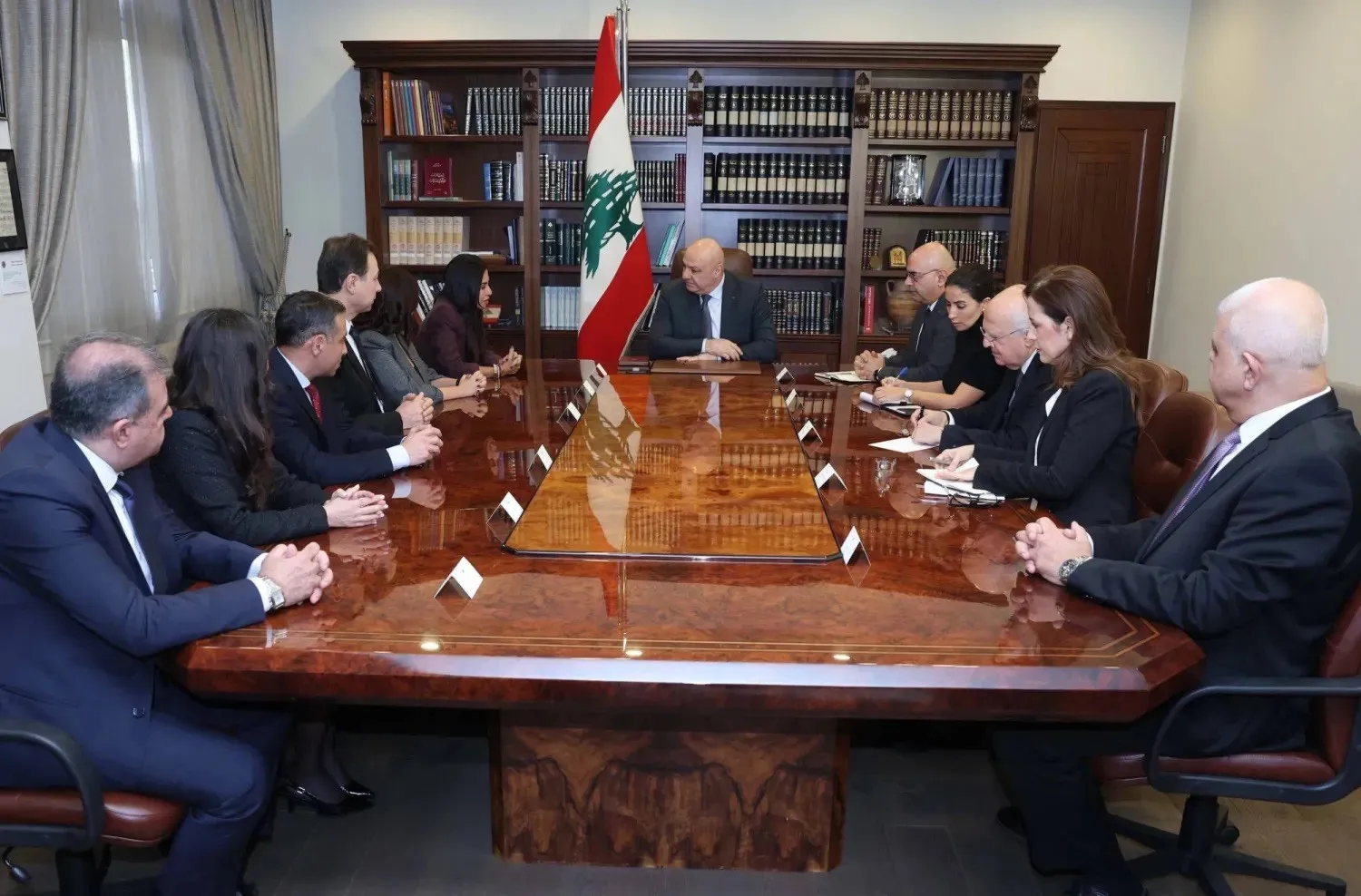
President Aoun meets with a delegation from the National Competition Authority, the regulatory body tasked with protecting free and fair competition and combating monopolies in Lebanese markets. (Lebanese Presidency)
TT

International Messages Reaffirm Support for Lebanon’s Sovereignty as Hezbollah Steps Up Criticism of Aoun

President Aoun meets with a delegation from the National Competition Authority, the regulatory body tasked with protecting free and fair competition and combating monopolies in Lebanese markets. (Lebanese Presidency)

International messages marking Lebanon’s Independence Day have reaffirmed support for the country’s aspirations for peace, stability and the restoration of its full sovereignty, while expressions of local support for President Joseph Aoun’s address have continued along with calls for concrete measures to strengthen state authority.
 
Hezbollah, meanwhile, has increased its rhetoric against Aoun over his remarks on sovereignty, foreign interference and relations with Iran.
 
International support for Lebanon
 
In his Independence Day message, Pope Leo XIV expressed hope for a peaceful and prosperous Lebanon.
 
Syrian President Ahmed al-Sharaa reaffirmed his country’s commitment to strengthening bilateral relations, wishing “the brotherly Lebanese people further prosperity and progress” and emphasizing the importance of enhancing ties in the interests of both countries and their peoples.
 
Turkish President Recep Tayyip Erdogan pledged that his country’s support for Lebanon would “continue across various sectors,” reflecting the importance Ankara attaches to Lebanon in the context of regional security and stability.
 
Italian President Sergio Mattarella placed particular emphasis on Lebanon’s sovereignty, reiterating Rome’s readiness to cooperate in achieving a just and lasting peace in the region.
 
Italy would continue working toward “a definitive cessation of hostilities and the restoration of Lebanon’s full sovereignty,” he affirmed, describing dialogue and diplomacy as “indispensable tools for overcoming conflicts and ensuring peaceful coexistence throughout the Middle East.”
 
Aoun also received congratulatory messages from the presidents of Uruguay, the Czech Republic, Tajikistan, the Democratic Republic of the Congo and Gabon.
 
Kataeb urges immediate action
 
At home, the Kataeb Party’s political bureau welcomed Aoun’s Independence Day address, urging the government and state agencies to follow it up with “immediate measures to implement previous government decisions on establishing a state monopoly on arms and banning Hezbollah’s security and military activities.”
 
The party warned that “hesitation in implementation threatens internal security,” citing what it described as Hezbollah’s continued prohibited activities.
 
It also called for referring the case of Hezbollah’s security and military apparatus to the Judicial Council to establish responsibility for “dragging Lebanon into war without the state’s consent.”
 
Hezbollah: Equating Israel with Iran a grave mistake
 
Hezbollah lawmaker Hassan Ezzeddine stepped up the party’s criticism of Aoun, taking aim at his Independence Day address without naming him directly.
 
“No one, regardless of their standing, should take a one-sided view of any issue, whether they are a president, an analyst, a thinker or anyone else,” he declared.
 
Equating Israel with Iran, Ezzeddine argued, was “a grave political mistake, indeed a moral crime that cannot be met with silence.”
 
Defending Tehran, he insisted that Iran “has never interfered with Lebanon’s sovereignty,” describing it instead as “the only hope and lifeline for Lebanon, its people, the resistance and its community.”
 
He further stressed that the resistance was here to stay, maintaining that it had endured throughout history and would continue to confront any aggressor or colonizer setting foot on Lebanese soil.
 
In his Independence Day address, Aoun said that Israel and Iran represent the two principal obstacles to the completion of Lebanon’s sovereignty and independence, stressing that the country must not remain captive to either project.

 Tehran opposes alternatives to UNIFIL
 
Iran’s Foreign Ministry also weighed in on the future of the international presence in South Lebanon as the mandate of the United Nations Interim Force in Lebanon (UNIFIL) nears its expiry at the end of the year.
 
The ministry warned against “US efforts to establish alternative mechanisms to the international force,” arguing that Washington’s attempts to create arrangements lacking national consensus in Lebanon would fail to safeguard the country’s rights and national interests.
 
Instead, it cautioned, such moves would “expose Lebanon’s independence, security, stability and national cohesion to grave risks.”