


Israeli Veteran Soldiers Protect Palestinians from Settler Attacks

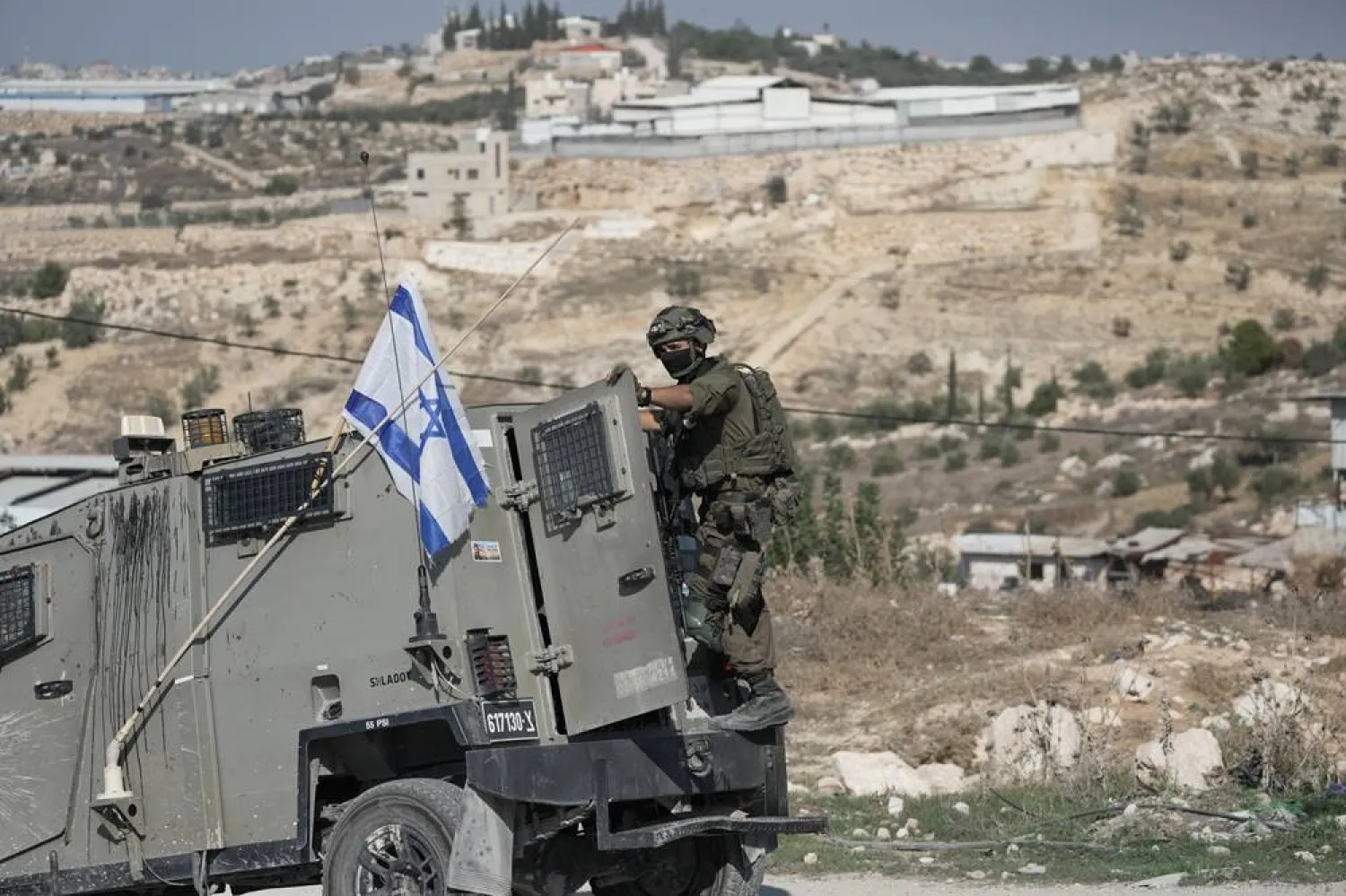
An Israeli soldier stands on the rear step of an army vehicle as troops block Palestinians from reaching the Hamsa area to protest settler attacks, property destruction and land confiscation, on the outskirts of the West Bank city of Dura, Friday, Nov. 27, 2026. (AP)
TT

Israeli Veteran Soldiers Protect Palestinians from Settler Attacks

An Israeli soldier stands on the rear step of an army vehicle as troops block Palestinians from reaching the Hamsa area to protest settler attacks, property destruction and land confiscation, on the outskirts of the West Bank city of Dura, Friday, Nov. 27, 2026. (AP)

The four Israeli soldiers stepped out of their car in the occupied West Bank, their faces masked, their uniforms unmarked and automatic weapons strapped across their shoulders.

They had entered a Palestinian olive grove but, little did they expect, the person there planning to tell them to leave could have once been issuing them orders.

A retired Israeli general, Eyal Ben Reuven, had come that day to the Palestinian town of As Sawiyah, on a mission to prevent some of the rampant violence against Palestinians by extremist Israeli settlers.

For the 72-year-old, joined by fellow battle-hardened veterans of the Israeli military, the violence is a stain on the institution in which they once served.

"I've fought in a number of wars. And unfortunately, I have reached the point where I have seen an evolution," said the former military man with piercing eyes, who spent much of his career driving tanks.

The army is failing to act, he said, even when the violence has reached a level "I never could have imagined".

Unrest has soared in the West Bank since the unprecedented October 7, 2023 attack by Hamas on Israel, which responded with a massive military campaign in the Gaza Strip.

More than 1,100 Palestinians have been killed by the army or settlers in the West Bank since then. More than 50 Israelis have died in the same time in the territory, which Israel captured in 1967.

The olive harvest has become a flashpoint, with settlers attacking or stealing from Palestinian farmers on a nearly daily basis.

With the other former soldiers, Ben Reuven has set up a protective presence, a tactic more common among leftist activists who put themselves in the way in a bid to stop attacks against Palestinians.
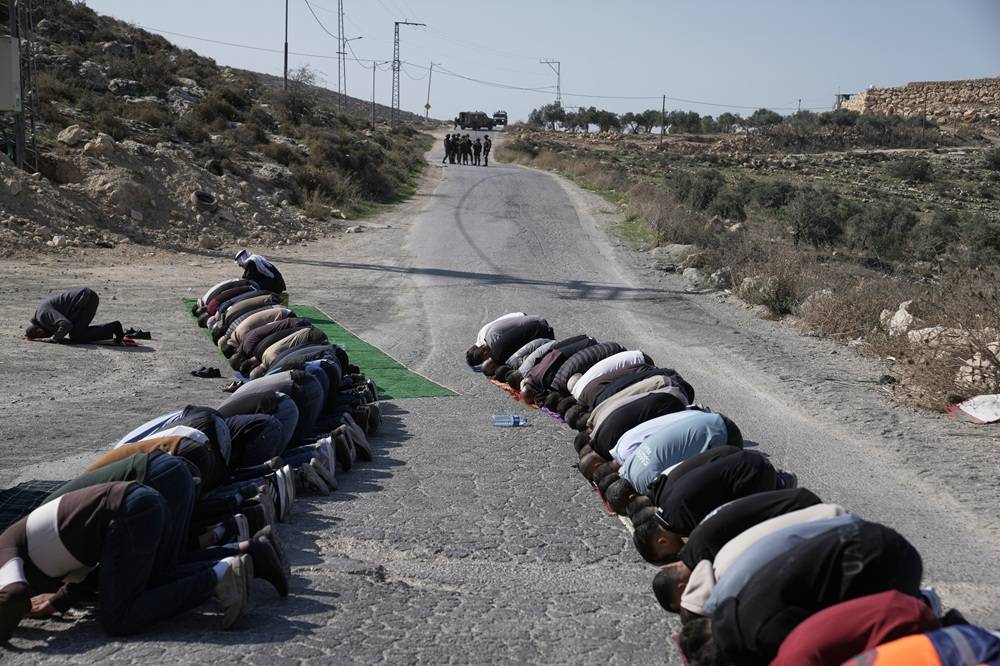
Palestinians pray on a road blocked by Israeli soldiers as they try to reach the Hamsa area to protest settler attacks, property destruction and land confiscation, on the outskirts of the West Bank city of Dura, Friday, Nov. 27, 2026. (AP)

- Army intervenes in harvest -

Clad in comfortable hiking attire and carrying walking sticks, it is difficult to imagine that some of the greying volunteers fought in intense combat.

Like good soldiers, they review instructions upon going out -- they are there to assist the olive harvest, not to confront the settlers, and they will obey the army's instructions.

A Palestinian human rights activist, Arafat Abu Ras, led the military men to a small olive grove. An old Palestinian woman was waiting to guide them and the soldiers, more accustomed to the battlefield than to farming, used sticks and small rakes to start knocking the olives off the trees, volunteering to do the work on the Palestinians' behalf.

Almost immediately a military vehicle arrived. Under the humming of a drone, one of the serving soldiers shoved aside an AFP team to prevent filming, while another checked Abu Ras's identity papers and ordered everyone to leave.

Abu Ras said that the olive farmers had coordinated with the army, which insists that Palestinians receive approval for their harvests in the occupied West Bank, arguing that it is for safety reasons.

"They say, 'yes, yes', and then the next day they come and force us to leave," Abu Ras said.

After the serving soldiers arrived, a second vehicle came, this time with Israeli settlers. An official from a neighboring settlement also ordered the olive pickers out, with troops saying it was a "closed military zone".

The Israeli veterans, in line with their guidance, complied. They instead moved elsewhere with the farmers, hoping to prevent attacks on them.

"Our army is a joke," fumed Yoel Feldschuh, a 77-year-old former air force brigadier general.

"Is it its role to shut an olive grove? What does the military have to do with that?"

Feldschuh made headlines when he was handcuffed and taken away by police in a similar action a month earlier.

Changing the behavior of the military, he said, "will take a generation".
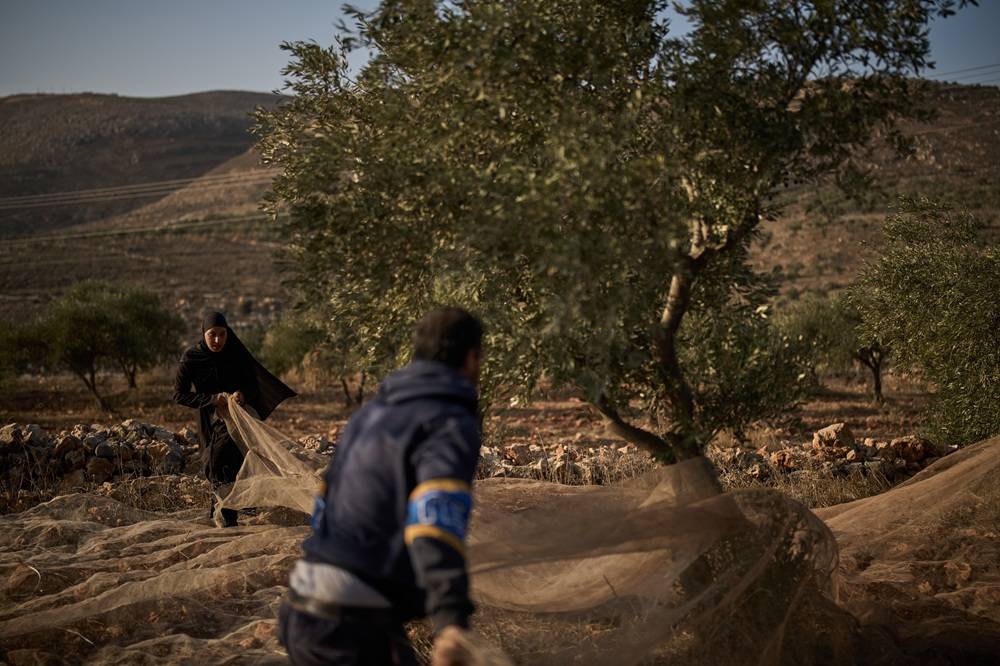
Salsabil, 16, left, and a Palestinian man spread a net under an olive tree to collect olives during the harvest with the support of Israeli activists in the West Bank village of Majdal Bani Fadil, Friday, Nov. 27, 2026. (AP)

- Rampant violence -

COGAT, the Israeli body responsible for civil affairs in the Palestinian territories, maintains that "security forces are deployed to ensure a safe olive harvest".

But since September, the harvest has been marked by nearly 500 attacks, some of them fatal, according to the Israeli human rights organization Yesh Din.

Amram Mitzna, an 81-year-old retired general, attributes the army's inaction to the young ages of the soldiers, who have grown up under now-caretaker Prime Minister Benjamin Netanyahu, Israel's longest-serving leader.

"They consider every Arab an enemy who must be treated as such," said Mitzna, who has also served as mayor of Haifa, Israel's third largest city.

Netanyahu has allied himself with the far-right and championed a rapid growth of West Bank settlements, which are considered illegal under international law.

Netanyahu is fighting for political survival after losing ground in elections. Gadi Eisenkot, a former general seeking to succeed him, supports many of Netanyahu's security policies but accuses him of yielding to "Jewish terrorism" in the West Bank and vowed to crack down on extremist settlers.

In As Sawiyah, the former soldiers eventually finished harvesting the olives in a nearby area alongside a school, putting them in bags to be taken by Palestinian villagers.

While no one was injured, Ben Reuven remained deeply disturbed by how the young soldier acted during the altercation.

"When I saw him arrive, masked, shouting, kicking sacks of olives, I was ashamed."


Israeli Veteran Soldiers Protect Palestinians from Settler Attacks

An Israeli soldier stands on the rear step of an army vehicle as troops block Palestinians from reaching the Hamsa area to protest settler attacks, property destruction and land confiscation, on the outskirts of the West Bank city of Dura, Friday, Nov. 27, 2026. (AP)
TT

Israeli Veteran Soldiers Protect Palestinians from Settler Attacks

An Israeli soldier stands on the rear step of an army vehicle as troops block Palestinians from reaching the Hamsa area to protest settler attacks, property destruction and land confiscation, on the outskirts of the West Bank city of Dura, Friday, Nov. 27, 2026. (AP)

The four Israeli soldiers stepped out of their car in the occupied West Bank, their faces masked, their uniforms unmarked and automatic weapons strapped across their shoulders.

They had entered a Palestinian olive grove but, little did they expect, the person there planning to tell them to leave could have once been issuing them orders.

A retired Israeli general, Eyal Ben Reuven, had come that day to the Palestinian town of As Sawiyah, on a mission to prevent some of the rampant violence against Palestinians by extremist Israeli settlers.

For the 72-year-old, joined by fellow battle-hardened veterans of the Israeli military, the violence is a stain on the institution in which they once served.

"I've fought in a number of wars. And unfortunately, I have reached the point where I have seen an evolution," said the former military man with piercing eyes, who spent much of his career driving tanks.

The army is failing to act, he said, even when the violence has reached a level "I never could have imagined".

Unrest has soared in the West Bank since the unprecedented October 7, 2023 attack by Hamas on Israel, which responded with a massive military campaign in the Gaza Strip.

More than 1,100 Palestinians have been killed by the army or settlers in the West Bank since then. More than 50 Israelis have died in the same time in the territory, which Israel captured in 1967.

The olive harvest has become a flashpoint, with settlers attacking or stealing from Palestinian farmers on a nearly daily basis.

With the other former soldiers, Ben Reuven has set up a protective presence, a tactic more common among leftist activists who put themselves in the way in a bid to stop attacks against Palestinians.

Palestinians pray on a road blocked by Israeli soldiers as they try to reach the Hamsa area to protest settler attacks, property destruction and land confiscation, on the outskirts of the West Bank city of Dura, Friday, Nov. 27, 2026. (AP)

- Army intervenes in harvest -

Clad in comfortable hiking attire and carrying walking sticks, it is difficult to imagine that some of the greying volunteers fought in intense combat.

Like good soldiers, they review instructions upon going out -- they are there to assist the olive harvest, not to confront the settlers, and they will obey the army's instructions.

A Palestinian human rights activist, Arafat Abu Ras, led the military men to a small olive grove. An old Palestinian woman was waiting to guide them and the soldiers, more accustomed to the battlefield than to farming, used sticks and small rakes to start knocking the olives off the trees, volunteering to do the work on the Palestinians' behalf.

Almost immediately a military vehicle arrived. Under the humming of a drone, one of the serving soldiers shoved aside an AFP team to prevent filming, while another checked Abu Ras's identity papers and ordered everyone to leave.

Abu Ras said that the olive farmers had coordinated with the army, which insists that Palestinians receive approval for their harvests in the occupied West Bank, arguing that it is for safety reasons.

"They say, 'yes, yes', and then the next day they come and force us to leave," Abu Ras said.

After the serving soldiers arrived, a second vehicle came, this time with Israeli settlers. An official from a neighboring settlement also ordered the olive pickers out, with troops saying it was a "closed military zone".

The Israeli veterans, in line with their guidance, complied. They instead moved elsewhere with the farmers, hoping to prevent attacks on them.

"Our army is a joke," fumed Yoel Feldschuh, a 77-year-old former air force brigadier general.

"Is it its role to shut an olive grove? What does the military have to do with that?"

Feldschuh made headlines when he was handcuffed and taken away by police in a similar action a month earlier.

Changing the behavior of the military, he said, "will take a generation".

Salsabil, 16, left, and a Palestinian man spread a net under an olive tree to collect olives during the harvest with the support of Israeli activists in the West Bank village of Majdal Bani Fadil, Friday, Nov. 27, 2026. (AP)

- Rampant violence -

COGAT, the Israeli body responsible for civil affairs in the Palestinian territories, maintains that "security forces are deployed to ensure a safe olive harvest".

But since September, the harvest has been marked by nearly 500 attacks, some of them fatal, according to the Israeli human rights organization Yesh Din.

Amram Mitzna, an 81-year-old retired general, attributes the army's inaction to the young ages of the soldiers, who have grown up under now-caretaker Prime Minister Benjamin Netanyahu, Israel's longest-serving leader.

"They consider every Arab an enemy who must be treated as such," said Mitzna, who has also served as mayor of Haifa, Israel's third largest city.

Netanyahu has allied himself with the far-right and championed a rapid growth of West Bank settlements, which are considered illegal under international law.

Netanyahu is fighting for political survival after losing ground in elections. Gadi Eisenkot, a former general seeking to succeed him, supports many of Netanyahu's security policies but accuses him of yielding to "Jewish terrorism" in the West Bank and vowed to crack down on extremist settlers.

In As Sawiyah, the former soldiers eventually finished harvesting the olives in a nearby area alongside a school, putting them in bags to be taken by Palestinian villagers.

While no one was injured, Ben Reuven remained deeply disturbed by how the young soldier acted during the altercation.

"When I saw him arrive, masked, shouting, kicking sacks of olives, I was ashamed."


Sudanese Families Return to Khartoum Only to Find Homes Uninhabitable

A house destroyed by the war in Khartoum (Asharq Al-Awsat)
TT

Sudanese Families Return to Khartoum Only to Find Homes Uninhabitable

A house destroyed by the war in Khartoum (Asharq Al-Awsat)

For many Sudanese families, returning to the capital Khartoum has brought little relief from the hardships of displacement. Instead, they face a new struggle: finding a habitable home. Shelling, fires and looting have devastated countless homes, leaving some as battered structures that will cost a fortune to repair or rebuild.

In Omdurman, Mustafa Saeed is trying to rebuild his home after artillery shelling at the outbreak of the war destroyed about 70% of it. An initial assessment of the damage led him to conclude that the house was beyond repair and would have to be rebuilt.

Saeed told Asharq Al-Awsat he had managed to build two rooms and some basic facilities before soaring construction costs forced him to halt work.

Price monitoring by Asharq Al-Awsat showed that a bag of cement now costs more than 120,000 Sudanese pounds ($11), while prices of reinforcing steel and other construction materials have risen sharply.

The burden of rebuilding

Even families whose homes survived the fighting face mounting expenses. Looters stripped properties of doors, windows, furniture, electrical wiring and plumbing, leaving homeowners to refit their houses from scratch.

In southern Khartoum, Heba Abdullah and her family returned home in early August to find their house stripped of doors, windows and furniture.

The family spent about 11 million pounds ($1,000) restoring electricity and water connections, Abdullah said. Aluminum costs 2.35 million pounds ($205) per meter, and she needs about four meters.

The kitchen still needs refurbishing, while bullet-riddled walls need repairing. The family has spent about 85 million pounds ($7,500) on repairs and electrical appliances, yet much of the furniture needed to resume daily life is still missing.

For Anas Abdel Qader, the situation is even more complicated. Unable to afford repairs to his badly damaged home or buy essential furniture and appliances, he has rented half a house to shelter his family until he can restore his own.

Costs beyond families’ means

Homeowners are returning in the hope of reclaiming their former lives, only to confront soaring material prices, labor costs and transport expenses. Repairs are draining household resources, while declining purchasing power is forcing families to put off buying furniture and household appliances.

Contractor Hashem Moussa said restoring homes damaged by artillery fire and stray bullets requires substantial sums, even when damage is limited to doors, windows, plumbing and electrical wiring.

Costs can run into millions of pounds, sums many families returning from displacement or refuge abroad struggle to raise after losing their livelihoods and facing mounting living expenses.

Moussa said repair costs vary according to the size of the property, the extent of the damage and the work required. Replacing doors and windows and restoring utilities is far less costly than repairing a partially collapsed house or one with extensive structural damage.

In Bahri, part of Amna Ishaq’s home has collapsed, leaving it uninhabitable. Her family cannot afford to repair it.

“My husband lost his job because of the war. He can no longer cover even our daily living expenses, let alone the cost of repairing and rebuilding our home,” Ishaq said.

Her predicament reflects the plight of families who have lost both their homes and livelihoods. With no income, covering daily expenses is a struggle in itself, while the repairs needed to make a return home possible remain on hold until families can raise the money.

Mounting price pressures

Building materials dealer Abbas al-Naji attributed rising prices to the weakening Sudanese pound, fuel shortages and higher transport costs. The dollar has risen above 10,000 Sudanese pounds on the parallel market.

Naji said a metric ton of cement costs about 2.4 million pounds, while a metric ton of 12-mm reinforcing steel fetches about 10.2 million pounds.

A 20-kg container of paint costs about 115,000 pounds, a ceiling fan 1.4 million pounds and a roll of electrical wire 320,000 pounds. The price of 4-mm wire stands at 700,000 pounds.

The cost of restoring a home goes well beyond cement and steel. Electrical repairs, painting and household fittings add to the financial strain on families whose savings or sources of income have been wiped out by the war.

Economist Haitham Mohammed Fathi told Asharq Al-Awsat that soaring construction costs and declining purchasing power had forced many Sudanese to carry out repairs in stages, often months apart, because they could not afford the full cost upfront.

He said rising living costs and falling household incomes underscored the growing need for financing arrangements to help affected families restore their homes.

The downturn in construction activity has also cost thousands of tradespeople and workers in related industries their jobs and livelihoods, while deteriorating economic conditions have limited their chances of finding alternative employment, Fathi added.

He attributed the sustained rise in construction material prices to the depreciation of the Sudanese pound against foreign currencies, rising costs of raw materials, energy and other production inputs, as well as higher transport, import and shipping costs, customs duties and government fees.


In Lebanon, the Opening of a Second Airport Reflects Political Shifts

The control tower and terminal area of Rene Mouawad Airport, also known as Qlayaat Airport, in Qlayaat, northern Lebanon, November 12, 2026. (Reuters)
TT

In Lebanon, the Opening of a Second Airport Reflects Political Shifts

The control tower and terminal area of Rene Mouawad Airport, also known as Qlayaat Airport, in Qlayaat, northern Lebanon, November 12, 2026. (Reuters)

Lebanon plans to open a second international airport next month to bring economic growth to the poorer north, in a project that underlines the diminished political sway of the Iran-backed Hezbollah group, which had long opposed it.

Kleiat Airport, located on the Mediterranean coast, about 20 km (12 miles) from the border crossing to Syria, will offer another gateway to Lebanon alongside Beirut international airport, where travel has been disrupted by wars between Israel and Hezbollah in recent years.

The opening comes as Lebanon continues to grapple with occupation by Israel in the south, political dysfunction and deep financial turmoil.

It is "a national economic need", Fayez Rasamny, the minister of public works and transport, told Reuters.

The private sector will invest $5 million to $6 million in the ‌airport and the ‌government will improve the region's roads, Rasamny added.

Also named Rene Mouawad Airport after ‌a ⁠president assassinated in 1989, ⁠it will initially offer flights to Türkiye, Egypt, and Jordan, Rasamny said.

LEBANON'S IMPOVERISHED NORTH

Politicians from the north had long pressed for the disused airbase at Qlayaat to be turned into a civilian airport, arguing it would boost prosperity in the Akkar region, an area adjoining the Syrian border. More than 300,000 people live in Akkar and the region is seen as Lebanon's poorest.

But the idea faced opposition from Hezbollah, which has long had a decisive say over government affairs, a politician and a political activist from the area told ⁠Reuters.

Hady Hobeiche, a former lawmaker from Akkar, said he and a group of ‌MPs from the region had tried to advance the project in 2022, ‌winning the approval of all parties apart from Hezbollah.

Hobeiche, a long-standing critic of Hezbollah, said the group had raised ‌concerns over who would be responsible for security at the airport and had shown "intense hostility" towards the idea at ‌the time.

"When the country's political conditions changed, we were able to open this airport," he said.

Hezbollah's media office didn't respond to a request for comment.

Lebanon's power balance has been turned on its head since 2024, when Israel pummeled Hezbollah in two wars in under two years and Syria's president, Bashar al-Assad, a Hezbollah ally, was ousted, severely weakening the group's grip over ‌Lebanese government affairs.

Assad had also opposed the airport, fearing it might fall under the purview of a hostile security force, a senior politician close to Hezbollah said.

Since ⁠taking office in early ⁠2025, Prime Minister Nawaf Salam has pursued a government policy aimed at securing Hezbollah's disarmament.

His agenda also included opening Qlayaat airport.

The government has awarded a four-year concession to a private sector company, Sky Lounge, to run the airport under a public-private partnership.

Sky Lounge Chairman Ziad Monla said the government wants the airport open "as fast as possible". "The north has been forgotten for 30 or 40 years," he told Reuters.

He envisages a hub serving both Syrian and Lebanese passengers and hopes the government can earn up to $20 million from it over four years.

Sky Lounge said it has so far signed with a local airline to run flights from the new airport, while negotiations with regional and international carriers remain ongoing.

When Reuters visited the airport in early November, dozens of workers buzzed around a hangar being transformed into a passenger terminal. Inside, cables snaked across the floor and scaffolding stood against bare walls.

Hamed Zakaria said he has been lobbying officials to open the Qlayaat airport for more than a decade. A local political activist and businessman, he hopes the new airport will be a boon for what he sees as a neglected region.

"Akkar is for development, for prosperity," he said.
