

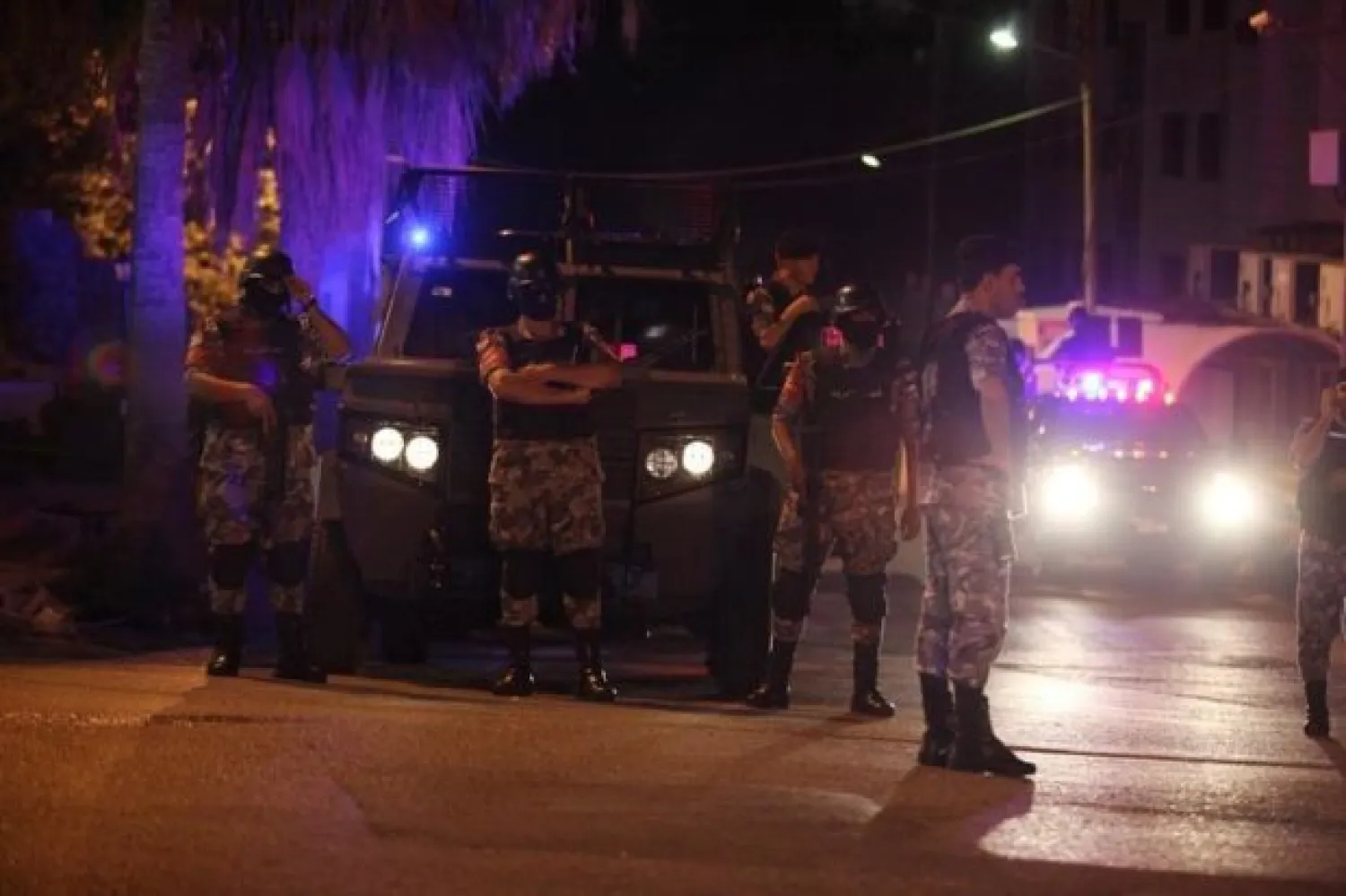

Netanyahu Orders Investigation into Shooting by Israeli Embassy Guard in Amman

Netanyahu Orders Investigation into Shooting by Israeli Embassy Guard in Amman
TT

Netanyahu Orders Investigation into Shooting by Israeli Embassy Guard in Amman

Netanyahu Orders Investigation into Shooting by Israeli Embassy Guard in Amman

In light of wide criticism, Israeli Prime Minister Benjamin Netanyahu ordered the transfer of the file of the Israeli embassy security guard to the Shin Bet for investigation into the shooting of two Jordanian citizens.

Netanyahu’s spokesperson stated that Israel abides by international laws and is keen on maintaining relations with Jordan.

The move comes after Jordan’s insistence that Israel prosecute the security guard, identified as Ziv.

On July 23, Ziv shot and killed 17-year-old MohammedJawawde, who had entered the residential building to install furniture. Then, the building’s landlord doctor Bashar Hamarneh was killed after being hit by a stray bullet.

The investigation is being overseen by Attorney General Avichai Mandelblit and State Prosecutor Shai Nitzan.

Israel’s Ministry of Foreign Affairs also confirmed to Israeli media that Israel was launching a probe into the incident, in accordance with the appropriate legal proceedings.

Israel’s attorney general “gave instructions to implicated (Israeli) bodies to provide all elements in their possession concerning the incident”, a ministry spokesman said in a statement.

“Israel will inform Jordan of developments and information gathered during this procedure,” the spokesman said.

Israeli Minister of Defense Avigdor Lieberman told reporters that relations with Jordan are strong, confirming that the truth will be revealed.

When asked whether he supports Netanyahu embracing the security guard regardless of Jordan’s frustration, Lieberman said: “We should convey a message to our security guards that we support them even if they have done something wrong.”

Political sources in Tel Aviv said that Israel had informed Jordan of the preliminary results of the investigation which revealed that Jawawde tried to stab the security guard for political reasons, while Hamarneh was killed by mistake. Israel said it is willing to pay compensation for the Hamarneh family.

Jordan expects Netanyahu to apologize for his rude behavior, according to sources, adding that the Israeli embassy staff, who came back to Israel on Monday following the violent incident, would not be allowed to return to Amman until an investigation was opened.

On Thursday, Jordan’s Attorney General Akram Masaadeh charged the guard in absentia with two counts of murder and for bearing an unlicensed weapon, despite his diplomatic immunity.

The Ministry of Foreign and Expatriate Affairs received the case file from the Ministry of Justice and handed it to the Israeli government.

Jordan asked that the guard be prosecuted as per Article 31 of the Vienna Convention on diplomatic ties for the crimes he committed.

Masaadeh said the embassy employee enjoyed diplomatic immunity, but this would not prevent him from being charged and stand trial in Israel.



Belgium Joins South Africa’s Genocide Case Against Israel

A general view of destroyed houses in Nuseirat camp in the central Gaza Strip on December 19, 2025. (AFP)
TT

Belgium Joins South Africa’s Genocide Case Against Israel

A general view of destroyed houses in Nuseirat camp in the central Gaza Strip on December 19, 2025. (AFP)

Belgium on Tuesday joined South Africa in a case brought before the International Court of Justice (ICJ), which accuses Israel of committing genocide in the Gaza Strip.

The UN's highest court, based in The Hague, said in a statement that Brussels had filed a declaration of intervention.

Several countries including Brazil, Colombia, Ireland, Mexico, Spain and Türkiye have already joined the case.

In December 2023, South Africa brought a case to the United Nations' highest court in The Hague, alleging Israel's Gaza offensive breached the 1948 UN Convention on the Prevention and Punishment of the Crime of Genocide.

Israel denies the accusation.

In rulings in January, March and May 2024, the ICJ told Israel to do everything possible to prevent acts of genocide in Gaza, including by providing urgently needed humanitarian aid to prevent famine.

These orders are legally binding, but the court has no concrete means to enforce them.

Israel has criticized the proceedings and rejected the accusations.

Hamas's October 7, 2023 attack resulted in the deaths of 1,221 people on the Israeli side, mostly civilians, according to an AFP tally based on official Israeli figures.

The Israeli military's retaliatory campaign has since killed 70,369 Palestinians, also mostly civilians, according to Gaza's health ministry, whose figures are considered reliable by the UN. The campaign has also displaced the majority of the 2.2 million people in the Palestinian territory.

Belgium was among a string of countries to recognize the State of Palestine in September, a status acknowledged by nearly 80 precent of UN members.


Egypt High-Speed Trains to Connect Red Sea, Mediterranean

Ships move through the Suez Canal, in Ismalia, Egypt, July 31, 2025. (Reuters)
TT

Egypt High-Speed Trains to Connect Red Sea, Mediterranean

Ships move through the Suez Canal, in Ismalia, Egypt, July 31, 2025. (Reuters)

Workers have started laying tracks in the desert east of Cairo for Egypt's first high-speed train, which will link the Red Sea and the Mediterranean in the latest attempt to modernize transport in the vast country.

Described by transport minister Kamel al-Wazir as a "new Suez Canal on rails", the project is slated to be completed in 2028, and will carry passengers and cargo the 660-kilometer (410-mile) distance in as little as three hours.

The Green Line, as it is known, is the latest of a long list of megaprojects undertaken by Egyptian President Abdel Fattah al-Sisi's government in the past decade -- the crowning jewel of which is the New Administrative Capital east of Cairo.

In 2021, Egypt signed a $4.5 billion contract with a consortium that includes German company Siemens to establish the Green Line, which will form the first of three high-speed tracks across the country.

Authorities hope the nearly 2,000 kilometer-network will carry 1.5 million passengers per day.

Egypt's existing train network -- used by a million people every day -- is plagued by infrastructure and maintenance problems that caused nearly 200 accidents last year, according to official figures.

The Green Line will run across the country's north, from Ain Sokhna on the Red Sea to Marsa Matrouh on the Mediterranean, crossing two Cairo satellite cities -- the New Administrative Capital to the east, and to the west 6th of October City, home to Egypt's only dry port.

- Urban planning bet -

According to Tarek Goueili, head of the National Authority for Tunnels, Egypt's revamped rail network will carry 15 million tons of cargo per year -- 3 percent of last year's Suez Canal transit volume.

For those behind it, the Green Line is also an urban planning bet.

"The high-speed line will ease pressure on Greater Cairo and encourage the emergence of new growth hubs," said Faical Chaabane of French company Systra, which is building the track.

In one desert station Systra showed reporters, workers on scaffolding have raised an imposing geometric ceiling over six open-air tracks.

Much of the New Administrative Capital that surrounds it is also still a construction site, home to government ministries where workers commute by bus every day.

With desert accounting for most of the country's million square kilometers, the vast majority of Egypt's 108 million people -- the Arab world's largest population -- are stacked vertically along the Nile River and its delta.

After its inauguration, the Green Line will be followed by the Blue Line, which will track the Nile linking Cairo to Aswan, and the Red Line, which will connect the Red Sea cities of Hurghada and Safaga inland to Luxor.


Saudi Arabia Welcomes Yemen Prisoner Exchange Agreement

Officials are seen at the announcement of the prisoner exchange in Muscat. (Saudi Ambassador to Yemen on X)
TT

Saudi Arabia Welcomes Yemen Prisoner Exchange Agreement

Officials are seen at the announcement of the prisoner exchange in Muscat. (Saudi Ambassador to Yemen on X)

Saudi Arabia welcomed on Tuesday the agreement signed in Muscat earlier to exchange prisoners and detainees in Yemen.

It deemed the development “an important humanitarian step that contributes to alleviating human suffering and boosting confidence-building opportunities.”

The Kingdom praised “the sincere efforts and generous initiatives exerted by Oman in hosting and sponsoring the talks, as well as its support for the negotiating efforts conducted from December 9 to 23.”

The Kingdom also hailed the efforts by the Office of the United Nations Special Envoy for Yemen, the International Committee of the Red Cross, and all parties who participated in the negotiations.

It reiterated its support for all efforts to achieve peace, security, and stability in a manner that fulfills the aspirations of the Yemeni people.

Yemen’s legitimate government and the Iran-backed Houthi militants reached an agreement to free 2,900 detainees held during the 11-year war.

Saudi Ambassador Mohamed Al-Haber said in a statement on X that the agreement was signed under the supervision of the Office of the UN Special Envoy for Yemen and the ICRC, “which will enable all detainees to return to their families.”

“I commend the efforts of the negotiation teams from both sides who succeeded in reaching an understanding and concluding this agreement, which addresses a humanitarian issue and strengthens efforts to bring calm and build confidence in Yemen,” he added.

The UN special envoy, Hans Grundberg, said the agreement was a “positive and meaningful step that will hopefully ease the suffering of detainees and their families across Yemen.”

“We are ready and determined to carry out the release, transfer and repatriation of detainees so that people separated from their families can be reunited in a safe and dignified manner,” said Christine Cipolla, the ICRC’s head of delegation in Yemen.