


Italian Parliament Approves Libya Naval Mission

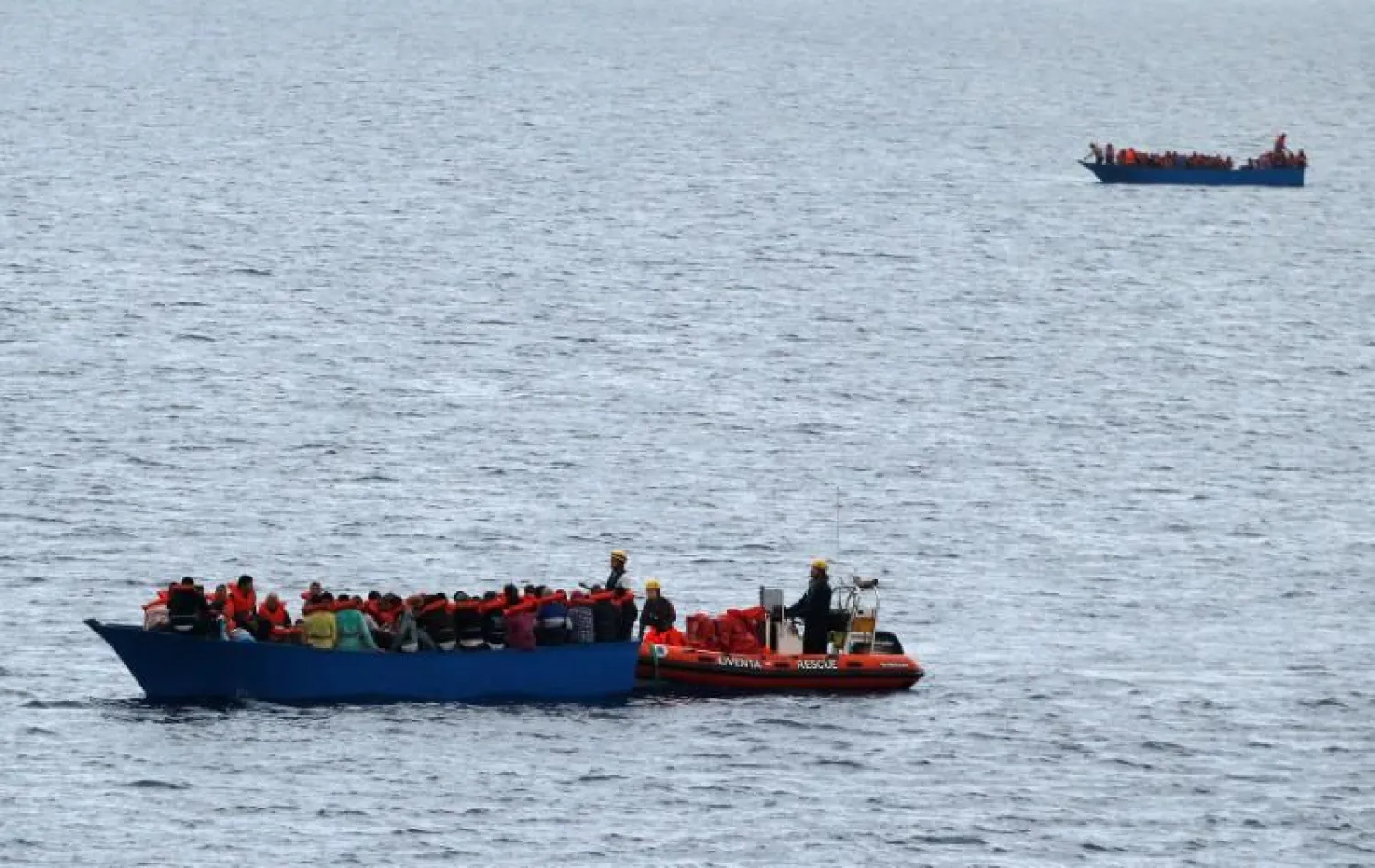
Migrants on a wooden boat are rescued by German NGO Jugend Rettet ship "Juventa" crew in the Mediterranean sea off Libya coast, June 18, 2017. Picture taken on June 18, 2017.
TT

Italian Parliament Approves Libya Naval Mission

Migrants on a wooden boat are rescued by German NGO Jugend Rettet ship "Juventa" crew in the Mediterranean sea off Libya coast, June 18, 2017. Picture taken on June 18, 2017.

Italian parliament approved on Wednesday a naval mission to help the Libyan coastguard in its fight against human traffickers and further reducing the number of migrant arrivals on Italy's coasts. Meanwhile, an Italian military ship arrived on Wednesday at the Abu Sittal Naval Port/Base in Tripoli.

In response, Tubrok House of Represntatives deemed the development as a violation of Libya’s sovereignty, saying that it did not recognize any agreement between the Presidency Council and Italy on the use of Libyan waters.

This came as Prime Minister of UN-backed government Fayez Sarraj met with Head of EU Delegation to Libya, Ambassador Bettina Muscheidt, along with a security military delegation which included Head of EUBAM Vincenzo Tagliaferri, Head of the EU Liaison and Planning Cell, Brigadier General Mauro De Vincentis and Admiral Virdis, EU Naval Force MED – Operation SOPHIA.

Ambassador Muscheidt hoped the Paris agreement between Sarraj and Field Marshal Khalifa Haftar would be put in action, adding that EU is determined to support Libya at this important moment.

“EU financial support to Libya targets a wide range of sectors, among them health and education institutions, private sector development and local communities as they seek to put conflict behind them,” she added.

For his part, Sarraj pointed out that Paris meeting is the beginning of other meetings, reiterating the importance of lifting the ban on arming Libyan Coast Guard and other security forces.

Libyan Navy spokesman Ayoub Qassim stated that “Commandante Prozene” ship arrived as part of the military cooperation between Libya and Italy. He said the Italian ship would work five days with experts from different areas in cooperation with the coast guard navy.

Later, EU delegates held a meeting with Libyan officials, notably Deputy Minister of Defence Colonel Ewhida Abdullah Ewhida, Chief of the Libyan Navy Commodore Salem Ali Salem Rhoumia and the Chief of the Libyan Coastguards, Senior Commodore Abdullah Omar Toumiyah.

The EU delegate informed Libyan officials of the extension of Sophia mission until the end of the year.

Earlier, Italy’s Senate voted on sending a military mission to Libyan coasts and it approved another motion proposed by opposition party Forza Italia, which described the decision to send the mission as the first right step on the right track.

Italy's lower house voted by 328 to 113 in favor of the mission, while the upper house voted by 191 to 47, thus granting an official order for a limited naval mission to help Libyan Coast guards.

Prime Minister Paolo Gentiloni announced that officials would assist the Libyan coast guard to stem the flow of irregular migration. He said the mission would help Libyan authorities reinforce their ability to control their borders and national territory.

Defence Minister Roberta Pinotti said Italy would only provide technical support without affecting the country's sovereignty but would not take part in a "hostile" naval blockade to prevent the departure of migrant boats.

"There will be no harm done or slight given to Libyan sovereignty, because, if anything, our aim is to strengthen Libyan sovereignty," she told parliament, stressing that Italy had no intention of imposing a blockade on Libya's coast.



Belgium Joins South Africa’s Genocide Case Against Israel

A general view of destroyed houses in Nuseirat camp in the central Gaza Strip on December 19, 2025. (AFP)
TT

Belgium Joins South Africa’s Genocide Case Against Israel

A general view of destroyed houses in Nuseirat camp in the central Gaza Strip on December 19, 2025. (AFP)

Belgium on Tuesday joined South Africa in a case brought before the International Court of Justice (ICJ), which accuses Israel of committing genocide in the Gaza Strip.

The UN's highest court, based in The Hague, said in a statement that Brussels had filed a declaration of intervention.

Several countries including Brazil, Colombia, Ireland, Mexico, Spain and Türkiye have already joined the case.

In December 2023, South Africa brought a case to the United Nations' highest court in The Hague, alleging Israel's Gaza offensive breached the 1948 UN Convention on the Prevention and Punishment of the Crime of Genocide.

Israel denies the accusation.

In rulings in January, March and May 2024, the ICJ told Israel to do everything possible to prevent acts of genocide in Gaza, including by providing urgently needed humanitarian aid to prevent famine.

These orders are legally binding, but the court has no concrete means to enforce them.

Israel has criticized the proceedings and rejected the accusations.

Hamas's October 7, 2023 attack resulted in the deaths of 1,221 people on the Israeli side, mostly civilians, according to an AFP tally based on official Israeli figures.

The Israeli military's retaliatory campaign has since killed 70,369 Palestinians, also mostly civilians, according to Gaza's health ministry, whose figures are considered reliable by the UN. The campaign has also displaced the majority of the 2.2 million people in the Palestinian territory.

Belgium was among a string of countries to recognize the State of Palestine in September, a status acknowledged by nearly 80 precent of UN members.


Egypt High-Speed Trains to Connect Red Sea, Mediterranean

Ships move through the Suez Canal, in Ismalia, Egypt, July 31, 2025. (Reuters)
TT

Egypt High-Speed Trains to Connect Red Sea, Mediterranean

Ships move through the Suez Canal, in Ismalia, Egypt, July 31, 2025. (Reuters)

Workers have started laying tracks in the desert east of Cairo for Egypt's first high-speed train, which will link the Red Sea and the Mediterranean in the latest attempt to modernize transport in the vast country.

Described by transport minister Kamel al-Wazir as a "new Suez Canal on rails", the project is slated to be completed in 2028, and will carry passengers and cargo the 660-kilometer (410-mile) distance in as little as three hours.

The Green Line, as it is known, is the latest of a long list of megaprojects undertaken by Egyptian President Abdel Fattah al-Sisi's government in the past decade -- the crowning jewel of which is the New Administrative Capital east of Cairo.

In 2021, Egypt signed a $4.5 billion contract with a consortium that includes German company Siemens to establish the Green Line, which will form the first of three high-speed tracks across the country.

Authorities hope the nearly 2,000 kilometer-network will carry 1.5 million passengers per day.

Egypt's existing train network -- used by a million people every day -- is plagued by infrastructure and maintenance problems that caused nearly 200 accidents last year, according to official figures.

The Green Line will run across the country's north, from Ain Sokhna on the Red Sea to Marsa Matrouh on the Mediterranean, crossing two Cairo satellite cities -- the New Administrative Capital to the east, and to the west 6th of October City, home to Egypt's only dry port.

- Urban planning bet -

According to Tarek Goueili, head of the National Authority for Tunnels, Egypt's revamped rail network will carry 15 million tons of cargo per year -- 3 percent of last year's Suez Canal transit volume.

For those behind it, the Green Line is also an urban planning bet.

"The high-speed line will ease pressure on Greater Cairo and encourage the emergence of new growth hubs," said Faical Chaabane of French company Systra, which is building the track.

In one desert station Systra showed reporters, workers on scaffolding have raised an imposing geometric ceiling over six open-air tracks.

Much of the New Administrative Capital that surrounds it is also still a construction site, home to government ministries where workers commute by bus every day.

With desert accounting for most of the country's million square kilometers, the vast majority of Egypt's 108 million people -- the Arab world's largest population -- are stacked vertically along the Nile River and its delta.

After its inauguration, the Green Line will be followed by the Blue Line, which will track the Nile linking Cairo to Aswan, and the Red Line, which will connect the Red Sea cities of Hurghada and Safaga inland to Luxor.


Saudi Arabia Welcomes Yemen Prisoner Exchange Agreement

Officials are seen at the announcement of the prisoner exchange in Muscat. (Saudi Ambassador to Yemen on X)
TT

Saudi Arabia Welcomes Yemen Prisoner Exchange Agreement

Officials are seen at the announcement of the prisoner exchange in Muscat. (Saudi Ambassador to Yemen on X)

Saudi Arabia welcomed on Tuesday the agreement signed in Muscat earlier to exchange prisoners and detainees in Yemen.

It deemed the development “an important humanitarian step that contributes to alleviating human suffering and boosting confidence-building opportunities.”

The Kingdom praised “the sincere efforts and generous initiatives exerted by Oman in hosting and sponsoring the talks, as well as its support for the negotiating efforts conducted from December 9 to 23.”

The Kingdom also hailed the efforts by the Office of the United Nations Special Envoy for Yemen, the International Committee of the Red Cross, and all parties who participated in the negotiations.

It reiterated its support for all efforts to achieve peace, security, and stability in a manner that fulfills the aspirations of the Yemeni people.

Yemen’s legitimate government and the Iran-backed Houthi militants reached an agreement to free 2,900 detainees held during the 11-year war.

Saudi Ambassador Mohamed Al-Haber said in a statement on X that the agreement was signed under the supervision of the Office of the UN Special Envoy for Yemen and the ICRC, “which will enable all detainees to return to their families.”

“I commend the efforts of the negotiation teams from both sides who succeeded in reaching an understanding and concluding this agreement, which addresses a humanitarian issue and strengthens efforts to bring calm and build confidence in Yemen,” he added.

The UN special envoy, Hans Grundberg, said the agreement was a “positive and meaningful step that will hopefully ease the suffering of detainees and their families across Yemen.”

“We are ready and determined to carry out the release, transfer and repatriation of detainees so that people separated from their families can be reunited in a safe and dignified manner,” said Christine Cipolla, the ICRC’s head of delegation in Yemen.