


Berri Confident in Lebanese Army’s Ability to Fight ISIS as Military Denies Working with Syria

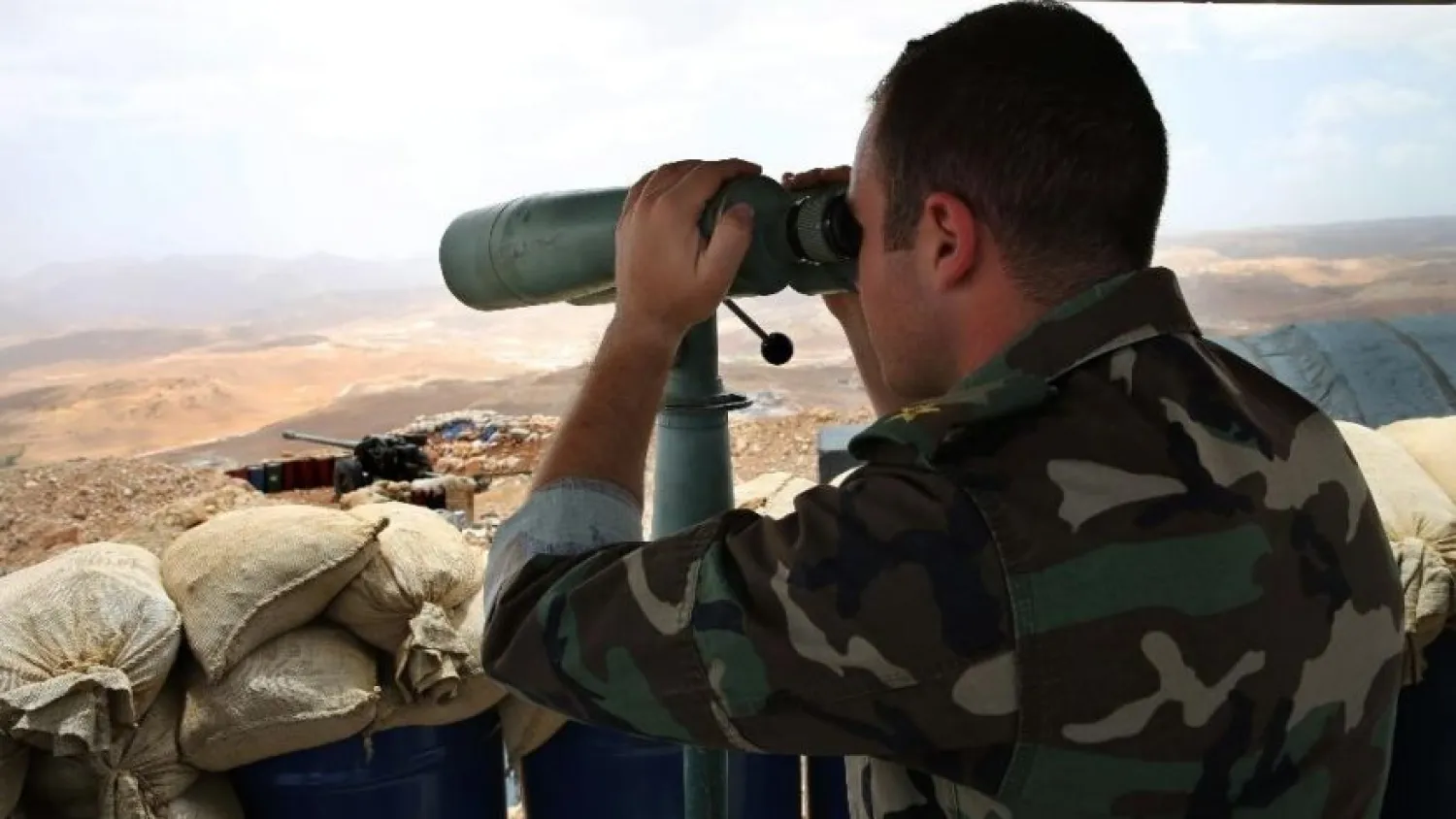
In this 2016 photo, a Lebanese army first lieutenant looks through binoculars toward areas controlled by ISIS on the edge of Arsal, on the Syrian border, in northeast Lebanon. (AP)
TT

Berri Confident in Lebanese Army’s Ability to Fight ISIS as Military Denies Working with Syria

In this 2016 photo, a Lebanese army first lieutenant looks through binoculars toward areas controlled by ISIS on the edge of Arsal, on the Syrian border, in northeast Lebanon. (AP)

Lebanese Speaker Nabih Berri voiced on Friday his confidence in the ability of the army in “completing the battle to cleanse the outskirts of Arsal from terrorism, especially since the remaining areas are still under ISIS control.”

He told reporters while visiting Tehran: “Our army is among the best in the region and it has demonstrated high fighting competence in its battle against terror.”

The timing of this battle lies however in the hands of the military, which knows when to launch it, he added.

The “victory” against the al-Nusra Front extremists in the northeastern region of Arsal is not new to the resistance group “Hezbollah,” he said, “but it had struck a victory against the Israeli enemy in July 2006.”

“The development is a major turning point on the national level that is equal and even expands on the 2006 victory,” Berri declared.

Meanwhile, Defense Minister Yaacoub al-Sarraf urged against “getting embroiled into military and security analyses and speculation that are based on inaccurate information.”

He stressed that the military has the sole authority in determining the time and place of any duty that is tasked to it.

On Saturday, a military source told Reuters that the army will not coordinate with the Syrian regime forces to fight ISIS in Arsal, rejecting a local media report of direct military cooperation between the two.

The source said the army had the military capability to confront and defeat the terrorist group without any regional or international support.

The presence of ISIS and Nusra militants in pockets on Lebanon's border is the biggest military spillover into the country from Syria's civil war.

An offensive launched last month by “Hezbollah” forced Nusra extremists to leave for a rebel-held area in northwest Syria under an evacuation deal. The Lebanese army did not take part in that offensive, but has been widely expected to lead an attack against the ISIS pocket.

On Friday “Hezbollah” leader Hassan Nasrallah said an assault on ISIS in the border zone would begin in a few days.

He said the Lebanese army would attack ISIS from the Lebanese side of the border, while “Hezbollah” and the Syrian regime forces would simultaneously attack from the Syrian side.

On Saturday, Lebanese newspaper al-Joumhouria reported from sources that direct military coordination had occurred between the Syrian forces and Lebanese army regarding the upcoming offensive against ISIS.

The military source said the Lebanese army had been attacking ISIS for some time, by preventing it spreading further and cutting supply routes.



Eight Muslim Countries Condemn Israel’s ‘Illegal’ West Bank Control Measures

 Israeli soldiers stand guard during a weekly settlers' tour in Hebron, in the Israeli-occupied West Bank, February 7, 2026. (Reuters)
Israeli soldiers stand guard during a weekly settlers' tour in Hebron, in the Israeli-occupied West Bank, February 7, 2026. (Reuters)
TT

Eight Muslim Countries Condemn Israel’s ‘Illegal’ West Bank Control Measures

 Israeli soldiers stand guard during a weekly settlers' tour in Hebron, in the Israeli-occupied West Bank, February 7, 2026. (Reuters)
Israeli soldiers stand guard during a weekly settlers' tour in Hebron, in the Israeli-occupied West Bank, February 7, 2026. (Reuters)

Saudi Arabia and seven other Muslim countries on Monday condemned new Israeli measures to tighten control of the West Bank and pave the way for more settlements on the occupied Palestinian territory.

Saudi Arabia, Jordan, the UAE, Qatar, Indonesia, Pakistan, Egypt and Türkiye "condemned in the strongest terms the illegal Israeli decisions and measures aimed at imposing unlawful Israeli sovereignty", a Saudi Foreign Ministry statement said.

Israel's security cabinet approved a series of steps on Sunday that would make it easier for settlers in the occupied West Bank to buy land while granting Israeli authorities more enforcement powers over Palestinians, Israeli media reported.

The West Bank is among the territories that the Palestinians seek for a future independent state. Much of it is under Israeli military control, with limited Palestinian self-rule in some areas run by the Palestinian Authority (PA).

Citing statements by Finance Minister Bezalel Smotrich and Defense Minister Israel ‌Katz, Israeli ‌news sites Ynet and Haaretz said ‌the ⁠measures included scrapping ‌decades-old regulations that prevent Jewish private citizens buying land in the West Bank.

They were also reported to include allowing Israeli authorities to administer some religious sites, and expand supervision and enforcement in areas under PA administration in matters of environmental hazards, water offences and damage to archaeological sites.

Palestinian President Mahmoud Abbas said ⁠the new measures were dangerous, illegal and tantamount to de-facto annexation.

The Israeli ministers ‌did not immediately respond to requests for ‍comment.

The new measures come three ‍days before Prime Minister Benjamin Netanyahu is scheduled to ‍meet in Washington with US President Donald Trump.

In his statement, Abbas urged Trump and the UN Security Council to intervene.

Jordan’s foreign ministry condemned the decision, which it said was “aimed at imposing illegal Israeli sovereignty” and entrenching settlements. The Hamas group called on Palestinians in the West Bank to “intensify the confrontation with the occupation and its settlers.”

Trump has ruled out Israeli annexation of the West Bank, but his administration has not sought to curb Israel's accelerated settlement building, which the Palestinians say denies them a potential state ⁠by eating away at its territory.

Netanyahu, who is facing an election later this year, deems the establishment of any Palestinian state a security threat.

His ruling coalition includes many pro-settler members who want Israel to annex the West Bank, land captured in the 1967 Middle East war to which Israel cites biblical and historical ties.

The United Nations' highest court said in a non-binding advisory opinion in 2024 that Israel's occupation of Palestinian territories and settlements there is illegal and should ‌be ended as soon as possible. Israel disputes this view.

The West Bank is divided between an Israeli-controlled section where settlements are located and sections equaling 40% of the territory where the Palestinian Authority has autonomy.

Palestinians are not permitted to sell land privately to Israelis. Settlers can buy homes on land controlled by Israel’s government.

More than 700,000 Israelis live in the occupied West Bank and east Jerusalem, territories captured by Israel in 1967 from Jordan and sought by the Palestinians for a future state. The international community overwhelmingly considers Israeli settlement construction in these areas to be illegal and an obstacle to peace.

Smotrich, previously a firebrand settler leader and now finance minister, has been granted cabinet-level authority over settlement policies and vowed to double the settler population in the West Bank.

In December, Israel’s Cabinet approved a proposal for 19 new Jewish settlements in the West Bank as the government pushes ahead with a construction binge that further threatens the possibility of a Palestinian state. And Israel has cleared the final hurdle before starting construction on a contentious settlement project near Jerusalem that would effectively cut the West Bank in two, according to a government tender reported in January.


OIC Condemns Israeli Cabinet's Legalization of Settlements

 Israeli soldier points his weapon towards the camera, during a weekly settlers' tour in Hebron, in the Israeli-occupied West Bank, February 7, 2026. (Reuters)
Israeli soldier points his weapon towards the camera, during a weekly settlers' tour in Hebron, in the Israeli-occupied West Bank, February 7, 2026. (Reuters)
TT

OIC Condemns Israeli Cabinet's Legalization of Settlements

 Israeli soldier points his weapon towards the camera, during a weekly settlers' tour in Hebron, in the Israeli-occupied West Bank, February 7, 2026. (Reuters)
Israeli soldier points his weapon towards the camera, during a weekly settlers' tour in Hebron, in the Israeli-occupied West Bank, February 7, 2026. (Reuters)

The General Secretariat of the Organization of Islamic Cooperation (OIC) condemned on Monday the Israeli cabinet’s approval of measures that aim to deepen Israeli control over the occupied West Bank and weaken the already limited powers of the Palestinian Authority.

The OIC said Israel’s “colonial settlement policy constitutes a war crime and a flagrant violation of international law and relevant United Nations resolutions, foremost among which is Security Council Resolution 2334 and the legal opinion issued by the International Court of Justice.”

It renewed its call on the international community, particularly the Security Council, “to shoulder its responsibilities and take immediate action to put an end to all crimes and violations committed by Israel against the Palestinian people, their land, and their holy sites.”

The office of Israeli far-right Finance Minister Bezalel Smotrich in a statement announced the decisions that would make it easier for Jewish settlers to force Palestinians to give up land, adding that “we will continue to bury the idea of a Palestinian state.”

Palestinian President Mahmoud Abbas in a statement called the decision “dangerous” and an “open Israeli attempt to legalize settlement expansion” and land confiscation. He called for the United States and UN Security Council to intervene immediately.

The decision was announced a few days before Israeli Prime Minister Benjamin Netanyahu is expected to meet with US President Donald Trump in Washington about Iran and other matters.

The measures announced Sunday include canceling a prohibition on sales of West Bank land to Israeli Jews, declassifying West Bank land registry records to ease land acquisition, transferring construction planning at religious and other sensitive sites in the volatile city of Hebron to Israeli authorities, and allowing Israeli enforcement of environmental and archaeological matters in Palestinian-administered areas.

The measures also would revive a committee that would allow the state of Israel to make “proactive” land purchases in the territory — “a step intended to guarantee land reserves for settlement for generations to come.”


US Vice President Vance Heads to Armenia, Azerbaijan to Push Peace, Trade

US Vice President JD Vance speaks during the Critical Minerals Ministerial at the State Department in Washington, DC, US, February 4, 2026. (Reuters)
TT

US Vice President Vance Heads to Armenia, Azerbaijan to Push Peace, Trade

US Vice President JD Vance speaks during the Critical Minerals Ministerial at the State Department in Washington, DC, US, February 4, 2026. (Reuters)

US Vice President JD Vance will visit Armenia and Azerbaijan this week to push a Washington-brokered peace agreement that could transform energy and trade routes in the strategic South Caucasus region.

His two-day trip to Armenia, which begins later on Monday, comes just six months after the Armenian and Azerbaijani leaders signed an agreement at the White House seen as the first step towards peace after nearly 40 years of war.

Vance, the first US vice president to visit Armenia, is seeking to advance the Trump Route for International Peace and Prosperity (TRIPP), a proposed 43-kilometre (27-mile) corridor that would run across southern Armenia and give Azerbaijan a direct route to its exclave ‌of Nakhchivan ‌and in turn to Türkiye, Baku's close ally.

"Vance's visit should ‌serve ⁠to reaffirm the ‌US's commitment to seeing the Trump Route through," said Joshua Kucera, a senior South Caucasus analyst at Crisis Group.

"In a region like the Caucasus, even a small amount of attention from the US can make a significant impact."

The Armenian government said on Monday that Vance would hold talks with Prime Minister Nikol Pashinyan and that both men would then make statements, without elaborating.

Vance will then visit Azerbaijan on Wednesday and Thursday, the White House has said.

Under the agreement signed last year, ⁠a private US firm, the TRIPP Development Company, has been granted exclusive rights to develop the proposed corridor, with Yerevan ‌retaining full sovereignty over its borders, customs, taxation and security.

The ‍route would better connect Asia to Europe ‍while - crucially for Washington - bypassing Russia and Iran at a time when Western countries are ‍keen on diversifying energy and trade routes away from Russia due to its war in Ukraine.

Russia has traditionally viewed the South Caucasus as part of its sphere of influence but has seen its clout there diminish as it is distracted by the war in Ukraine.

Securing US access to supplies of critical minerals is also likely to be a key focus of Vance's visit.

TRIPP could prove a key transit corridor for the vast mineral wealth of ⁠Central Asia - including uranium, copper, gold and rare earths - to Western markets.

CLOSED BORDERS, BITTER RIVALS

In Soviet times the South Caucasus was criss-crossed by railways and oil pipelines until a series of wars beginning in the 1980s disrupted energy routes and shuttered the border between Armenia and Türkiye, Azerbaijan's key regional ally.

Armenia and Azerbaijan were locked in bitter conflict for nearly four decades, primarily over the mountainous region of Nagorno-Karabakh, an internationally recognized part of Azerbaijan that broke away from Baku's control as the Soviet Union fell apart in 1991.

Azerbaijan and Armenia fought two wars over Karabakh before Baku finally took it back in 2023. Karabakh's entire ethnic Armenian population of around 100,000 people fled to Armenia. The two neighbors have made progress in recent months on normalizing relations, including restarting ‌some energy shipments.

But major hurdles remain to full and lasting peace, including a demand by Azerbaijan that Armenia change its constitution to remove what Baku says contains implicit claims on Azerbaijani territory.