Jobs, Factories and Stocks Provide Economic Lift for Trump

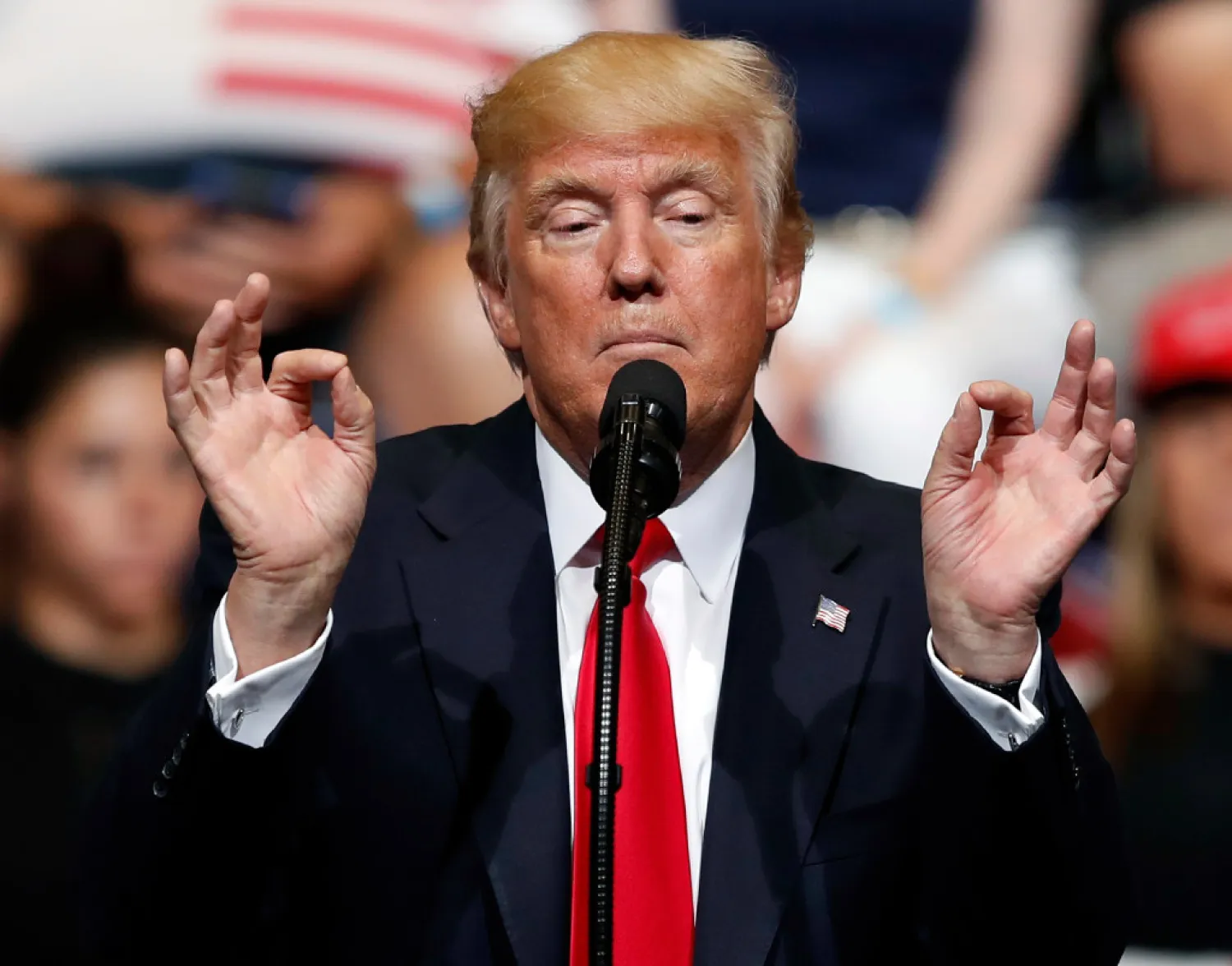
US President Donald Trump. (AP)
TT

Jobs, Factories and Stocks Provide Economic Lift for Trump

US President Donald Trump. (AP)

A stock market hitting record highs. Foreign corporations announcing big new plants in the United States. And robust hiring that has brought the unemployment rate to a 16-year low.

That convergence added up to a solid economic report card on Friday that President Trump was happy to present to the nation as a sign of good work.

On the hiring front, the Labor Department reported that 209,000 jobs were added in July, somewhat above Wall Street economists’ expectations, with the unemployment rate matching May’s 4.3 percent, the lowest since early 2001.

Hours earlier, two Japanese automotive giants, Toyota and Mazda, said they would open a new factory at an undetermined United States location that will employ about 4,000 workers, a trophy in Trump’s campaign to reverse the flight of American manufacturing jobs.

And while the stock market had a relatively quiet day, the Dow Jones industrial average reached another high, two days after it closed above 22,000 for the first time.

As all that positive economic news ricocheted through Wall Street, on social media and around office cubicles, conversation inevitably turned to one question: How much credit does Trump deserve?

In a series of early-morning tweets, the president claimed quite a bit.

On the hiring news, he declared, “Excellent Jobs Numbers just released — and I have only just begun.” Earlier, in addition to saluting the “great investment” by Toyota and Mazda, he noted, “Consumer confidence is at a 16 year high .... and for good reason.” Both tweets pointed to a looser regulatory environment as a factor.

Of course, as economists are fond of saying, correlation is not causation. Many of the trends Trump is benefiting from — falling unemployment, steady hiring, a rising stock market — were firmly in place under his predecessor, Barack Obama.

And in the case of Friday’s jobs data, Trump is citing figures he called phony not long ago on the campaign trail.

In the end, there is no way to quantify exactly how much credit the president is due for attracting foreign investment or encouraging the creation of jobs here instead of overseas.

But even some skeptics of his overall approach concede that Trump’s promises of tax reform and higher infrastructure spending, as well as pressure to increase domestic manufacturing, are resonating in boardrooms in the United States and abroad.

“It’s still 80 percent lip service in the corporate world, but there are some executives who want to support Trump’s initiatives,” said Howard Rubel, an analyst at Jefferies who covers aerospace and defense giants like Boeing and United Technologies.

Ravin Gandhi, founder and chief executive of GMM Nonstick Coatings in Chicago, is a case in point.

The son of immigrants from India, Gandhi fiercely opposed Trump before the election, even appearing on CNBC to denounce the candidate’s proposals on trade, immigration and health care.

After Trump was elected, however, “I bought into the economic growth rhetoric,” Gandhi said. “I was hearing stories about 4 percent growth, about tax reform and my health care costs going down.”

None of that has come to pass, of course.

But this year Gandhi has invested $3 million to expand domestically and hired more than 20 employees, even though sales are flat compared with 2016, when they were up by double digits.

“It’s nuanced,” he said, noting that his company was recently purchased by a Japanese conglomerate and that the American houseware firms he supplies make their pots and pans mostly overseas.

“A lot of us who were against Trump are still rooting for him to succeed because as citizens we want the economy to do well,” Gandhi said. “But so far, it’s been all hat and no cattle.”

Despite generally strong earnings, many manufacturers continue to shed jobs.

In December, Trump persuaded United Technologies, parent of Carrier, not to proceed with a shutdown of an Indianapolis plant, but the company did go ahead with several hundred previously announced layoffs last month.

“When it matches the market, companies are still establishing production outside the US,” Rubel said.

“If it’s a tossup, though, companies seem more willing to keep the work here,” he added. “The optics are better, especially if it will help them in their pitch for tax reform, infrastructure or to get defense contracts.”

Perhaps even more than outsourcing, the real threat to job growth for Trump’s blue-collar base comes from automation and other efforts to improve productivity on the factory floor. In Obama’s final year in office, Boeing’s work force fell to 148,138 from 159,469, according to Rubel.

Boeing reported stellar earnings recently, lifting its stock to record levels, but it has cut another 4,500 positions since Trump moved into the White House.

Boeing and Carrier aside, reviving manufacturing has been one of Trump’s principal economic goals since taking office, with visits to places like the Snap-on plant in Kenosha, Wisconsin, where he announced his “Buy American, Hire American” initiative in April.

The factory sector has been showing signs of life this year, although experts said that has more to do with improving economies overseas and a weaker dollar that benefits exporters than with any specific White House policies. Still, manufacturers added 16,000 jobs in July, lifting employment in the sector to its highest level since January 2009.

On the other hand, wage growth, the missing ingredient throughout the recovery, has remained tepid. The Labor Department said wages grew by 0.3 percent last month, bringing the 12-month gain to 2.5 percent, down from 2.8 percent a year ago.

It is not such good news for American workers, but moderate salary gains are just fine with Wall Street. The lack of upward pressure on wages gives the Federal Reserve ample room to maneuver before its next rate increase.

“This is a Goldilocks report for the markets,” said Michael Gapen, chief United States economist at Barclays, meaning it was not too hot or too cold, but just right for investors and Fed policy makers. The Dow closed up 66.71 to finish the week at 22,092.81.

Gapen said the latest jobs figures suggested the central bank would stick with the plan Wall Street has been anticipating: a reduction in its bond holdings in September as the central bank gradually reduces its stimulus efforts, followed by a rate increase in December.

For Trump and leaders from both parties on Capitol Hill, business owners say the key is to requite their increased optimism and hiring with actual accomplishments.

“We may not agree in corporate America with the president on social issues like global warming or transgender people serving in the military,” said Tom Gimbel, chief executive of LaSalle Network, a Chicago staffing company.

But Gimbel, who opened a new office in Nashville on Monday and plans to add 100 workers this year, said he remained confident that the president and Congress would deliver on their promise of business-friendly legislation in the next year or two.

“Trump hasn’t done anything tangible yet, but he has injected hope for corporate growth, tax reform and deregulation among business leaders, and that’s driving hiring,” Gimbel said.

The New York Times


Hormuz LNG Traffic Hits Highest in October since Iran War Began

 Vessels at the Strait of Hormuz, as seen from Musandam, Oman, November 9, 2026. REUTERS/Stringer
Vessels at the Strait of Hormuz, as seen from Musandam, Oman, November 9, 2026. REUTERS/Stringer
TT

Hormuz LNG Traffic Hits Highest in October since Iran War Began

 Vessels at the Strait of Hormuz, as seen from Musandam, Oman, November 9, 2026. REUTERS/Stringer
Vessels at the Strait of Hormuz, as seen from Musandam, Oman, November 9, 2026. REUTERS/Stringer

The monthly ‌tally of laden liquefied natural gas (LNG) tankers exiting the Strait of Hormuz reached its highest in October since the US-Iran conflict disrupted shipping this year, vessel tracking data showed.

-Last month, 31 LNG tankers went through the key waterway, according to data from S&P Global Energy, of which 23 were loaded at Ras Laffan in Qatar and eight at Das Island in ‌the United Arab Emirates.

-October exports were the highest ‌since ⁠February when the war ⁠started and were up from September's corresponding tally of 23 vessels exiting the strait, the data showed.

-"We are looking at UAE back to pre-war transit levels and Qatar at over 30% of pre-war Hormuz transits," said Eric ⁠Yep, a senior principal analyst at S&P ‌Global Energy.

-Kpler's ‌shiptracking data showed 42 LNG cargoes were loaded in ‌October, up from 27 in September.

-The ‌changes come as Ras Laffan's October loadings reached 35 cargoes, surpassing 2.7 million tons, the highest since the war started, according to Kpler data. Qatar exported ‌nearly 6.2 million tons in February.

-Two of the vessels carrying LNG ⁠from ⁠Ras Laffan that exited the strait subsequently conducted ship-to-ship (STS) transfers off the coast of Oman's Sohar anchorage, Kpler data showed. The SC Prestige transferred LNG to the BW ENN Crystal Sky, which is now bound for South Korea.

-The Al Mafyar moved its LNG to Shandong Redwood and Ejnan, both of which delivered the cargoes to Pakistan.

-Das Island exports held steady at seven loadings in October, flat with September, Kpler data showed.


Gold Prices Ease as Focus Shifts to US Inflation Data

The People's Bank of China's gold holdings increased by 830,000 ounces in October (Reuters)
TT

Gold Prices Ease as Focus Shifts to US Inflation Data

The People's Bank of China's gold holdings increased by 830,000 ounces in October (Reuters)

Gold prices eased on Tuesday as investors locked in profits after bullion's more than 1% rally in the previous session and awaited US inflation data for clues on the Federal Reserve's policy path.

Spot gold was down 0.4% at $4,124.42 per ounce, as of 0618 GMT. US gold futures for December delivery rose 0.5% to $4,133.00.

"It's just ‌a bit of ‌churn in the market. Prices are ‌easing back ⁠from the highs ⁠reached during the US session, which could be attributed to profit-taking," said Kyle Rodda, senior financial market analyst at Capital.com.

"If we continue to see a situation where the US does not want to escalate the conflict in the Middle East and oil prices are reversing as a result, that'd be very ⁠beneficial for gold because of its impact on ‌the dollar, inflation and interest ‌rate expectations," Rodda said.

US President Donald Trump said on Monday he plans ‌to hold off on new military strikes against Iran for ‌the time being after appeals from countries in the region, including from Qatar's prime minister in White House talks. Oil prices fell on Tuesday, extending losses from the previous day, Reuters said.

Meanwhile, the US central bank ‌should move its monetary policy "with care" as it maps a response to inflation that remains its ⁠greatest risk, ⁠Richmond Federal Reserve President Tom Barkin said on Monday, adding he had no base case for what should be done at the December meeting.

Traders currently see an 84% chance that the US Fed will raise rates in December, according to CME's FedWatch tool.

Higher interest rates increase the opportunity cost of holding non-yielding bullion, reducing its appeal.

Investors now await the consumer price index report, due later in the day, followed by the producer price index data on Friday.

Among other metals, spot silver slid 0.3% to $53.22 per ounce, platinum steadied at $1,577.57 and palladium dropped 0.2% to $1,039.16.


Oil Falls as Trump Downplays Prospect of Escalation with Iran

Oil prices are set for a sharp weekly decline amid expectations of a de-escalation in the Iran war following election losses suffered by Trump's party (Reuters).
TT

Oil Falls as Trump Downplays Prospect of Escalation with Iran

Oil prices are set for a sharp weekly decline amid expectations of a de-escalation in the Iran war following election losses suffered by Trump's party (Reuters).

Oil prices fell on Tuesday, adding to the previous day's losses after US President Donald Trump downplayed the need for military action against Iran "at this point", easing fears of sustained supply disruptions in the Middle East.

Brent crude futures declined 70 cents, or 0.75%, to $91.88 a barrel by 0246 GMT, while US West Texas Intermediate (WTI) futures fell 78 cents, or 0.90%, to $86.07 a barrel. Both benchmarks had fallen 1% earlier in the session.

Brent settled down 5.85% in the previous session after sliding to its lowest since ‌August 31.

Trump said ‌on Monday he plans to hold off ‌on ⁠new military strikes against ⁠Iran for the time being after appeals from countries in the region, including from Qatar's prime minister in White House talks.

Trump, in a Reuters interview and a later appearance in the White House press briefing room, said he plans to keep up a naval blockade in the Strait of Hormuz for now.

"The market continues to prioritize President Trump's ⁠more conciliatory tone toward Iran since the midterms," ‌said Tim Waterer, chief market analyst at ‌KCM Trade.

"While attacks on shipping around the Strait of Hormuz are still occurring, ‌they have not escalated in a way that has forced a ‌fresh risk premium into the market," he said.

On the supply side, OPEC oil output rose in October, a Reuters survey found, led by gains in Saudi Arabia, Kuwait and Iraq despite continued constraints on exports.

Brent has retreated ‌about 22% from the six-month high of $118 it touched on October 30 as fears that ⁠Trump might step ⁠up attacks on Iran following the US midterms have eased, however there is still concern shipping could be disrupted.

"Despite the recent selloff, prices are unlikely to fall below $90 per barrel for Brent without more durable signs of de-escalation and a US-Iran deal," Gregory Brew, a senior analyst with Eurasia Group said in a note.

"At the same time, risks to shipping remain high, as Iran continues to attack vessels transiting the Strait of Hormuz," Brew said.

Elsewhere, Russian and Ukrainian officials planned to meet on Tuesday for two days of US-brokered talks — their first since February — after Trump suggested last week that a broad peace deal was possible in their 4-1/2-year-old war and could incorporate Europe's security.