Mediocre Euros, Copa América Show There is Such a Thing as Too Much Football

At the Euros, transport infrastructure broke down, basic security was inept and illogical and no effort was made to tackle the scourge of beer being used as a projectile. - Reuters
TT

Mediocre Euros, Copa América Show There is Such a Thing as Too Much Football

At the Euros, transport infrastructure broke down, basic security was inept and illogical and no effort was made to tackle the scourge of beer being used as a projectile. - Reuters

On the one hand, the best side in both the Euros and Copa América ended up triumphant. On the other hand, there was just about everything else, from the general quality of play to the fact football’s authorities seem to have entirely lost the capacity to stage matches. However bad Uefa’s organisation of various aspects of the Euros was, what happened at Hard Rock Stadium was on a different level.

An inquiry will presumably be held to determine exactly who or what was to blame for the scenes that delayed kick-off by 75 minutes and led to as an estimated 7,000 fans without tickets gaining access to the ground, but what is clear is that there is need of major improvement before the stadium hosts seven games at the World Cup finals in 2026. It’s not just a question of more security: lengthy queues in searing heat are not a solution to anything.

What happened at Hard Rock Stadium was just the culmination of a month of desperate organisation. The tournament was hosted by Conmebol with little input from officials on the ground in the US, but lessons must be taken by Fifa before the World Cup returns to America in less than two years. Even before Sunday’s chaos, there had been the scenes at the semi-final as Uruguay’s players waded into the stand to, as they saw it, protect their families from Colombian fans.

At the Euros, transport infrastructure broke down, basic security was inept and illogical and no effort was made to tackle the scourge of beer being used as a projectile.

An inability to handle large crowds has been an increasing feature of recent Uefa tournaments, and it shouldn’t be forgotten that eight people died in a crush outside an Africa Cup of Nations game in Yaoundé, Cameroon, two years ago. Although many have said that there were few such issues at the last World Cup in Qatar, the circumstances were very different.

Both the Euros and the Copa América suffered from poor playing surfaces. Frankfurt was the worst surface in Germany, cutting up dreadfully, apparently because of a poor re-lay after an NFL game was staged there in November. In Düsseldorf, Uefa insisted the pitch be relaid three times between the end of the domestic season and the start of the Euros; not surprisingly, there was no time for it to bed in. There were problems in Hamburg and Gelsenkirchen as well.

At Copa América, the problem was playing in NFL stadiums, which meant pitches were often narrower than usual and that natural turf had to be hastily laid over artificial surfaces. Again, bedding in was a problem, leading to larger and looser divots, while in certain cases it appeared pallets had not been adequately fitted so the joins between adjoining tiles created gaps and ridges. Given eight of the 14 stadiums will be used at the World Cup, that is something for Fifa to consider with a degree of urgency. Conmebol seemed more concerned with the nonsense of a Shakira concert that meant half-time of the final had to be extended. How about just doing the football right?

But beyond the specifics, there has been something more existential going on. Neither the Euros nor Copa América produced consistently high-level football. Uruguay aside, pressing was limited. That’s often the case in the international game and is understandable, given the lack of time available for coaches to work with their players. Matches are far more regularly determined by individual moments. The lower quality is often offset by a greater sense of struggle and drama. In both tournaments this summer, though, the sense has been of fatigue.
Everybody is exhausted. That’s why teams so often, having taken the lead, sat back: try to hold on, run less, go again only if we have to. It’s why so many players underperformed. It’s why the most thrilling football tended to be played by countries with fewer players operating at the highest club level.

In part, that’s still the hangover from the Covid lockdown and the subsequent disruption in the calendar caused by a December World Cup in 2022. For Uefa and Conmebol there have been three major international tournaments in three years. Nobody has had a proper break since before the pandemic. On top of that, Fifa wants everybody to come back to the US next summer for the Club World Cup, although with players and clubs protesting, no venues booked and no TV deal signed, there must be at least some doubt that will go ahead.

Something, somewhere, has to give. The present fixture list is unsustainable, for players and – possibly – for the audience. The game’s authorities have to give that serious consideration, but as the last month has shown, both in Europe and in the Americas, it’s been a long time since they could be trusted to act for the good of the actual game.

The Guardian Sport


AFC Confirm Jeddah to Host Postponed Asian Champions League Matches

The Asian Football Confederation logo
TT

AFC Confirm Jeddah to Host Postponed Asian Champions League Matches

The Asian Football Confederation logo

Four Asian Champions League Elite ties that were postponed due to the conflict in the Middle East will be moved to Jeddah and played on a single-leg basis next month, the Asian Football Confederation said on Tuesday.

The ⁠last-16 encounters had originally been scheduled to be played in Qatar, Iran, Saudi Arabia and the United Arab Emirates on a home-and-away basis in the first two weeks of March.

Defending champions Al-Ahli ⁠are due to take on Al-Duhail from Qatar while four-times winners Al-Hilal face Al-Sadd. Shabab Al-Ahli from the UAE play Iran's Tractor FC and Al-Wahda meet Saudi Pro League champions Al-Ittihad.

Those fixtures will now be held on April 13 and 14 as single-leg ties ahead of the tournament's finals stage.

Jeddah had already been slated to ⁠host ⁠the quarter-finals, semis and final on a centralized basis with matches running from April 16 to 25.

Last-16 matches on the Eastern side of the draw have already been concluded, with Japanese pair Vissel Kobe and Machida Zelvia joined in the quarter-finals by Thailand's Buriram United and Johor Darul Ta'zim from Malaysia.

The draw for the quarter-finals will be conducted in Kuala Lumpur on Wednesday.


Netherlands Attacker Lang to Miss Norway Friendly After Surgery

Galatasaray's Dutch forward #77 Noa Lang reacts on the floor after cutting his thumb during the UEFA Champions League, round of 16 second leg football match between Liverpool and Galatasaray at Anfield in Liverpool, northwest England on March 18, 2026. (AFP)
TT

Netherlands Attacker Lang to Miss Norway Friendly After Surgery

Galatasaray's Dutch forward #77 Noa Lang reacts on the floor after cutting his thumb during the UEFA Champions League, round of 16 second leg football match between Liverpool and Galatasaray at Anfield in Liverpool, northwest England on March 18, 2026. (AFP)

Netherlands ‌attacker Noa Lang will miss Friday's friendly against Norway after having surgery on his hand but could return for their match against Ecuador next week, the team said.

Lang misses the first of the two World Cup ‌warm-ups after ‌suffering a deep cut ‌to ⁠his right thumb ⁠during Galatasaray's Champions League match against Liverpool at Anfield last Wednesday, the Dutch football association confirmed.

The 26-year-old's hand was trapped between two ⁠advertising boards in a ‌freak accident ‌and was operated on at ‌an English hospital.

While Friday's match ‌in Amsterdam comes too soon for Lang, Dutch medical staff expect him to be available for ‌the friendly against Ecuador in Eindhoven, media reports ⁠on ⁠Tuesday said.

The Netherlands already have a long list of injuries as they prepare for the World Cup with Frenkie de Jong, Matthijs de Ligt, Memphis Depay, Emmanuel Emegha, Justin Kluivert and back-up goalkeeper Robin Roefs all unavailable this month.


Gattuso Prioritizes Mental Issues Over Tactics as Italy Face World Cup Playoff

Italy's head coach Gennaro Gattuso gestures during the 2026 World Cup Group I qualifier match between Italy and Norway in Milan, Italy, Nov. 16, 2025. (AP)
TT

Gattuso Prioritizes Mental Issues Over Tactics as Italy Face World Cup Playoff

Italy's head coach Gennaro Gattuso gestures during the 2026 World Cup Group I qualifier match between Italy and Norway in Milan, Italy, Nov. 16, 2025. (AP)

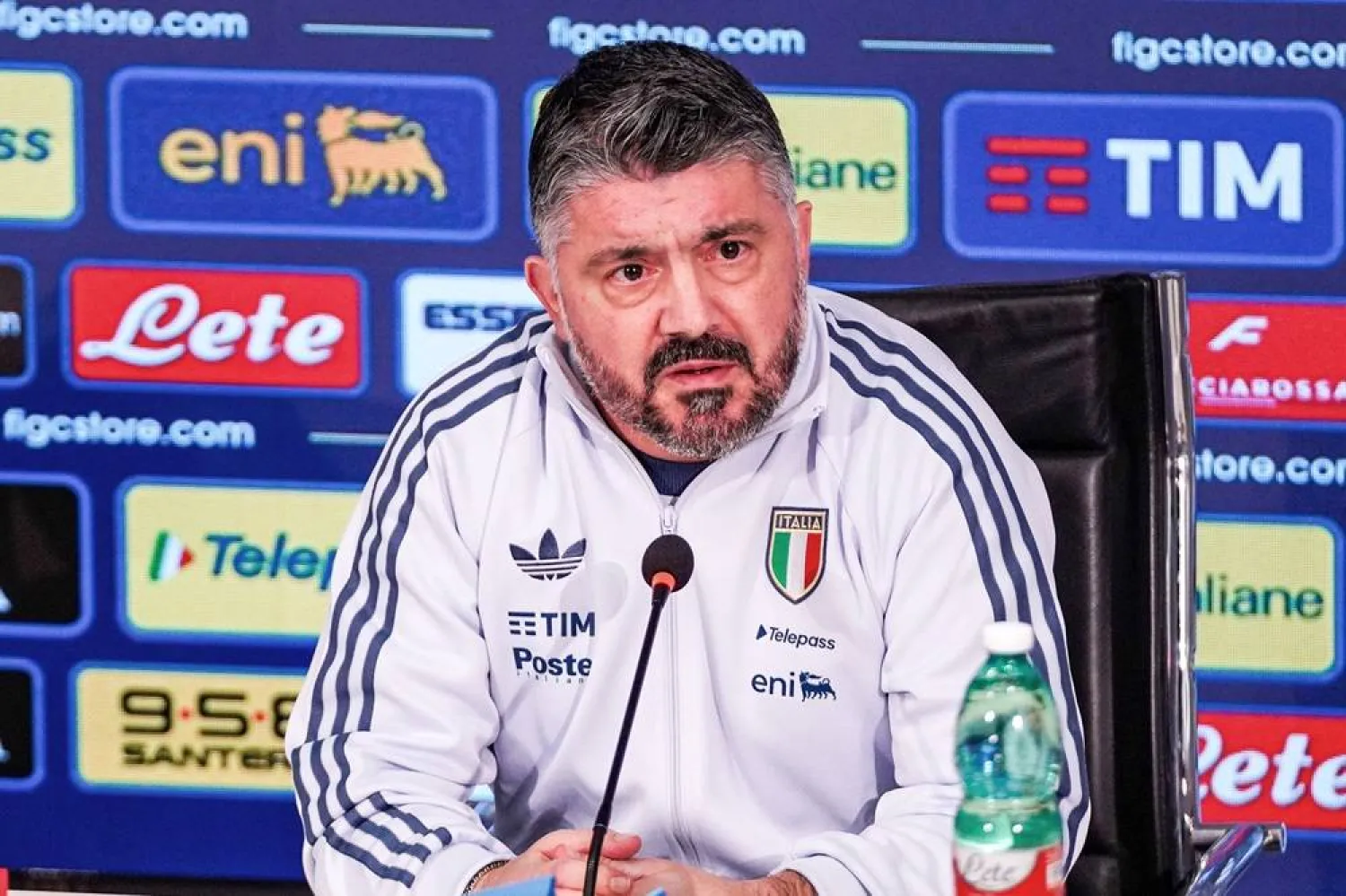
Italy coach Gennaro Gattuso has called for composure ahead of Italy’s World Cup playoff semi-final against Northern Ireland on Thursday, urging his players to block out the trauma of past failures.

With the specter of failed 2018 and 2022 qualification campaigns looming over the squad, Gattuso knows his players must overcome the mental weakness that has plagued Italy's World Cup ambitions.

Seeking to avoid a third consecutive qualification failure, the Italians ‌have managed only ‌one victory at a World Cup, a ‌2-1 ⁠group-stage win over ⁠England 12 years ago, since lifting the trophy in 2006 for the fourth time.

"We must be able to make the players feel lighter," Gattuso told reporters at Italy’s Coverciano training base on Monday. "Italy didn’t play in the last two World Cups... but there is no need to suffocate them. These are players who have won the Euros ⁠and played in Champions League finals. They are accustomed ‌to these games."

"There are no excuses; ‌we must only think about Thursday’s game," Gattuso said. "We must have the ‌right mentality and serenity. We respect the opponents... but we must ‌be clear-headed and smell the danger."

Should they get past Northern Ireland they would face a final against Wales or Bosnia & Herzegovina on March 31 to qualify for the showpiece tournament in North America.

Gattuso confirmed that Liverpool forward ‌Federico Chiesa had left the camp.

"He had a few physical problems, and we decided it was ⁠useless for him ⁠to stay here," Gattuso said. "When I heard that he had problems and doubts, I had to make a decision. He didn’t feel up for it, so he decided to return home. When one wants to return home, it’s right to let him do it."

Gattuso revealed he personally chose the 23,000-seat Stadio di Bergamo over the San Siro for the clash, admitting he feared the "caustic" atmosphere of a larger stadium if the team struggled early.

"At a 60,000-seat stadium like San Siro, they might start booing after a few wrong passes," Gattuso explained. "I want to create a real cauldron-like atmosphere. Thursday’s game is the only target. All the rest is the past."