Djokovic Finally Adds Olympic Gold to his Resume by Beating Alcaraz

Gold medalist, Serbia's Novak Djokovic kisses his medal on the podium at the presentation ceremony for the men's singles tennis event on Court Philippe-Chatrier at the Roland-Garros Stadium during the Paris 2024 Olympic Games, in Paris on August 4, 2024. (Photo by CARL DE SOUZA / AFP)
TT

Djokovic Finally Adds Olympic Gold to his Resume by Beating Alcaraz

Gold medalist, Serbia's Novak Djokovic kisses his medal on the podium at the presentation ceremony for the men's singles tennis event on Court Philippe-Chatrier at the Roland-Garros Stadium during the Paris 2024 Olympic Games, in Paris on August 4, 2024. (Photo by CARL DE SOUZA / AFP)

For all of his Grand Slam championships and other titles, for all of his time at No. 1, Novak Djokovic really, really wanted an Olympic gold medal for Serbia, the last significant accomplishment missing from his glittering resume.
He finally got one at age 37 on Sunday, beating Carlos Alcaraz 7-6 (3), 7-6 (2) in an enthralling and evenly matched men’s tennis singles final at the 2024 Games, The Associated Press reported.
In a sense, it doesn't matter one bit how long it took, of course. Djokovic is now an Olympic champion and forever will be. And in another sense, the years of waiting, the stumbles along the journey, made him appreciate this triumph as much as — no, make that more than — every other, which is why his hands trembled when he knelt on Court Philippe Chatrier's red clay at the end and why his tears flowed.
“When I take everything into consideration, this probably is the biggest sporting success I ever had in my career,” said Djokovic, who didn't drop a set in Paris and is the oldest man to win the Summer Games tennis title since 1908. “This kind of supersedes everything that I imagined, that I hoped that I could experience, that I could feel.”
With margins so thin that any mistake felt as if it could tilt things, Djokovic was at his best when the stakes were highest, dominating each of the two tiebreakers against Alcaraz, who beat him in the Wimbledon final three weeks ago.
“In the close moments, in the difficult situations, in the tiebreaks, he played an impressive game,” said silver medalist Alcaraz, the 21-year-old from Spain who sobbed, too, after falling short of becoming the youngest male singles gold medalist. “That’s why I saw that he’s hungry for the gold medal. He was going to go for it.”
Djokovic already owns a men's-record 24 Grand Slam trophies and the most weeks spent atop in the rankings by any man or woman. He also already owned an Olympics medal, from 2008, but it was a bronze — and he made it clear that simply wasn't sufficient. He kept talking over the past week, but also the past months, about what a priority the gold was for him — and Alcaraz said Sunday he kept hearing about it.
Until getting Paris bronze medalist Lorenzo Musetti of Italy on Friday, Djokovic was 0-3 in Olympic semifinals, losing to the gold winner each time: Rafael Nadal at Beijing in 2008, Andy Murray at London in 2012, and Alexander Zverev in Tokyo three years ago.
This time, Djokovic said, “I was ready.”
In Paris, wearing a gray sleeve over the right knee that required surgery for a torn meniscus two months ago, Djokovic faced Nadal in the second round and eliminated his longtime rival in straight sets.
The 2-hour, 50-minute final featured one of the best to ever do it, in Djokovic — and the “highest mountain to climb at the moment,” in Alcaraz, as Djokovic put it.
There was superb ball-striking, deft drop shots and tremendous sprinting, sliding, stretching defense. The No. 1 seed Djokovic saved eight break points, No. 2 Alcaraz saved six. Pressure? Ha. What pressure?
“We both played at a very high level," Djokovic said. "We really went toe-to-toe.”
The only shame, perhaps, for the fans — and, naturally, Alcaraz — was that the Olympics uses a best-of-three-set format, instead of the best-of-five at Grand Slam tournaments. Those in the stands became part of the show, breaking out into choruses of “No-le! No-le!” or “Car-los! Car-los!” that often overlapped, creating an operatic fugue. As Alcaraz attempted to mount a comeback, his supporters chanted “Si, se puede!” (essentially, “Yes, you can!”).
Yet the place was as quiet as a theater between points; play was delayed briefly when a young child’s crying pierced the air that was thick with anticipation.
The first set alone lasted more than 1 1/2 hours, full of epic shots and epic games. One lasted 18 points spread over more than a dozen mesmerizing minutes on the way to that tiebreaker, when Djokovic grabbed the last four points, then turned to face his guest box — which included his tennis team and his wife and their two children — with a fist held high.
In the second tiebreaker, after Djokovic laced a cross-court forehand winner on the run to cap a 10-shot point for a 3-2 lead, he waved his arms to encourage the folks standing and screaming. Soon, thanks to one last forehand winner, he had earned that prize he wanted, at long last.
When the Serbian national anthem finished ringing out, Djokovic reached for his gold and brought it to his lips for a kiss.
Was he worried that moment would never arrive?
“There are always doubts. Absolutely, I had doubts," Djokovic said. “But the belief and the conviction that I can make it is stronger than my doubts. It always has been. I knew that it’s going to happen. It was just a matter of when it’s going to happen.”



Cartel Violence Fuels Doubts About FIFA World Cup Games in Mexico

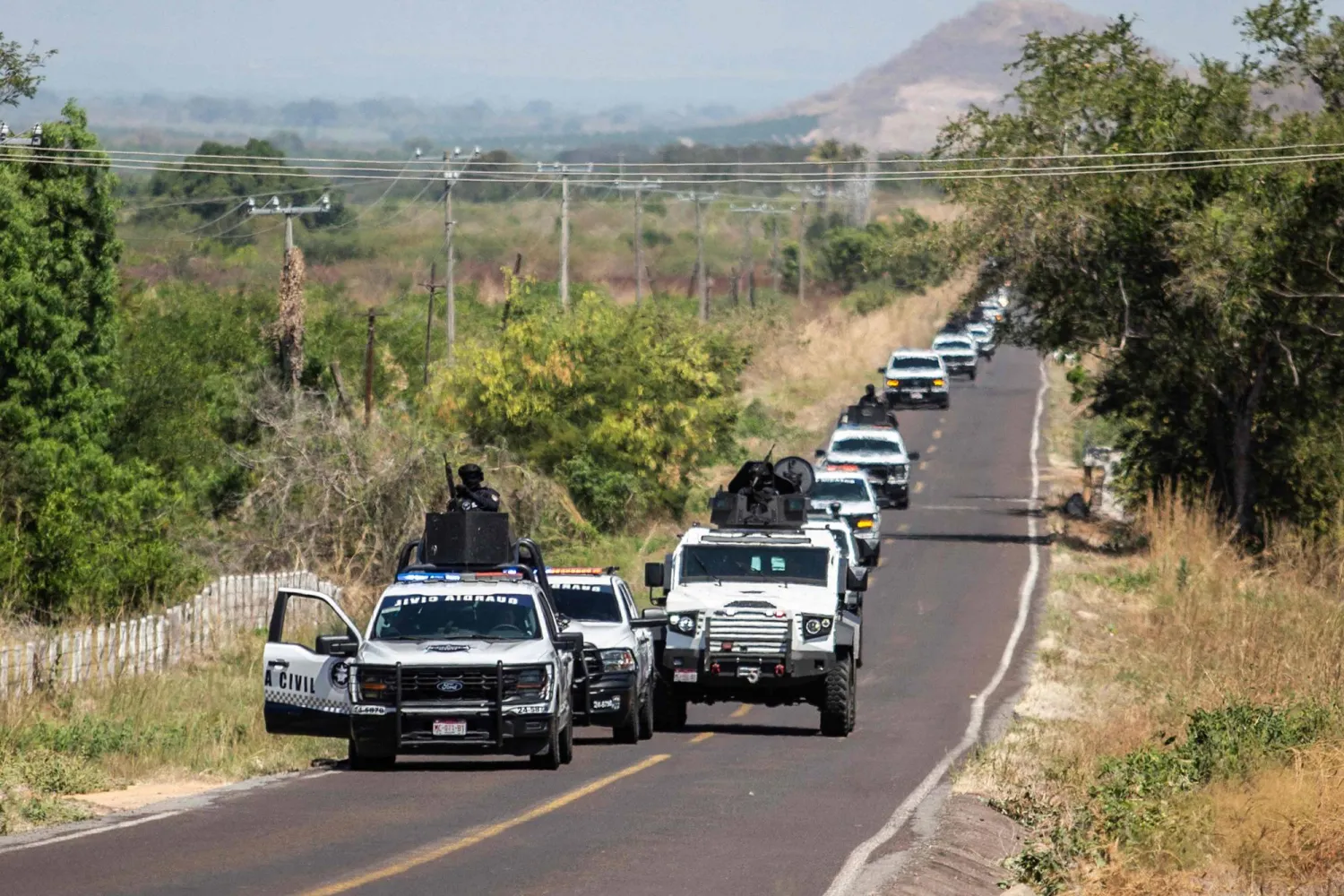
People walk at a parking lot of a supermarket where several vehicles were consumed by flames days after a series of blockades and attacks by organized crime following a military operation in which drug cartel leader Nemesio Oseguera, known as "El Mencho," was killed, in Puerto Vallarta, Mexico, February 24, 2026. REUTERS/Daniel Becerril
TT

Cartel Violence Fuels Doubts About FIFA World Cup Games in Mexico

People walk at a parking lot of a supermarket where several vehicles were consumed by flames days after a series of blockades and attacks by organized crime following a military operation in which drug cartel leader Nemesio Oseguera, known as "El Mencho," was killed, in Puerto Vallarta, Mexico, February 24, 2026. REUTERS/Daniel Becerril

Hugo Alejandro Pérez was in his house a few miles from the Mexican stadium that is slated to host FIFA World Cup games when gunfire and explosions erupted just outside his door.

The 53-year-old restaurant owner was already skeptical about his city, Guadalajara, hosting the international sporting event.

He saw a government that failed to fix basic things, like water service to his home, along with cartel violence in the surrounding state of Jalisco and shook his head. The surge of bloodshed this week following the Mexican military's killing of the country’s most powerful cartel boss offered more confirmation of his doubts.

“I don’t think they should host the World Cup here,” Peréz said. “We have so many problems, and they want to invest in the World Cup? With all the violence, it’s not a good idea.”

Peréz joined other people Tuesday in questioning Guadalajara's capacity to be a host city for the summer soccer competition, even as the Mexican government vowed that the international event — hosted jointly by Mexico, the United States and Canada — will not be affected.

President offers ‘every guarantee’ for World Cup President Claudia Sheinbaum was asked at her daily news briefing what guarantees there are that World Cup matches will be held in Jalisco. “Every guarantee,” she said, adding that there was “no risk” for fans coming to the tournament.

Jalisco Gov. Jesús Pablo Lemus said he had spoken with local FIFA officials, who have "absolutely no intention of removing any venues from Mexico. The three venues remain completely unchanged.”

The same day, the Portuguese soccer federation said it was “closely monitoring the delicate situation” in Mexico.” Its national team was scheduled to play Mexico’s team in a friendly on March 28 at the newly renovated Azteca Stadium in Mexico City, which is scheduled to host the opening World Cup match on June 11.

Jalisco, in western Mexico, was already facing scrutiny. The state has been plagued by some of the starkest examples of cartel violence in recent years, including the discovery of a cartel killing site at a ranch last March and a crisis of disappearances.

The state, with Guadalajara as its capital, is the central hub for the Jalisco New Generation Cartel, whose leader Nemesio Oseguera Cervantes, or “El Mencho,” was killed Sunday in a capture attempt by the military.

The operation and waves of violence killed 70 people. Cartel gunmen set fire to cars to block streets in states across the country, namely Jalisco, and fought with Mexican forces into Monday as the government said the conflict was under control.

The death of Oseguera Cervantes came as Mexico’s government has stepped up its offensive against cartels in an effort to meet demands by US President Donald Trump to crack down on criminal groups. The cartel, also known as CJNG, is one of the fastest-growing criminal networks in Mexico.

The White House confirmed that the US provided intelligence support to capture the cartel leader and applauded Mexico’s army for taking down a man who was one of the most wanted criminals in both countries. On Tuesday night, US President Donald Trump appeared to briefly reference the operation during his State of the Union address, saying “We’ve also taken down one of the most sinister cartel kingpins of all. You saw that yesterday.”

Drug lord's death could lead to more violence Peréz, the restaurant owner, also commended Sheinbaum's efforts to go after cartels, saying the government has taken cartel violence more seriously than her predecessors. At the same time, he said, local authorities in Jalisco have fallen short in protecting civilians.

The root concern for many is that the death of “El Mencho” could pave the way for more violence. Killing capos, in what's become known as the “kingpin strategy,” has been criticized by Sheinbaum herself because it can often spark internal conflict between cartel factions and push rival cartels to make territorial grabs.

Vanda Felbab-Brown, an academic at the Brookings Institution, said she doesn't see more acts of “revenge” by the cartel as likely, but the future remains uncertain, especially after leading figures in both CJNG and the Sinaloa Cartel have been knocked out in recent years.

“If there is no clear line of succession (in CJNG), we might see a lot of fighting within the cartel, its breakup, and there are a lot of scenarios," she said.

On Sunday, when firefights broke out between the cartel and soldiers, and gunmen began to burn a car just feet in front of Peréz's house, he let people on the street scramble inside his home to seek cover. The fighting raged for an hour.

Now he says he doesn't see the point of holding the games, adding that he doubts any of the money from the games will trickle down to businesses in working-class neighborhoods like his, even if they are just a 10-minute drive from the stadium. Similar tensions have simmered in Mexico City.

The World Cup is expected to be a $3 billion economic engine in Mexico, according to the Mexican Soccer Federation.

“It doesn't help us residents at all, honestly. They should move it to Monterrey or Mexico City. But right now here, we're not convinced,” The Associated Press quoted him as saying. "Things aren't in good enough shape for foreigners to be coming to Jalisco for an event like this.”

On Monday, some foreign tourists trapped in the violence in the city of Puerto Vallarta took to social media to warn of the violence, with a few remarking that they didn't plan to return.

Hope of snapping back to normal Despite that, Guadalajara was snapping back to its normal rhythm Tuesday. Many businesses opened their doors for the first time in two days, and streets were packed with traffic.

Workers were busy fixing up the exterior of the soccer stadium that will host World Cup matches. Cyclists zipped around outside the stadium, and parents played with children in parks.

Heavily armed police officers and National Guard members roamed the city, a sign for some that the government had the situation under control.

Juan Carlos Pila, a 55-year-old taxi driver, rolled his eyes at the reports of violence after spending two days waiting with his family for things to calm down. He said social media and local news outlets were overplaying the extent of the violence.

“People should come, man. Everyone is welcome,” he said.

Others, like Maria Dolores Aguirre, simply hoped for the best. Aguirre runs a small corner story in the cobblestoned tourist town of Tapalpa tucked away in Jalisco's mountains, where Mexico's military killed “El Mencho."

Aguirre’s family business of over 50 years depends on the flow of tourists to the normally sleepy town. Now she worries bloodshed will deal a blow to her livelihood and change towns like hers.

“It’s going to affect us. It’s collateral damage,” Aguirre said. “The government is going to have to have a lot of security. ... The entire world just saw what happened and, of course, people are going to think twice about coming.”


‘We Won’t Talk About That’: Benfica’s Tralhao Shuts Down Questions on Prestianni 

SL Benfica's assistant coach Joao Tralhao give a press conference on the eve of their UEFA Champions League knockout round playoff second leg football match against Real Madrid CF at Santiago Bernabeu Stadium in Madrid on February 24, 2026. (AFP)
TT

‘We Won’t Talk About That’: Benfica’s Tralhao Shuts Down Questions on Prestianni 

SL Benfica's assistant coach Joao Tralhao give a press conference on the eve of their UEFA Champions League knockout round playoff second leg football match against Real Madrid CF at Santiago Bernabeu Stadium in Madrid on February 24, 2026. (AFP)

Benfica assistant coach Joao Tralhao said his side's identity did not depend on any individual player as he declined to comment on the suspension of winger Gianluca Prestianni ahead of Wednesday's Champions League playoff second leg at Real Madrid.

Prestianni received a provisional one-match suspension from UEFA on Monday after he was accused of directing a racist slur at Real Madrid forward Vinicius Jr during the Spanish club's 1-0 first-leg win in Lisbon last week.

The 20-year-old Argentine winger denied the allegation, stating Vinicius "misunderstood what he thinks he heard," with Real midfielder Aurelien Tchouameni saying Prestianni admitted ‌to making a ‌homophobic remark instead.

"We are not going to talk about the ‌topic ⁠you asked about," ⁠Tralhao told reporters at a press conference on Tuesday.

"What we can say is that, regardless of the player on the pitch, we have an identity — a clear identity... whether player A plays or player B plays, we maintain the same profile."

Real Madrid goalkeeper Thibaut Courtois condemned both racism and homophobia earlier on Tuesday, describing any form of insult as "just as serious".

He also criticized Benfica fans who made monkey gestures during the first leg, calling ⁠their behavior "deplorable" and "shameful" while defending Vinicius' goal celebration as harmless.

The ‌situation adds tension to Benfica's preparations for the match. ‌Midfielder Fredrik Aursnes said the squad experienced "a little bit different week."

"It's like a final tomorrow. ‌We have to win against an amazing team in a difficult stadium," the 30-year-old ‌Norwegian added.

Benfica will also be without head coach Jose Mourinho, who is suspended after receiving a red card in the first leg.

Mourinho, 63, stirred controversy after the first leg by suggesting Vinicius had provoked the crowd with his goal celebration.

Though absent from the bench on Wednesday, Mourinho ‌led training on Tuesday, where Prestianni participated with the team.

"I don’t know where he (Mourinho) will be. We prepared this match anticipating ⁠every scenario that ⁠may happen... From our side, as staff, we prepared the team, we prepared all the scenarios so that tomorrow we can perform at our level,” Tralhao said.

UEFA has appointed an Ethics and Disciplinary Inspector to investigate allegations of discriminatory behavior, with a decision expected after proceedings conclude.

Benfica have appealed Prestianni's provisional suspension.

"We filed an appeal because we understand that nothing has been proven," Benfica President Rui Costa told reporters in Lisbon on Tuesday.

"It doesn't justify the player's absence from this game.

"I wasn't on the pitch to know what was said. What I can say is that I believe in my player. Prestianni is being crucified as a racist person and I can assure you that he is not.

"I expected something definitive, but in the end, there was only this provisional suspension."


Swansea Celebrity Co-Owner Snoop Dogg Receives Grand Welcome on First Visit 

Football - Championship - Swansea City v Preston North End - Swansea.com Stadium, Swansea, Wales, Britain - February 24, 2026 Swansea City co-owner Snoop Dogg poses with kids before the match. (Action Images via Reuters/Peter Cziborra)
TT

Swansea Celebrity Co-Owner Snoop Dogg Receives Grand Welcome on First Visit 

Football - Championship - Swansea City v Preston North End - Swansea.com Stadium, Swansea, Wales, Britain - February 24, 2026 Swansea City co-owner Snoop Dogg poses with kids before the match. (Action Images via Reuters/Peter Cziborra)

American rapper ‌and producer Snoop Dogg received a guard of honor and was greeted with twirling white towels on Tuesday on his first visit to Swansea City since becoming an investor with the Welsh side last year.

Dressed in Swansea's colors, the 54-year-old ‌took the ‌field ahead of the ‌Championship ⁠game against Preston ⁠North End through a guard of honor comprising young footballers from Wales, as over 20,000 fans filled the stands.

The match ended 1-1, with Swansea's ⁠Liam Cullen netting a ‌95th-minute equalizer.

Swansea ‌head coach Vitor Matos told reporters that ‌Snoop Dogg had spoken with ‌the players in the dressing room.

"He's someone that likes to be involved. He was involved not only ‌with us, but as well with the (US) Olympic team. ⁠He ⁠really loves sports," added Matos.

"It's good for him to be involved. I'm happy that we have someone like him who loves the club, loves the city, wants to be here."

Swansea, who are 14th in the English second tier, face Ipswich Town on Saturday.