


Pressure Builds on Milano Cortina Organizers Amid Climate Concerns and Funding Issues

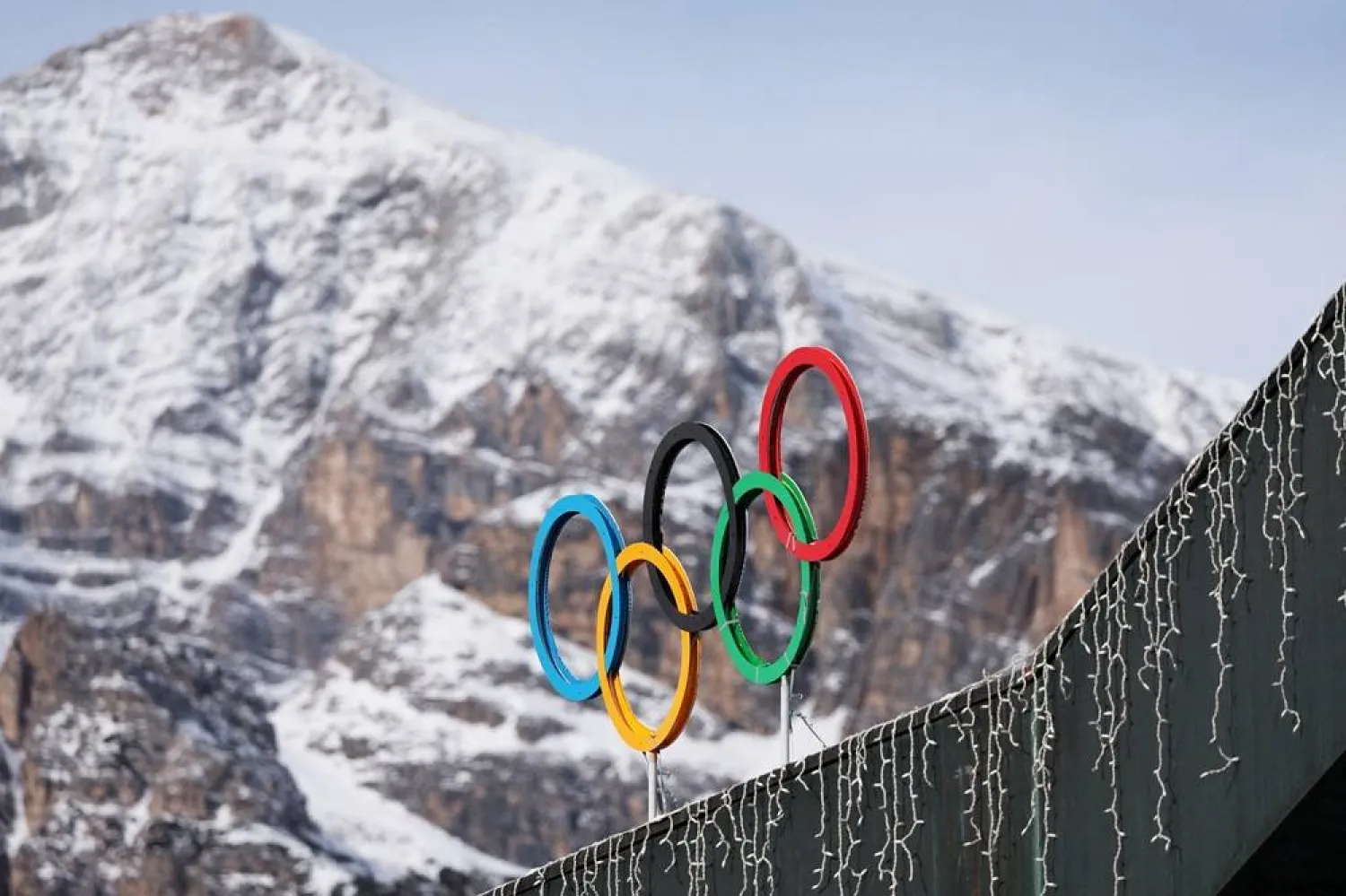
A general view shows the Olympic rings on the Cortina Curling Olympic Stadium, which will host the curling, wheelchair curling, and Paralympic closing ceremony during the Milano Cortina Winter Olympic Games 2026, in Cortina, Italy, January 25, 2025. (Reuters)
TT

Pressure Builds on Milano Cortina Organizers Amid Climate Concerns and Funding Issues

A general view shows the Olympic rings on the Cortina Curling Olympic Stadium, which will host the curling, wheelchair curling, and Paralympic closing ceremony during the Milano Cortina Winter Olympic Games 2026, in Cortina, Italy, January 25, 2025. (Reuters)

Pressure is mounting on Italian authorities to accelerate preparations for the Milano Cortina Olympics amid funding gaps and unusually warm temperatures, even as the head of world skiing openly advocates a fundamental overhaul of how future Winter Games are hosted.

With the Games due to start in February, International Ski and Snowboard Federation (FIS) president Johan Eliasch said Italy’s challenges were symptomatic of deeper structural issues facing winter sport, as rising costs, climate pressure and under-used infrastructure fuel calls for a rotating model of permanent Olympic hosts.

Growing concern over climate pressure, escalating costs and the waste of Olympic infrastructure after the Games is strengthening support within international sport for a rotation system, under which a small pool of established venues would host the Winter Olympics on a recurring basis.

Proponents argue that such a model would allow long-term planning, reduce spending and ensure consistent conditions for athletes and spectators, rather than forcing hosts to build or upgrade facilities that are rarely used once the Games end.

Eliasch said several Olympic venues were facing technical difficulties not because of shortcomings by local organizers, but because of funding issues at government level.

Games ‌organizers have said the ‌venues will be ready on time.

"We see here that there are some venues that have ‌technical ⁠difficulties. It’s not the ‌organizing committees. It’s just simply a lack of funding from the Italian government," he told Reuters in an interview.

"It’s really important that every effort is now made to make sure that everything is ready on time."

Eliasch warned that readiness alone was not enough.

"We know that we will get everything somehow ready on time," he said. "But the question is, of course, what? And that what needs to meet a certain quality threshold and also experience threshold for the spectators, the fans, the athletes, first and foremost, to make this a success."

He warned that funding constraints could push preparations beyond critical tipping points.

SNOWMAKING CONCERNS

"We shouldn’t be penny wise and pound foolish," Eliasch said. "And there are certain tipping points here in the process beyond which there is no return."

"So from a quality perspective, for ⁠what we’re trying to do here, it’s really important that funding doesn’t become an impediment to delivering the best of the best for those two and a half weeks in February," he added.

Snowmaking has emerged as a key concern as organizers prepare venues across northern Italy, and ‍Eliasch noted that parts of the downhill course in Bormio had ‍no snow on them.

"We know right now that the snowmaking equipment is working, but we have an additional problem, and that is that ‍the temperatures are very warm," Eliasch said. "Which means we can only produce snow during the night, not during the daytime because it’s too warm."

"So the theoretical capacity simply can’t be met," he added.

Alessandro Morelli, Italian Undersecretary of the Presidency of the Council of Ministers, said he was happy with the situation.

"In Livigno, 53 additional snow cannons are in operation, ensuring the production of the snow needed for the smooth running of the competitions, ahead of the Olympics," he told Italian news agency ANSA.

"The situation satisfies us, and we are confident that we can achieve an even better result than we had imagined."

Eliasch contrasted the situation with regular international competitions.

"If this was a World Cup race or a World Championship race, it would be easy," Eliasch ⁠said. "We’d know exactly what plan B, plan C, plan D is. We wouldn't start making snow this late. We would have plans to bring in snow from other areas, track it in. We would have all sorts of contingency planning."

Olympic events are far more complex, making financial certainty essential.

"Without clarity on and transparency for the organizing committee that we’re trying to support in every possible way — and they are doing their best, they’re working incredibly hard — but without resources, no one is going to step forward and deliver without knowing that they will get paid," Eliasch, an International Olympic Committee (IOC) member, said.

IOC HAT ON

"It is a very logical step to take," Eliasch said of a rotation model. "And I have advocated for it with my IOC hat on. Without long-term planning, people are not going to invest. And the Games are getting more and more expensive."

"Huge investments, billions of dollars, are being invested in infrastructure," Eliasch added. "Which becomes wasted after the Olympic Games have been held."

"For Olympic Winter Games, to pull all that together, they need at least five- or six-years’ notice," Eliasch said.

"I think we’re looking at maybe six to eight venues to start with," Eliasch said.

Climate pressure is accelerating the debate.

"Climate change could become an ‌existential threat," Eliasch said. "The only logical way to bring costs down to reasonable levels is to have a rotation scheme."

The stakes extend far beyond winter sport.

"We are competing with Formula One, NFL, NBA, football — we have to be at the forefront," he said. "The five rings are magical. And that’s something we must protect at ‌all costs."


Verona Prepares its Ancient Arena for the Olympics Closing Ceremony on Sunday

A view of the Arena ahead of the closing ceremony at the 2026 Winter Olympics, in Verona, Italy, Tuesday, Feb. 17, 2026. (AP Photo/Antonio Calanni)
TT

Verona Prepares its Ancient Arena for the Olympics Closing Ceremony on Sunday

A view of the Arena ahead of the closing ceremony at the 2026 Winter Olympics, in Verona, Italy, Tuesday, Feb. 17, 2026. (AP Photo/Antonio Calanni)

A city forever associated with Romeo and Juliet, Verona will host the final act of the Milan Cortina Winter Olympics on Sunday inside the ancient Roman Arena, where some 1,500 athletes will celebrate their feats against a backdrop of Italian music and dance.

Acclaimed ballet dancer Roberto Bolle has been rehearsing for the closing ceremony inside the Arena di Verona this week under a veil of secrecy, along with some 350 volunteers, for a spectacle titled “Beauty in Motion," which frames beauty as something inherently dynamic.

“Beauty cannot be fixed in time. This ancient monument is beautiful if it is alive, if it continues to change,” said the ceremony's producer, Alfredo Accatino. “This is what we want to narrate: An Italy that is changing, and also the beauty of movement, the beauty of sport and the beauty of nature."

Other headlining Italian artists include singer Achille Lauro and DJ Gabry Ponte, whose hits could be heard blasting from the Arena during rehearsals this week.

Inside a tent serving as a dressing room, seamstresses put the finishing touches on costumes inspired by the opera world as volunteers prepped for the stage, The Associated Press reported.

“It’s really special to be inside the Arena,” said Matilde Ricchiuto, a student from a local dance school. "Usually, I am there as a spectator and now I get to be a star, I would say. I feel super special.”

The Arena has been a venue for popular entertainment since it was first built in 1 A.D., predating the larger Roman Colosseum by decades. Accatino said the ancient monument will produce some surprises from within its vast tunnels.

“Under the Arena there is a mysterious world that hides everything that has happened. At a certain point, this world will come out," Accatino said, promising “something very beautiful."

The ceremony will open with athletes parading triumphantly through Piazza Bra into the Arena, which once served as a stage for gladiator fights and hunts for exotic beasts.

The closing ceremony stage was inspired by a drop of water, meant to symbolically unite the Olympic mountain venues with the Po River Valley, where Milan and Verona are located, while serving as a reminder that the Winter Games are being reshaped by climate change.

While the opening ceremony was held in Milan, the other host city, Cortina d’Ampezzo, nestled in the Dolomite mountains, was considered too small and remote to host the closing ceremony. Verona, in the same Veneto region as Cortina, was chosen for its unique venue and relatively central location, said Maria Laura Iascone, the local organizing committee's head of ceremonies.

“Only Italians can use such monuments to do special events, so this is very unique, very rare," Iascone said of the Arena.

She promised a more intimate evening than the opening ceremony in Milan's San Siro soccer stadium, with about 12,000 people attending the closing compared with more than 60,000 for the opening.

Iascone said about 1,500 of the nearly 3,000 athletes participating in the most spread-out Winter Games in Olympic history are expected to drive a little over an hour from Milan and between two and four hours from the six mountain venues.

The ceremony will close with the Olympic flame being extinguished. A light show will substitute fireworks, which are not allowed in Verona to protect animals from being disturbed.

The Verona Arena will also be the venue for the Paralympic opening ceremony on March 6. For the ceremonies, the ancient Arena has been retrofitted with new wheelchair ramps and accessible restrooms along with other safety upgrades. The six Paralympic events will be held in Milan and Cortina until March 15.


Arsenal Blows 2-goal Lead at Wolves to Boost Man City's Premier League Title Chances

Soccer Football - Premier League - Wolverhampton Wanderers v Arsenal - Molineux Stadium, Wolverhampton, Britain - February 18, 2026  Wolverhampton Wanderers' Tom Edozie celebrates scoring their second goal with teammates REUTERS/Chris Radburn
Soccer Football - Premier League - Wolverhampton Wanderers v Arsenal - Molineux Stadium, Wolverhampton, Britain - February 18, 2026 Wolverhampton Wanderers' Tom Edozie celebrates scoring their second goal with teammates REUTERS/Chris Radburn
TT

Arsenal Blows 2-goal Lead at Wolves to Boost Man City's Premier League Title Chances

Soccer Football - Premier League - Wolverhampton Wanderers v Arsenal - Molineux Stadium, Wolverhampton, Britain - February 18, 2026  Wolverhampton Wanderers' Tom Edozie celebrates scoring their second goal with teammates REUTERS/Chris Radburn
Soccer Football - Premier League - Wolverhampton Wanderers v Arsenal - Molineux Stadium, Wolverhampton, Britain - February 18, 2026 Wolverhampton Wanderers' Tom Edozie celebrates scoring their second goal with teammates REUTERS/Chris Radburn

Arsenal blew a two-goal lead at last-place Wolves on Wednesday to give a huge boost to Manchester City in the race for the Premier League title.

The league leader was held to a surprise 2-2 draw at Molineux, having led 2-0 in the second half.

Teenage debutant Tom Edozie scored in the fourth minute of added time to complete Wolves' comeback.

“There was a big difference in how we played in the first half and the second half. We dropped our standards and we got punished for it,” Arsenal forward Bukayo Saka told the BBC.

The draw means Arsenal has dropped points in back-to-back games and leaves it just five ahead of second-place City, having played a game more.

With the top two still to play each other at City's Etihad Stadium, the title race is too close to call.

“(It's) time to focus on ourselves, improve our standards and improve our performances and it is in our control,” Saka said.

Arsenal has led the way for the majority of the season and one bookmaker paid out on Mikel Arteta's team winning the title after it opened up a nine-point lead earlier this month.

But Wednesday's result was the latest sign that it is feeling the pressure, having finished runner-up in each of the last three seasons. It has won just two of its last seven league games.

Having blown a lead against Brentford last week, it was even worse at a Wolves team that has won just one game all season.

Victory looked all but secured after Saka gave Arsenal the lead with a header in the fifth minute and Piero Hincapie ran through to blast in the second in the 56th.

But Wolves' fightback began with Hugo Bueno's curling shot into the top corner in the 61st.

The 19-year-old Edozie was sent on as a substitute in the 84th and his effort earned the home team only its 10th point of a campaign that looks certain to end in relegation.

While it did little for Wolves' chances of survival, it may have had a major impact at the top of the standings.

“Incredibly disappointed that we gave two points away,” Arteta said. "I think we need to fault ourselves and give credit to Wolves. But what we did in the second half was nowhere near our standards that we have to play in order to win a game in the Premier League.

“When you don’t perform you can get punished, and we got punished and we have to accept the hits because that can happen when you are on top."

Arsenal plays Tottenham on Sunday. Its lead could be cut to two points before it kicks off if City wins against Newcastle on Saturday.


Sinner Sees off Popyrin to Reach Doha Quarters

 Italy's Jannik Sinner greets the fans after defeating Australia's Alexei Popyrin in their men's singles match at the Qatar Open tennis tournament in Doha on February 18, 2026. (AFP)
Italy's Jannik Sinner greets the fans after defeating Australia's Alexei Popyrin in their men's singles match at the Qatar Open tennis tournament in Doha on February 18, 2026. (AFP)
TT

Sinner Sees off Popyrin to Reach Doha Quarters

 Italy's Jannik Sinner greets the fans after defeating Australia's Alexei Popyrin in their men's singles match at the Qatar Open tennis tournament in Doha on February 18, 2026. (AFP)
Italy's Jannik Sinner greets the fans after defeating Australia's Alexei Popyrin in their men's singles match at the Qatar Open tennis tournament in Doha on February 18, 2026. (AFP)

Jannik Sinner powered past Alexei Popyrin in straight sets on Wednesday to reach the last eight of the Qatar Open and edge closer to a possible final meeting with Carlos Alcaraz.

The Italian, playing his first tournament since losing to Novak Djokovic in the Australian Open semi-finals last month, eased to a 6-3, 7-5 second-round win in Doha.

Sinner will play Jakub Mensik in Thursday's quarter-finals.

Australian world number 53 Popyrin battled gamely but failed to create a break-point opportunity against his clinical opponent.

Sinner dropped just three points on serve in an excellent first set which he took courtesy of a break in the sixth game.

Popyrin fought hard in the second but could not force a tie-break as Sinner broke to grab a 6-5 lead before confidently serving it out.

World number one Alcaraz takes on Frenchman Valentin Royer in his second-round match later.
