


Too Hot to Handle? Searing Heat Looming Over 2026 World Cup

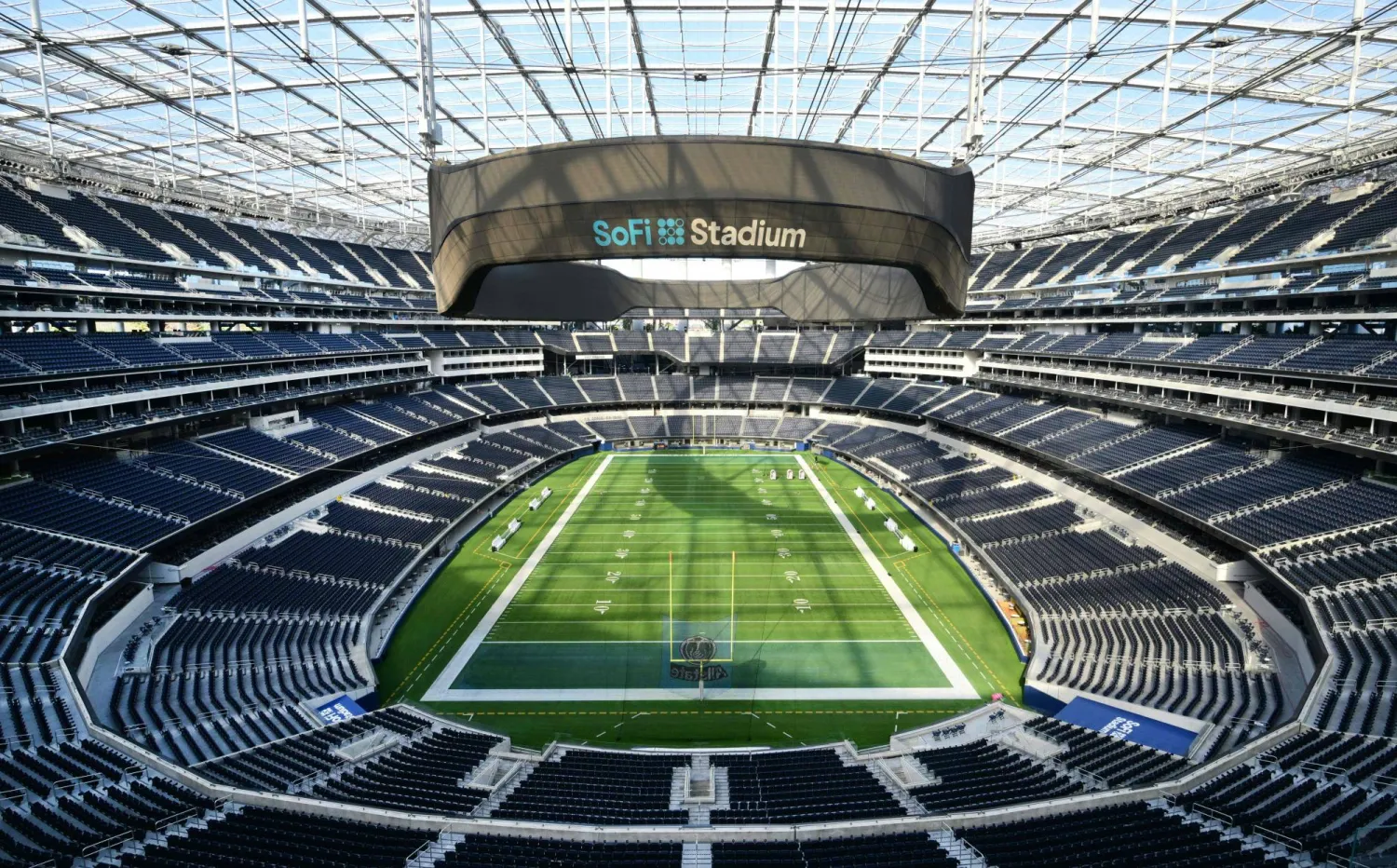
A view of the field is seen from the stands at SoFi Stadium in Inglewood, California, on December 9, 2025. (AFP)
TT

Too Hot to Handle? Searing Heat Looming Over 2026 World Cup

A view of the field is seen from the stands at SoFi Stadium in Inglewood, California, on December 9, 2025. (AFP)

With less than six months to go before the 2026 World Cup kicks off, organizers are bracing for what could be their most challenging opponent yet: extreme heat.

Soaring temperatures across the United States, Mexico and Canada pose safety issues for players and fans and a host of logistical issues that remain far from settled.

In the depths of the $5.5 billion SoFi Stadium in Los Angeles, which will host eight World cup matches, around 15 industrial misting fans more than two meters sit in storage, waiting to be deployed. If temperatures climb above 80F (26.7C), the fans will be rolled out around the stadium.

A roof suspended some 45 meters above the SoFi Stadium pitch offers some shade for spectators, while large openings along the sides of the stadium allow for breezes from the nearby Pacific Ocean to provide a form of natural air conditioning.

"Knowing that you can put 70,000 people into a building, the energy, the excitement, the activity that comes with that, and the higher temperature, that's where we want to make sure we respond," Otto Benedict, vice president of operations for the company that manages the stadium, told AFP.

Not all of the World Cup's 16 stadiums are as modern. And Southern California is not considered to be among the highest-risk areas for a competition scheduled from June 11 to July 19, three and a half years after a winter World Cup in Qatar.

- Automatic cooling breaks -

A study published in the International Journal of Biometeorology in January warned of "serious concern" for the health of players and match officials at the 2026 World Cup due to extreme heat.

The study identified six "high-risk" host cities: Monterrey, Miami, Kansas City, Boston, New York and Philadelphia.

The "Pitches in Peril" report by the Football for Future non-profit noted that in 2025 those cities each recorded at least one day above 35C on the wet-bulb globe temperature (WBGT) scale, which factors in humidity and is considered the upper limit of human heat tolerance.

The issue of heat featured prominently at this year's FIFA Club World Cup in the United States, which drew complaints from players and coaches.

Extreme heat also marked the 1994 World Cup, the last men's edition held in the United States.

FIFA has responded by mandating cooling breaks in the 22nd and 67th minutes of all matches at the World Cup, regardless of conditions.

The World Cup match schedule released after December's draw in Washington shows daytime games largely assigned to air-conditioned stadiums in Dallas, Houston and Atlanta, while higher-risk venues are set to host evening kickoffs.

"You can clearly see an effort to align the competition schedule planning and venue selection with the concerns around player health, but also player performance," a spokesperson for the FIFPro players union told AFP. "This is a clear outcome, which we welcome, and a lesson learned from the Club World Cup."

- 'High-risk matches' -

FIFPRO says the biggest takeaway is that heat will play an increasingly central role in organizing competitions on a warming planet.

The union believes though that several World Cup fixtures remain "high-risk" and recommends postponements when WBGT readings exceed 28C.

Among those fixtures causing FIFPro concern: group-stage matches scheduled for mid-afternoon in New York, Boston and Philadelphia, as well as the final, set for a 3:00 p.m. kickoff in New York.

While teams and players work to mitigate effects of the conditions, some officials say the risks to spectators both inside stadiums and in fan zones have been underestimated.

"There is a risk and importantly, we feel like it's an underappreciated risk," said Chris Fuhrmann, deputy director of the Southeast Regional Center of the US National Oceanic and Atmospheric Administration.

"When you're cheering, you're actually generating a lot of metabolic heat and your heart rate's going up. Spectators obviously compared to professional athletes are generally not in as good physical health.

"They have a lot of comorbidities that increase the likelihood that they would have a negative health outcome or succumb to heat stress."

Stadium temperatures are also amplified by the "urban heat island" effect of concrete, asphalt and metal.

Adequate air circulation, plenty of shaded areas and access to hydration are crucial, Fuhrmann said.

FIFA has yet to clarify whether fans will be allowed to bring refillable water bottles into venues or whether water will be sold inside. FIFA did not respond to requests for comment.

- Prevention -

For National Weather Service meteorologist Benjamin Schott, who has advised FIFA and its World Cup task force, the priority is prevention, particularly for foreign visitors unfamiliar with local climates.

Another lesson from the Club World Cup, he said, is the need for multilingual messaging to ensure heat-safety warnings are clearly understood.

"The lesson learned is just trying to maybe better educate fans as they come to the United States to have a better understanding of what the weather could be like during those two months," Schott said.



Sinner Sees off Popyrin to Reach Doha Quarters

 Italy's Jannik Sinner greets the fans after defeating Australia's Alexei Popyrin in their men's singles match at the Qatar Open tennis tournament in Doha on February 18, 2026. (AFP)
Italy's Jannik Sinner greets the fans after defeating Australia's Alexei Popyrin in their men's singles match at the Qatar Open tennis tournament in Doha on February 18, 2026. (AFP)
TT

Sinner Sees off Popyrin to Reach Doha Quarters

 Italy's Jannik Sinner greets the fans after defeating Australia's Alexei Popyrin in their men's singles match at the Qatar Open tennis tournament in Doha on February 18, 2026. (AFP)
Italy's Jannik Sinner greets the fans after defeating Australia's Alexei Popyrin in their men's singles match at the Qatar Open tennis tournament in Doha on February 18, 2026. (AFP)

Jannik Sinner powered past Alexei Popyrin in straight sets on Wednesday to reach the last eight of the Qatar Open and edge closer to a possible final meeting with Carlos Alcaraz.

The Italian, playing his first tournament since losing to Novak Djokovic in the Australian Open semi-finals last month, eased to a 6-3, 7-5 second-round win in Doha.

Sinner will play Jakub Mensik in Thursday's quarter-finals.

Australian world number 53 Popyrin battled gamely but failed to create a break-point opportunity against his clinical opponent.

Sinner dropped just three points on serve in an excellent first set which he took courtesy of a break in the sixth game.

Popyrin fought hard in the second but could not force a tie-break as Sinner broke to grab a 6-5 lead before confidently serving it out.

World number one Alcaraz takes on Frenchman Valentin Royer in his second-round match later.


Ukraine's Officials to Boycott Paralympics over Russian Flag Decision

Milano Cortina 2026 Winter Olympics - Skeleton - Interview with Ukraine Youth and Sports minister Matvii Bidnyi - N H Hotel, Milan, Italy - February 12, 2026 Ukraine Youth and Sports Minister Matvii Bidnyi speaks after the disqualification of Ukrainian skeleton racer Vladyslav Heraskevych from the Winter Games. REUTERS/Kevin Coombs
TT

Ukraine's Officials to Boycott Paralympics over Russian Flag Decision

Milano Cortina 2026 Winter Olympics - Skeleton - Interview with Ukraine Youth and Sports minister Matvii Bidnyi - N H Hotel, Milan, Italy - February 12, 2026 Ukraine Youth and Sports Minister Matvii Bidnyi speaks after the disqualification of Ukrainian skeleton racer Vladyslav Heraskevych from the Winter Games. REUTERS/Kevin Coombs

Ukrainian officials will boycott the Paralympic Winter Games, Kyiv said Wednesday, after the International Paralympic Committee allowed Russian athletes to compete under their national flag.

Ukraine also urged other countries to shun next month's Opening Ceremony in Verona on March 6, in part of a growing standoff between Kyiv and international sporting federations four years after Russia invaded.

Six Russians and four Belarusians will be allowed to take part under their own flags at the Milan-Cortina Paralympics rather than as neutral athletes, the Games' governing body confirmed to AFP on Tuesday.

Russia has been mostly banned from international sport since Moscow invaded Ukraine. The IPC's decision triggered fury in Ukraine.

Ukraine's sports minister Matviy Bidny called the decision "outrageous", and accused Russia and Belarus of turning "sport into a tool of war, lies, and contempt."

"Ukrainian public officials will not attend the Paralympic Games. We will not be present at the opening ceremony," he said on social media.

"We will not take part in any other official Paralympic events," he added.

Ukrainian Foreign Minister Andriy Sybiga said he had instructed Kyiv's ambassadors to urge other countries to also shun the opening ceremony.

"Allowing the flags of aggressor states to be raised at the Paralympic Games while Russia's war against Ukraine rages on is wrong -- morally and politically," Sybiga said on social media.

The EU's sports commissioner Glenn Micallef said he would also skip the opening ceremony.

- Kyiv demands apology -

The IPC's decision comes amid already heightened tensions between Ukraine and the International Olympic Committee, overseeing the Winter Olympics currently underway.

The IOC banned Ukrainian skeleton racer Vladyslav Heraskevych for refusing to ditch a helmet depicting victims of the war with Russia.

Ukraine was further angered that the woman chosen to carry the "Ukraine" name card and lead its team out during the Opening Ceremony of the Games was revealed to be Russian.

Media reports called the woman an anti-Kremlin Russian woman living in Milan for years.

"Picking a Russian person to carry the nameplate is despicable," Kyiv's foreign ministry spokesman Georgiy Tykhy said at a briefing in response to a question by AFP.

He called it a "severe violation of the Olympic Charter" and demanded an apology.

And Kyiv also riled earlier this month at FIFA boss Gianni Infantino saying he believed it was time to reinstate Russia in international football.

- 'War, lies and contempt' -

Valeriy Sushkevych, president of the Ukrainian Paralympic Committee told AFP on Tuesday that Kyiv's athletes would not boycott the Paralympics.

Ukraine traditionally performs strongly at the Winter Paralympics, coming second in the medals table four years ago in Beijing.

"If we do not go, it would mean allowing Putin to claim a victory over Ukrainian Paralympians and over Ukraine by excluding us from the Games," said the 71-year-old in an interview.

"That will not happen!"

Russia was awarded two slots in alpine skiing, two in cross-country skiing and two in snowboarding. The four Belarusian slots are all in cross-country skiing.

The International Paralympic Committee (IPC) said earlier those athletes would be "treated like (those from) any other country".

The IPC unexpectedly lifted its suspension on Russian and Belarusian athletes at the organisation's general assembly in September.


'Not Here for Medals', Nakai Says after Leading Japanese Charge at Olympics

Ami Nakai of Japan competes during the women's short program figure skating at the 2026 Winter Olympics, in Milan, Italy, Tuesday, Feb. 17, 2026. (AP Photo/Ashley Landis)
TT

'Not Here for Medals', Nakai Says after Leading Japanese Charge at Olympics

Ami Nakai of Japan competes during the women's short program figure skating at the 2026 Winter Olympics, in Milan, Italy, Tuesday, Feb. 17, 2026. (AP Photo/Ashley Landis)

Ami Nakai entered her first Olympics insisting she was not here for medals — but after the short program at the Milano Cortina Games, the 17-year-old figure skater found herself at the top, ahead of national icon Kaori Sakamoto and rising star Mone Chiba.

Japan finished first, second, and fourth on Tuesday, cementing a formidable presence heading into the free skate on Thursday. American Alysa Liu finished third.

Nakai's clean, confident skate was anchored by a soaring triple Axel. She approached the moment with an ease unusual for an Olympic debut.

"I'm not here at this Olympics with the goal of achieving a high result, I'm really looking forward to enjoying this Olympics as much as I can, till the very last moment," she said.

"Since this is my first Olympics, I had nothing to lose, and that mindset definitely translated into my results," she said.

Her carefree confidence has unexpectedly put her in medal contention, though she cannot imagine herself surpassing Sakamoto, the three-time world champion who is skating the final chapter of her competitive career. Nakai scored 78.71 points in the short program, ahead of Sakamoto's 77.23.

"There's no way I stand a chance against Kaori right now," Nakai said. "I'm just enjoying these Olympics and trying my best."

Sakamoto, 25, who has said she will retire after these Games, is chasing the one accolade missing from her resume: Olympic gold.

Having already secured a bronze in Beijing in 2022 and team silvers in both Beijing and Milan, she now aims to cap her career with an individual title.

She delivered a polished short program to "Time to Say Goodbye," earning a standing ovation.

Sakamoto later said she managed her nerves well and felt satisfied, adding that having three Japanese skaters in the top four spots "really proves that Japan is getting stronger". She did not feel unnerved about finishing behind Nakai, who also bested her at the Grand Prix de France in October.

"I expected to be surpassed after she landed a triple Axel ... but the most important thing is how much I can concentrate on my own performance, do my best, stay focused for the free skate," she said.

Chiba placed fourth and said she felt energised heading into the free skate, especially after choosing to perform to music from the soundtrack of "Romeo and Juliet" in Italy.

"The rankings are really decided in the free program, so I'll just try to stay calm and focused in the free program and perform my own style without any mistakes," said the 20-year-old, widely regarded as the rising all-rounder whose steady ascent has made her one of Japan's most promising skaters.

All three skaters mentioned how seeing Japanese pair Riku Miura and Ryuichi Kihara deliver a stunning comeback, storming from fifth place after a shaky short program to capture Japan's first Olympic figure skating pairs gold medal, inspired them.

"I was really moved by Riku and Ryuichi last night," Chiba said. "The three of us girls talked about trying to live up to that standard."