
A Powerful Rivalry: Sabalenka and Svitolina Set for Australian Open Semi-Final Showdown

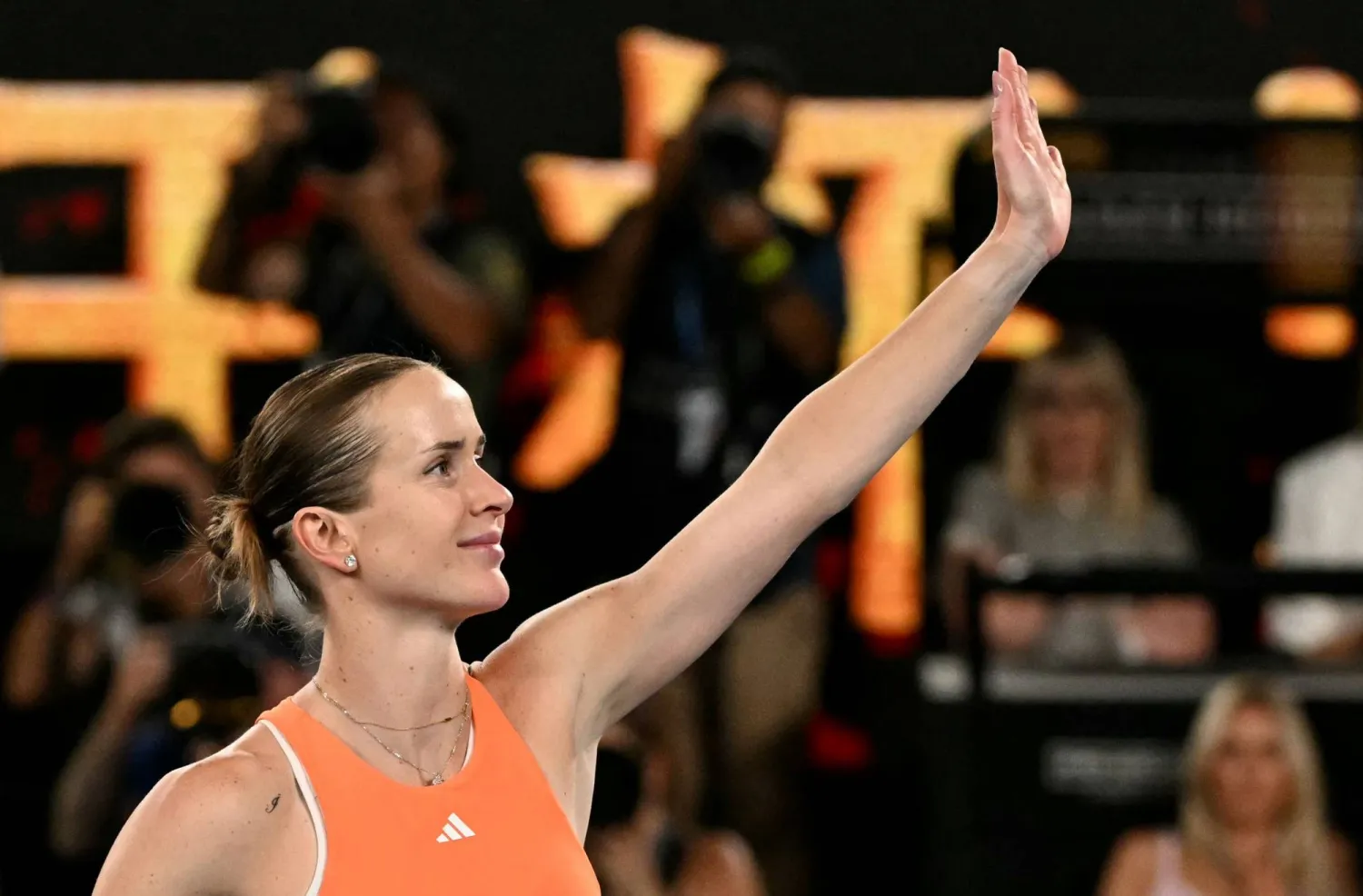
Ukraine's Elina Svitolina celebrates after winning against USA's Coco Gauff during their women's singles quarter-final match on day ten of the Australian Open tennis tournament in Melbourne on January 27, 2026. (AFP)
TT

A Powerful Rivalry: Sabalenka and Svitolina Set for Australian Open Semi-Final Showdown

Ukraine's Elina Svitolina celebrates after winning against USA's Coco Gauff during their women's singles quarter-final match on day ten of the Australian Open tennis tournament in Melbourne on January 27, 2026. (AFP)

Naturally there'll be attention on the backstory when Aryna Sabalenka and Elina Svitolina meet in the Australian Open women's semi-finals.

Top-ranked Sabalenka, who is seeking a third title in four years in Australia, is a 27-year-old from Belarus. She’s popular on TikTok for her humorous posts and dance routines.

Svitolina is a 31-year-old Ukrainian who will be returning to the Top 10 next week for the first time since returning from a maternity break she took in 2022. She reached her first Australian Open semi-final with a lopsided win over No. 3 Coco Gauff, needing only 59 minutes to end her run of three quarter-final losses at Melbourne Park.

They're both regularly asked questions relating to Russia's war on Ukraine. Both have regularly said they want the focus to be on tennis. Svitolina is trying to bring joy to the people of Ukraine, of course. Sabalenka said she supports peace.

“It's very close to my heart to see a lot of support from Ukrainians,” she said. “So I feel like (I) bring this light, a little light, you know, even just positive news to Ukrainian people, to my friends when they are watching.”

Players from Ukraine don't shake hands with players from Russia or Belarus at the net after matches. It's accepted on both sides.

They're both on 10-match winning streaks so far in 2026 and entered the season's first major with titles in warmup tournaments — Sabalenka in Brisbane, and Svitolina in Auckland, New Zealand, her 19th career title. That was Svitolina's first foray back after an early end to the 2025 season for a mental health break.

Sabalenka, who has 22 career titles including back-to-back Australian championships in 2023 and '24 and back-to-back US Open triumphs in 2024 and last year, is 5-1 in career meetings with Svitolina. She is into the final 4 at a major for the 14th time, and has made the final seven times.

“It's no secret that she’s a very powerful player. I watched a little bit of her (quarter-final) match. She was playing great tennis, and I think, the power on all aspects of her game is her strengths,” Svitolina said of Sabalenka. “She’s very consistent. For me, I’ll have to ... try to find the ways and the little holes, little opportunities in her game.

“When you play the top players, you have to find these small opportunities and then be ready to take them.”

Svitolina is playing her fourth semi-final at a major — 2019 and 2023 at Wimbledon and the 2019 US Open — and aiming for her first final.

Sabalenka played her quarter-final against 18-year-old Iva Jovic before the searing heat forced organizers to close the roof of the Rod Laver Arena stadium on Tuesday. She was long gone before Svitolina and Guaff played under the roof at night. At that stage, she didn't know who she'd next be playing, but was sure “it's going to be a battle.”

“Because whoever makes it there, it’s an incredible player,” she said. “I think my approach going to be the same. Doesn’t matter who I’m facing.

“I’ll just go, and I’ll be focused on myself and on my game.”


Belgian Federation to Challenge FIFA Decision to Let Balogun Play in World Cup Match

Football - FIFA World Cup 2026 - Round of 32 - United States v Bosnia and Herzegovina - San Francisco Bay Area Stadium, Santa Clara, California, US - July 1, 2026 Folarin Balogun of the US is shown a red card by referee Raphael Claus. (Reuters)
TT

Belgian Federation to Challenge FIFA Decision to Let Balogun Play in World Cup Match

Football - FIFA World Cup 2026 - Round of 32 - United States v Bosnia and Herzegovina - San Francisco Bay Area Stadium, Santa Clara, California, US - July 1, 2026 Folarin Balogun of the US is shown a red card by referee Raphael Claus. (Reuters)

The Belgian soccer federation wants an explanation from FIFA about a decision to let US forward Folarin Balogun play at the World Cup despite getting a red card in his previous game.

Belgium takes on the United States later Monday for a spot in the quarterfinals.

The Belgian federation (RBFA) said it has still not received either “FIFA’s decision or any explanation regarding this matter. In these circumstances, it has no choice but to challenge the player’s eligibility for the upcoming match.”

It did not specify where it intends to appeal FIFA’s decision.

US President Donald Trump intervened on behalf of Balogun, whose red-card suspension was lifted in a decision that allowed him to play against Belgium.

The Belgian federation said it learned through media reports about the FIFA's move and sent a letter to the governing body requesting a copy of the decision as well as an explanation of the process.

“As its only response, FIFA sent a letter to the RBFA stating that it considered this correspondence to constitute an appeal, that a judge had been appointed, and that the RBFA had only a few hours to complete that appeal,” it said. “No information whatsoever was provided by FIFA.

The RBFA insisted that FIFA’s regulations state that the reasoned decision must first have been communicated to the appellant.

“While the RBFA was merely seeking legitimate explanations, FIFA itself created an appeal and immediately ensured that it would be declared inadmissible,” it said. “All of this occurred while FIFA simultaneously refused to respond to the RBFA’s legitimate requests.”

Balogun, the star forward for the US with three goals in the tournament, received a red card for stepping awkwardly on the right ankle of Tarik Muharemović of Bosnia-Herzegovina in a 2-0 round of 32 win on Wednesday, triggering an automatic one-game suspension.

FIFA announced Sunday that the suspension had been lifted for the round of 16 match, an extraordinary move that triggered praise from Trump and outrage from Belgium’s team. It appeared to be the first time since 1962 that a red card during a World Cup didn’t result in a suspension.

“Regardless of the sporting outcome of this match, the RBFA is deeply concerned by the course of events and will continue to fight in the coming hours, days and months in defense of the fundamental principles of ethics, fair competition, and the interests of football as a whole,” the Belgian federation added.

The FIFA decision drew criticism from the European Commission, the powerful executive arm of the European Union, which is based in Brussels.

Glenn Micallef, the European Union’s commissioner for sport, said that decisions “on sporting rules and sporting matters belong to sporting bodies, not politicians.”

“Influencing sporting decisions would undermine the autonomy of sport,” he wrote in a message on X. “Our focus should instead be on the real governance challenges facing sport, including the weaponization of sport for political purposes.”


Trump Says He Asked FIFA Chief to Review Red Card Foul

President Donald Trump holds up a red card during a meeting with FIFA president Gianni Infantino in the Oval Office of the White House, Tuesday, Aug. 28, 2018, in Washington. (AP)
TT

Trump Says He Asked FIFA Chief to Review Red Card Foul

President Donald Trump holds up a red card during a meeting with FIFA president Gianni Infantino in the Oval Office of the White House, Tuesday, Aug. 28, 2018, in Washington. (AP)

President Donald Trump said on Monday he asked FIFA chief Gianni Infantino to review a red-card foul against USA striker Folarin Balogun and that he did not think the foul called by the "horrible" referee was fair.

"All I did, I asked for ‌a review, ‌because I didn't think it ‌was ⁠a foul," Trump ⁠told reporters in the Oval Office.

The unprecedented move has thrust FIFA's disciplinary process into the global spotlight and prompted an angry response from Belgium, who play the US on Monday for a place ⁠in the quarter-finals.

Trump said the incident ‌that got Balogun ‌the red card was simply a case ‌of two athletes colliding and he raised ‌questions about the fairness of the referee who called the foul.

"I saw the play," Trump said. "That wasn't a foul. That wasn't even ‌an infraction. That was two guys running full speed that happened ⁠to ⁠crash into each other."

He said FIFA made a "really brilliant decision" to suspend the red card. "I think the referee's call was horrible," he said.

Trump said all he did was ask for a review. "I didn't tell them what to do. I can't tell them what to do," he said.

He said it was important for team USA to have its best players on the field.


EU Says Sport Decisions 'Belong to Sporting Bodies, Not Politicians' after Balogun Red-card U-turn

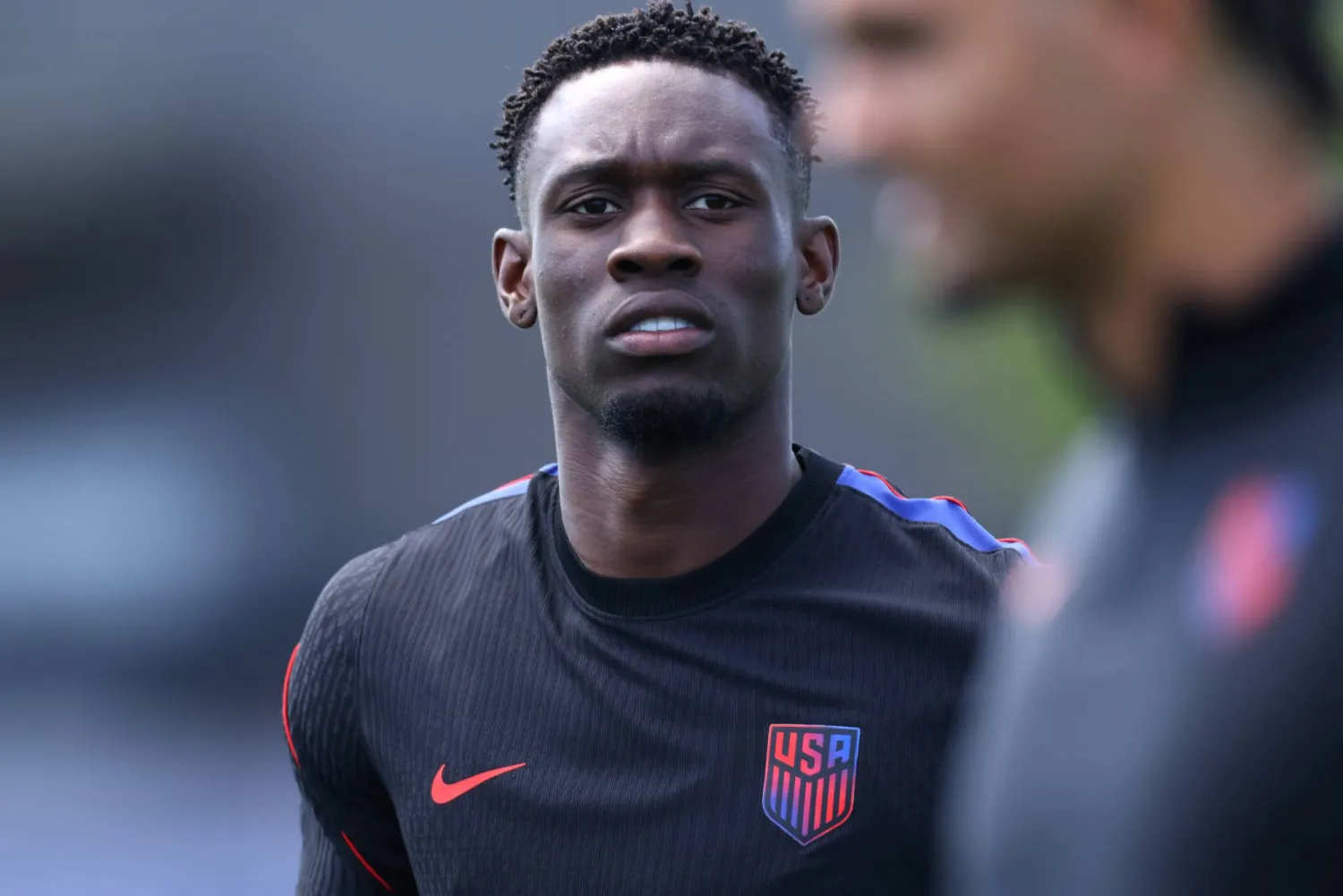
Balogun during a recent US training session (AFP)
TT

EU Says Sport Decisions 'Belong to Sporting Bodies, Not Politicians' after Balogun Red-card U-turn

Balogun during a recent US training session (AFP)

Decisions on sport "belong to sporting bodies, not politicians", EU sports chief Glenn Micallef said on Monday after FIFA overturned US striker Folarin Balogun's suspension following a reported intervention by President Donald Trump.

"Influencing sporting decisions would undermine the autonomy of sport. Our focus should instead be on the real governance challenges facing sport, including the weaponization of sport for political purposes," Micallef said.