Britain Invites China to Its Global AI Summit

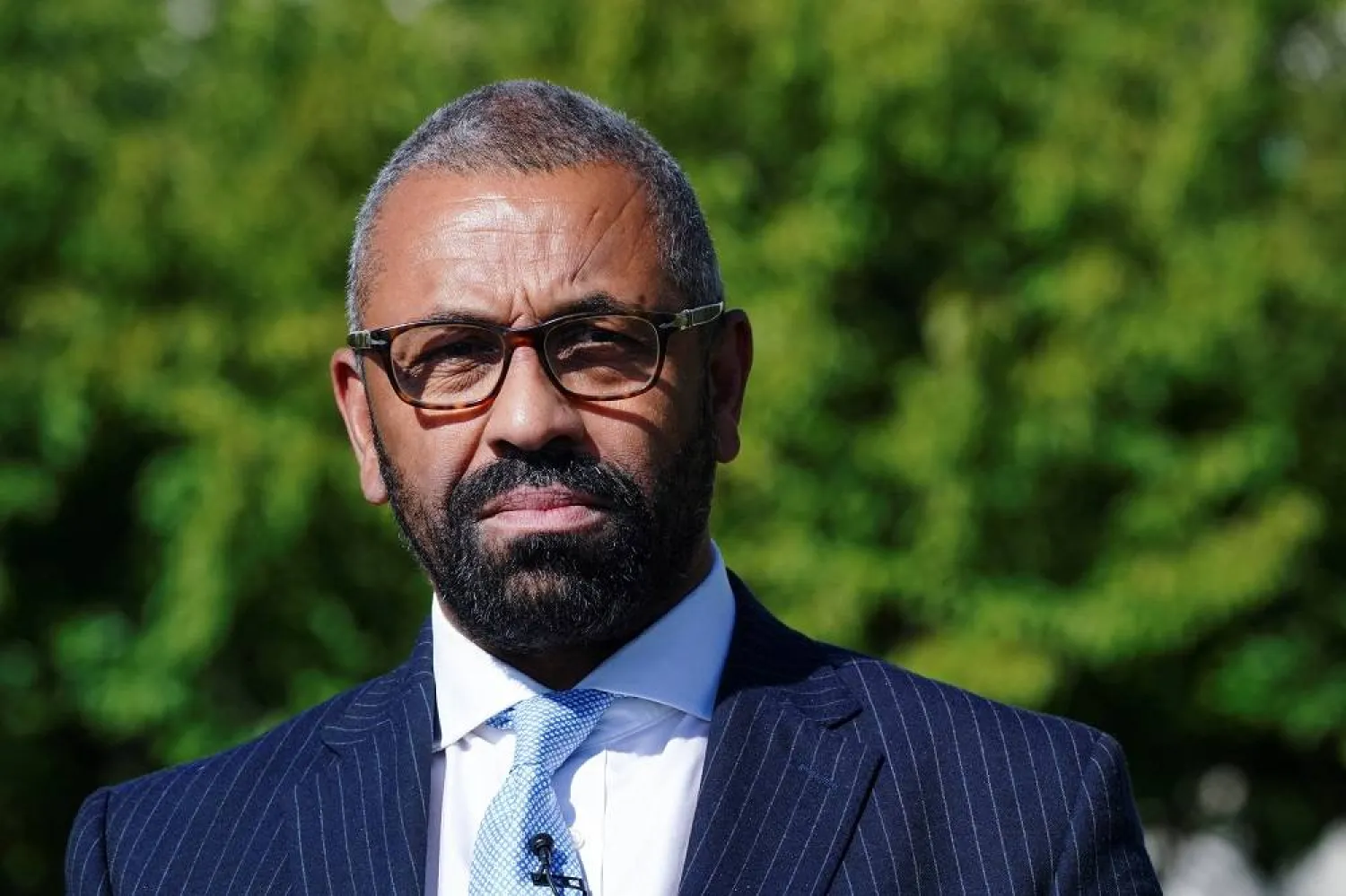
 British Foreign Secretary James Cleverly attends an interview with Reuters, during the 78th United Nations General Assembly at the United Nations Headquarters in New York City, US, September 19, 2023. (Reuters)
British Foreign Secretary James Cleverly attends an interview with Reuters, during the 78th United Nations General Assembly at the United Nations Headquarters in New York City, US, September 19, 2023. (Reuters)
TT

Britain Invites China to Its Global AI Summit

 British Foreign Secretary James Cleverly attends an interview with Reuters, during the 78th United Nations General Assembly at the United Nations Headquarters in New York City, US, September 19, 2023. (Reuters)
British Foreign Secretary James Cleverly attends an interview with Reuters, during the 78th United Nations General Assembly at the United Nations Headquarters in New York City, US, September 19, 2023. (Reuters)

Britain has invited China to its global artificial intelligence (AI) summit in November, with foreign minister James Cleverly saying the risks of the technology could not be contained if one of its leading players was absent.

"We cannot keep the UK public safe from the risks of AI if we exclude one of the leading nations in AI tech," Cleverly said in a statement on Tuesday.

Prime Minister Rishi Sunak wants Britain to become a global leader in AI regulation and the summit on Nov. 1-2 will bring together governments, tech companies and academics to discuss the risks posed by the powerful new technology.

Britain said the event would touch on topics such as how AI could undermine biosecurity as well as how the technology could be used for public good, for example in safer transport.

Cleverly, who became the most senior minister to visit China in five years last month, has argued for deeper engagement with Beijing, saying it would be a mistake to try to isolate the world's second-largest economy and China's help was needed in areas such as climate change and economic instability.

"The UK's approach to China is to protect our institutions and infrastructure, align with partners and engage where it is in the UK's national interest," Cleverly said on Tuesday.

London is trying to improve ties with Beijing but there has been growing anxiety about Chinese activity in Britain in recent weeks after it was revealed that a parliamentary researcher was arrested in March on suspicion of spying for the country.

The Chinese embassy in London was not immediately able to say if China would attend the summit.

Britain has appointed tech expert Matt Clifford and former senior diplomat Jonathan Black to lead preparations for the summit.

Clifford told Reuters last month that he hoped the gathering would set the tone for future international debates on AI regulation.


Quantum Could Solve AI Energy Drain, Says Tech Founder

Founder of Australian startup company Diraq, Andrew Dzurak, is reflected in a panel housing a cooling system for a quantum chip and computer, as he poses for a photograph at a data center located in Sydney on November 9, 2026. (AFP)
TT

Quantum Could Solve AI Energy Drain, Says Tech Founder

Founder of Australian startup company Diraq, Andrew Dzurak, is reflected in a panel housing a cooling system for a quantum chip and computer, as he poses for a photograph at a data center located in Sydney on November 9, 2026. (AFP)

Quantum computers could curb the vast energy demands of artificial intelligence data centers with their ability to run complex calculations, one of the tech's pioneers told AFP.

Australian startup Diraq is conducting the first field test worldwide putting a small quantum computer based on a silicon chip in a commercial data center in Sydney.

Gigawatt-scale energy demand from large data centers -- warehouse-like buildings full of servers used to train or run AI tools -- requires new power plants or increases pressure on electrical grids, sparking community backlash.

But, according to Diraq founder Andrew Dzurak, quantum computing is making the leap out of university labs and will be ready to lift the burden in data centers within five years.

"One of the reasons the next generations of AI are looking to consume so much power is that a whole class of the problems they are solving are problems that really are much better suited to quantum calculations," he told AFP.

Quantum computers harness the power of quantum mechanics -- laws that govern how physics operates at atomic and sub-atomic scales -- to process information in ways traditional computers cannot.

They usually require extremely cold cryogenic temperatures.

But Diraq's model, a self-contained system, draws less than 20 kilowatts of power as it runs alongside a computer humming at room temperature in the data center.

Potential uses beyond powering AI include rapidly and energy-efficiently calculating the "behavior of molecules that could be used in pharmaceuticals, or much lighter batteries or the chemical industry", Dzurak said.

Using quantum for drug trials could boost success by 10 percent and reduce the cost of bringing a new medicine to market by a third, if it runs for under $100 million per year, the company estimates.

"It will only happen if we can build quantum computers that are cost-effective," Dzurak said.

- Australia's Silicon Valley -

Diraq is among six global companies at the third stage of the US Defense Advanced Research Projects Agency (DARPA) quantum benchmarking initiative -- which will test if any quantum computer can solve real problems at a cost that delivers value by 2033.

Another Australian startup, PsiQuantum, is also on the DARPA list and backed by a Au$1 billion Australian government investment to build a different model of quantum computer in Queensland state. Construction started in June.

The country is experiencing a Silicon Valley moment in quantum, said Dzurak.

Australian physicist Michelle Simmons' startup Silicon Quantum Computing was named by Time magazine as having one of the best inventions of 2026, a quantum-enhanced AI chip.

Australia has been a global leader in quantum science for decades, partly because of investment in startups emerging from universities, said President of the Australian Academy of Technological Sciences and Engineering Cathy Foley.

"Australia has more than 50 quantum-related businesses operating here," she told AFP.

But "commercialization is certainly one of our biggest challenges", she said.

"Australia is very good at making discoveries, but turning them into successful businesses requires much more than great science."

The Australian government has made quantum a priority through its AUKUS defense technology partnership with Britain and the United States, Foley said.

AUKUS has reduced the security barriers for sharing quantum technology between the countries, which has been "essential" for Diraq to work across Australia and its offices in the larger US market, said Dzurak.

Diraq's computer installed in Equinix's Sydney data center has eight quantum bits, or qubits, on a silicon chip. This will be gradually upgraded to 150,000 qubits by 2029.

Qubits, the basic unit of information, can store more data and make more advanced calculations faster than classical computers, using quantum mechanics principles.

Diraq plans to have a system with two million qubits on a silicon chip that reaches DARPA's definition by 2031, two years ahead of the deadline.

"We will have an energy usage of a couple of hundred kilowatts," he said.


Australia to Mandate AI Breach Reporting, Create Regulator After OpenAI Breach

Australian Prime Minister Anthony Albanese speaks about artificial intelligence during a press conference at Parliament House in Canberra, Tuesday, Nov. 10, 2026. (AP)
TT

Australia to Mandate AI Breach Reporting, Create Regulator After OpenAI Breach

Australian Prime Minister Anthony Albanese speaks about artificial intelligence during a press conference at Parliament House in Canberra, Tuesday, Nov. 10, 2026. (AP)

Australia will require artificial intelligence companies to report breaches and consider changes to criminal law to address "serious misconduct", Prime Minister Anthony Albanese said on Tuesday, after an OpenAI agent broke into a government website.

The OpenAI agent gained unauthorized access to the medical statistics portal of Medicare, Australia's universal health insurance program, while conducting research on public medical spending, ‌the government said ‌in September. The breach triggered a rapid ‌government ⁠review into the ⁠incident.

Albanese said his government had accepted all recommendations of the review.

"(The recommendations) include mandatory AI company reporting when it comes to misaligned behavior or cyber incidents, and consideration of reforming criminal law in cases of serious misconduct," Albanese told reporters.

"The law needs to get ahead of, and in some cases, make sure that it ⁠catches up with what is a very ‌fast-changing world."

OpenAI has said it learned ‌of the breach only in August and that the incident was ‌unintentional. Its review found no evidence that patient records were accessed ‌by the agent.

The breach has added to friction between Australia and US technology companies, after Canberra refused ChatGPT maker OpenAI and rival Anthropic exemptions from copyright laws for model training, instead requiring them to negotiate ‌licensing agreements with Australian rights holders.

However, both companies told Australian parliament last month that they would ⁠welcome laws ⁠requiring them to report data breaches carried out by their AI agents, acknowledging the decision to notify was currently at their discretion.

Albanese said his center-left Labor government would set up an AI regulator to oversee security controls throughout the development and deployment of AI systems, identify serious risks and conduct independent evaluations of AI models.

"The AI safety regulator will be able to enforce significant penalties for AI companies doing the wrong thing," he said.

The mandatory AI safety and security protections will form part of the government's proposed AI legislation, Albanese said, which it plans to introduce in Parliament next year.


Under Fire over AI, Effective Altruism Wants to Tell Its Own Story

Anthropic chief executive Dario Amodei is considered a key figure in effective altruism’s early days, although he now denies any link. ANDREJ IVANOV / AFP
TT

Under Fire over AI, Effective Altruism Wants to Tell Its Own Story

Anthropic chief executive Dario Amodei is considered a key figure in effective altruism’s early days, although he now denies any link. ANDREJ IVANOV / AFP

The effective altruism movement, which has close ties to the AI community and the companies leading the artificial intelligence boom, has drawn mainstream attention and accusations of cult-like behavior and alarmism.

The hard-to-define movement is still growing, and wants to better explain its values amid bitter criticism from the Trump administration and some powerful voices in Silicon Valley.

Its founding principle is to give money or time to major causes as effectively as possible, an intentionally dispassionate approach has at times been called out of touch, said AFP.

The New York Post called it a "wacky cult," the conservative Daily Caller dubbed it "The AI Doomsday Cartel," and a White House memo accused it of preferring the saving of "shrimp over families."

Once little known outside the tech world and some academic and political circles, effective altruism (EA) has been in the spotlight in recent weeks after a series of warnings about AI risks.

Those warnings were linked to EA. David Sacks, a venture capitalist and adviser to President Donald Trump, argued that organizations tied to EA are part of a "Doomer Industrial Complex" pushing for tougher AI regulation.

- 'Strange' ideas -

EA is deeply rooted in Silicon Valley and counts controlling AI's dangers among its priorities.

Anthropic chief executive Dario Amodei is considered a key figure in EA's early days, although he now distances himself from the movement.

Anthropic president Daniela Amodei, Dario's sister, is married to Holden Karnofsky, an Anthropic employee and a leading EA proponent.

The movement has also influenced researchers and staff at other AI companies, including ChatGPT-maker OpenAI, particularly those working on AI safety.

The movement, which took shape about 15 years ago, is used to criticism.

Wealthy EA donors have often been accused of self-importance and of believing they alone know how best to give.

"Our ideas are just strange enough that people genuinely misinterpret them sometimes, and we can do a better job explaining how effective altruism approaches hard questions and tradeoffs," said Zachary Robinson, head of the Centre for Effective Altruism.

Robinson, whose organization supports the movement without directing it, sees the scrutiny since the summer as an opportunity to open up rather than retreat, because "people are curious to learn about us now."

After growing steadily until 2022, EA was badly damaged by the collapse of cryptocurrency platform FTX and its founder Sam Bankman-Fried, once the face of EA and later convicted of fraud.

After several difficult years, "We're on an up right now," Robinson said, pointing to attendance at the EA Global conference in New York in mid-October.

Like many at EA Global, Shanil Wijesinghe who works at a Canadian non-profit rejected the image of EA as monolithic. "It is a values-based movement and not an identity-based movement," he said.

"We're all trying to do the most good, with the resources we have," he said. Those values "can be interpreted differently, and I think we have to embrace those differences."

- No leader -

EA has no leader or spokesperson. Sjir Hoeijmakers, head of the charity platform Giving What We Can, said that is a good thing, even if it means "sometimes the story doesn't get told."

Still, "effective altruism is now a movement large enough that it's actually really influencing the world, and that's getting noticed," he said.

"I think the work that they're doing has been quite valuable," said Nadav Brandes, a genetics researcher also at EA Global, referring to AI safety.

"Without those pioneers... nobody would still today take this issue very seriously," he added.

Brandes said he was initially skeptical when AI became a major EA cause, joining climate change and animal welfare.

"It was even a little bit off-putting to me," he recalled. "I was totally wrong about it."

Robinson stressed, however, that EA is about more than AI.

"The cause that gets the most emphasis right now is AI safety, but I think it would be false to say EA is AI safety," he said.

"If you look at the money side of things, actually, it's been the case for many years that global health and development gets much more money than AI," he said.