


US Appeals Court Upholds TikTok Law Forcing Its Sale

The TikTok logo is displayed outside TikTok social media app company offices in Culver City, California, on March 16, 2023. (AFP)
TT

US Appeals Court Upholds TikTok Law Forcing Its Sale

The TikTok logo is displayed outside TikTok social media app company offices in Culver City, California, on March 16, 2023. (AFP)

A US federal appeals court on Friday upheld a law requiring Chinese-based ByteDance to divest its popular short video app TikTok in the United States by early next year or face a ban.

The decision is a complete win for the Justice Department and opponents of the Chinese-owned app and a devastating blow to ByteDance. The ruling now increases the possibility of an unprecedented ban in just six weeks on a social media app used by 170 million Americans.

The ruling is likely be appealed to the Supreme Court or full appeals court panel by ByteDance and TikTok.

Free speech advocates immediately criticized the ruling. The American Civil Liberties Union said it sets a "flawed and dangerous precedent."

"Banning TikTok blatantly violates the First Amendment rights of millions of Americans who use this app to express themselves and communicate with people around the world,” said Patrick Toomey, deputy director of the ACLU's National Security Project.

But the appeals court said the law “was the culmination of extensive, bipartisan action by the Congress and by successive presidents. It was carefully crafted to deal only with control by a foreign adversary, and it was part of a broader effort to counter a well-substantiated national security threat posed by the PRC (People's Republic of China)."

US appeals court Judges Sri Srinivasan, Neomi Rao and Douglas Ginsburg considered the legal challenges brought by TikTok and users against the law that gives ByteDance until Jan. 19 to sell or divest TikTok's US assets or face a ban.

The decision -- unless the Supreme Court reverses it -- puts TikTok's fate in the hands of first President Joe Biden on whether to grant a 90-day extension of the Jan. 19 deadline to force a sale and then to President-elect Donald Trump, who takes office on Jan. 20. But it is not clear whether ByteDance could meet the heavy burden to show it had made significant progress toward a divestiture needed to trigger the extension.

Trump, who unsuccessfully tried to ban TikTok during his first term in 2020, said before the November presidential election he would not allow the ban on TikTok.

There was no immediate comment from the Justice Department or TikTok on the decision.

The decision upholds the law that gives the US government sweeping powers to ban other foreign-owned apps that could raise concerns about collection of Americans' data. In 2020, Trump also tried to ban Tencent-owned WeChat, but was blocked by the courts.

Shares of Meta Platforms, which competes against TikTok in online ads, hit an intraday record high following the ruling, last up over 3%. Google parent Alphabet, whose YouTube video platform also competes with TikTok, was up over 1% at a session high following the ruling.

TIKTOK BAN LOOMS

The court acknowledged its decision would lead to TikTok's ban on Jan. 19 without an extension from Biden.

"Consequently, TikTok's millions of users will need to find alternative media of communication," the court said, which was because of China's "hybrid commercial threat to US national security, not to the US Government, which engaged with TikTok through a multi-year process in an effort to find an alternative solution."

The opinion was written by Ginsburg, an appointee of President Ronald Reagan, and joined by Rao, who was named to the bench by Trump, and Srinivasan, an appointee of President Barack Obama.

The Justice Department says under Chinese ownership, TikTok poses a serious national security threat because of its access to vast personal data of Americans, asserting China can covertly manipulate information that Americans consume via TikTok.

US officials have also warned TikTok's management is beholden to the Chinese government, which could compel the company to share the data of its US users.

TikTok has denied it has or ever would share US user data, accusing American lawmakers in the lawsuit of advancing "speculative" concerns.

TikTok and ByteDance argue the law is unconstitutional and violates Americans' free speech rights. They call it "a radical departure from this country's tradition of championing an open Internet."

ByteDance, backed by Sequoia Capital, Susquehanna International Group, KKR & Co, and General Atlantic, among others, was valued at $268 billion in December 2023 when it offered to buy back around $5 billion worth of shares from investors, Reuters reported at the time.

The law prohibits app stores like Apple and Alphabet's Google from offering TikTok and bars internet hosting services from supporting TikTok unless ByteDance divests TikTok by the deadline.

Apple and Google did not immediately respond to requests for comment.

In a concurring opinion, Srinivasan acknowledged the decision will have major impacts, noting "170 million Americans use TikTok to create and view all sorts of free expression and engage with one another and the world. And yet, in part precisely because of the platform’s expansive reach, Congress and multiple Presidents determined that divesting it from (China's) control is essential to protect our national security."

He added that "Because the record reflects that Congress's decision was considered, consistent with longstanding regulatory practice, and devoid of an institutional aim to suppress particular messages or ideas, we are not in a position to set it aside."



Indian PM, President of Saudi Arabia’s SDAIA Discuss AI Cooperation 

Indian Prime Minister Narendra Modi and President of the Saudi Data and Artificial Intelligence Authority (SDAIA) President Dr. Abdullah Al-Ghamdi meet on the sidelines of the India AI Impact Summit 2026. (SPA)
TT

Indian PM, President of Saudi Arabia’s SDAIA Discuss AI Cooperation 

Indian Prime Minister Narendra Modi and President of the Saudi Data and Artificial Intelligence Authority (SDAIA) President Dr. Abdullah Al-Ghamdi meet on the sidelines of the India AI Impact Summit 2026. (SPA)

Indian Prime Minister Narendra Modi held talks with President of the Saudi Data and Artificial Intelligence Authority (SDAIA) President Dr. Abdullah Al-Ghamdi on the sidelines of the India AI Impact Summit 2026, reported the Saudi Press Agency on Friday.

Discussions focused on knowledge transfer and the exchange of expertise to accelerate digital development in both nations. They also tackled expanding bilateral cooperation in data and AI.

Al-Ghamdi commended India’s leadership in hosting the summit, noting that such international partnerships are essential for harnessing advanced technology to benefit humanity and achieve shared strategic goals.


India Chases 'DeepSeek Moment' with Homegrown AI

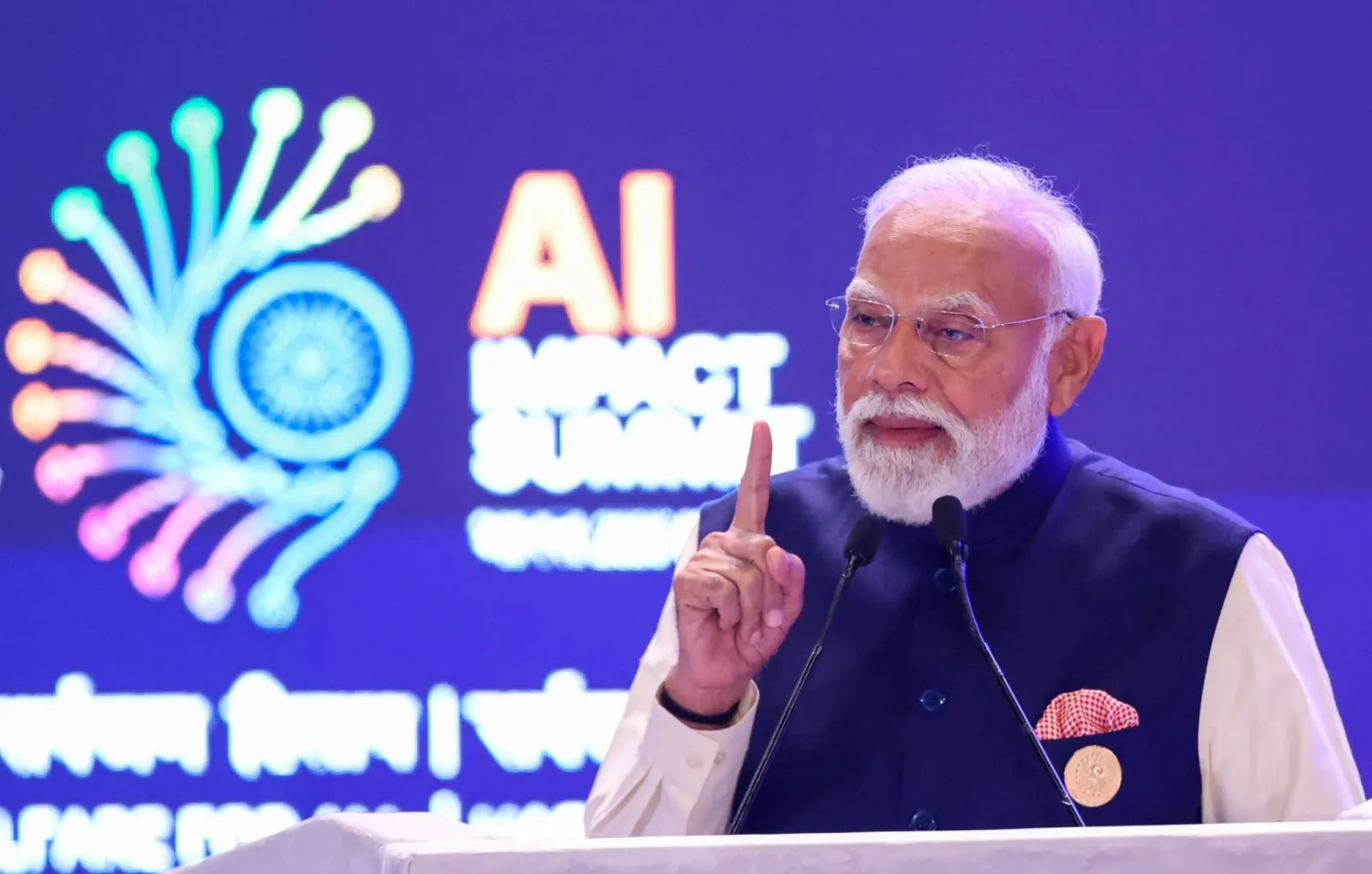
A handout photo made available by the Press Information Bureau (PIB) of Indian Prime Minister Narendra Modi speaking with global leaders at the AI Impact Summit 2026 at Bharat Mandapam in New Delhi, India, 19 February 2026.EPA/PRESS INFORMATION BUREAU HANDOUT HANDOUT
TT

India Chases 'DeepSeek Moment' with Homegrown AI

A handout photo made available by the Press Information Bureau (PIB) of Indian Prime Minister Narendra Modi speaking with global leaders at the AI Impact Summit 2026 at Bharat Mandapam in New Delhi, India, 19 February 2026.EPA/PRESS INFORMATION BUREAU HANDOUT HANDOUT

Fledgling Indian artificial intelligence companies showcased homegrown technologies this week at a major summit in New Delhi, underpinning big dreams of becoming a global AI power.

But analysts said the country was unlikely to have a "DeepSeek moment" -- the sort of boom China had last year with a high-performance, low-cost chatbot -- any time soon, AFP reported.

Still, building custom AI tools could bring benefits to the world's most populous nation.
At the AI Impact Summit, Prime Minister Narendra Modi lauded new Indian AI models, along with other examples of the country's rising profile in the field.

"All the solutions that have been presented here demonstrate the power of 'Made in India' and India's innovative qualities," Modi said Thursday.

One of the startups making a buzz at the five-day summit was Sarvam AI, which this week released two large language models it says were trained from scratch in India.

Its models are optimized to work across 22 Indian languages, says the company, which received government-subsidized access to advanced computer processors.

The five-day summit, which wraps up Friday, is the fourth annual international meeting to discuss the risks and rewards of the fast-growing AI sector.

It is the largest yet and the first in a developing country, with Indian businesses striking deals with US tech giants to build large-scale data center infrastructure to help train and run AI systems.

On Friday, Abu Dhabi-based tech group G42 said the United Arab Emirates would deploy an AI supercomputer system in India, in a project "designed to lower barriers to AI innovation".

So-called sovereign AI has become a priority for many countries hoping to reduce dependence on US and Chinese platforms while ensuring that systems respect local regulations, including on data privacy.

AI models that succeed in India "can be deployed all over the world", Modi said on Thursday.

But experts said the sheer computational might of the United States would be hard to match.

"Despite the headline pledges, we don't expect India to emerge as a frontier AI innovation hub in the near term," said Reema Bhattacharya, head of Asia research at risk intelligence company Verisk Maplecroft.

"Its more realistic trajectory is to become the world's largest AI adoption market, embedding AI at scale through digital public infrastructure and cost-efficient applications," she said.

Another Indian company that drew attention with product debuts this week was the Bengaluru-based Gnani.ai, which introduced its Vachana speech models at the summit.

Trained on more than a million hours of audio, Vachana models generate natural-sounding voices in Indian languages that can process customer interactions and allow people to interact with digital services out loud.

Job disruption and redundancies, including in India's huge call center industry, have been one key focus of discussions at the Delhi summit.

Prihesh Ratnayake, head of AI initiatives at think-tank Factum, told AFP that the new Indian AI models were "not really meant to be global".

"They're India-specific models, and hopefully we'll see their impact over the coming year," he said.

"Why does India need to build for the global scale? India itself is the biggest market."
And Nanubala Gnana Sai at the Cambridge AI Safety Hub said that homegrown models could bring other benefits.

Existing models, even those developed in China, "have intrinsic bias towards Western values, culture and ethos -- as a product of being trained heavily on that consensus", Sai told AFP.

India already has some major strengths, including "technology diffusion, eager talent pool and cheap labor", and dedicated efforts can help startups pivot to artificial intelligence, he said.

"The end-product may not 'rival' ChatGPT or DeepSeek on benchmarks, but will provide leverage for the Global South to have its own stand in an increasingly polarized world."


Report: Nvidia Nears Deal for Scaled-down Investment in OpenAI

Nvidia chief executive Jensen Huang has insisted that the AI chip powerhouse is committed to a big investment in ChatGPT-maker OpenAI. Lionel BONAVENTURE / AFP
TT

Report: Nvidia Nears Deal for Scaled-down Investment in OpenAI

Nvidia chief executive Jensen Huang has insisted that the AI chip powerhouse is committed to a big investment in ChatGPT-maker OpenAI. Lionel BONAVENTURE / AFP

Nvidia is on the cusp of investing $30 billion in OpenAI, scaling back a plan to pump $100 billion into the ChatGPT maker, the Financial Times reported Thursday.

The AI-chip powerhouse will be part of OpenAI's new funding round with an agreement that could be concluded as early as this weekend, according to the Times, which cited unnamed sources close to the matter.

Nvidia declined to comment on the report.

Nvidia chief executive Jensen Huang has insisted that the US tech giant will make a "huge" investment in OpenAI and dismissed as "nonsense" reports that he is unhappy with the generative AI star.

Huang made the remarks late in January after the Wall Street Journal reported that Nvidia's plan to invest up to $100 billion in OpenAI had been put on ice.

Nvidia announced the plan in September, with the investment helping OpenAI build more infrastructure for next-generation artificial intelligence.

The funding round is reported to value OpenAI at some $850 billion.

Huang told journalists that the notion of Nvidia having doubts about a huge investment in OpenAI was "complete nonsense."

Huang insisted that Nvidia was going ahead with its investment in OpenAI, describing it as "one of the most consequential companies of our time".

"Sam is closing the round, and we will absolutely be involved in the round," Huang said, referring to OpenAI chief executive Sam Altman.

"We will invest a great deal of money."

Nvidia has become the coveted supplier of processors needed for training and operating the large language models (LLM) behind chatbots like OpenAI's ChatGPT or Google Gemini.

LLM developers like OpenAI are directing much of the mammoth investment they have received into Nvidia's products, rushing to build GPU-stuffed data centers to serve an anticipated flood of demand for AI services.

The AI rush, and its frenzy of investment in giant data centers and the massive purchase of energy-intensive chips, continues despite signs of concern in the markets.