


Trump Offers Support to Musk's Car Company in a Surprising Post as Tesla Stock Plunges

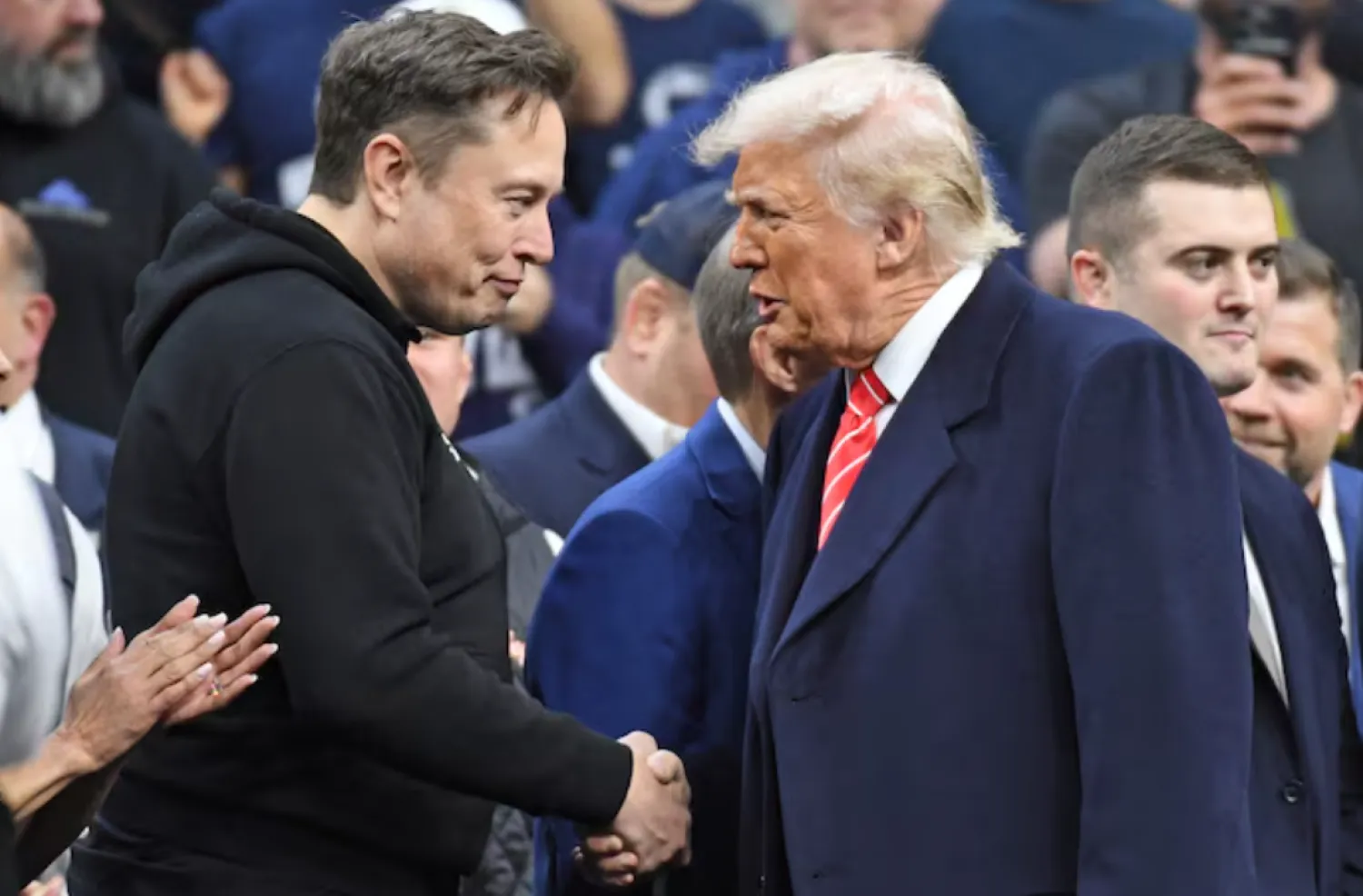
Mar 22, 2025; Philadelphia, PA, USA; Elon Musk and President Donald Trump during the Division I Men's Wrestling Championship held at Wells Fargo Center. Mandatory Credit: Eric Hartline-Imagn Images/File Photo
TT

Trump Offers Support to Musk's Car Company in a Surprising Post as Tesla Stock Plunges

Mar 22, 2025; Philadelphia, PA, USA; Elon Musk and President Donald Trump during the Division I Men's Wrestling Championship held at Wells Fargo Center. Mandatory Credit: Eric Hartline-Imagn Images/File Photo

President Donald Trump took to social media Thursday morning to support Elon Musk's car company, a startling development given their bitter public feud.

”I want Elon, and all businesses within our Country, to THRIVE,” Trump wrote on Truth Social, Reuters reported.

The post wasn't enough to help Tesla's stock, which fell sharply after the company reported another quarter of lackluster financial results and Musk warned of some potentially “rough quarters” into next year. At midday, the stock was down around 9%.

Late Wednesday, Tesla said revenue fell 12% and profit dropped 16% in the April-June quarter. Many prospective buyers have been turned off by Musk’s foray into right-wing politics, and the competition has ramped up in key markets such as Europe and China.

Investors have been unnerved by Musk's social media spat with the president because Trump has threatened to retaliate by ending government contracts and breaks for Musk's various businesses, including Tesla.

But Trump struck a starkly different tone Thursday morning.

“Everyone is stating that I will destroy Elon’s companies by taking away some, if not all, of the large scale subsidies he receives from the US Government. This is not so!" Trump wrote. “The better they do, the better the USA does, and that’s good for all of us.”

After Trump's massive budget bill passed earlier this month, Tesla faces the loss of the $7,500 EV tax credit and stands to make much less money from selling regulatory credits to other automakers. Trump’s tariffs on countries including China and Mexico will also cost Tesla hundreds of millions of dollars, the company said on its earnings call.

Musk has blasted the budget bill on his own social media platform X for adding to US debt at a time when it is already too large. The Tesla CEO has called the budget pushed by the president a “disgusting abomination” and has threatened to form a new political party.

On Wednesday's call, Musk said the electric vehicle maker will face “a few rough quarters” as it moves into a future focused less on selling cars and more on offering people rides in self-driving cars. He also talked up the company's business making humanoid robotics. But he acknowledged those businesses are a ways off from contributing to Tesla’s bottom line.

Tesla began a rollout in June of its paid robotaxi service in Austin, Texas, and hopes to introduce the driverless cabs in several other cities soon. Musk told analysts that the service will be available to probably “half of the population of the US by the end of the year — that’s at least our goal, subject to regulatory approvals.”

“We’re in this weird transition period where we’ll lose a lot of incentives in the US,” Musk said, adding that Tesla “probably could have a few rough quarters” ahead. He added, though, “Once you get to autonomy at scale in the second half of next year, certainly by the end of next year, I would be surprised if Tesla’s economics are not very compelling.”




Alswaha: Saudi Arabia Leads International Indicators, Efforts to Bridge AI Gaps

Saudi Minister of Communications and Information Technology Abdullah Alswaha speaks at the event in New York. (SPA)
TT

Alswaha: Saudi Arabia Leads International Indicators, Efforts to Bridge AI Gaps

Saudi Minister of Communications and Information Technology Abdullah Alswaha speaks at the event in New York. (SPA)

Saudi Minister of Communications and Information Technology Abdullah Alswaha stressed on Tuesday that the Kingdom’s achievements represent the greatest digital success story of the 21st century.

This was possible by the support of Custodian of the Two Holy Mosques King Salman bin Abdulaziz Al Saud and the direct enablement by Prince Mohammed bin Salman bin Abdulaziz Al Saud, Crown Prince and Prime Minister, reflecting their ambitious vision for building a comprehensive technological future.

The minister made his remarks from New York during his participation in the high-level meeting of the United Nations General Assembly (UNGA) on the overall review of the implementation of the outcomes of the World Summit on the Information Society (WSIS).

Alswaha said that progress in the information society is reflected worldwide, with the number of internet users rising from around 800 million to nearly 6 billion.

The Kingdom ranked first globally on the ICT Development Index (IDI) issued by the UN International Telecommunication Union (ITU) and made remarkable progress in empowering women in the digital world, with female participation reaching approximately 36%, he revealed.

He highlighted that the foremost challenge today lies in bridging the gaps in artificial intelligence (AI), namely the computing gap, the data gap, and the algorithm gap.

Alswaha stated that the Kingdom leveraged its capabilities to boost advanced computing power and launch national language models that help close the data gap in the Arab world, including the AI model “ALLaM.”

Moreover, he noted global scientific achievements, such as Saudi scientist Omar Yaghi winning the 2025 Nobel Prize in Chemistry, reflecting Saudi Arabia’s scientific presence on the international stage.

He stressed that the achievements reflect the profound impact of the support from King Salman and Crown Prince Mohammed in consolidating the Kingdom’s global standing, enhancing its pivotal role in leading a more inclusive technological future, harnessing technologies for human benefit, supporting sustainable development, and aligning with the world’s aspirations for a more advanced and integrated era.


App Developers Urge EU Action on Apple Fee Practices 

An Apple logo adorns the façade of the downtown Brooklyn Apple store on March 14, 2020, in New York. (AP)
TT

App Developers Urge EU Action on Apple Fee Practices 

An Apple logo adorns the façade of the downtown Brooklyn Apple store on March 14, 2020, in New York. (AP)

A coalition of 20 app developers and consumer groups on Tuesday called upon European regulators to enforce EU laws against Apple, saying the company's fee structure unfairly disadvantages European developers compared to their US rivals after a recent court decision in the United States.

The European Union's Digital Markets Act (DMA), implemented in 2023, mandates that large tech platforms labelled "gatekeepers", such as Apple, facilitate in-app transactions outside their ecosystem at no charge.

The coalition's appeal reflects concerns over a disparity following a US court ruling that restricts Apple's ability to impose fees on external transactions.

The European Commission earlier this year fined Apple 500 million euros ($588 million) for breaching the DMA by obstructing developers from guiding users to alternative payment methods.

In response to the EU ruling, Apple revised its terms to impose fees ranging from 13% for smaller businesses to up to 20% for App Store purchases, alongside penalties of 5% to 15% on external transactions.

The Coalition for Apps Fairness (CAF), representing firms such as Deezer and Proton, argues these revised fees still violate DMA stipulations and says that US developers benefit from more favorable terms after the court decision.

"This situation is untenable and damaging to the app economy," CAF said in a statement, accusing Apple of undermining transparency and stifling innovation.

Global Policy Counsel for CAF, Gene Burrus, said that developers in the EU have to either bear the cost of those fees or pass them down to customers.

"It is bad for European companies, and it is bad for European consumers," he said.

According to CAF, European developers remain disadvantaged six months after the Commission declared Apple's policies illegal under the DMA.

Although Apple has announced further policy changes to take effect in January, it has yet to specify what these revisions will entail, fueling dissatisfaction among developers over the lack of clarity.

"We want the EU Commission to tell Apple that the law is the law and that free of charge means free of charge," Burrus said, adding that the European authorities should consider referring the issue to the European Court of Justice if necessary.


Will OpenAI Be the Next Tech Giant or Next Netscape?

While OpenAI does not expect to be profitable before 2029, the startup's valuation keeps climbing in funding rounds baffling some financial analysts. Kirill KUDRYAVTSEV / AFP
TT

Will OpenAI Be the Next Tech Giant or Next Netscape?

While OpenAI does not expect to be profitable before 2029, the startup's valuation keeps climbing in funding rounds baffling some financial analysts. Kirill KUDRYAVTSEV / AFP

Three years after ChatGPT made OpenAI the leader in artificial intelligence and a household name, rivals have closed the gap and some investors are wondering if the sensation has the wherewithal to stay dominant.

Investor Michael Burry, made famous in the film "The Big Short," recently likened OpenAI to Netscape, which ruled the web browser market in the mid-1990s only to lose to Microsoft's Internet Explorer.

"OpenAI is the next Netscape, doomed and hemorrhaging cash," Burry said recently in a post on X, formerly Twitter.

Researcher Gary Marcus, known for being skeptical of AI hype, sees OpenAI as having lost the lead it captured with the launch of ChatGPT in November 2022.

The startup is "burning billions of dollars a month," Marcus said of OpenAI.

"Given how long the writing has been on the wall, I can only shake my head" as it falls.

Yet ChatGPT was a tech launch like no other, breaking all consumer product growth records and now boasting more than 800 million -- paid subscription and unpaid -- weekly users.

OpenAI's valuation has soared to $500 billion in funding rounds, higher than any other private company.

But the ChatGPT maker will end this year with a loss of several billion dollars and does not expect to be profitable before 2029, an eternity in the fast-moving and uncertain world of AI.

Nonetheless, the startup has committed to paying more than $1.4 trillion to computer chip makers and data center builders to build infrastructure it needs for AI.

The fierce cash burn is raising questions, especially since Google claims some 650 million people use its Gemini AI monthly and the tech giant has massive online ad revenue to back its spending on technology.

Rivals Amazon, Meta and OpenAI-investor Microsoft have deep pockets the ChatGPT-maker cannot match.

Turbulence ahead?

A charismatic salesman, OpenAI chief executive Sam Altman flashed rare annoyance when asked about the startup's multi-trillion-dollar contracts in early November.

A few days later, he warned internally that the startup is likely to face a "turbulent environment" and an "unfavorable economic climate," particularly given competitive pressure from Google.

And when Google released its latest model to positive reactions, Altman issued a "red alert," urging OpenAI teams to give ChatGPT their best efforts.

OpenAI unveiled its latest ChatGPT model last week, that same day announcing Disney would invest in the startup and license characters for use in the bot and Sora video-generating tool.

OpenAI's challenge is inspiring the confidence that the large sums of money it is investing will pay off, according to Foundation Capital partner Ashu Garg.

For now OpenAI is raising money at lofty valuations while returns on those investments are questionable, Garg added.

Yet OpenAI still has the faith of the world's deepest-pocketed investors.

"I'm always expecting OpenAI's valuation to come down because competition is coming and its capital structure is so obviously inappropriate," said Pluris Valuation Advisors president Espen Robak.

"But it only seems to be going up."

Opinions are mixed on whether the situation will result in OpenAI postponing becoming a publicly traded company or instead make its way faster to Wall Street to cash in on the AI euphoria.

Few AI industry analysts expect OpenAI to implode completely, since there is room in the market for several models to thrive.

"At the end of the day, it's not winner take all," said CFRA analyst Angelo Zino.

"All of these companies will take a piece of the pie, and the pie continues to get bigger," he said of AI industry frontrunners.

Also factored in is that while OpenAI has made dizzying financial commitments, terms of deals tend to be flexible and Microsoft is a major backer of the startup.