

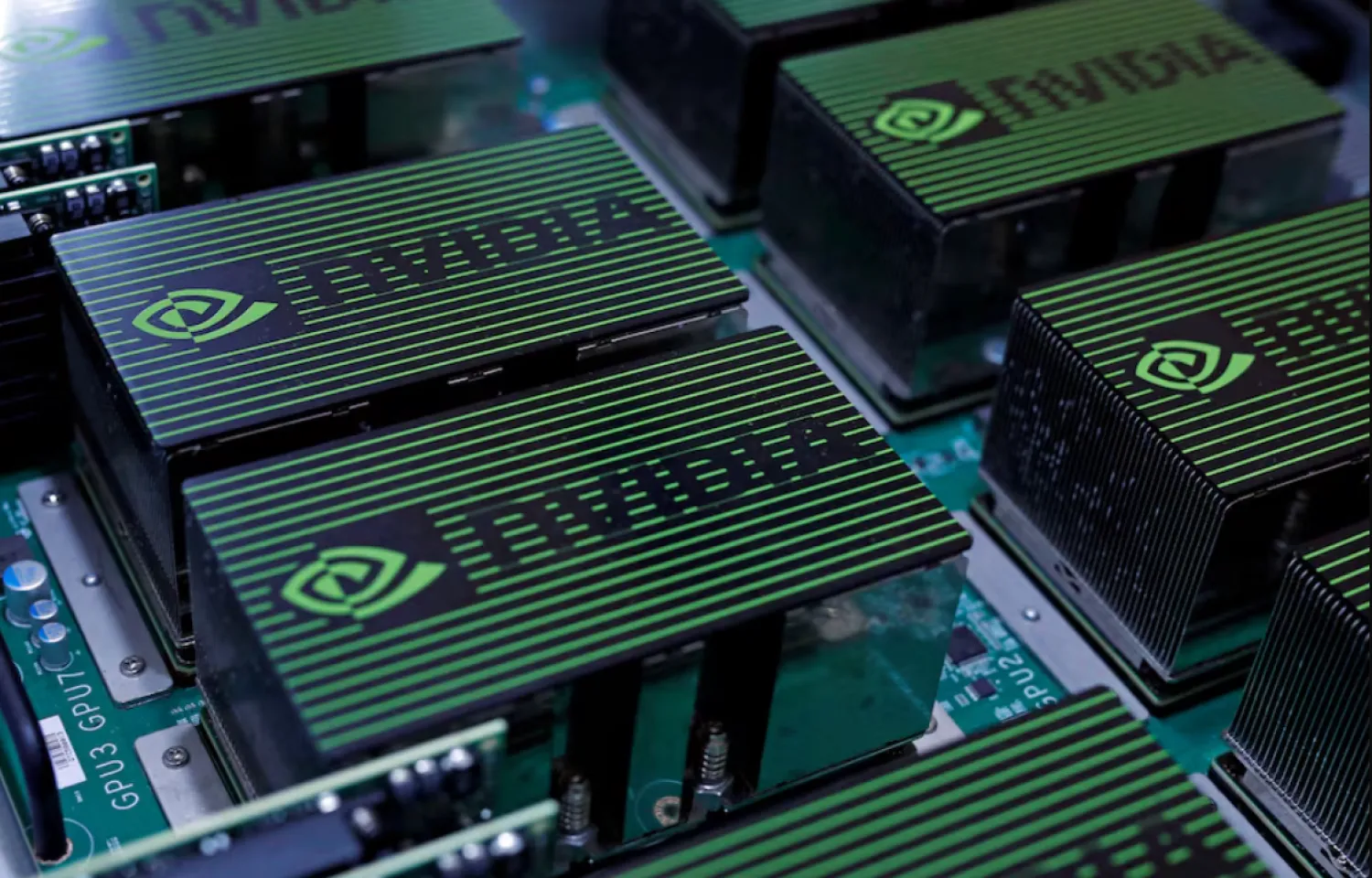

Nvidia, AMD to Pay 15% of China Chip Sale Revenue to US Government

The logo of Nvidia Corporation is seen during the annual Computex computer exhibition in Taipei, Taiwan May 30, 2017. REUTERS/Tyrone Siu/File Photo
TT

Nvidia, AMD to Pay 15% of China Chip Sale Revenue to US Government

The logo of Nvidia Corporation is seen during the annual Computex computer exhibition in Taipei, Taiwan May 30, 2017. REUTERS/Tyrone Siu/File Photo

Nvidia and AMD agreed to share 15% of their revenues from chip sales to China with the US government, a US government official has confirmed.

President Donald Trump's administration halted the sale of advanced computer chips to China back in April over national security concerns, but Nvidia and AMD revealed in July that Washington would allow them to resume sales of the H20 and MI308 chips, which are used in artificial intelligence development, Reuters reported.

The official, who insisted on anonymity to discuss a policy not yet formally announced, confirmed to The Associated Press the revenue sharing terms of the deal, and said the broad strokes of the initial report by The Financial Times were accurate.

The FT reports that Nvidia and AMD agreed to the financial arrangement as a condition for obtaining export license to resume sales to China.

Nvidia did not comment about the specific details of the agreement or its quid pro quo nature, but said they would adhere to the export rules laid out by the administration.

"We follow rules the US government sets for our participation in worldwide markets. While we haven’t shipped H20 to China for months, we hope export control rules will let America compete in China and worldwide,” Nvidia wrote in a statement to the AP. “America cannot repeat 5G and lose telecommunication leadership. America’s AI tech stack can be the world’s standard if we race.”

AMD did not immediately reply to a request for comment.

The top Democrat on a House panel focusing on competition with China raised concerns over the reported agreement, calling it “a dangerous misuse of export controls that undermines our national security.”

Rep. Raja Krishnamoorthi, the ranking member of the House Select Committee on China, said he would seek answers about the legal basis for this arrangement and demand full transparency from the administration.

“Our export control regime must be based on genuine security considerations, not creative taxation schemes disguised as national security policy,” he said. “Chip export controls aren’t bargaining chips, and they’re not casino chips either. We shouldn’t be gambling with our national security to raise revenue.”

Back in July, Nvidia argued that tight export controls around their chip sales would cost the company an extra $5.5 billion. They’ve argued that such limits hinder US competition in a sector in one of the world’s largest markets for technology, and have also warned that US export controls could end up pushing other countries toward China’s AI technology.

Commerce Secretary Howard Lutnick told CNBC in July that the renewed sale of Nvidia's chips in China was linked to a trade agreement made between the two countries on rare earth magnets.

Restrictions on sales of advanced chips to China have been central to the AI race between the world’s two largest economic powers, but such controls are also controversial. Proponents argue that these restrictions are necessary to slow China down enough to allow US companies to keep their lead. Meanwhile, opponents say the export controls have loopholes — and could still spur innovation. The emergence of China’s DeepSeek AI chatbot in January particularly renewed concerns over how China might use advanced chips to help develop its own AI capabilities.



Saudi Arabia, Japan Explore AI and Digital Government Collaboration

The Saudi Minister of Communications and Information Technology met with Japan's Minister for Digital Transformation in Davos. SPA
TT

Saudi Arabia, Japan Explore AI and Digital Government Collaboration

The Saudi Minister of Communications and Information Technology met with Japan's Minister for Digital Transformation in Davos. SPA

Saudi Minister of Communications and Information Technology Abdullah Alswaha met with Japan's Minister for Digital Transformation Hisashi Matsumoto during the Kingdom's participation in the World Economic Forum (WEF) in Davos.

The meeting focused on expanding the partnership between the two countries in digital government, AI, digital capability development, and the empowerment of entrepreneurship.


Taiwan Says It Will Lead ‘Democratic’ High-Tech Supply Chain with US

Taiwan's Vice Premier Cheng Li-chiun speaks at a press conference about US-Taiwan trade deal in Taipei, Taiwan, January 20, 2026. (Reuters)
TT

Taiwan Says It Will Lead ‘Democratic’ High-Tech Supply Chain with US

Taiwan's Vice Premier Cheng Li-chiun speaks at a press conference about US-Taiwan trade deal in Taipei, Taiwan, January 20, 2026. (Reuters)

Taiwan aims to build a "democratic" high-tech supply chain ​with the United States and form a strategic AI partnership under the new tariffs deal it sealed with Washington last week, Taipei's top negotiator in the talks said on Tuesday.

US President Donald Trump has pushed the major producer of semiconductors, which runs a large trade surplus with the United States, to invest more in the US, specifically in chips that power AI.

Under the terms of the long-negotiated deal, chipmakers like TSMC that expand US production will incur a lower tariff on semiconductors or related manufacturing equipment and products they import into the US and will ‌be able ‌to import some items duty-free. Broad tariffs that apply to most ‌other Taiwanese ⁠exports ​to ‌the US will fall from 20% to 15%.

Taiwan companies will also invest $250 billion to boost production of semiconductors, energy and artificial intelligence in the US, while Taiwan will also guarantee an additional $250 billion in credit to facilitate further investment.

Speaking to reporters in Taipei, Vice Premier Cheng Li-chiun said the deal was not about hollowing out Taiwan's chip industry, which is so important for the economy it is widely referred to as the "sacred mountain protecting the country".

"This is not supply-chain relocation; rather, it is ⁠support for Taiwan's high-tech industries to extend their strength abroad - through addition, and even multiplication - to expand a strong international footprint in ‌the United States," she said.

CHIPMAKER INVESTMENTS

Under the agreement, chipmakers that ‍expand in the US will be able ‍to import up to 2.5 times their new capacity of semiconductors and wafers with no ‍extra tariffs during an approved construction period. Preferential treatment would apply to chips that exceed that quota.

Cheng said Taiwan has secured preferential treatment in advance under any future Section 232 measures on semiconductors, which is an ongoing US national security investigation into imports of key products like chips and pharmaceuticals.

"As for what the actual ​Section 232 semiconductor tariff will be in the future, (US Commerce) Secretary Lutnick recently mentioned a possible rate of 100%, but this remains undecided," Cheng said.

"Regardless, under any ⁠future tariff scenario, we have ensured that the US will grant Taiwan the most favorable treatment: zero tariffs within the quota and preferential tariffs even outside the quota."

In an interview with CNBC last week, US Commerce Secretary Howard Lutnick said that if companies do not build in the US, a tariff would likely be 100%.

"In the past we said, 'Taiwan can help'," Cheng added, referring to Taiwan's past efforts to help the international community during the COVID pandemic and other crises.

"We hope in the future it will be "Taiwan-US can lead,' with the two sides joining forces and, under the wave of AI, working together to build a high-tech supply chain for the democratic camp. This is our strategic objective."

The US is Taiwan's most important backer and arms supplier, despite the lack of formal diplomatic ‌ties. Beijing claims the democratically governed island as its own and has not ruled out the use of force to achieve its goals.


OpenAI Introducing Ads to ChatGPT

FILE PHOTO: OpenAI logo is seen in this illustration taken May 20, 2024. REUTERS/Dado Ruvic/Illustration/File Photo
TT

OpenAI Introducing Ads to ChatGPT

FILE PHOTO: OpenAI logo is seen in this illustration taken May 20, 2024. REUTERS/Dado Ruvic/Illustration/File Photo

OpenAI announced Thursday it will begin testing advertisements on ChatGPT in the coming weeks, as the wildly popular artificial intelligence chatbot seeks to increase revenue to cover its soaring costs.

The ads will initially appear in the United States for free and lower-tier subscribers, the company said in a blog post outlining its long-anticipated move into advertising.

The integration of advertising has been a key question for generative AI chatbots, with companies largely reluctant to interrupt the user experience with ads.

But the exorbitant costs of running AI services may have forced OpenAI's hand.
Only a small percentage of its nearly one billion users pay for subscription services, putting pressure on the company to find new revenue sources.

Since ChatGPT's launch in 2022, OpenAI's valuation has soared to $500 billion in funding rounds -- higher than any other private company. Some expect it could go public with a trillion-dollar valuation.

But the ChatGPT maker burns through cash at a furious rate, mostly on the powerful computing required to deliver its services.

With its move, OpenAI brings its business model closer to tech giants Google and Meta, which have built advertising empires on the back of their free-to-use services.

Unlike OpenAI, those companies have massive advertising revenue to fund AI innovation -- with Amazon also building a solid ad business on its shopping and video streaming platforms.

"Ads aren't a distraction from the gen AI race; they're how OpenAI stays in it," said Jeremy Goldman, an analyst at Emarketer.

"If ChatGPT turns on ads, OpenAI is admitting something simple and consequential: the race isn't just about model quality anymore; it's about monetizing attention without poisoning trust," he added.

OpenAI's pivot comes as Google gains ground in the generative AI race, infusing services including Gmail, Maps and YouTube with AI features that -- in addition to its Gemini chatbot -- compete directly with ChatGPT.

To address concerns about its pivot into advertising, OpenAI pledged that ads would never influence ChatGPT's answers and that user conversations would remain private from advertisers.

"Ads do not influence the answers ChatGPT gives you," the company stated, according to AFP. "Answers are optimized based on what's most helpful to you. Ads are always separate and clearly labeled."

In an apparent reference to Meta, TikTok and Google's YouTube -- platforms accused of maximizing user engagement to boost ad views -- OpenAI said it would "not optimize for time spent in ChatGPT."

"We prioritize user trust and user experience over revenue," it added.

The commitment to user well-being is a sensitive issue for OpenAI, which has faced accusations of allowing ChatGPT to prioritize emotional engagement over safety, allegedly contributing to mental distress among some users.