


Big Tech is Paying Millions to Train Teachers on AI, in Push to Bring Chatbots Into Classrooms

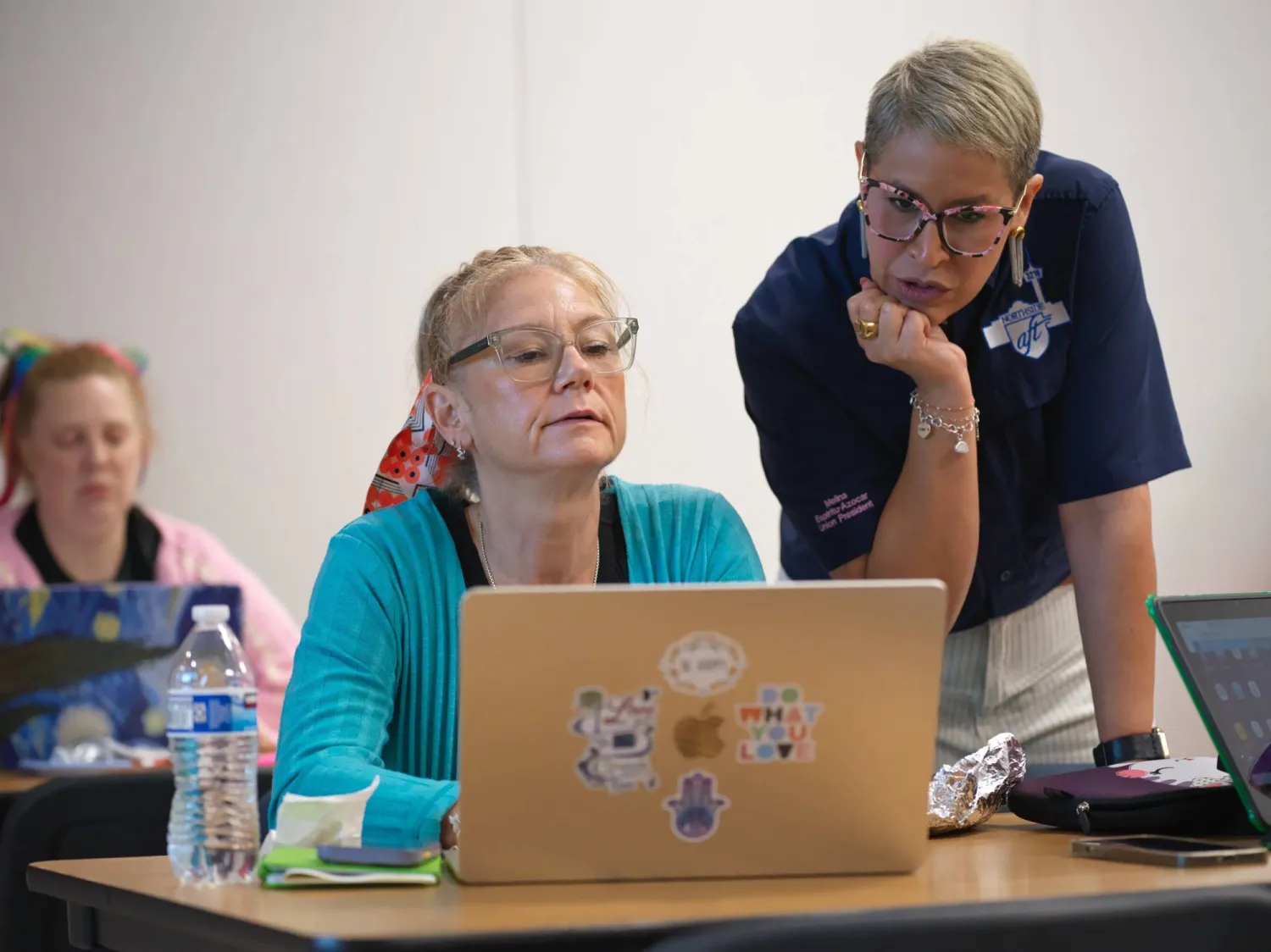
Northside American Federation of Teachers President Melina Espiritu-Azocar, right, speaks with middle school teacher Celeste Simone during a Microsoft AI skilling event, Saturday, Sept. 27, 2025, in San Antonio. (AP Photo/Darren Abate)
TT

Big Tech is Paying Millions to Train Teachers on AI, in Push to Bring Chatbots Into Classrooms

Northside American Federation of Teachers President Melina Espiritu-Azocar, right, speaks with middle school teacher Celeste Simone during a Microsoft AI skilling event, Saturday, Sept. 27, 2025, in San Antonio. (AP Photo/Darren Abate)

On a scorching hot Saturday in San Antonio, dozens of teachers traded a day off for a glimpse of the future. The topic of the day’s workshop: enhancing instruction with artificial intelligence.

After marveling as AI graded classwork instantly and turned lesson plans into podcasts or online storybooks, one high school English teacher raised a concern that was on the minds of many: “Are we going to be replaced with AI?”

That remains to be seen. But for the nation’s 4 million teachers to stay relevant and help students use the technology wisely, teachers unions have forged an unlikely partnership with the world’s largest technology companies. The two groups don’t always see eye to eye but say they share a common goal: training the future workforce of America.

Microsoft, OpenAI and Anthropic are providing millions of dollars for AI training to the American Federation of Teachers, the country’s second-largest teachers union, The Associated Press reported. In exchange, the tech companies have an opportunity to make inroads into schools and win over students in the race for AI dominance.

AFT President Randi Weingarten said skepticism guided her negotiations, but the tech industry has something schools lack: deep pockets.

“There is no one else who is helping us with this. That’s why we felt we needed to work with the largest corporations in the world,” Weingarten said. “We went to them — they didn’t come to us.”

Weingarten first met with Microsoft CEO Brad Smith in 2023 to discuss a partnership. She later reached out to OpenAI to pursue an “agnostic” approach that means any company's AI tools could be used in a training session.

Under the arrangement announced in July, Microsoft is contributing $12.5 million to AFT over five years. OpenAI is providing $8 million in funding and $2 million in technical resources, and Anthropic has offered $500,000.

Tech money will build an AI training hub for teachers With the money, AFT is planning to build an AI training hub in New York City that will offer virtual and in-person workshops for teachers. The goal is to open at least two more hubs and train 400,000 teachers over the next five years.

The National Education Association, the country’s largest teachers union, announced its own partnership with Microsoft last month. The company has provided a $325,000 grant to help the NEA develop AI trainings in the form of “microcredentials” — online trainings open to the union’s 3 million members, said Daaiyah Bilal, NEA’s senior director of education policy. The goal is to train at least 10,000 members this school year.

“We tailored our partnership very surgically,” Bilal said. “We are very mindful of what a technology company stands to gain by spreading information about the products they develop.”

Both unions set similar terms: Educators, not the private funders, would design and lead trainings that include AI tools from multiple companies. The unions own the intellectual property for the trainings, which cover safety and privacy concerns alongside AI skills.

The Trump administration has encouraged the private investment, recently creating an AI Education Task Force as part of an effort to achieve "global dominance in artificial intelligence.” The federal government urged tech companies and other organizations to foot the bill. So far, more than 100 companies have signed up.

Tech companies see opportunities in education beyond training teachers. Microsoft unveiled a $4 billion initiative for AI training, research and the gifting of its AI tools to teachers and students. It includes the AFT grant and a program that will give all school districts and community colleges in Washington, Microsoft’s home state, free access to Microsoft CoPilot tools. Google says it will commit $1 billion for AI education and job training programs, including free access to its Gemini for Education platform for US high schools.

Several recent studies have found that AI use in schools is rapidly increasing but training and guidance are lagging.

The industry offers resources that can help scale AI literacy efforts quickly. But educators should ensure any partnership focuses on what’s best for teachers and students, said Robin Lake, director of the Center on Reinventing Public Education.

“These are private initiatives, and they are run by companies that have a stake,” Lake said.

Microsoft CEO Brad Smith agrees that teachers should have a “healthy dose of skepticism” about the role of tech companies.

“While it’s easy to see the benefits right now, we should always be mindful of the potential for unintended consequences,” Smith said in an interview, pointing to concerns such as AI’s possible impact on critical thinking. “We have to be careful. It’s early days.”

Teachers see new possibilities At the San Antonio AFT training, about 50 educators turned up for the three-hour workshop for teachers in the Northside Independent School District. It is the city's largest, employing about 7,000 teachers.

The day started with a pep talk.

“We all know, when we talk about AI, teachers say, ‘Nah, I’m not doing that,’” trainer Kathleen Torregrossa told the room. “But we are preparing kids for the future. That is our primary job. And AI, like it or not, is part of our world.”

Attendees generated lesson plans using ChatGPT, Google’s Gemini, Microsoft CoPilot and two AI tools designed for schools, Khanmingo and Colorín Colorado.

Gabriela Aguirre, a 1st grade dual language teacher, repeatedly used the word “amazing” to describe what she saw.

“It can save you so much time,” she said, and add visual flair to lessons. She walked away with a plan to use AI tools to make illustrated flashcards in English and Spanish to teach vocabulary.

“With all the video games, the cellphones you have to compete against, the kids are always saying, ‘I’m bored.’ Everything is boring,” Aguirre said. “If you can find ways to engage them with new technology, you’ve just got to do that.”

Middle school teacher Celeste Simone said there is no turning back to how she taught before.

As a teacher for English language learners, Simone can now ask AI tools to generate pictures alongside vocabulary words and create illustrated storybooks that use students' names as characters. She can take a difficult reading passage and ask a chatbot to translate it into Spanish, Pashto or other languages. And she can ask AI to rewrite difficult passages at any grade level to match her students' reading levels. All in a matter of seconds.

“I can give my students access to things that never existed before,” Simone said. “As a teacher, once you’ve used it and see how helpful it is, I don’t think I could go back to the way I did things before.”


Nvidia, Bitcoin and Other Superstars on Wall Street Keep Falling

FILE PHOTO: Representation of Bitcoin cryptocurrency is seen in this illustration taken September 10, 2025. REUTERS/Dado Ruvic/Illustration/File Photo
TT

Nvidia, Bitcoin and Other Superstars on Wall Street Keep Falling

FILE PHOTO: Representation of Bitcoin cryptocurrency is seen in this illustration taken September 10, 2025. REUTERS/Dado Ruvic/Illustration/File Photo

Nvidia, bitcoin and others among Wall Street’s highest flyers are falling more toward Earth on Friday, and the US stock market is heading for a second straight sharp loss.

The S&P 500 sank 1.2%, coming off one of its worst days since its springtime sell-off and a global wipeout for stocks. Critics had been warning that such drops could be possible because of how high stock prices had shot since April, leaving them looking too expensive. They pointed in particular to stocks swept up in the mania around artificial-intelligence technology.

But even with its recent drops, and the S&P 500 on track for a second straight weekly loss, the index that dictates the movements for many 401(k) accounts is still within 3.3% of its record set late last month, Reuters reported.

The Dow Jones Industrial Average dropped 582 points, or 1.2%, and was pulling further from its own all-time high set on Wednesday, while the Nasdaq composite was down 1.5%, as of 9:35 a.m. Eastern time.

AI stocks once again were at the center of the action. Nvidia, which has become the poster child of the AI frenzy, fell 2.2%.

To be sure, it’s still up 36.1% for the year so far. That would count as a stellar year for most any stock, but Nvidia’s price has more than doubled in four of the last five years.

Bitcoin, meanwhile, fell below $96,000 and is back to where it was in May. It had been near $125,000 only in October.

That helped drag down stocks of companies throughout the crypto industry. Strategy, the company that’s built a hoard of bitcoin and used to be known as MicroStrategy, fell 4%. Coinbase Global sank 3.1%, and Robinhood Markets dropped 3.6%.

Outside of tech and crypto, Walmart sank 2.4% after saying its CEO, Doug McMillon, will retire in January in a surprise move. He had helped the nation’s largest retailer embrace technology more.

One way companies can tamp down criticism about too-high stock prices is to deliver solid growth in profits. That’s raising the stakes for Nvidia’s upcoming profit report coming on Wednesday, when it will say how much it earned during the summer.

If it falls short of analysts’ lofty expectations, even more drops could be on the way. That would have a huge effect on the market because Nvidia has grown to become Wall Street’s largest stock by value, briefly topping $5 trillion.

That means Nvidia’s stock movements have a bigger effect on the S&P 500 than any other’s, and it can almost single-handedly steer the index up or down on any given day.

Another way for stock prices broadly to look less expensive is if interest rates fall. That’s because when bonds are paying less in interest, investors are often willing to stomach higher prices for stocks and other kinds of investments.

Treasury yields had been falling for most of this year on expectations that the Federal Reserve would cut its main interest rate several times this year. And the Fed has indeed cut twice already in hopes of shoring up the slowing job market.

But questions are rising now about whether a third cut, which traders had earlier seen as very likely, will actually happen at the Fed’s next meeting in December. The downside of lower interest rates is that they can make inflation worse, and it’s already still above the Fed’s 2% target.

Fed officials have pointed to the US government’s shutdown, which just ended. It delayed the release of many updates on the job market and other signals about the economy. With less information and less certainty about how the economy is doing, some Fed officials have said it may be better to just wait in December to get more clarity.

In the bond market, the yield on the 10-year Treasury ticked down to 4.09% from 4.11% late Thursday.

In stock markets abroad, indexes tumbled across Europe and Asia. South Korea’s Kospi fell 3.8%, and Germany’s DAX lost 1.8% for two of the larger drops.


UNESCO Delegation Visits ICAIRE in Riyadh to Review Global AI Ethics Efforts

The UNESCO delegation also learned about the center's scientific efforts to enhance knowledge exchange with specialized global centers - SPA
TT

UNESCO Delegation Visits ICAIRE in Riyadh to Review Global AI Ethics Efforts

The UNESCO delegation also learned about the center's scientific efforts to enhance knowledge exchange with specialized global centers - SPA

A UNESCO delegation visited the International Center for AI Research and Ethics (ICAIRE) in Riyadh to review the center's international research and knowledge initiatives focusing on AI ethics, underscoring ICAIRE's role as a global platform leading these ethical efforts under UNESCO's auspices.

Key projects and programs reviewed during the visit included international initiatives supporting the responsible use of AI, research related to safe AI applications, and a capacity-building program aimed at empowering local and global expertise, SPA reported.

The UNESCO delegation also learned about the center's scientific efforts to enhance knowledge exchange with specialized global centers, highlighting ICAIRE's commitment to advancing global ethical standards in AI.


Amazon, Microsoft Back Effort to Curb Nvidia's Exports to China

FILE PHOTO: Nvidia logo is seen on graphic card package in this illustration taken August 19, 2025. REUTERS/Dado Ruvic/Illustration/File Photo
TT

Amazon, Microsoft Back Effort to Curb Nvidia's Exports to China

FILE PHOTO: Nvidia logo is seen on graphic card package in this illustration taken August 19, 2025. REUTERS/Dado Ruvic/Illustration/File Photo

Amazon is joining Microsoft in backing legislation to further restrict chipmaker Nvidia's ability to export chips to China, the Wall Street Journal reported on Thursday, citing people familiar with the matter.

The legislation, known as the GAIN AI Act, is also backed by AI startup Anthropic, the report said.

Short for Guaranteeing Access and Innovation for National Artificial Intelligence (GAIN), the Act was introduced as part of the National Defense Authorization Act and stipulates that AI chipmakers prioritize domestic orders for advanced processors before supplying them to foreign customers.

Microsoft publicly came out in favor of the legislation, while officials at Amazon's cloud unit have privately told Senate staffers that they also support it, the report said.

Meta Platforms and Alphabet's Google have not taken a position on the Act, and neither has US President Donald Trump, the report added.

White House officials, including AI czar David Sacks, told GAIN Act sponsor Senator Jim Banks that the policy's impact is limited as the Commerce Department already regulates chip exports, the report said.

Reuters could not immediately verify the report. Amazon declined to comment, while Microsoft, Anthropic and the White House did not immediately respond to Reuters' requests for comment.

Nvidia, the world's dominant chipmaker, has previously said the GAIN AI Act stands to restrict global competition for advanced chips, limiting computing power available to other countries.

The touted legislation reflects Washington's attempt to prioritize American needs amid fears that China would leverage access to high-end AI capabilities to supercharge its military.
