Samsung Electronics Family to Sell $1.2 Bln Stake amid Share Rally

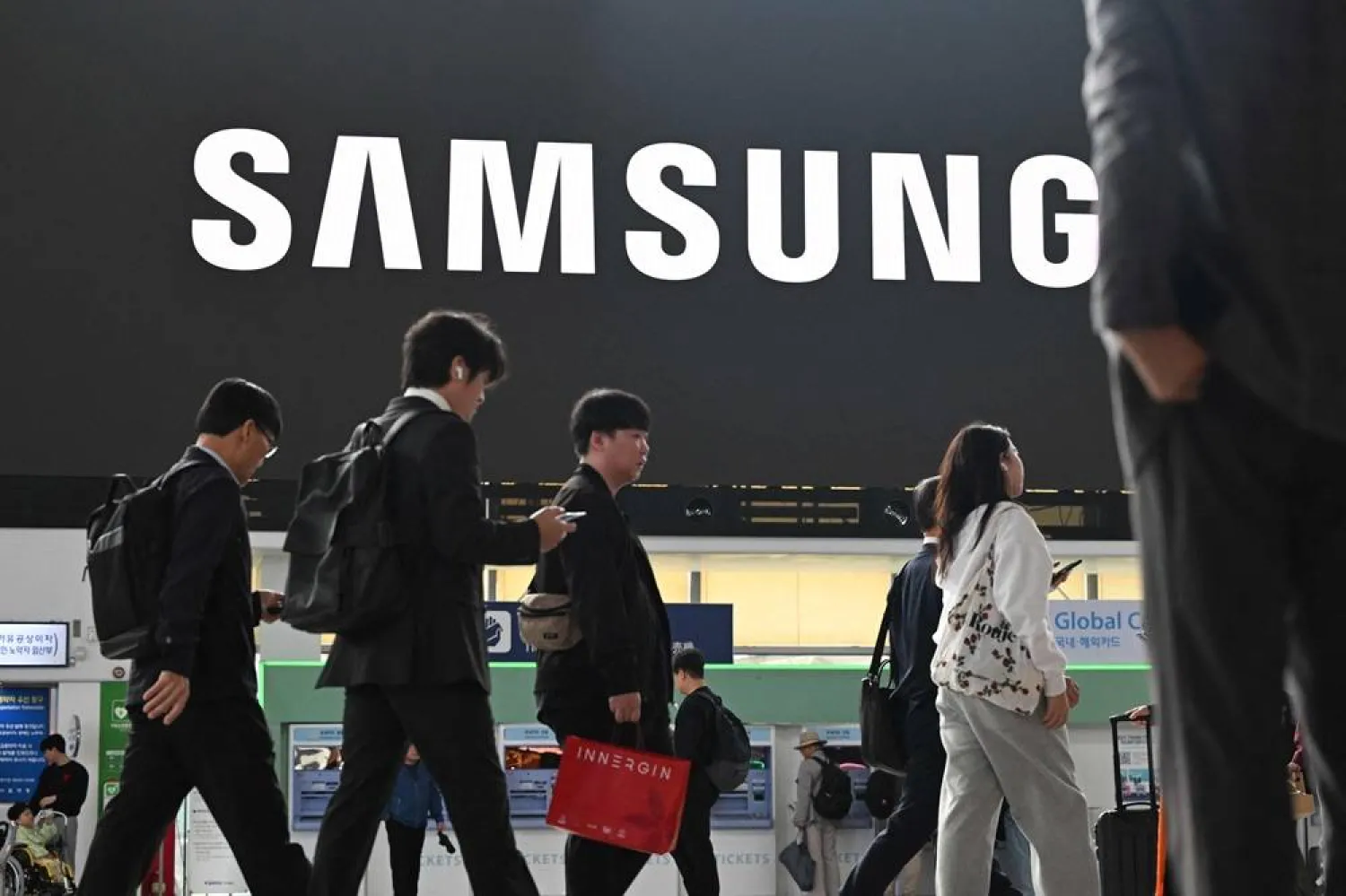
People walk past a large electronic screen showing the Samsung logo at Seoul train station in Seoul on October 14, 2025. (AFP)
TT

Samsung Electronics Family to Sell $1.2 Bln Stake amid Share Rally

People walk past a large electronic screen showing the Samsung logo at Seoul train station in Seoul on October 14, 2025. (AFP)

The mother and two sisters of Samsung Electronics Chairman Jay Y. Lee plan to sell some 1.73 trillion won ($1.22 billion) worth of shares in the South Korean tech firm, the company said in a regulatory filing.

The purpose of the sale of 17.7 million shares, or a 0.3% stake in Samsung Electronics, is to cover tax payments and loan repayment, according to the late Friday filing with the Korea Exchange.

Experts view the sale by Lee's sisters Lee Boo-jin and Lee Seo-hyun and his mother, Hong Ra-hee, as part of the owner family's efforts to secure funds to pay their inheritance tax estimated at about 12 trillion won, following the 2020 death of Samsung patriarch Lee Kun-hee.

The sale will be handled by Shinhan Bank under a trust contract and completed by next April, according to the filing.

Samsung shares have jumped more than 48% since it announced a chip-supply deal with Tesla in July. It has secured supply deals with other major customers such as OpenAI, and expectations have risen that the company will be able to supply its latest high-bandwidth memory products to Nvidia.

The stock is up more than 84% this year, gaining 0.2% on Friday to 97,900 won.

"Samsung's 10 trillion won share buyback plan last year was aimed at protecting the stock value, which would help the Samsung family to secure fund for inheritance tax," said Park Ju-gun, head of corporate analysis firm Leaders Index.

With Samsung's share price now nearing 100,000 won, the planned sale likely aims to complete inheritance tax payments.

"One disappointing aspect is that the owner family is selling shares at a time like this, which could dampen sentiment among retail investors," he said.

"After all, Samsung Electronics is practically a 'national stock', owned by about 5 million retail shareholders who have been eagerly watching the shares approach the 100,000-won mark after the recent rally."


Czech Authorities Probe Suspected Arson at Drone Technology Company

Emergency services attend the industrial storage hall after a fire in Pardubice, Czech Republic, Friday March 20, 2026. (Josef Vostarek/CTK via AP)
TT

Czech Authorities Probe Suspected Arson at Drone Technology Company

Emergency services attend the industrial storage hall after a fire in Pardubice, Czech Republic, Friday March 20, 2026. (Josef Vostarek/CTK via AP)

Czech authorities said Friday they were investigating a fire at a warehouse of a company that makes drone technology as a suspected arson linked to terrorism.

The fire broke out in an industrial zone in the city of Pardubice, some 100 kilometers (60 miles) east of Prague, causing no injuries, police said.

LPP Holding confirmed a fire in one of its buildings. It said it was cooperating with the investigation and declined further comment.

The company develops and makes products for civilian and military use, such as drone technologies used by Ukraine’s armed forces in the fight against the Russian invasion.

Interior Minister Lubomír Metnar said “the incident may be related to a terrorist attack.”

“At the moment, we don’t have information about a further danger,” he said.

According to The Associated Press, Prime Minister Andrej Babiš called the news “very serious.” Top police officer Martin ondrášek said police assumed arson.

The fire was extinguished by firefighters and police said there was no danger to the public. It was not immediately clear what was inside the warehouse that was on fire.

LPP Holding had previously said it was planning to open a center to develop and produce drones and train personnel in cooperation with Israeli Elbit Systems, a military technology company.

Metnar said the Czech side will share details of the investigation with its foreign partners.


White House Urges US Congress to Act on AI

FILE PHOTO: Figurines with computers and smartphones are seen in front of the words "Artificial Intelligence AI" in this illustration created on February 19, 2024. REUTERS/Dado Ruvic/Illustration/File Photo
TT

White House Urges US Congress to Act on AI

FILE PHOTO: Figurines with computers and smartphones are seen in front of the words "Artificial Intelligence AI" in this illustration created on February 19, 2024. REUTERS/Dado Ruvic/Illustration/File Photo

The Trump administration on Friday unveiled a sweeping legislative blueprint for regulating artificial intelligence, pressing Congress to establish a uniform federal standard and override a potential patchwork of state-level laws.

The four-page framework, billed by the White House as a "commonsense national policy framework," lays out broad priorities, including provisions on child protection, energy costs, intellectual property and free speech.

The White House is also seeking federal preemption of state AI rules, after states moved to pass their own laws amid political gridlock that has blocked federal legislation in Washington, AFP reported.

"Congress should preempt state AI laws that impose undue burdens to ensure a minimally burdensome national standard consistent with these recommendations, not fifty discordant ones," the framework states.

In a major shift, the difficulty in passing laws at the federal level has seen major AI companies pivot to supporting state laws they can get behind.

OpenAI said this week that in the absence of a national framework, states "should align around the emerging model in California and New York."

Google president of global affairs Kent Walker told Axios that state coordination on AI laws is welcome and flagged legislation California and New York backed by pro-big tech governors as a good example to follow.

On child protection, the White House calls for age-verification requirements for AI platforms likely to be accessed by minors, parental controls over privacy settings and screen time, and mandatory features to combat sexual exploitation and self-harm risks.

On intellectual property, the Trump administration believes that the training of AI models on copyrighted material "does not violate copyright laws," but acknowledging arguments to the contrary, it "supports allowing the Courts to resolve this issue."

Despite the White House's push for swift action, like most attempts at tech regulation in the United States, the legislation faces a tough road to become law in Congress.

Two previous attempts by the White House to enshrine federal preemption in Congress have failed.

The administration has also threatened to impose broadband and internet funding restrictions on states whose AI legislation is judged as too cumbersome.


China's Alibaba Targets $100B in AI and Cloud Revenue over 5 Years

FILE PHOTO: Deepseek and Alibaba logos are seen in this illustration taken on January 29, 2025. REUTERS/Dado Ruvic/Illustration/File Photo
TT

China's Alibaba Targets $100B in AI and Cloud Revenue over 5 Years

FILE PHOTO: Deepseek and Alibaba logos are seen in this illustration taken on January 29, 2025. REUTERS/Dado Ruvic/Illustration/File Photo

China’s technology giant Alibaba Group pledged on Thursday a goal of surpassing $100 billion in revenue from its artificial intelligence and cloud businesses over the next five years, which it said would be powered by the AI demand boom.

The announcement of the ambitious target came as the company posted a 67% drop in profit in the latest quarter, even as growth in its cloud business remained robust.

For the October-December quarter, the company, which shifted its focus to cloud and AI technologies in recent years, reported an overall revenue increase of 2% year-on-year to 284.8 billion yuan ($41.4 billion), lower than analysts’ estimates.

Revenue from its cloud business jumped 36% in the quarter to 43.3 billion yuan ($6.2 billion) from a year ago.

CEO Eddie Wu said during an earnings call on Thursday that Alibaba stands to benefit from the “exponential growth in AI demand.” It has been expanding and upgrading its flagship Qwen AI app and consumer-facing chatbot and also provides cloud computing and storage services to commercial customers.

“(There is) enormous and sustained growth momentum of the AI market,” Wu said.

Profit for the quarter was 16.3 billion yuan ($2.4 billion), down from 48.9 billion yuan the same quarter last year, in part due to growing marketing and sales expenses.

The Hangzhou-based company, which started out in e-commerce, has also seen a price war in the food delivery segment over the past months adding pressure to its profitability.

To help drive profit and amid rising costs and growing demand, the company said on Wednesday it would be increasing prices for some AI services by as much as 34%. It also launched the agentic AI tool Wukong this week, in an expansion of its products for commercial customers.

Alibaba’s AI ambitions was also tested recently following the departure this month of Lin Junyang, head of its AI model division Qwen. Last year, the company pledged investments of at least 380 billion yuan ($53 billion) in three years to advance its cloud computing and AI infrastructure.

Chinese tech companies have been stepping up their competitiveness against US rivals and growing their dominance, especially after AI startup DeepSeek sent shock waves across the industry last year.