


China's DeepSeek Releases Long-awaited New AI Model

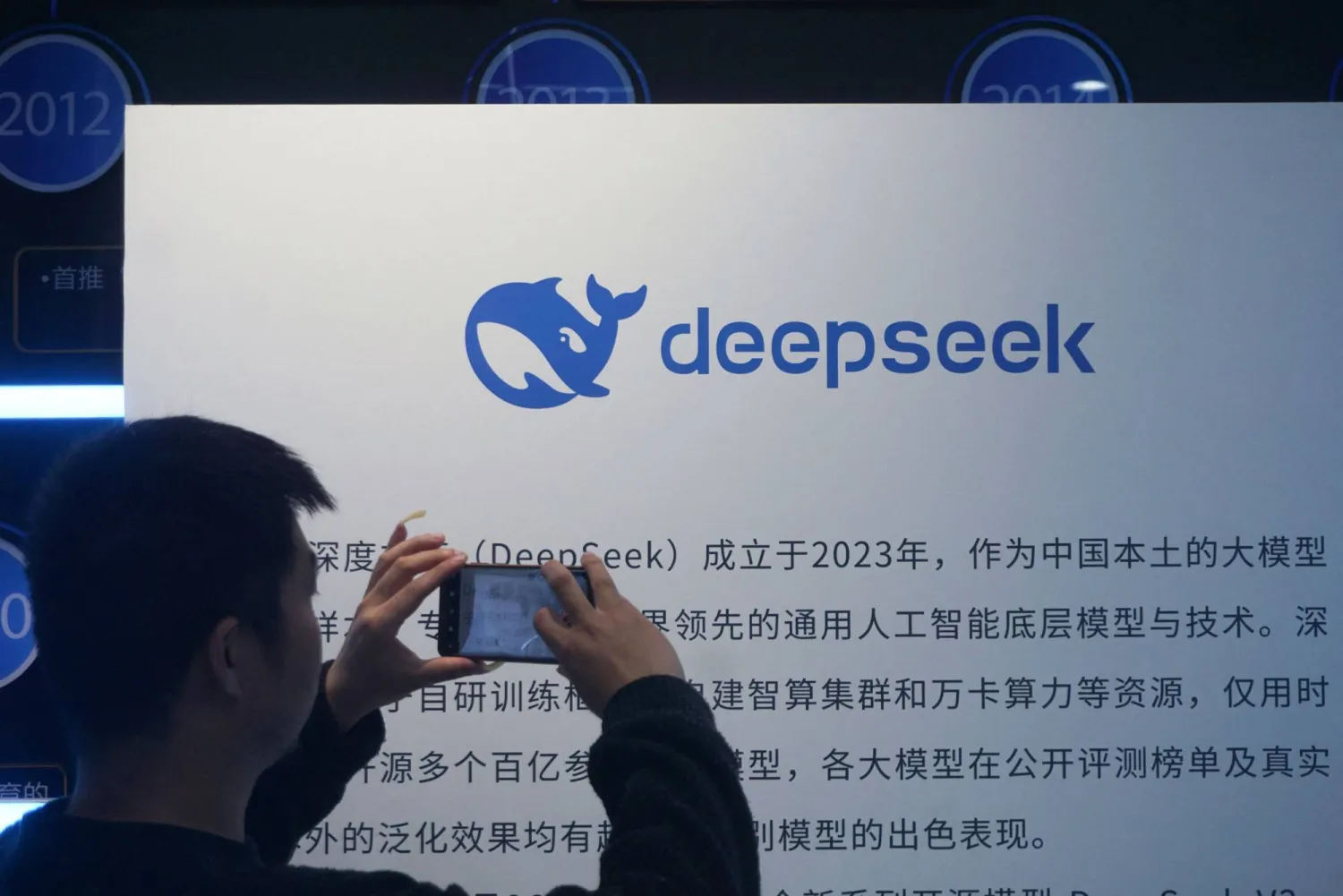
A man takes photos of a DeepSeek display at a shopping mall in Hangzhou, in China's eastern Zhejiang province on April 23, 2026. (Photo by CN-STR / AFP)
TT

China's DeepSeek Releases Long-awaited New AI Model

A man takes photos of a DeepSeek display at a shopping mall in Hangzhou, in China's eastern Zhejiang province on April 23, 2026. (Photo by CN-STR / AFP)

Chinese startup DeepSeek released a new artificial intelligence model with "drastically reduced" costs Friday, more than a year after it stunned the world with a low-cost reasoning model that matched the capabilities of US rivals.

The AI race has intensified the rivalry between China and the United States, with the White House on Thursday accusing Chinese entities of a massive effort to steal artificial intelligence technology. Beijing called the claim "baseless".

Hangzhou-based DeepSeek burst onto the scene in January last year with a generative AI chatbot, powered by its R1 reasoning model, that upended assumptions of US dominance in the strategic sector.

DeepSeek-V4 "features an ultra-long context", the company said in a statement on social media platform WeChat, hailing it as "world-leading... with drastically reduced compute (and) memory costs" in a separate announcement on X.

V4 supports a context length of one million "tokens" -- small components of text including words or punctuation -- putting it on par with Google's Gemini.

Context length determines how much input a model is able to absorb to help it complete tasks.

The new V4 is released as two versions, DeepSeek-V4-Pro and DeepSeek-V4-Flash, with the latter being "a more efficient and economical choice" because it has smaller parameters.

In terms of "world knowledge", a benchmark for reasoning, V4-Pro trails only the latest Gemini model, DeepSeek said.

A "preview version" of the open source model is now available, the company said, without indicating when a final version would be released.

Experts say V4's arrival marks an "inflection point" in terms of hardware and cost.

"This addresses the long-standing issues of slower performance and higher costs associated with long context lengths, marking a genuine inflection point for the industry," Zhang Yi, the founder of tech research firm iiMedia, told AFP.

"For end users, this will bring widespread, accessible benefits. For instance, if ultra-long context support becomes a standard feature, long-text processing is expected to move beyond high-end research labs and enter mainstream commercial applications," he said.

V4-Pro has 1.6 trillion parameters while the V4-Flash has 284 billion parameters, which refine models' decision-making ability.

The model has also been "optimized" for popular AI Agent products such as Claude Code, OpenClaw, OpenCode and CodeBuddy, the DeepSeek statement said.

It can also run on chips manufactured by Chinese tech giant Huawei, the company added.

Huawei -- sanctioned by the US since 2019 over national security -- said in a statement Friday that the full range of its Ascend SuperPoD products are supporting DeepSeek's V4 series.

DeepSeek's latest release is a "milestone" for Chinese firms, said veteran AI industry analyst Max Liu.

"It's a good thing for the entire domestic AI industry. It can provide better models for domestic users and we can now expect a lot more things -- more products (and a) more competitive market," he told AFP.

"This is no less shocking than when DeepSeek first came out" if its new model indeed matches the performance of leading models from Western labs, he added.

Last year's so-called "DeepSeek shock" sparked a sell-off of AI-related shares and a reckoning on business strategy in what was also described as a "Sputnik moment" for the industry.

The chatbot performed at a similar level to ChatGPT and other top American offerings, but the company said it had taken significantly less computing power to develop.

However, its sudden popularity raised questions over data privacy and censorship, with the chatbot often refusing to answer questions on sensitive topics such as the 1989 Tiananmen crackdown.

DeepSeek's AI tools have been widely adopted by Chinese municipalities and healthcare institutions as well as the financial sector and other businesses.

This has been partly driven by DeepSeek's decision to make its systems open source, with their inner workings public -- in contrast to the proprietary models sold by OpenAI and other Western rivals.

But the White House has accused Chinese firms of vying to "steal" American technology, ahead of an expected summit between Donald Trump and Xi Jinping in Beijing next month.

"The US has evidence that foreign entities, primarily in China, are running industrial-scale distillation campaigns to steal American AI," Trump's science and technology chief advisor Michael Kratsios said in a post on X.

Distillation is a common practice within AI development, often used by companies to create cheaper, smaller versions of their own models.

"The US claims are entirely baseless," Chinese foreign ministry spokesman Guo Jiakun told a news conference in Beijing. "They are a slanderous smear against the achievements of China's artificial intelligence industry."



Four Takeaways from Musk vs OpenAI Trial

 OpenAI CEO Sam Altman arrives at the federal courthouse, as the trial in Elon Musk's lawsuit over OpenAI's for-profit conversion continues, in Oakland, California, US, May 14, 2026. (Reuters)
OpenAI CEO Sam Altman arrives at the federal courthouse, as the trial in Elon Musk's lawsuit over OpenAI's for-profit conversion continues, in Oakland, California, US, May 14, 2026. (Reuters)
TT

Four Takeaways from Musk vs OpenAI Trial

 OpenAI CEO Sam Altman arrives at the federal courthouse, as the trial in Elon Musk's lawsuit over OpenAI's for-profit conversion continues, in Oakland, California, US, May 14, 2026. (Reuters)
OpenAI CEO Sam Altman arrives at the federal courthouse, as the trial in Elon Musk's lawsuit over OpenAI's for-profit conversion continues, in Oakland, California, US, May 14, 2026. (Reuters)

After three weeks of intense hearings, Silicon Valley's first major AI trial -- over the lawsuit filed by Elon Musk against the co-founders of OpenAI -- is nearing an end. It is expected to go to the jury on Monday.

Here are four scenes that defined the trial:

Musk blames his own naivety

At the opening of the trial on April 28, Musk portrayed himself as a selfless benefactor and Good Samaritan concerned with protecting humanity from an AI that, if left in the wrong hands, could "kill us all."

"I came up with the idea, the name, recruited the key people, taught them everything I know, provided all of the initial funding," the SpaceX CEO said regarding OpenAI's founding in 2015.

"I gave $38 million essentially for nothing, which they used to build a company worth $800 billion. I was literally an idiot," he said, blaming his own naivety.

Musk was visibly annoyed during the trial as he called out OpenAI's lawyer for asking questions "designed to trap me."

"Mr. Musk, you are a brilliant man," said OpenAI's lawyer William Savitt, as he doubled down on his attacks, disguised with a show of courtesy.

Altman strikes back

Swapping his usual T-shirt, jeans and sneakers for a dark suit and tie, OpenAI CEO and co-founder Sam Altman sat stone-faced in the front row of the Oakland courtroom for most of the proceedings.

But on May 12, it was finally his turn. Musk's lawyer, Steven Molo, was waiting for him, asking if he had always told the truth.

Altman responded: "I'm sure there have been times in my life when I didn't."

But then, with a blank expression and wide eyes, he struck back, saying Musk in 2017 had demanded "90 percent of the equity" and "refused to commit in writing" to sharing power.

Altman said he had no choice as "we did not think that artificial general intelligence should be under the control of a single person."

Brockman's notebook

Every day in the courtroom, Greg Brockman, the president and co-founder of OpenAI, took extensive notes on yellow notepads.

During his questioning on May 4, old journals he kept from years ago took center stage, with Musk's lawyer highlighting some of the most embarrassing excerpts.

Brockman wanted to make money, writing, "financially, what will take me to $1B?" He also wanted "to convert to a b-corp without him (Musk)," a reference to a private company with social and environmental standards.

The journal recorded his concerns about a plan to "steal the non-profit from him (Musk)" as "pretty morally bankrupt."

"There's nothing in there I'm ashamed of," Brockman hit back, claiming that the journal did not include details of an outburst from Musk in 2017.

"I really thought he was going to hit me," Brockman said of the incident. Musk did not touch him, but took a painting of a Tesla, a gift from one of the co-founders, down from the wall and left the room, he said.

Brockman's shares in the company are now worth $30 billion.

The secret go-between

Shivon Zilis -- the mother of four of Musk's children -- is a woman in the shadows, rarely appearing in public.

So her May 6 appearance in the courtroom attracted intense curiosity.

Zilis, who was appointed to the OpenAI board from 2020 to 2023, was asked about her awkward role as both Musk's colleague at Neuralink and Altman's friend.

At the time, her mysterious relationship with Musk was secret. Their children were conceived through in vitro fertilization.

OpenAI accuses her of working as a mole for Musk.

Zilis responded to questions briefly and, at times, sarcastically.

"Relationship is a relative term," she said when asked about her relationship with Musk, before conceding, "there have been romantic moments."

But ultimately, her testimony may matter less than the content of her messages to Musk and Altman.

Those could lead the jury to conclude that Musk, having been sufficiently informed by Zilis, knew of OpenAI's direction long before 2023. If so, his lawsuit could be thrown out before the jury even starts deliberating the merits of the case.


YouTube, Snap and TikTok Settle School District’s Social Media Addiction Claims

The TikTok logo is displayed on signage outside TikTok social media app company offices in Culver City, California on September 30, 2025. (AFP)
TT

YouTube, Snap and TikTok Settle School District’s Social Media Addiction Claims

The TikTok logo is displayed on signage outside TikTok social media app company offices in Culver City, California on September 30, 2025. (AFP)

Alphabet's YouTube, Snap and TikTok have reached settlements in the first case set for trial in litigation seeking to force social media platforms to cover the costs school districts incur to combat a youth mental health crisis they say the companies fueled.

The settlements were detailed in court filings on Friday in federal court in Oakland, California, and resolve claims by a Kentucky school district that is still due to take Facebook and Instagram parent Meta Platforms to trial on June 15.

Terms of the settlements with ‌Breathitt County School District ‌in rural Eastern Kentucky were not disclosed.

"This ‌matter ⁠has been amicably resolved ⁠and our focus remains on building age-appropriate products and parental controls that deliver on that promise," a YouTube spokesperson said in a statement.

Snap, the parent company of Snapchat, said it resolved the case amicably. TikTok did not immediately respond to a request for comment.

More than 3,300 lawsuits involving addiction claims are pending in California state court against the social media companies. ⁠Another 2,400 cases brought by individuals, municipalities, states and ‌school districts have been centralized in California ‌federal court.

In a landmark trial, a Los Angeles jury on March ‌25 found Meta and Alphabet's Google negligent for designing social media platforms that ‌are harmful to young people. It awarded a combined $6 million to a 20-year-old woman who said she became addicted to social media as a child.

The companies have denied the allegations and say they take extensive steps to keep ‌teens and young users safe on their platforms.

Breathitt is one of about 1,200 school districts suing the social ⁠media companies ⁠over claims they caused a mental health crisis among students and then saddled schools with the fallout.

The school district has been seeking over $60 million to cover the costs of counteracting social media's impact on students’ mental health and to fund a 15-year mental health program to abate the problem.

It also seeks a court order requiring the companies to modify their platforms to reduce addictive features.

Its case is a bellwether, or test case, for over a thousand similar school districts' lawsuits.

Judges and attorneys often use bellwether verdicts to assess the potential value of remaining claims and guide settlement talks. Typically, several bellwether cases are tried before reaching a broader resolution.


Foxconn Logs Quarterly Net Profit Jump on AI Demand

FILE PHOTO: A signage at Foxconn booth at the International Automobile & Motorcycle Parts & Accessories Show (AMPA) trade show in Taipei, Taiwan, April 14, 2026. REUTERS/Edgar Su/File Photo
TT

Foxconn Logs Quarterly Net Profit Jump on AI Demand

FILE PHOTO: A signage at Foxconn booth at the International Automobile & Motorcycle Parts & Accessories Show (AMPA) trade show in Taipei, Taiwan, April 14, 2026. REUTERS/Edgar Su/File Photo

Taiwanese tech hardware giant Foxconn on Thursday announced a 19-percent jump in quarterly net profit as the booming market for artificial intelligence servers drives growth, despite geopolitical uncertainty.

Foxconn, whose official name is Hon Hai Precision Industry, has gone beyond assembling low-margin iPhones to making AI servers for Nvidia, along with electric vehicles and robots.

Soaring global demand for generative AI tools is boosting business for Foxconn, even as the war in the Middle East has threatened supply chain volatility.

On Thursday the company said net profit for January-March came to NT$49.9 billion (US$1.6 billion), up from NT$42.1 billion in the same period the previous year.

The figure beat estimates of $48.4 billion in a Bloomberg survey of analysts, AFP reported.

Foxconn said it expects "strong demand for AI servers" to continue this year, forecasting "high double-digit quarter-on-quarter growth" for AI rack shipments in the second quarter.

When the company reported its annual results in March, chairman Young Liu had shrugged off concerns that market volatility caused by global conflict would dent profits.

Taiwanese contract chipmaker TSMC has also said it does not expect geopolitics to impact its supply of key materials such as helium and hydrogen in the near term.

On Wednesday, some of Foxconn's factories in North America suffered a cyberattack, according to a company statement.

"The affected factories are currently resuming normal production," after a response from the cybersecurity team, said the statement dated Wednesday afternoon in Taiwan.

TechCrunch and other media outlets reported that ransomware gang Nitrogen had claimed responsibility for the hack on the dark web.