
Humanoids Dance and Thread Needles as Japanese Robotics Developers Look to Outdo Chinese

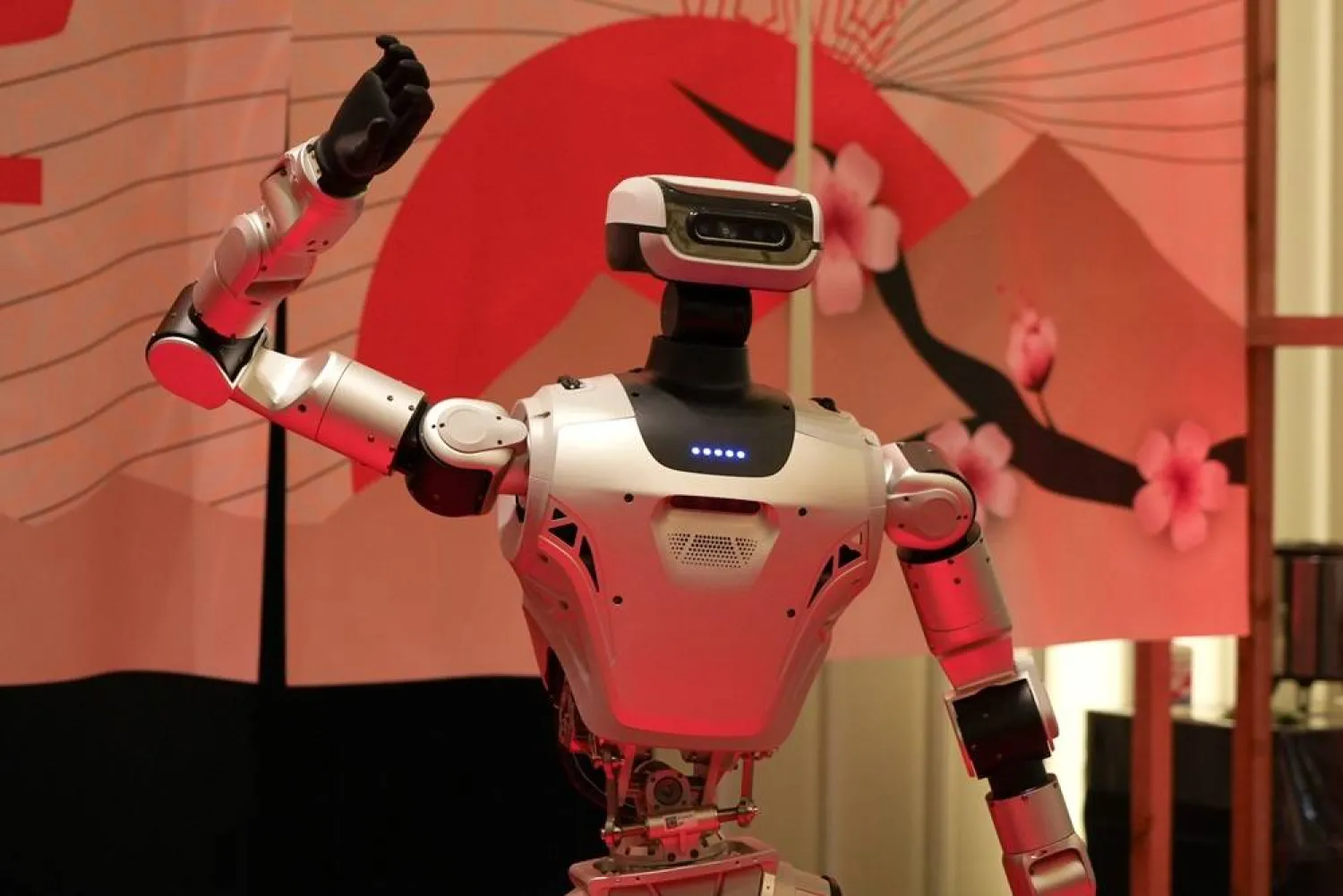
A humanoid robot poses for photo at the Humanoids Summit 2026 in Tokyo, Thursday, May 28, 2026. (AP)
TT

Humanoids Dance and Thread Needles as Japanese Robotics Developers Look to Outdo Chinese

A humanoid robot poses for photo at the Humanoids Summit 2026 in Tokyo, Thursday, May 28, 2026. (AP)

Mechanical hands dexterous enough to thread a needle, childlike dancing robots and adult-sized ones to help with deliveries were on display Thursday as the Humanoids Summit Tokyo opened.

Among the dozens of companies taking part, including well-known players like Boston Dynamics and Toyota Motor Corp., the big stars now were clearly the Chinese.

Chinese newcomers, like Booster Robotics and LimX Dynamics, took the technology initially developed in Japan and the US and fine-tuned it, often for cheaper mass production. It’s a repeat of what happened in other Japanese industries, from consumer electronics to cellphones and electric vehicles. In humanoids, Japan was initially ahead but then failed to produce major commercial solutions.

Tim Hornyuk, author of “Loving the Machine: The Art and Science of Japanese Robots,” who was at the event, categorized it as the so-called “Galapagos syndrome,” referring to how innovative Japanese products evolve in isolation and end up not translating for the international market.

“I really hope that Japan can come up with a Ford Model T-version of humanoid roots. But I think China has already stolen their lunch. It’s a bit too little too late,” he said.

The dancing and wiggling Mini Pi Plus robot from High Torque of China, for instance, still can’t help at an auto plant or do your dishes. But it’s cute. And it doesn’t come with an eye-popping price tag, starting at $5,500.

One telling example of Chinese robotics use in Japan was GMO, a Tokyo-based AI and robotics company working on a humanoid with camera eyes that will help with Japan Airlines cargo and other chores at an airport.

The key is to have the robot do the work in the same way as people so they would be interchangeable, an initiative meant to tackle the labor shortage problem that is increasingly serious in Japan.

The inner robotics workings were all courtesy of Unitree, a Chinese outfit, which is also working on a four-legged dog-like “stellar explorer.”

Experts say Japan, with its finesse in manufacturing, proved a good breeding ground for robotics development. The sociological backdrop of a public receptive to robotics also helped.

A recent Pew global survey showed that people in Japan are highly aware of AI but are less anxious about it, at about 28%, than people in the US at 50%.

Japanese automaker Honda Motor Co., a leader in robotics with its walking humanoid Asimo, first shown in 2000, was demonstrating a motorized four-fingered robotic hand that could screw on and off tiny bolts, or thread a needle.

It didn’t seem to bother Keisuke Tsuta, assistant chief engineer, that similar mechanical hands were on display galore near his booth, many of them from Chinese makers.

Japanese robotics show their prowess

The technology Honda had developed is more durable and powerful than rival offerings, and the Japanese have historically shown they can excel at quality mass production, according to Tsuta.

The looming threat of a Chinese robotics domination didn’t seem to phase Osaka University Professor Hiroshi Ishiguro, who has worked on humanoids for decades, including one that’s his clone.

“What’s significant is that Japan has a culture that’s receptive to robotics. If we’re going to really start using robots in society, Japan is the ideal place,” he said, stressing that Japanese don’t discriminate against robots.

His robotic counterpart, dressed all in black like the professor, did as good a job, if not better, of answering a key existentialist question on the meaning of robots.

“I think robots will coexist with people. Robots are the mirror of human beings,” the robot replied in a slightly monotonous but human-like voice.

Earlier, the professor had answered a similar question, but a bit differently.

“No one is interested in me. All everyone cares about is my robot,” he said, sitting next to his twin-like humanoid.

“As long as people identify with what I have produced, I am a success,” he added.


KSrelief Holds Workshop on AI’s Role in Advancing Humanitarian and Development Work

The workshop discussed emerging trends and risks. SPA
TT

KSrelief Holds Workshop on AI’s Role in Advancing Humanitarian and Development Work

The workshop discussed emerging trends and risks. SPA

The King Salman Humanitarian Aid and Relief Center (KSrelief), in collaboration with the UK Foreign, Commonwealth & Development Office (FCDO) and the Saudi Fund for Development (SFD), organized a two-day workshop titled “Data and Artificial Intelligence in the Humanitarian and Development Sectors: A Saudi-UK Partnership for Leadership and Impact” at its headquarters in Riyadh.

The workshop that started Tuesday was attended by KSrelief Director of Information Technology Eng. Tamim Al-Husain and UK Deputy Ambassador to Saudi Arabia Dr. Alice Burt.

The event brought together experts from the Saudi Data and Artificial Intelligence Authority (SDAIA), the King Abdulaziz City for Science and Technology (KACST), and specialists from KSrelief, SFD, and FCDO.

The workshop discussed emerging trends and risks, facilitated the exchange of expertise, and explored opportunities for future cooperation and partnerships between Saudi Arabia and the United Kingdom in the field of artificial intelligence to advance humanitarian and development work.

It also highlighted the importance of data and AI in humanitarian and development leadership, reviewed practical applications of AI in humanitarian needs assessments, early warning systems, inclusion efforts, and demographic trend analysis, and examined AI governance and safeguards for the safe and responsible use of emerging technologies.

In addition, participants discussed Saudi Arabia’s approach to leveraging technology in the humanitarian sector and developed a roadmap for the next round of strategic dialogue between the two countries.

The workshop was held as part of efforts to strengthen cooperation and coordination between Saudi Arabia and the UK in data and AI, to advance humanitarian, relief, and development work through the effective use of modern technologies.


Saudi Arabia: Tuwaiq Academy, Google Cloud Launch AI, Cloud Computing Initiative

The initiative was launched during Google Cloud’s annual AI Live + Labs event in Riyadh. SPA
TT

Saudi Arabia: Tuwaiq Academy, Google Cloud Launch AI, Cloud Computing Initiative

The initiative was launched during Google Cloud’s annual AI Live + Labs event in Riyadh. SPA

Saudi Arabia’s Tuwaiq Academy, in collaboration with Google Cloud, has launched the AI & Cloud Champions Program, aiming to build national capabilities and empower local talent to develop innovative cloud-based solutions using AI and emerging technologies.

The initiative, launched during Google Cloud’s annual AI Live + Labs event in Riyadh, builds on the strategic partnership between the two sides. It focuses on developing digital skills while expanding the Kingdom’s ecosystem of developers, tech startups, and tech professionals.

The program includes developing specialized training content and programs, as well as access to hands-on sandbox environments, cloud service credits, and vouchers for professional certification exams. It is further supported by a grant from Google Cloud’s economic and community development team to help drive its implementation.

Running from June through December, the program targets students, graduates, employees, tech startup entrepreneurs, and tech enthusiasts.

The initiative features three main tracks, including training programs and professional certifications designed to help participants strengthen their skills in applying AI in cloud computing. Additionally, a dedicated track will support more than 60 tech startups through intensive sessions and practical consulting to help them advance their growth and development.

The program will also offer a series of workshops and knowledge-sharing sessions led by experts and specialists to enhance participants’ expertise and capabilities in AI and cloud computing.


Intense AI Use Still Rare Among Euro Zone Firms, ECB Researchers Find

FILE PHOTO: AI (Artificial Intelligence) letters and robot hand miniature in this illustration taken, June 23, 2023. REUTERS/Dado Ruvic/Illustration/File Photo
TT

Intense AI Use Still Rare Among Euro Zone Firms, ECB Researchers Find

FILE PHOTO: AI (Artificial Intelligence) letters and robot hand miniature in this illustration taken, June 23, 2023. REUTERS/Dado Ruvic/Illustration/File Photo

Only a small fraction of euro zone firms use artificial intelligence intensely and they tend to be small, young, service-oriented companies, leaving plenty of room for diffusion, a European Central Bank blog post said on Wednesday.

The vast majority of firms now say they have been using AI but economists have been debating just how intense this use is and whether it can yield the sort of efficiency gains that ⁠are relevant on a ⁠macroeconomic level.

Surveying more than 5,000 companies across the bloc, the ECB found that over 70% report using AI and much of the rest plan to start this year, Reuters reported. But use is moderate or infrequent and ⁠only 7% use AI intensely, the survey found.

"The intensive use that drives transformation and generates macroeconomic gains remains rare," the authors, all ECB researchers, said, in a post that does not necessarily represent the ECB's views.

Intense use is skewed towards smaller companies with large firms clearly lagging behind, the survey results showed. Younger firms also used AI more intensely than older companies ⁠and ⁠use was skewed towards high-tech, knowledge-intensive services.

"Firms at an early stage of adoption often cite cost reductions and improvements in operational efficiency as their main reasons for using it," the blog said. "Intensive users are more frequently motivated by growth and innovation."

Firms tend to invest in AI when their competitors do, succumbing to peer pressure, and intensive users spend heavily on customized solutions that go well beyond just purchasing licenses, the blog said.