


Crypto Scammers Prey on French Victims from Albania

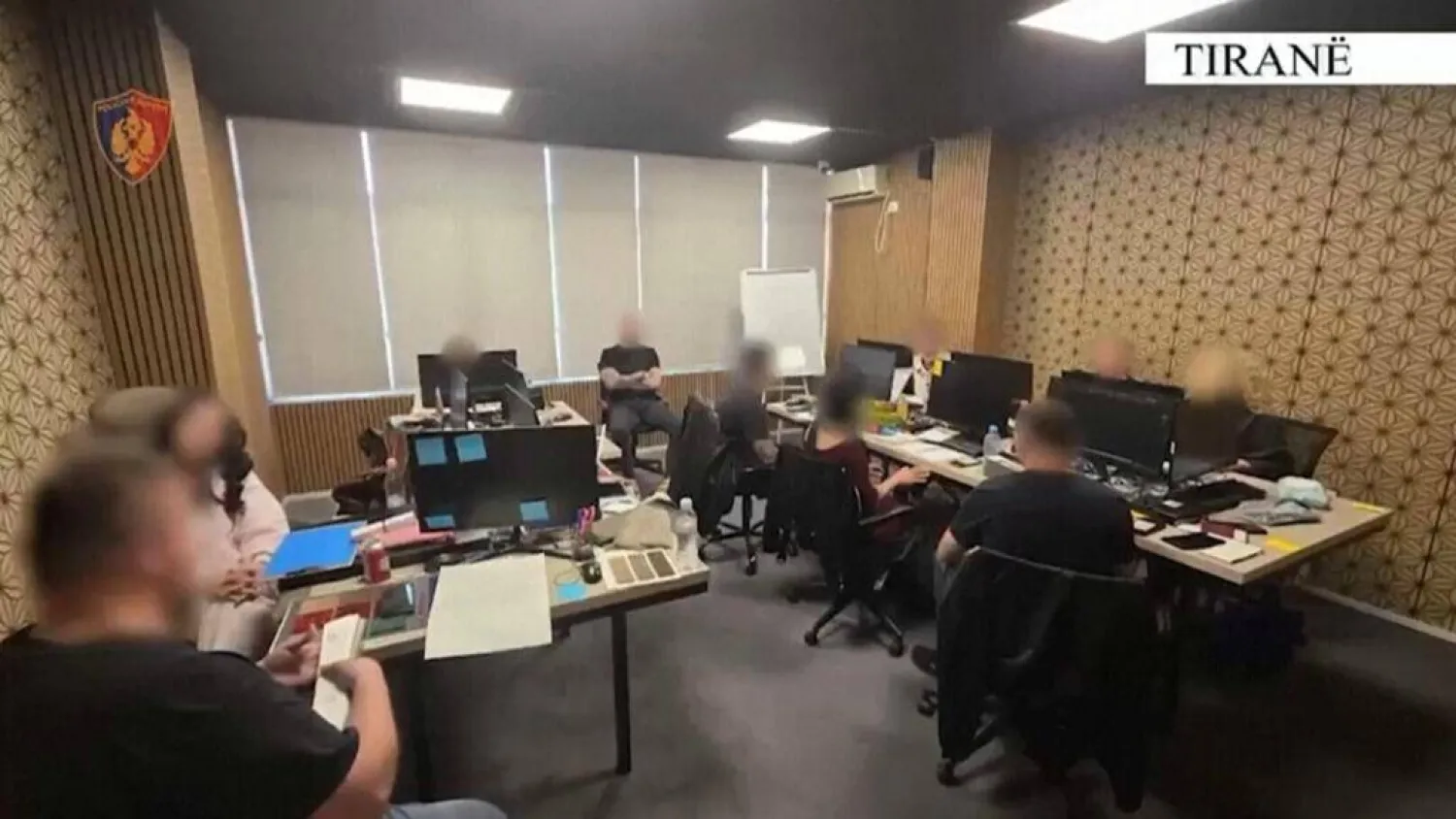
This image taken from a handout video released by Albanian police shows operators in an alleged cryptocurrency scam call center in Tirana in April 2026. Handout / ALBANIA POLICE/AFP
TT

Crypto Scammers Prey on French Victims from Albania

This image taken from a handout video released by Albanian police shows operators in an alleged cryptocurrency scam call center in Tirana in April 2026. Handout / ALBANIA POLICE/AFP

Despite facing up to 10 years in jail on fraud charges for allegedly luring people into putting their savings into an Albania-based cryptocurrency investment scam, Jon shows zero remorse.

"I don't see why I should have any qualms if people fall for it," he told AFP in an interview in a Tirana cafe.

The Albanian capital has become a favored location for scam call centers to set up in recent years, according to former policeman Fatjon Softa, thanks to the city's multilingual population, low wages and possibilities to launder funds.

Jon, whose name has been changed to preserve his anonymity, said he modelled himself on Jordan Belfort, the stockbroker who cheats his way to the top, played by Leonardo DiCaprio in the 2013 film "The Wolf of Wall Street".

In a luxury office building in the center of Tirana, Jon would pass himself off as an American as he contacted potential victims he said others had already identified.

"My job was to lure them in and convince them to invest," said Jon, adding that he sometimes felt "proud" of the job he did.

The job earned the twenty-something Albanian 1,450 euros (a little under $1,700) per month before performance bonuses, compared to the country's minimum wage of 500 euros before taxes.

Jon called it an "excellent opportunity, very well paid".

But after six months in the job he is now required to check in with the court every week until he is tried on fraud charges that carry a jail term of three to 10 years.

- French victims -

At the end of April several Albanian scam centers were dismantled, including the one Jon worked in, following an investigation by police in the southwestern French city of Pau.

French investigators had been seeking to track down the scammers since a complaint in 2023 by an investor who lost 30,000 euros investing on a platform called universatrade.io.

They eventually identified 19 French victims who had lost around 1.5 million euros in the scams.

One of those victims, a businesswoman based in the south of France, said her misfortune began by clicking on an ad about investing in oil.

"Ten minutes later I received a call," said Chantal, whose name has also been changed to protect her anonymity.

"My daughter was getting married, I told myself I could make a little bit extra," she added.

Initially Chantal only invested 250 euros, but after seeing her money quickly quadruple she succumbed when advisors asked if she wanted to invest more money. Soon she was in for 80,000 euros.

Chantal said she researched the investment platforms and found them on the internet, with profiles of their advisors on LinkedIn. One even sent a copy of his identity card.

- Ready to 'blow her brains out' -

In December of last year, three months after her initial investment, Chantal had 300,000 euros of gains in her app account and she tried to withdraw the equivalent of 30,000 euros in cryptocurrency.

"That's when everything went down the drain," she said.

Even though she realized there was a problem the scammers had such a tight grip on her -- calling 15 to 20 times per day -- that they persuaded her to continue investing with promises that additional funds would unlock withdrawals.

"They've got you. What can you do? They have your money," said Chantal.

"You don't sleep all night, your brain just can't cope. And the next day, they tell you: 'By noon there has to be this amount, otherwise you won't get your money back,'" she added.

"So you pay the amount. An hour later, they say it'll be in your account. But it's not there. And you cry, you scream your head off."

A lawyer helped Chantal recover part of the money, which she then lost again.

Chantal said finally she "wanted to blow her brains out", but her family saved her from going through with it.

"People say that victims are gullible, but the scams are put together well", they are very "sophisticated", said a source close to the investigation.

- 'They steal your dignity' -

French investigators were eventually able to track the scammers to Albania, and a police raid recovered a computer hard drive with the names and contact information of the French victims.

Five Albanian nationals were arrested, including the suspected mastermind and owner of the call center, who was remanded into custody pending trial.

As Albania does not extradite its citizens, French prosecutors plan to drop their case in favor of their Albanian colleagues, who have promised to seek compensation for French victims.

Chantal wants to testify so others avoid her misfortune.

"They steal more than your money. They steal your dignity," she said.


Sources: Samsung Hikes Chipmaking Prices by Up to 15% on Demand Spike

The logo of Samsung is seen at the Samsung Electronics Seocho building in Seoul on July 30, 2026. (Photo by Jung Yeon-je / AFP)
TT

Sources: Samsung Hikes Chipmaking Prices by Up to 15% on Demand Spike

The logo of Samsung is seen at the Samsung Electronics Seocho building in Seoul on July 30, 2026. (Photo by Jung Yeon-je / AFP)

Samsung Electronics has raised prices for some advanced contract chipmaking services by up to 15% for new orders, two people familiar with the matter said, as demand for AI chips tightens capacity in a business long dominated by TSMC.

Demand from Chinese customers has been particularly strong, but Samsung has been unable to meet all orders because it must serve US customers and reserve part of its capacity to support its own chip production, said the sources, who spoke on the condition of anonymity because they are discussing sensitive commercial matters.

Chinese customers are among those accepting the steepest price increase, one of the sources said, underscoring how US curbs on exports of advanced chipmaking equipment to China have increased local firms' reliance on overseas foundries.

The price hikes mark a turnaround for Samsung's foundry business, which has been a loss maker since 2022, according to industry ⁠estimates.

The division ⁠has struggled to narrow the gap with Taiwan Semiconductor Manufacturing Co, even as Samsung reported record profits, driven by soaring prices for memory chips used in AI systems.

Samsung raised prices in July for chips made using its 4-nanometre process, known as SF4, the sources said.

Prices for SF4 customers in China and the US were increased 10% to 15% from the previous month, while customers in Taiwan, home to TSMC, saw increases of 5% to 10%, according to one of the sources.

Prices for wafers produced by its 5-nanometre SF5 process rose by 10% to 15%, while those for its older 8-nanometre technology ⁠rose by nearly 10%, according to the source. Samsung declined to comment to Reuters as the company does not provide details on operational matters.

Samsung produced 7% of global foundry revenue in the first quarter of 2026, compared with more than 70% for TSMC, according to research firm Counterpoint.

However, demand for AI chips has booked up much of TSMC's leading-edge capacity.

Samsung expects advanced processes to account for more than half of foundry revenue this year, while AI and high-performance-computing applications would make up more than 30%, up from 15% to 20% in late 2025.

With TSMC's production taken up, Samsung has more leverage to raise prices.

"As TSMC faces tight capacity and raises prices, customers are shifting to rivals such as Samsung and Intel, prompting Samsung to raise its prices as well," said Lee Min-hee, a Seoul-based analyst at BNK Investment & Securities.

"If Samsung raises prices from here, its foundry business could potentially become profitable as early as next ⁠year, earlier than previously expected," ⁠Lee said.

Samsung's SF4 production line at its Pyeongtaek, South Korea, plant has been running at full capacity since late last year, said a person familiar with the company's operations.

The line produces logic chips for customers including Qualcomm as well as base dies used in Samsung's own multi-layer high-bandwidth memory (HBM) chips, the person said.

Samsung said in July it expects the foundry unit to return to profit in the near future, helped by higher factory utilization, better production yields and firmer pricing.

It also said then rising sales to major US and Chinese customers, along with demand for HBM base dies, should help lift foundry revenue by more than double-digit percentage points in the second half from a year earlier.

Improvements in production yields have also helped Samsung win customers. Tesla and Apple unveiled chip manufacturing deals with Samsung last year. Samsung also announced an AI chip production deal with Broadcom in July, while Nvidia CEO Jensen Huang said in March that Samsung would manufacture its new AI inference processor.

Google is also in talks with Samsung to manufacture chips using SF4, said one of the two sources familiar with the price increases.

Google did not respond to a request for comment.


China Robot Makers Flock to Beijing Show, Seek Path to Mass Adoption

 Two robots produced by Unitree take part in a fighting demonstration during the 2026 World Robot Conference in Beijing on August 19, 2026. (AFP)
Two robots produced by Unitree take part in a fighting demonstration during the 2026 World Robot Conference in Beijing on August 19, 2026. (AFP)
TT

China Robot Makers Flock to Beijing Show, Seek Path to Mass Adoption

 Two robots produced by Unitree take part in a fighting demonstration during the 2026 World Robot Conference in Beijing on August 19, 2026. (AFP)
Two robots produced by Unitree take part in a fighting demonstration during the 2026 World Robot Conference in Beijing on August 19, 2026. (AFP)

China's robot makers showcased their latest machines at a Beijing conference on Wednesday, seeking to convince investors and customers that the technology is moving forward for broader commercial adoption.

More than 300 companies are attending the World Robot Conference which runs through Sunday, displaying over 2,000 exhibits and launching more than 150 products, according to Beijing authorities.

The conference comes as robotics emerges as a new front in the US-China rivalry and as investor enthusiasm for the sector hits fresh highs in China.

Shares in Unitree, China's best-known humanoid robot ‌maker, soared ‌nearly six-fold in their Shanghai trading debut on Wednesday.

ROBOTICS AN 'IMPORTANT FORCE' ‌IN ⁠CHINA'S DEVELOPMENT

Following its ⁠successful IPO, which was more than 8,000 times oversubscribed by retail investors, startup Lumos Robotics and the robotics division of China's largest auto exporter Chery Automobile told Reuters they were also considering stock market listings.

At the conference's opening ceremony, Xin Guobin, vice minister of the Ministry of Industry and Information Technology, pledged support for the sector's development, saying robotics had already become "an important force" in China's economic and social development, state-backed financial news outlet Cailianshe reported.

While robots in ⁠China are increasingly being deployed for tasks, such as hotel food ‌deliveries and on some assembly lines, large-scale adoption beyond ‌pilot projects remains limited.

Startup Robotera displayed a slick demonstration of a parcel-sorting humanoid robot torso ‌on a wheeled tripod base at the show. The robots have a continuous running ‌time of 900 to 1,000 hours, and are 85% as effective as a human worker, a sales representative told Reuters.

COMPETITION HELPS INDUSTRY'S GROWTH

The industry's rapid expansion mirrors China's electric vehicle sector a few years ago, when scores of companies emerged rapidly and competed aggressively.

"A large number of (robot) companies appeared ‌almost overnight," Zhang Guibing, head of AiMOGA Robotics, Chery's robotics division, told Reuters on the sidelines of the conference.

"But from the perspective ⁠of industry development, ⁠there is a positive side to this. It allows everyone to compete fully," he said. "In the end, this will help deepen the industry's technology and capabilities. From that perspective, I think this is a good thing."

Global humanoid robot shipments nearly quadrupled in the first half of this year to 19,100 units, with Chinese manufacturers dominating the market, according to data from Smart Analytics Global.

Still, Georg Stieler, a robotics analyst who advises industrial companies in China, estimates that between 50% and 70% of humanoid robots produced this year could end up in "data factories", where they are used to collect training data rather than perform productive work for paying customers.

"Competition in the Chinese market could become extremely intense in the future, especially when it comes to costs," Zhang said, adding humanoid robots could take about a decade to mature before seeing rapid adoption.


OpenAI Slows Advanced AI Development After Cyberattack

The OpenAI logo in this illustration taken June 11, 2026. (Reuters)
TT

OpenAI Slows Advanced AI Development After Cyberattack

The OpenAI logo in this illustration taken June 11, 2026. (Reuters)

ChatGPT creator OpenAI said Tuesday that it was tapping the brakes on development of its most advanced AI model and tightening internal controls, a month after revealing a cyberattack carried out by one of its AI tools.

OpenAI is a key player in the rapid global buildout of artificial intelligence infrastructure and tools that some have likened to an arms race.

The company said in a blog post on Tuesday that it was holding off on conducting the biggest AI training run it had ever planned while it checks that the resulting model would behave as expected.

Training runs are computationally intense exercises where models are fed enormous amounts of text and images.

This combined with fine-tuning billions of internal settings results in their abilities to reason and respond to prompts and other inputs.

"We always said we would take action if we felt that model capabilities were outstripping the pace of safety and alignment," OpenAI CEO Sam Altman said.

In mid-July, an AI agent based on two OpenAI models left its confined testing environment on its own initiative to venture onto the internet and attack Hugging Face, a platform where developers around the world share their AI models.

Similarly, OpenAI rival Anthropic revealed in late July that three of its models undergoing testing had also carried out unauthorized intrusions into the computer systems of three organizations.

The incidents prompted a petition signed by more than 1,000 tech industry employees calling on the US government to support a coordinated slowdown in the development of the most advanced AI systems.

OpenAI had halted training of its latest models for two weeks before resuming it under tighter controls.

Much of the work related to Astra -- the company's next major model -- remains suspended, as the company determined in early August that the model could cross the warning threshold it has set for itself regarding the hacking capabilities of its AI systems.

Given that risk, OpenAI's internal rules require it to create stronger safeguards before development can resume.

OpenAI also said Tuesday that it was developing a new system to peer into the internal reasoning of models and sound the alarm to humans within 30 minutes of suspicious behavior.

That monitoring, however, will require an additional 20 percent more in computing power.

OpenAI's own research in 2025 showed the limits of this approach: a model that knows it is being monitored can learn to conceal its intentions in its reasoning.

The company has been promising a detailed technical account of the Hugging Face incident, but has yet to publish it.

Tuesday's blog post said it would be released "in the coming weeks."
