

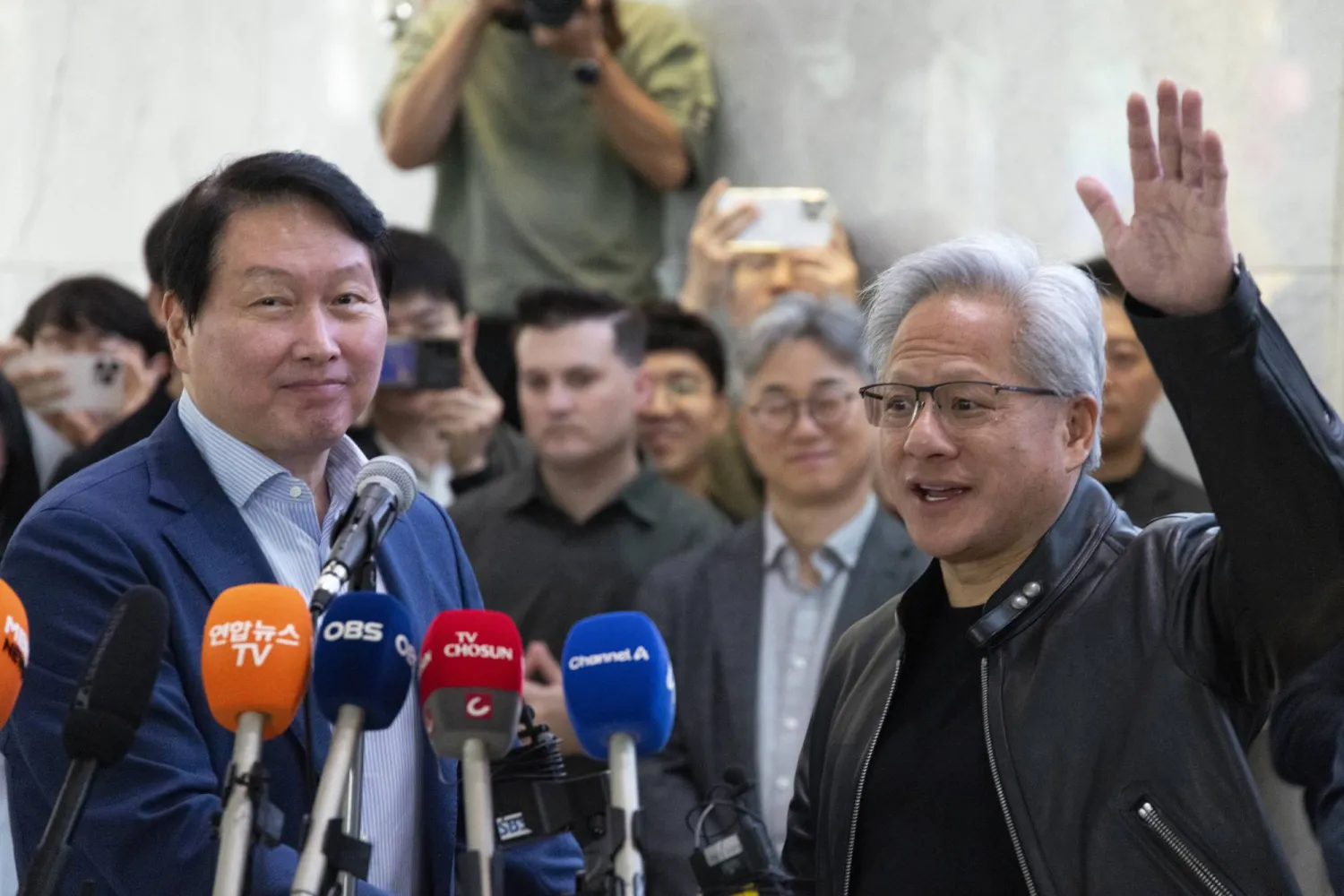

Nvidia Clinches Deals with South Korean Giants Including SK Group to Advance AI Boom

US chip giant Nvidia Corp. CEO Jensen Huang (R), and SK Group Chairman Chey Tae-won (L), arrive to a briefing after their meeting at the business group's headquarters in Seoul, South Korea, 08 June 2026. (EPA)
TT

Nvidia Clinches Deals with South Korean Giants Including SK Group to Advance AI Boom

US chip giant Nvidia Corp. CEO Jensen Huang (R), and SK Group Chairman Chey Tae-won (L), arrive to a briefing after their meeting at the business group's headquarters in Seoul, South Korea, 08 June 2026. (EPA)

Nvidia on Monday announced a series of deals in South Korea with tech giants including SK Hynix and Naver, as it looks to secure crucial memory chips to power its AI ambitions and entice new customers.

The agreements come during a high-profile trip by Nvidia CEO Jensen Huang to South Korea that began on Friday and has seen him dine on grilled pork belly and local spirit soju with the country's top corporate bosses, throw a baseball pitch and meet with a well-known gamer.

Nvidia and its partners, which also included SK Telecom and conglomerate Doosan Group, did not disclose the value of the deals.

SK Group, South Korea's second-largest family-owned conglomerate, said its SK Hynix and SK Telecom arms had agreed deals with Nvidia.

Memory chip maker SK Hynix signed a multi-year technology partnership ‌that will see ‌it commit to developing advanced types of memory for global AI data centers, SK ‌Group ⁠said.

SK Hynix and ⁠Nvidia said the agreement, which comes as memory chip makers have been straining to keep up with demand, would enable supply to keep pace with Nvidia's plans, which have expanded to robotics, personal computers and AI supercomputers.

"SK Hynix has been Nvidia's largest memory partner. SK Hynix will continue to be Nvidia's largest memory partner," Huang said after a meeting with SK Group Chairman Chey Tae-won at the headquarters of the chipmaker's parent.

Huang said the deal with SK Hynix, a rival to Samsung Electronics and US-based Micron Technology, was for more than two years with the option to keep extending.

"We already procure and we buy from SK Hynix already billions ⁠and billions of dollars each year, and it's going to grow substantially," he said.

Ryu Young-ho, ‌a senior analyst at NH Investment & Securities, said the SK Hynix-Nvidia partnership reinforced ‌the view that memory chips were evolving from a commodity product into a more customer-specific business.

OTHER DEALS

SK Telecom said it would build ‌a gigawatt-scale AI cloud in South Korea using Nvidia technology, with the first AI data center to come online in ‌2027. Nvidia said internet giant Naver and conglomerate Doosan would also use its technology to help build AI data centers.

Doosan, which is developing robots and makes materials used in Nvidia's most powerful Blackwell chips, said it expected its energy solution to be used in Nvidia's data center platforms and for it to use the US firm's physical AI technology as well.

Nvidia is also partnering with LG Group on electronics, mechanical ‌systems and AI for humanoid robots, Huang said after a meeting with the tech conglomerate's Chairman Koo Kwang-mo.

Huang said the pair were also working on the architecture ⁠of future data centers including cooling, ⁠power delivery and the entire design and building of the data centers.

SOUTH KOREA STOCK RALLY FALTERS

South Korea is an Asian manufacturing powerhouse, home to major producers of chips, electronics, cars and ships. SK Hynix and Samsung are the world's two largest makers of memory chips, which are key components in data centers.

The country's benchmark Kospi index has doubled in six months as heavyweights SK Hynix and Samsung benefited from the AI wave, but dove almost 9% on Monday after robust US jobs data fanned bets on a Federal Reserve rate hike this year and sparked a rout in global tech stocks.

Shares in Samsung and SK Hynix both plunged more than 10% in early trading before trimming some losses, with Samsung later down 4.6% and SK Hynix falling 0.6%.

When asked about the global chip stock rout, Huang waved off concerns, saying: "Everybody should be very excited; they can now buy stock at a cheaper price, and it's absolutely true that the future of AI is very bright."

Huang also told reporters after a fried chicken dinner with Chey on Sunday that he planned to meet Samsung's Jun Young-hyun, who leads the company's semiconductor business, on Monday. He will also meet with Hyundai Motor Group Executive Chair Euisun Chung on Monday afternoon.



Amid Criticism, Meta Reins in New AI Tool That Automatically Accessed Public Instagram Images

A teenager holds her smartphone displaying the logo of US social network Instagram in Brussels on July 7, 2026. (AFP)
TT

Amid Criticism, Meta Reins in New AI Tool That Automatically Accessed Public Instagram Images

A teenager holds her smartphone displaying the logo of US social network Instagram in Brussels on July 7, 2026. (AFP)

Meta has pulled the plug on a feature of a recently launched AI tool following criticism that it made Instagram accounts fodder for use in creating AI-generated images.

The move on Friday came less than a week after the parent of Instagram and Facebook rolled out Muse Image, its first image-generation model available through the company’s artificial intelligence assistant, Meta AI.

“Our intent was to provide a useful creative tool and to give people control over whether their public content could be referenced in this way,” Meta said in a statement. “We’ve heard the feedback that this feature missed the mark, so it’s no longer available.”

Like other AI apps with image-generating capabilities, Muse Image creates images based on users’ suggestions. But it also automatically made photos posted on all public Instagram accounts usable by the AI tool as a reference when creating new images.

That led to a flurry of social media posts flagging privacy concerns and instructing Instagram users how to opt out of having their accounts accessed by Muse Image.

Hollywood also was quick to raise concerns about the image-generation feature.

The Screen Actors Guild-American Federation of Television and Radio Artists urged its members to change the settings on their Instagram account to protect their likeness.

In a statement on X, SAG-AFTRA applauded Meta’s decision to shut off the feature.

“With the dangers of nonconsensual digital replicas well known to all, a feature that encouraged that behavior is unwise,” the union said. “We appreciate its discontinuance. It is the right thing to do.”


Apple Sues OpenAI for Stealing Trade Secrets

 11 July 2026, Taiwan, Taichung: Apple and OpenAI logos displayed on smartphone. (dpa)
11 July 2026, Taiwan, Taichung: Apple and OpenAI logos displayed on smartphone. (dpa)
TT

Apple Sues OpenAI for Stealing Trade Secrets

 11 July 2026, Taiwan, Taichung: Apple and OpenAI logos displayed on smartphone. (dpa)
11 July 2026, Taiwan, Taichung: Apple and OpenAI logos displayed on smartphone. (dpa)

Apple on Friday sued OpenAI, accusing the artificial intelligence company of orchestrating a campaign to steal the iPhone maker's trade secrets as it tries to develop its own consumer hardware device.

The lawsuit -- filed in a federal court in San Jose, California -- paints a picture of an aggressive effort by OpenAI to poach Apple employees and extract confidential information to build its own device.

The lawsuit marks a dramatic escalation in tensions between two companies that partnered in 2024 to integrate ChatGPT into Apple's products.

That relationship has since deteriorated. Bloomberg reported in May that OpenAI was itself considering legal action against Apple, alleging the tech giant had failed to adequately promote the ChatGPT integration.

"At every level, from members of its Technical Staff to its Chief Hardware Officer, and in coordination with business partners, OpenAI has been stealing Apple's trade secrets and confidential information," Apple said in the 41-page complaint.

The suit will significantly complicate OpenAI's plans for a hotly anticipated initial public offering.

The company, valued at roughly $852 billion, has raised more than $180 billion from investors, and expanding into consumer hardware was seen as a major opportunity for growth.

"Significant evidence has emerged suggesting individuals employed by OpenAI wrongfully took Apple's secret and confidential information regarding our unreleased technologies, processes and products," the company said in a statement to AFP.

"We will always defend our teams' hard work and innovations, and we are taking all appropriate steps to do so."

OpenAI responded to AFP's request for comment with an emailed statement Friday.

"We have no interest in other companies' trade secrets. We remain focused on building innovative technology that empowers people everywhere," an OpenAI spokesperson said.

The suit names OpenAI, its hardware subsidiary io Products -- the company co-founded by former Apple design chief Jony Ive -- and two former Apple employees: Tang Yew Tan, now OpenAI's chief hardware officer, and engineer Chang Liu.

Apple said it was seeking damages and an injunction barring OpenAI from using its confidential information, calling the lawsuit necessary after OpenAI failed to respond to concerns the company raised in February.

- 'Show and tell' -

Tan spent 24 years at Apple, most recently as vice president of product design for the iPhone and Apple Watch, before co-founding io Products, which OpenAI acquired for roughly $6.5 billion in 2025.

Apple alleged that Tan used confidential project code names during OpenAI job interviews to probe candidates about unreleased Apple products. According to the complaint, about 400 employees at OpenAI are former Apple staffers.

Tan also allegedly told Apple employees to bring physical components, such as batteries, circuit boards, and other parts, to interviews for "show and tell" sessions.

Apple described its findings as "the tip of the iceberg," saying it had limited visibility into what was happening behind OpenAI's closed doors.

"OpenAI's nascent hardware business now rests on the shakiest of foundations, rotten to its core by its illegal reliance on misappropriated trade secrets," the complaint said.


EU Tells Instagram, Facebook to Change Addictive Features or Risk Fines

FILE PHOTO: A blue verification badge and the logos of Facebook and Instagram are seen in this picture illustration taken January 19, 2023. REUTERS/Dado Ruvic/Illustration/File Photo
TT

EU Tells Instagram, Facebook to Change Addictive Features or Risk Fines

FILE PHOTO: A blue verification badge and the logos of Facebook and Instagram are seen in this picture illustration taken January 19, 2023. REUTERS/Dado Ruvic/Illustration/File Photo

The EU charged Meta Platforms' Instagram and Facebook on Friday with breaching its tech rules, with regulators targeting features they say are designed to keep users hooked and demanding changes to autoplay and infinite scroll or risk fines.

The European Commission's preliminary findings follow a two-year investigation under the European Union's landmark Digital Services Act, which requires large online platforms to do more to tackle illegal and harmful content.

Social media companies face growing scrutiny around the world over concerns that their platforms are contributing to a mental health crisis among children, prompting some governments to impose or consider bans for underage users.

The Commission, the EU's tech regulator, said Meta had failed to adequately assess the addictive risks posed by highly personalized recommendations, autoplay and infinite ⁠scroll, which continuously feed ⁠users new content and encourage prolonged engagement.

It said reels and stories on Facebook and Instagram could contribute to excessive or compulsive use.

The regulator criticized Meta's measures to mitigate these risks, saying time management tools can be easily dismissed, while parental controls require significant time, effort and technical knowledge to use effectively.

Meta should disable features such as autoplay and infinite scroll by default, introduce effective screen-time breaks and make its recommendation system less focused on driving engagement, Reuters quoted the Commission as saying.

"We disagree with these preliminary findings, which don't accurately take into account the significant steps we've taken to protect teens," Meta spokesperson Ben Walters said.

"Since this investigation began, we rolled out Teen Accounts that automatically protect teens and put parents in control - allowing them to block access to Instagram at night and cap daily screen time at just 15 minutes."

Meta added it would continue to engage constructively with EU regulators.

"Our starting point is that, based on our findings, this design is too addictive and changes need to be made," EU tech chief Henna Virkkunen told Reuters.

"The next step is either that Meta changes its design or a non-compliance decision will follow."

Meta, which risks a fine of up to 6% of its global annual turnover, can ⁠respond to the ⁠charges before the Commission issues a final decision in the coming months.

The company last month failed in its bid to dismiss claims by 29 US state attorneys general's that Facebook and Instagram are addictive to children.

The EU charges against Meta mirror those brought against TikTok in February, when regulators demanded similar changes to its app.

The Commission is separately investigating so-called rabbit hole effects caused by Facebook and Instagram recommendation systems, where users can be drawn into prolonged viewing by algorithmic recommendations that push them towards similar content. In another case announced in April, it told Meta to do more to prevent children under 13 from accessing its social networks or risk fines.

The Commission is due to receive findings from experts on Monday that could help pave the way for a Europe-wide social media ban for teenagers that Commission President Ursula von der Leyen is expected to announce in her September state of the union address.